


Your L&D team launches a new technical certification program. Three weeks later, seventeen employees are stuck waiting for SME validation. The SMEs themselves? Drowning in their day jobs, treating skill reviews like Friday afternoon homework nobody wants to grade.
The approval chain that every HR team knows (and dreads)
This pattern kills skills programs faster than budget cuts.
Most organizations treat SME validation like a luxury review process—something that happens when experts have spare time. Spare time for your best technical experts is about as common as finding a conference room with working AV equipment.
The real cost when SME validation becomes a black hole
Pull up any skills management platform and check the pending validations queue. If your organization is typical, you'll find assessments sitting there for 8–12 weeks. Some probably longer.
Stop losing track of critical skills.
Talioly helps you track, develop, and certify your workforce efficiently.
- Centralized skill profiles
- Automated training reminders
- Competency gap analysis
No credit card required
Each delayed validation creates cascading problems. Employees stop submitting evidence because why bother if nobody reviews it. Managers stop encouraging skill development because the process feels broken. Your carefully designed competency framework becomes decorative documentation that nobody trusts.
A manufacturing company lost three senior technicians because their advanced certifications sat unvalidated for four months. These weren't entry-level workers—they were people with specialized hydraulics expertise who got recruited away by competitors who moved faster on recognition.
The validation bottleneck doesn't just slow things down. It actively damages your talent pipeline.
Why traditional SME workflows collapse under real workload
Traditional validation assumes your SMEs have predictable schedules and protected review time. That assumption breaks immediately when you look at who your SMEs actually are—senior engineers pulling 50-hour weeks, lead technicians covering multiple shifts, architects juggling six active projects.
These people became SMEs by being exceptional at their primary jobs. Now you're asking them to context-switch into evaluation mode, often with zero administrative support and unclear expectations about turnaround times.
The typical process looks deceptively simple on paper:
-
Employee submits skill evidence
-
System routes to appropriate SME
-
SME reviews within 5 business days
-
Feedback provided and skill validated
In reality, that same process operates more like:
-
Employee submits evidence
-
System sends a notification that gets buried under 200 other emails
-
SME remembers to check three weeks later during lunch
-
Quick approval with minimal review because seventeen more are waiting
No wonder validation quality varies wildly.
Building validation workflows that actually move
After watching dozens of organizations struggle with this, some clear patterns emerge around what makes validation sustainable. The solution isn't forcing SMEs to work harder—it's designing workflows that respect their constraints while maintaining validation integrity.
Service Level Agreements that reflect reality
Stop pretending every validation needs the same timeline. A basic Excel competency shouldn't require the same review depth as advanced welding certification.
-
Critical skills (safety, compliance, customer-facing)
- Initial response: 48 hours - Full validation: 5 business days - Escalation trigger: 3 days
-
Core operational skills
- Initial response: 5 business days - Full validation: 10 business days - Escalation trigger: 7 days
-
Development skills (nice-to-have, growth-oriented)
- Initial response: 10 business days - Full validation: 15 business days - Escalation trigger: 12 days
These SLAs give SMEs breathing room while setting clear expectations. More importantly, they create automatic escalation points before things completely stall.
Evidence standards that eliminate guesswork
Most validation delays happen because SMEs don't know what constitutes sufficient evidence. They spend unnecessary time requesting additional documentation or, worse, approve things they shouldn't because the standard isn't clear.
| Skill Level | Required Evidence | Optional Supporting Evidence |
|---|---|---|
| Foundational | Completion certificate OR supervisor observation form | Work samples, peer feedback |
| Intermediate | 2 work samples + supervisor sign-off OR certification + 1 work sample | Project documentation, client feedback |
| Advanced | 3 work samples + project lead verification OR industry certification + 2 work samples | Published work, training delivered, process improvements |
| Expert | Portfolio of 5+ examples OR industry recognition + portfolio of 3+ examples | Speaking engagements, mentorship records, innovations |
When SMEs know exactly what they're looking for, review time drops by roughly 40%. They stop playing detective and start actually validating.
Automation triggers that prevent pile-ups
Manual routing kills validation workflows. By the time someone notices a bottleneck, you've already got a three-week backlog.
-
Pre-validation automation
- Auto-reject if missing minimum evidence (with clear feedback on what's needed) - Auto-approve renewals where previous validation exists and evidence meets standards - Flag high-priority validations based on role requirements or compliance deadlines
-
During validation
- Send reminder at 50% of SLA timeline - Escalate to backup SME at 75% of timeline - Alert L&D team at 90% for intervention
-
Post-validation
- Auto-notify employee and manager upon completion - Trigger skill badge or system update - Schedule re-validation reminder based on skill shelf-life
These aren't complex automations—most can be built with basic workflow tools or even spreadsheet scripts. The key is having them trigger consistently without someone manually babysitting the queue.
A diagram of the validation workflow follows.
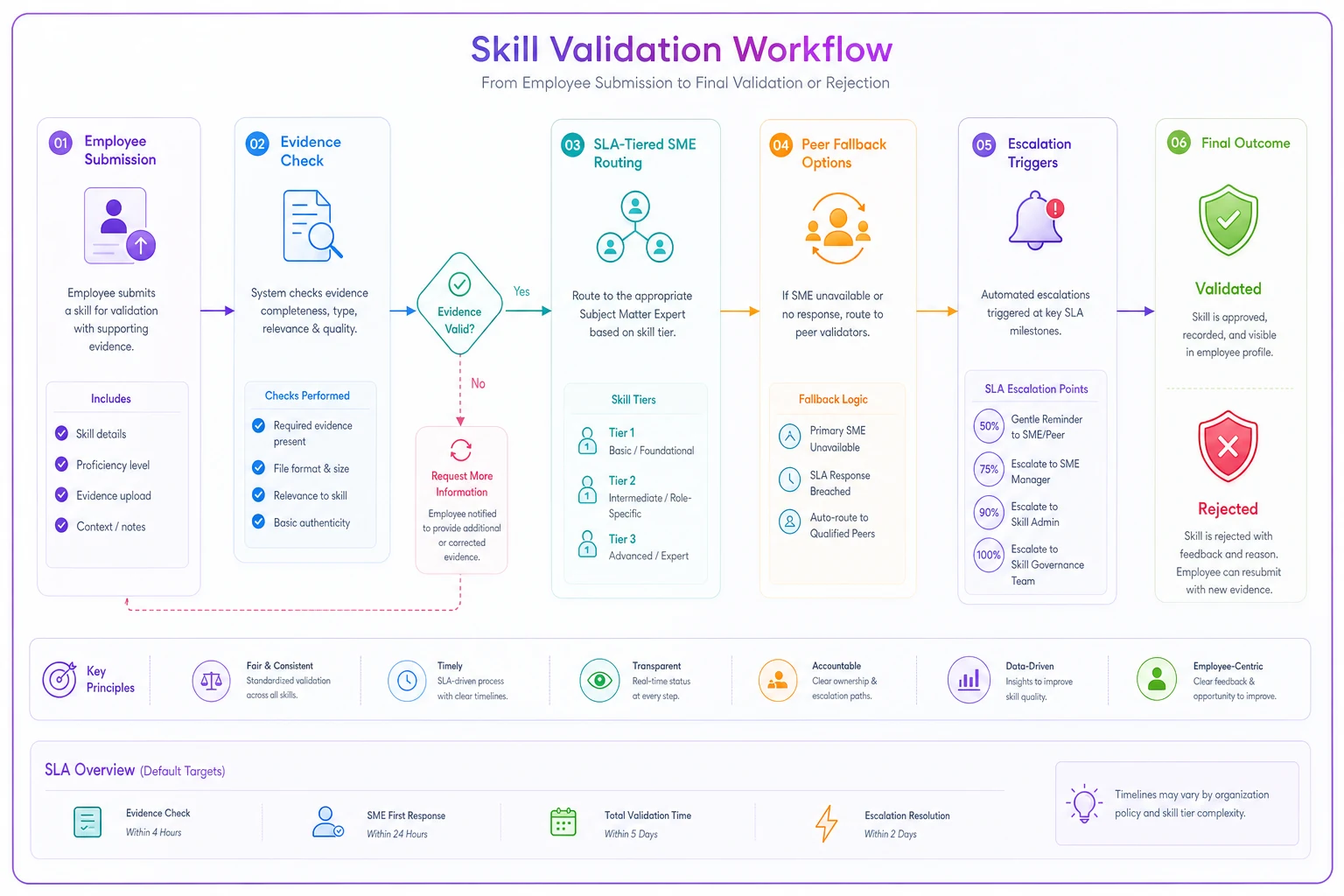
This diagram shows the flow from submission to final validation and escalation so teams can align routing and SLAs.
The peer validation safety net nobody talks about
Every L&D team knows but rarely admits: sometimes your best SME for a specific skill is unavailable for weeks. Maybe they're on vacation, maybe they're heads-down on a critical project, maybe they just changed jobs.
Traditional workflows treat this as an exception to handle manually. Smart workflows build peer validation in as an automatic fallback.
Structured peer review requirements
Not every skill needs single-SME validation. For many competencies—especially at foundational and intermediate levels—qualified peer review provides sufficient validation.
-
Reviewer must be validated at one level above the skill being assessed
-
Requires two peer reviews instead of one SME review
-
Both peers must agree on validation decision
-
Disagreements automatically escalate to SME
This approach distributes validation load while maintaining quality. A senior developer can absolutely validate a junior's Python basics. Two experienced project managers can confirm whether someone demonstrates intermediate stakeholder management.
Creating validation pools, not bottlenecks
Instead of routing to specific individuals, route to validation pools based on skill domain:
-
Technical Skills Pool
5–7 senior practitioners
-
Leadership Skills Pool
4–5 experienced managers
-
Operational Skills Pool
6–8 process experts
-
Compliance Skills Pool
3–4 certified professionals
When validation requests come in, they go to the pool with intelligent distribution—first available takes it, auto-redistribute if no response in 24 hours, escalate to peer validation if no SME is available within the SLA window.
Vacation schedules and project deadlines stop creating bottlenecks when requests aren't tied to a single person.
Making it work: a real implementation example
A medical device manufacturer struggled with validation delays for technical assembly skills. Their five SMEs were also their best production engineers, constantly pulled into troubleshooting and new product launches.
They restructured their validation workflow across six weeks:
-
Week 1–2
Defined three skill tiers with clear evidence requirements - Basic assembly: Video demonstration + supervisor checklist - Complex assembly: 3 work samples + quality metrics + supervisor verification - Specialized assembly: 5 work samples + quality data + peer review + SME spot-check
-
Week 3–4
Built simple automation rules - Auto-reminder after 3 days of no action - Auto-escalation to peer validators after 5 days - Manager notification after 7 days
-
Week 5–6
Created validation pools - 12 senior technicians qualified for peer review - 5 SMEs for final validation - 3 quality engineers as compliance validators
Results after 90 days were hard to argue with. Average validation time dropped from 8 weeks to 8 days. The backlog cleared completely. Employee skill submissions increased roughly threefold. And SMEs spent significantly less time on validations while maintaining quality.
The key wasn't making SMEs work harder—it was building a system that respected their constraints while keeping validations moving.
Common pitfalls that break even good workflows
Even well-designed validation workflows fail when organizations make predictable mistakes.
-
Over-engineering the process. Some companies create 40-something-step validation workflows with multiple approval gates. Every additional step increases the chance of stalling. Keep it as simple as the quality standard allows.
-
Ignoring SME capacity reality. If your SME can realistically review 2–3 validations per week, don't build a system that sends them 10. Either expand your validation pool or adjust program rollout pace.
-
Making evidence requirements too vague. "Demonstrate competency" isn't an evidence standard. "Submit three code reviews with senior developer feedback" is. Specificity reduces both submission and review time.
-
Treating all validations as equal priority. A forklift certification expiring next week needs faster review than someone's Excel skills assessment. Build priority logic into your routing.
-
Forgetting about re-validation. Skills expire. Certifications need renewal. Building validation workflows without re-validation triggers creates future bottlenecks that sneak up on you.
Even small mistakes in design can cause workflows to stall; watch for these predictable traps when you implement.
Technology that enables (not complicates) validation
The right operational software transforms SME validation from a manual chase into a systematic flow. Modern platforms handle routing, reminders, and escalations automatically while you focus on quality standards and program design.
AI-powered platforms particularly excel at pre-validation—checking evidence completeness, matching submissions to requirements, even suggesting appropriate validators based on expertise and current availability. This isn't about replacing human judgment. It's about eliminating the administrative burden that makes validation painful in the first place.
When an employee submits welding certification evidence, the system can automatically verify certification authenticity, check expiration dates, confirm it meets your standards, then route only complete packages to validators. Your SMEs review actual skills, not paperwork.
The same platform can surface validation metrics you've never had visibility into—which skills create bottlenecks, which SMEs consistently deliver fast reviews, where peer validation works versus where you genuinely need expert eyes. That data shapes better workflows over time.
Building your lightweight validation system
Start with your most problematic skill category. Usually it's either highly technical skills with few SMEs or high-volume operational skills overwhelming your validators.
Map out the basics first:
-
Current average validation time
-
Number of SMEs available
-
Weekly validation volume
-
Current backlog size
Then build incrementally.
-
Phase 1 (Weeks 1–2)
Define evidence standards and SLAs.
Get extremely specific about what constitutes valid evidence. Create a simple matrix that validators can reference without thinking. -
Phase 2 (Weeks 3–4)
Implement basic automation.
Start with reminder emails and escalation triggers. These alone often cut validation time significantly. -
Phase 3 (Weeks 5–6)
Enable peer validation.
Identify qualified peers and create clear peer review criteria. Run it as a pilot with a single skill category. -
Phase 4 (Weeks 7–8)
Expand and refine.
Scale successful elements to other skill categories. Adjust SLAs based on actual performance data, not guesses.
Organizations that follow this phased approach consistently see validation times drop by 70% or more while maintaining—or improving—validation quality.
When lightweight validation isn't enough
Some situations genuinely require more robust validation, and it's worth being clear about where shortcuts don't belong.
-
Regulatory compliance skills. When external auditors review your validations, peer review might not suffice. Keep stricter SME-only validation for these.
-
Safety-critical competencies. If incorrect validation could cause injury, maintain multiple validation gates. Speed matters less than accuracy here.
-
Customer-specified requirements. Some clients mandate specific validation processes. Don't try to streamline what's contractually required.
-
Union environments. Validation processes might be collectively bargained. Work within existing agreements rather than around them.
For everything else—roughly 80% of the skills that keep your operation running—lightweight validation workflows prevent the bottlenecks that kill skills programs.
The validation workflow that actually scales
The best SME validation workflow is one that barely needs SMEs at all. Through clear evidence standards, intelligent automation, and peer validation fallbacks, you can reserve true expert review for where it genuinely matters while keeping everything else moving.
Most organizations can cut validation time significantly without sacrificing quality. They just need to stop treating every validation like a doctoral thesis defense and start treating it like an operational process that needs to actually function.
Your SMEs aren't the bottleneck. The workflow that assumes unlimited SME availability is. Fix the workflow, respect the constraints, and watch your skills program actually deliver on its promise.
The validation queue that's been growing for months doesn't have to exist.
Build workflows around real constraints instead of theoretical availability, and validation bottlenecks become a solved problem.
Ready to elevate your team's skills?
Join 500+ companies using Talioly to boost skill visibility, streamline training, and drive performance growth.