

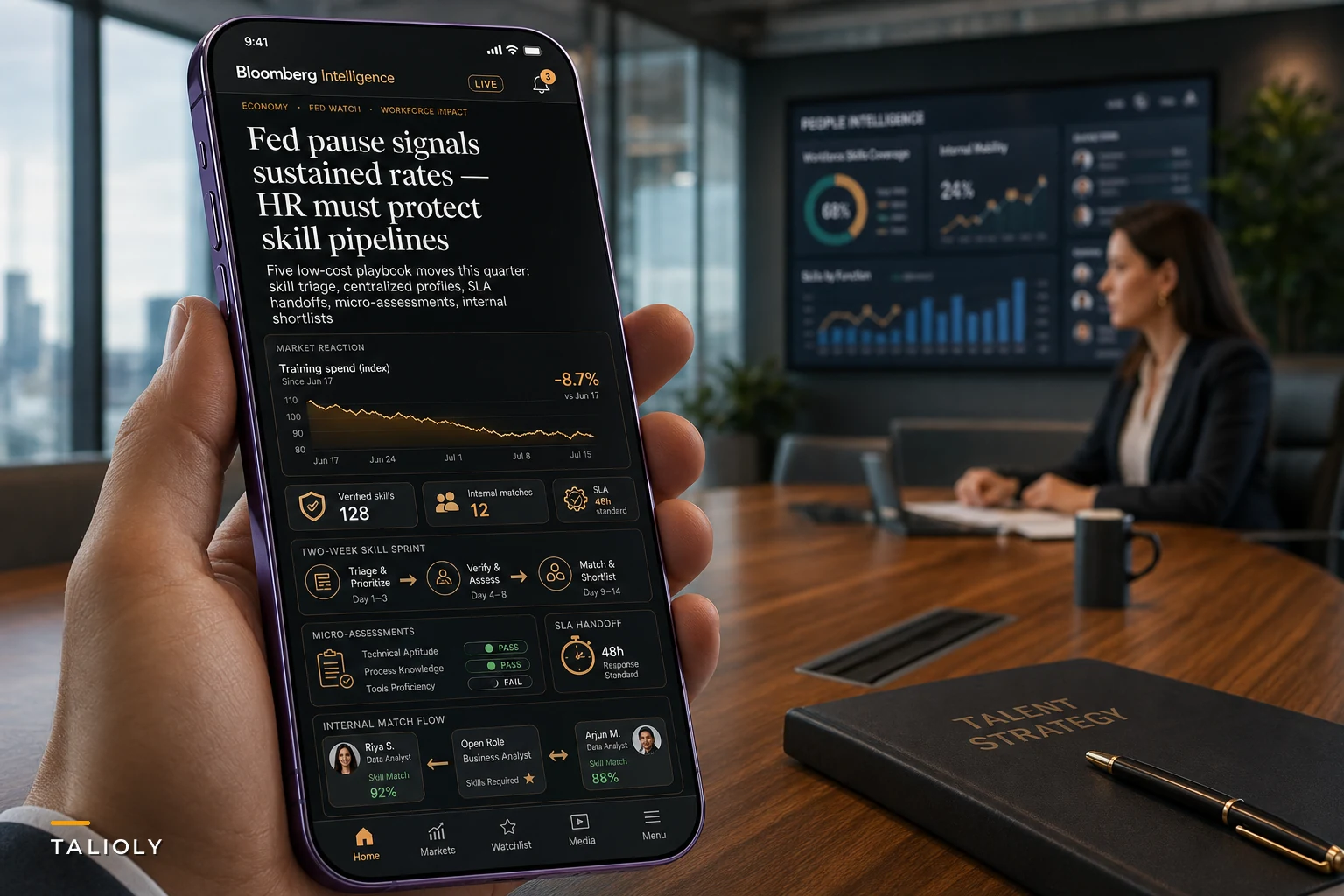

Yesterday's Fed announcement wasn't shocking—they held rates steady at 3.50%–3.75%. What caught attention was the removal of any language hinting at future cuts. The Fed's statement under new Chair Kevin Warsh was notably shorter and stripped of dovish signals. Translation: companies that were planning around cheaper capital later this year just had those plans shelved.
For HR teams, this hits fast. CFOs who were already scrutinizing hiring plans are now freezing them entirely. Training budgets that looked secure in January are getting cut by July. "Do more with the team we have" just became the mandate through at least Q4.
What makes this moment tricky is that you can't just freeze everything and wait it out. Critical skill gaps don't pause. Key employees still leave. Technical capabilities still go stale. The companies that navigate this well will be the ones shifting from external hiring to internal mobility and upskilling—but not through some vague "culture of learning" initiative. That requires operational precision, not good intentions.
The hidden complexity of internal mobility during budget freezes
Most HR leaders get the concept: instead of hiring externally, develop and move existing employees into critical roles. Simple enough. The execution breaks down in predictable ways.
First problem: nobody actually knows who has which skills. You have an LMS showing course completions. Performance reviews mentioning "strong technical skills." Maybe skills listed in employee profiles. But can you confidently say which of your 800 employees could step into that critical data analyst role that just opened? Probably not.
The data exists—it's just scattered everywhere. Sarah in accounting completed advanced Excel training last year, logged in the LMS. She also built complex financial models at her previous job, mentioned once during onboarding. She taught herself SQL during COVID, never documented. She regularly helps the FP&A team with reporting—her manager knows, but it's not written anywhere. When that analyst role opens, Sarah never even hears about it because her title says "Senior Accountant."
Second problem: managers hoard talent. When budgets tighten, every department head becomes protective of their top performers. That junior developer who could easily handle the DevOps role somewhere else? Their manager suddenly discovers they're "absolutely critical" and "not ready for a move." Without clear rules and executive backing, internal mobility turns into a political minefield.
Third problem: speed. External hiring takes 6–8 weeks on average. Internal moves should be faster, but often aren't. By the time you identify candidates, assess real capabilities, negotiate with current managers, build transition plans, and get approvals, the business need has either become critical or disappeared entirely.
Step 1: Create a skill verification sprint team (not another database project)
Forget building the perfect skills taxonomy. You need actionable skill data for critical roles within 30 days.
Stop losing track of critical skills.
Talioly helps you track, develop, and certify your workforce efficiently.
- Centralized skill profiles
- Automated training reminders
- Competency gap analysis
No credit card required
Pick your five most critical skill gaps—not nice-to-haves, but capabilities where lack of coverage actually breaks operations. For most companies right now, these cluster around data analysis, automation tools, project management, and customer success.
Form a three-person sprint team: one HR ops person, one technical manager who understands the skills, and one data-savvy analyst. Their only job for two weeks is figuring out who in your organization can actually perform these critical capabilities.
The verification process needs to be lightweight but real. Not "do you know Python?" but "show us a script you've written that's currently in use." Not "are you good at project management?" but "walk us through the last project you delivered on time with multiple stakeholders."
A verification framework that actually works:
| Skill Level | Verification Method | Time to Verify | Who Validates |
|---|---|---|---|
| Basic awareness | Self-reported + manager confirms they've seen it applied | 5 minutes | Direct manager |
| Working proficiency | Show actual work output from last 90 days | 15 minutes | Peer in that domain |
| Full competency | Demonstrate live problem-solving in that skill area | 30 minutes | Senior practitioner |
| Expert/trainer level | Present complex project + teach back to others | 60 minutes | Department head |
A quick visual of the sprint workflow can help align stakeholders.
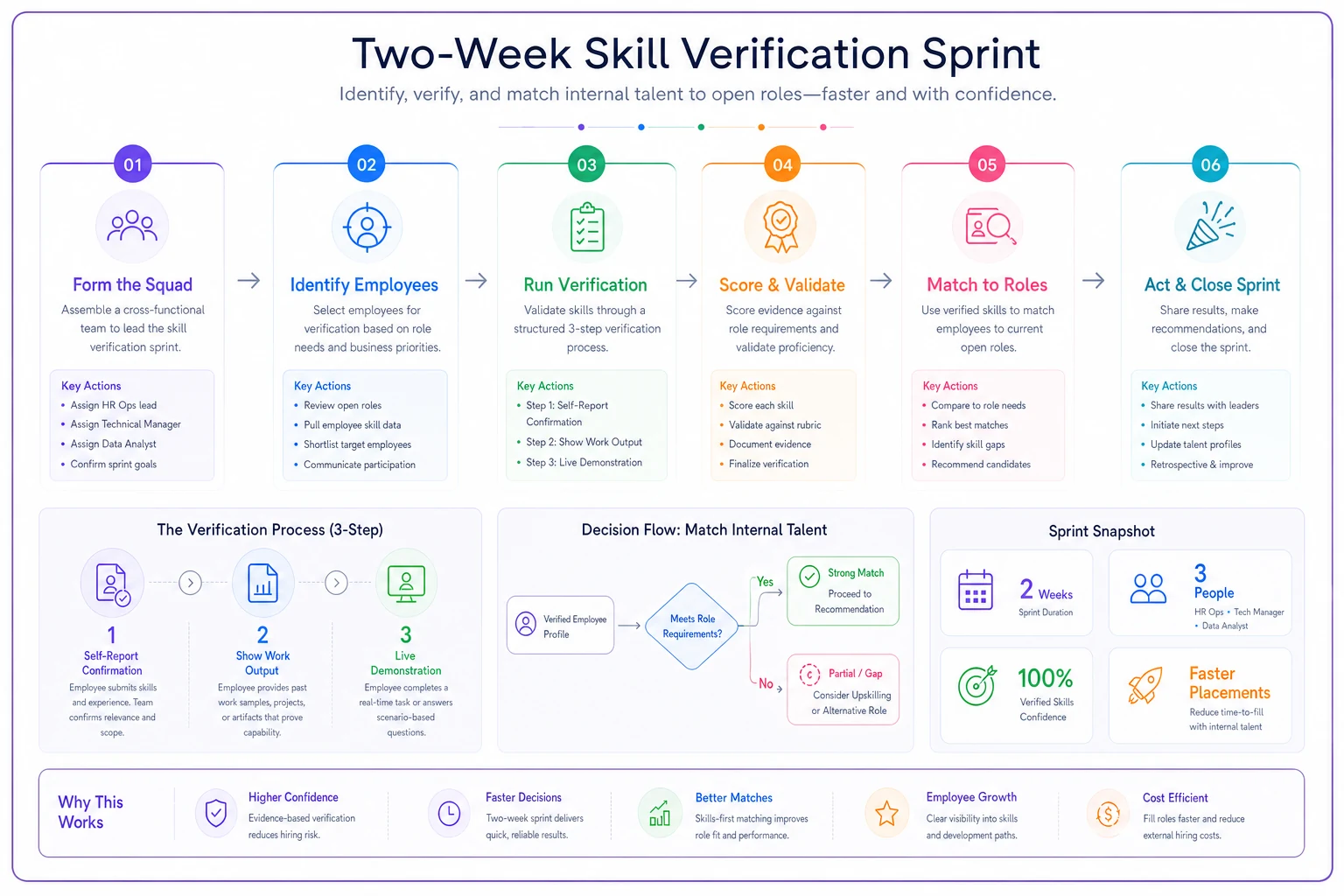
Don't try to verify everyone for everything. Focus on critical gaps and the roughly 20% of employees most likely to have those skills based on their current roles and recent projects.
Step 2: Build "skill bridges" with explicit development paths
Once you know who has what skills—even partially—you need clear paths showing how someone moves from their current capability to filling a critical gap. Not vague development plans, but specific, time-bound progressions.
A skill bridge has four components:
-
Current verified skill level
-
Target skill level needed for the role
-
Specific activities to bridge the gap
-
Realistic timeline with checkpoints
Example: moving a financial analyst with basic SQL knowledge into a data analyst role requiring advanced SQL and Python.
Week 1–2: Advanced SQL course + apply to real financial dataset
Week 3–4: Python basics + recreate existing Excel models in Python
Week 5–6: Work shadow current data team on a live project
Week 7–8: Own a small analysis project with data team supervision
Week 9–10: Full capability assessment + transition planning
The bridge needs an owner (usually the hiring manager), clear success metrics, and—critically—protected time for the employee to actually do the development. This is where most programs fall apart. You can't expect someone to learn Python while maintaining 100% of their current workload.
Step 3: Establish "mobility windows" with predetermined rules
Internal mobility can't be an always-on free-for-all or a locked-down approval maze. You need structured windows where moves can happen, with rules everyone understands upfront.
Quarterly mobility windows work for most organizations. Every three months, there's a two-week period where:
-
All internal roles are posted
-
Employees can express interest without manager approval
-
Skill assessments happen
-
Decisions are made
-
Transition plans are created
The rules need to address the political challenges directly:
-
Manager veto rights Managers can only block a move if the employee has been in role less than 12 months OR if they're actively leading a critical project with no backup. No blocking because "they're too valuable."
-
Backfill commitments If an employee moves internally, their previous department gets priority for the next external hire when budgets allow. This reduces hoarding behavior.
-
Performance thresholds Only employees meeting performance standards can move, but high performance in their current role isn't required. Solid B-players often become A-players in roles that better match their skills.
-
Notification timelines Selected employees get at least 30 days to transition. Their current manager gets a transition bonus if the handoff goes smoothly.
Give managers a clear backfill timeline to reduce hoarding and speed approvals.
Without these explicit rules, internal mobility becomes another bureaucratic process that takes too long and rewards political players over actual skill matches.
Step 4: Run micro-upskilling sprints for specific gaps
Traditional training programs—12-week courses, multi-day workshops, certification tracks—don't work when budgets are tight and needs are urgent. You need micro-upskilling sprints that deliver specific capabilities fast.
A micro-upskilling sprint targets one specific skill gap, runs 2–3 weeks max, and combines rapid learning with immediate application. It's not about comprehensive education. It's about minimum viable capability.
Structure that works:
Week 1: Foundation + First Application
-
2 hours self-study (videos, documentation)
-
1 hour group session with an internal expert
-
3 hours applying to a real work problem
-
30-minute validation checkpoint
Week 2: Advanced Application + Feedback
-
Build something real that the business actually needs
-
Daily 15-minute check-ins with the expert
-
Peer review with others learning the same skill
-
Deliver working output by Friday
Week 3: Integration + Certification
-
Implement in actual role
-
Document what was built
-
Teach-back session to validate understanding
-
Manager sign-off on capability
The key is picking skills that can actually be developed this quickly. You're not creating data scientists in three weeks. But you can teach Excel power users how to build basic Python scripts, train project coordinators on modern PM tools, or help customer success reps learn basic data querying.
Step 5: Create skill-lending agreements between departments
The most underutilized solution during budget freezes: temporary skill sharing between departments. Marketing has three people who know Tableau but only need that skill 20% of the time. Finance desperately needs Tableau expertise but can't hire. The solution isn't training or permanent moves—it's structured lending.
Skill-lending agreements formalize what often happens informally anyway. Without structure, these arrangements create confusion, resentment, and dropped balls.
The Agreement Covers:
-
Specific skill being lent
-
Hours per week (usually 8–16)
-
Duration (typically 3–6 months)
-
Project vs. ongoing support
-
Who manages the work
-
How conflicts get resolved
Example Agreement:
-
Marketing lends data visualization expertise to Finance
-
12 hours per week for 3 months
-
Focus
Building automated revenue dashboards
-
Finance provides requirements and priorities
-
Marketing manager retains HR authority
-
Weekly sync between department heads
-
Finance covers any tool licenses needed
The lending department needs incentive to participate. Options include priority access to the borrowing department's skills, credit toward departmental goals, or explicit recognition in performance reviews. As CNBC reported, companies are already bracing for an extended period of tighter budgets, making these kinds of resource-sharing arrangements increasingly important.
The coordination problem nobody really plans for
What trips up most HR teams trying to implement internal mobility and upskilling programs is the coordination overhead. You're tracking skills across hundreds of employees, managing development paths, coordinating between departments, running assessments, navigating political tensions, and trying to move fast enough to actually meet business needs.
This is where operational discipline matters. Clear owners, documented processes, and a single source of truth for skill and mobility data. Building an operating model with defined SLAs and handoffs is what separates programs that execute from programs that die in planning.
Manual tracking in spreadsheets breaks down around 50 employees. Email chains for approvals create bottlenecks. Shared docs get out of sync. HR teams often need the same operational rigor they preach to other departments—and that's not a criticism, just reality.
Modern HR platforms increasingly include AI-powered features that can surface skill patterns, suggest development paths, and match internal candidates to open roles. Even basic automation—skills surveys, simple matching logic, centralized approval workflows—can take a significant chunk of the coordination burden off your team's plate.
The companies that get through this period well won't necessarily have the best training programs or the most sophisticated skills taxonomies. They'll be the ones who can actually execute internal mobility at speed, develop critical skills in weeks rather than months, and move people without everything falling apart in the process.
Start with critical gaps, not comprehensive transformation
The temptation is to use this moment to build the comprehensive talent management system you've always wanted. Resist it. You have maybe 90 days before pressure for results becomes overwhelming.
Pick three critical skill gaps that are genuinely blocking operations. Run the verification sprint for just those skills. Create bridges for the 5–10 employees closest to filling those gaps. Establish mobility windows for next quarter. Start one micro-upskilling sprint. Set up one skill-lending agreement.
Small, complete, and operational beats large, perfect, and theoretical every time—especially when budgets are frozen and the business needs answers now.
The Fed's signal is clear: the era of easy money and unlimited hiring budgets isn't coming back anytime soon. HR teams that adapt quickly—shifting from external hiring to internal development, from comprehensive programs to targeted sprints, from perfect systems to working ones—will help their organizations stay competitive even as resources tighten.
The playbook isn't complicated. Execution is what separates the companies that hold their ground from the ones that stall waiting for conditions to improve.
Ready to elevate your team's skills?
Join 500+ companies using Talioly to boost skill visibility, streamline training, and drive performance growth.