

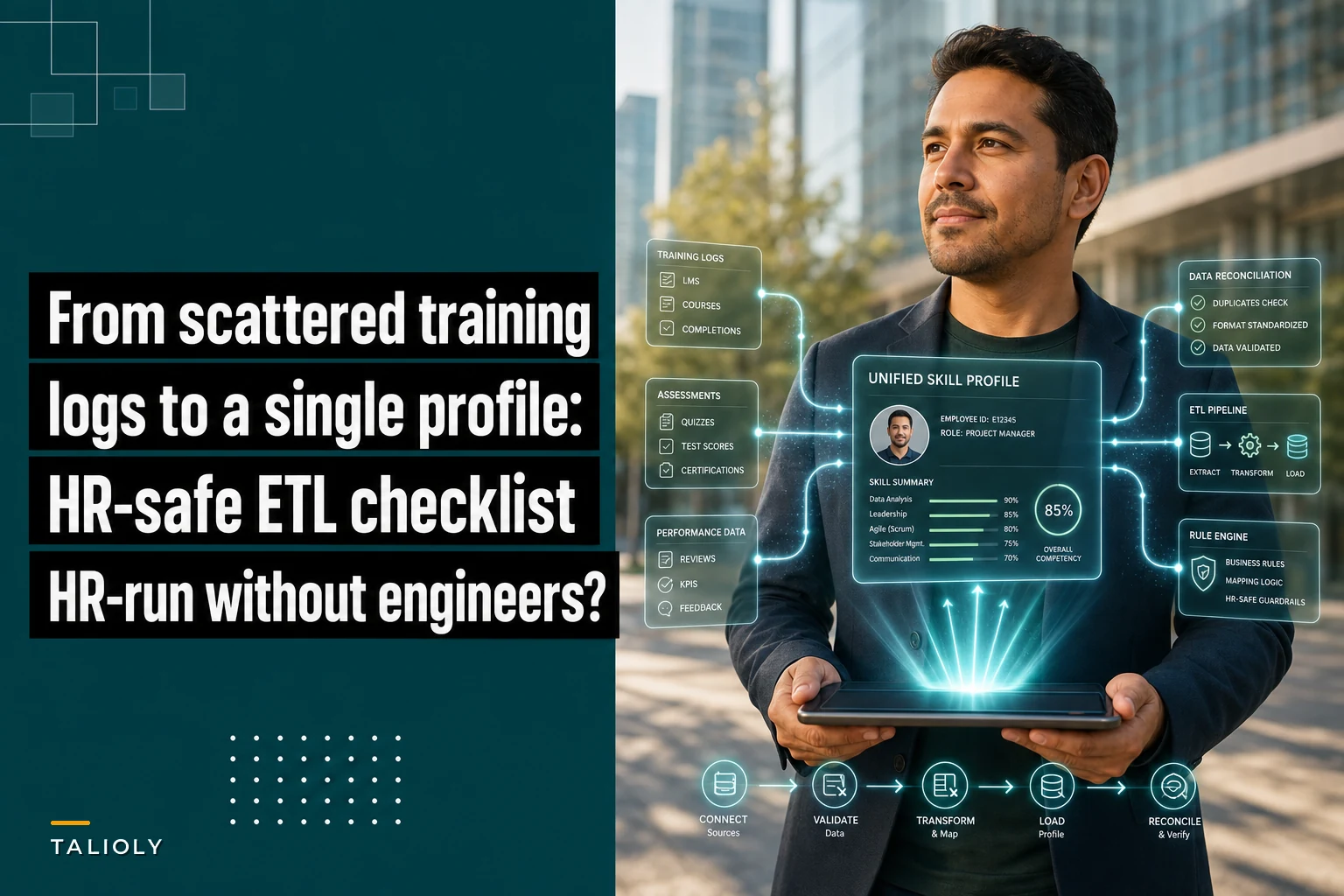

Your HR team maintains seventeen different spreadsheets tracking employee certifications. The LMS exports training completions into CSV files that nobody trusts. Assessment scores live in three separate systems. And every quarter, someone spends four days manually combining everything to produce a skills matrix that's already outdated by the time it's done.
This fragmented data landscape creates real operational risk. Compliance audits fail because certification records don't match. Managers can't identify qualified employees for new projects. Training budgets get wasted on redundant courses because nobody has visibility into what skills already exist across the organization.
More spreadsheets won't fix this. Neither will another tracking tool. You need a structured approach to consolidate scattered training data into unified employee skill profiles that actually reflect current capabilities.
Why training data stays scattered (and gets worse over time)
Most HR departments inherit a patchwork of systems accumulated over years. The original LMS from 2018 handles compliance training. A newer platform manages technical certifications. External vendors send assessment results via email. Meanwhile, managers track on-the-job skills in their own formats.
Each system made sense when it was first implemented. The safety team needed OSHA compliance tracking, so they bought a specialized platform. IT wanted technical certification management, so they got their own tool. Sales implemented something separate for product training. Nobody planned for this to multiply—it just happened as departments solved their own immediate problems.
It accelerates when companies grow through acquisition. Suddenly you're managing five different LMS platforms from acquired companies, each with its own data structure and export format. One subsidiary tracks certifications by employee ID, another uses email addresses, a third uses some combination of first name and department code.
Data quality degrades with every manual transfer. Someone exports training records from System A, reformats them in Excel, uploads to System B. Dates change format. Names get misspelled. Completion percentages become text strings. By the time data reaches its final destination, nobody fully trusts its accuracy.
The hidden cost of fragmented skill data
Scattered training records create cascading operational problems that compound over time.
Stop losing track of critical skills.
Talioly helps you track, develop, and certify your workforce efficiently.
- Centralized skill profiles
- Automated training reminders
- Competency gap analysis
No credit card required
Project staffing becomes guesswork. A manager needs someone certified in ISO 9001 and proficient in statistical analysis. HR checks three systems, finds partial matches, emails around for clarification. Two weeks later, they discover the perfect candidate was available the whole time—their certifications just weren't visible in the main system.
Compliance failures trigger expensive remediation. During an audit, regulators ask for proof that all warehouse operators completed forklift safety training within the past year. The training happened, but records are split between the old LMS for pre-merger employees and the new system for recent hires. Reconstructing complete records takes 80 hours of staff time plus consultant fees.
Training investments get duplicated unnecessarily. Marketing sends twelve people through Adobe Creative Suite training at $1,200 each. Meanwhile, IT already has eight employees with the same certification who could have provided internal training. Nobody knew because IT tracks certifications in ServiceNow while Marketing uses a shared drive.
Career development stalls without clear skill visibility. Employees complete external certifications expecting career advancement, but their new qualifications never make it into the official HR system. Promotion decisions happen based on outdated skill profiles. High performers leave for companies that actually recognize their capabilities.
The operational burden grows from there. Every new system adds another export/import cycle. Every acquisition brings legacy data that needs reconciliation. Every audit requires more manual compilation. What started as minor inefficiency becomes a significant operational constraint.
Building your consolidation approach without breaking production systems
Start with a data mapping exercise that captures reality, not wishful thinking.
Document every system currently storing training or skill data. Include the obvious ones—LMS platforms, certification trackers, assessment tools. But also capture the hidden repositories: departmental spreadsheets, manager notebooks, email folders stuffed with PDF certificates.
For each system, record what data it contains (courses, scores, certifications, skills), how data gets updated (automatic, manual upload, email submission), who owns the system (IT, HR, specific department), export capabilities (API, CSV, manual only), update frequency (real-time, daily, quarterly), and any data quality issues like missing fields, formatting problems, or duplicates.
Map the relationships between systems too. The safety LMS might feed completion data to the main HR system monthly. External certification providers email results that get manually entered quarterly. Understanding these connections reveals where data gets lost or corrupted.
Here's a simple visual of how data flows from sources to a unified profile.
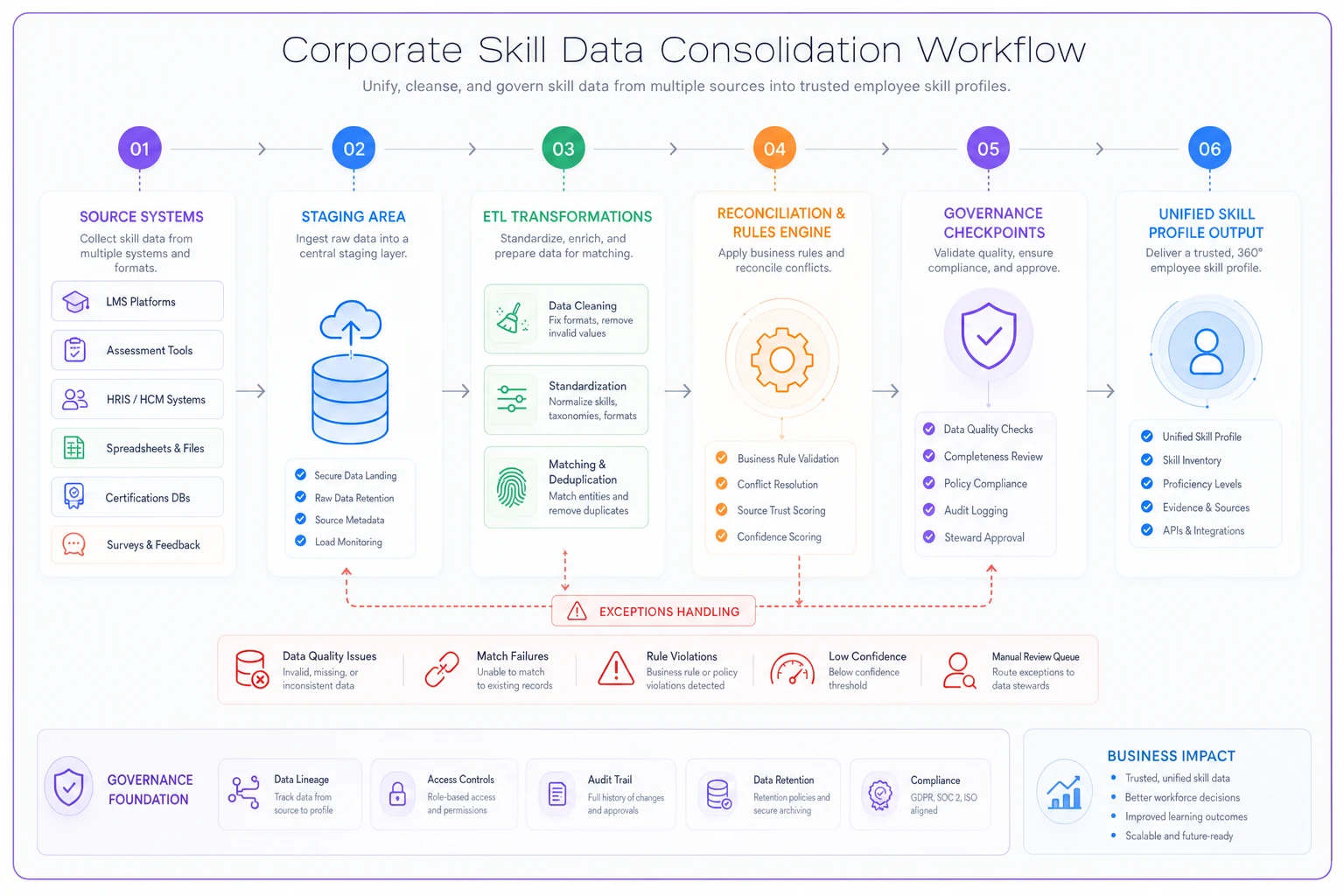
Here's a simple source system inventory to work from:
| System | Data Type | Update Method | Frequency | Quality Issues |
|---|---|---|---|---|
| CoreLMS | Compliance training | API push | Daily | Missing employee IDs for contractors |
| TechCert Pro | IT certifications | Manual CSV | Monthly | Dates in multiple formats |
| Assessment360 | Skills tests | Email PDFs | Quarterly | No standard naming |
| Manager sheets | On-job skills | Manual entry | Sporadic | Subjective ratings |
This mapping becomes your consolidation blueprint. You know what data exists, where it lives, how to access it, and what problems to expect before you start touching anything.
Quick wins that prove the consolidation works
Don't attempt a full migration immediately. Start with high-value, low-complexity data consolidations that demonstrate success.
Pick one critical certification that matters for compliance or operations—forklift operator licenses, food handling certificates, security clearances. It should be required for specific roles, tracked in two or three systems at most, needed for an upcoming audit or project, and relatively clean data.
Build your first consolidation pipeline around just that certification. Export data from each source system. Create a simple matching algorithm using employee ID or email. Combine records into a single view showing who has valid certification, expiration dates, and training history.
The consolidation immediately reveals gaps. You discover employees with expired certifications who need immediate retraining. Others have the certification but weren't flagged in the HR system, making them available for specialized projects. Duplicate training surfaces—two departments sent the same person through identical certification courses three months apart.
This focused success builds credibility for broader consolidation. Stakeholders see real value: compliance risk reduced, hidden skills discovered, training waste identified. They become advocates for expanding the approach.
Next, add assessment scores for the same employee population. Now you have certification status plus competency levels. A forklift operator might be certified but scored poorly on safety assessments—flagging them for additional training before an incident happens.
Each incremental addition proves the concept while maintaining data quality. You're not consolidating everything at once. You're building unified employee skill profiles piece by piece, validating accuracy at each step.
The reconciliation routine that catches mismatches before audits do
Data reconciliation isn't a one-time activity. It's an ongoing operational routine that maintains data integrity as source systems evolve.
Establish a weekly reconciliation cycle for critical data. Here's what a Monday morning check should cover:
-
Record count validation
Compare employee counts between source and consolidated systems. If the LMS shows 847 employees completed training but your consolidated system shows 823, investigate the gap immediately.
-
Certification status matching
Sample around 20 random employees. Verify their certification status matches across all systems. When mismatches appear, trace back through the data pipeline to identify where corruption occurred.
-
Date consistency checks
Ensure completion dates, expiration dates, and assessment dates align logically. An employee can't have an advanced certification before completing prerequisite training.
-
Duplicate detection
Look for multiple records for the same employee with slight variations—John Smith vs J. Smith vs Smith, John. These duplicates inflate training metrics and hide actual skill gaps.
Build simple exception reports that flag anomalies automatically, like employees with certifications but no base training, expiration dates in the past that still show as active, assessment scores without corresponding course completion, or certification records with missing employee IDs.
When mismatches surface, document the root cause and resolution. Common patterns show up fast. The acquired company's LMS exports dates in DD/MM/YYYY format while your system expects MM/DD/YYYY. Contractor records lack employee IDs, requiring email-based matching. Bulk uploads occasionally timeout, causing partial data loads.
These documented patterns become your reconciliation playbook. New team members can handle routine mismatches without escalation. Data quality improves systematically rather than through heroic individual effort.
Create a reconciliation log that tracks mismatches identified, root cause analysis, resolution steps taken, time to resolve, and any system or process changes needed.
After three months, you'll have enough data to identify systemic issues. Maybe 40% of mismatches stem from date format problems—that justifies building an automated formatter. Or contractor data causes 60% of reconciliation work, suggesting a need for better onboarding processes.
Governance templates that prevent future fragmentation
Without governance, consolidated data fragments again within months. New systems get added. Departments create shadow databases. Manual processes introduce errors. Carefully constructed unified employee skill profiles decay back into scattered spreadsheets.
Prevent this with practical governance templates that people actually follow.
Data Input Standards Template
Define exactly how data enters the consolidated system. Who can add new data sources (requires VP approval), acceptable formats (CSV with specific columns, API with documented schema), required fields (employee ID, completion date, score/status), validation rules (dates must be YYYY-MM-DD, scores between 0-100), and update frequency (daily for compliance, weekly for assessments, monthly for external certs).
Source System Registry
Maintain a living document of all systems feeding skill data, including system name and purpose, data owner and contact, integration method (API, file transfer, manual), update schedule, quality metrics like error rate and completeness, and a sunset date for when the system will be retired.
Review this registry quarterly. Systems that consistently provide poor quality data get remediation plans or retirement schedules. New systems must be registered before connecting to the consolidated platform.
Change Control Process
Every modification to data structure or integration requires documented approval. That means a business justification for why the change is needed, an impact assessment covering which downstream processes are affected, a testing plan to verify the change works, a rollback procedure in case problems occur, and a communication plan for who needs to know.
This isn't bureaucracy for its own sake. One undocumented change—like adding a new certification type without updating validation rules—can corrupt months of data before anyone notices.
Quality Scorecard Template
Track data quality metrics monthly: completeness (percentage of employees with skill profiles), accuracy (percentage of records passing validation), timeliness (average lag between training and system update), and consistency (percentage of records matching across systems).
Publish these metrics to stakeholders. When quality drops, investigate immediately. Usually it's something simple—someone changed an export format, a new hire didn't follow input standards, or a system upgrade modified field names.
Access Control Matrix
Define who can view and modify different data types. View-only access for managers so they can see their team's skills. Update access for HR specialists to modify certification records. Admin access for system owners to change integration settings. Audit access for the compliance team to read all records without modifying anything.
This prevents well-meaning modifications that break data integrity. The sales manager who helpfully updates their team's certifications directly might use different naming conventions, quietly corrupting the consolidated dataset.
Making ETL work in HR's operational reality
HR teams operate differently from technical teams. They deal with exception cases constantly. Every acquisition brings unique data structures. Every audit has different requirements. Every manager wants custom reports.
Staged ingestion for messy data
When acquiring a company with five years of training history in Excel files, don't demand perfect formatting. Create a staging area where messy data gets cleaned gradually. Map what you can automatically, flag exceptions for manual review, and improve the mapping logic based on patterns you discover.
Business rules that reflect HR logic
Technical ETL focuses on data structure. HR ETL needs business logic built in. An expired certification doesn't just mean a date passed—it might mean the employee can't work certain shifts, needs immediate retraining, or requires supervisor notification. These rules need to live inside the consolidation process, not in someone's head.
Exception handling for special cases
Some employees split time between departments. Others have certifications from previous employers that need validation. Contractors might use different ID systems. Your ETL process needs escape hatches for these exceptions without corrupting the main data flow.
Audit trails for compliance
HR data has legal implications. Document every transformation, combination, and modification. When an auditor asks why an employee's certification date changed, you need to show the original source data, the transformation applied, and who approved the change.
The path from scattered data to unified employee skill profiles
A mid-sized healthcare company with around 1,200 employees ran into serious compliance issues not long ago. Nursing certifications were tracked in the scheduling system. Continuing education credits lived in an external vendor's portal. Safety training was in the corporate LMS. Performance assessments were in spreadsheets.
When joint commission auditors arrived, producing complete skill profiles for nursing staff took two weeks of manual compilation. Several nurses had expired certifications that nobody caught. Others had completed advanced training that wasn't reflected in their unit assignments. The hospital ended up paying roughly $340,000 in compliance penalties and consulting fees.
They started consolidation with just nursing certifications—the highest risk area. Using a structured ETL checklist approach, they mapped four source systems containing nursing credentials, built weekly reconciliation routines that caught expiration dates before they lapsed, created governance templates preventing new shadow systems from forming, and established unified nurse skill profiles updated daily.
Within three months, they had complete visibility into nursing capabilities. Expired certifications got flagged 60 days before expiration. Nurses with specialized training got assigned to appropriate units. The next audit passed without issues.
They expanded gradually to other clinical roles, then administrative staff. Today their unified employee skill profiles cover all 1,200 employees, automatically updated from twelve source systems. Managers can find qualified staff quickly. HR can prove compliance on demand. Training budgets target actual skill gaps rather than assumptions.
The transformation didn't require massive technology investment or organizational restructuring. It needed a systematic approach to consolidating scattered data into unified employee skill profiles that reflected operational reality.
The operational advantage of unified employee skill profiles
When skill data gets consolidated properly, entire operational workflows transform.
Project staffing accelerates from weeks to hours. Instead of emails asking "who knows Python?" or "who's certified in lean manufacturing?", managers search unified employee skill profiles and find qualified candidates immediately. They see not just certifications but assessment scores, experience levels, and recent training completion.
Succession planning becomes data-driven rather than speculative. HR can identify skill gaps for critical roles, see which employees are one certification away from promotion readiness, and target development investments precisely. The panic when a key employee leaves diminishes because you already know who has overlapping capabilities.
Compliance transforms from reactive scrambling to proactive management. Expiring certifications trigger automatic notifications. Skill gaps for regulated roles get flagged before auditors notice. Documentation exists in one place, not scattered across departments.
Most importantly, employees see their development recognized. External certifications, online course completions, and assessment achievements all contribute to their official skill profile. Career paths become clearer because required skills are documented and tracked.
The scattered spreadsheets and disconnected systems don't disappear overnight. But with systematic ETL practices adapted for HR's operational reality, they gradually transform into unified skill intelligence that drives better decisions across the organization.
The scattered spreadsheets and disconnected systems don't disappear overnight. But with systematic ETL practices adapted for HR's operational reality, they gradually transform into unified skill intelligence that drives better decisions across the organization.
Ready to elevate your team's skills?
Join 500+ companies using Talioly to boost skill visibility, streamline training, and drive performance growth.