

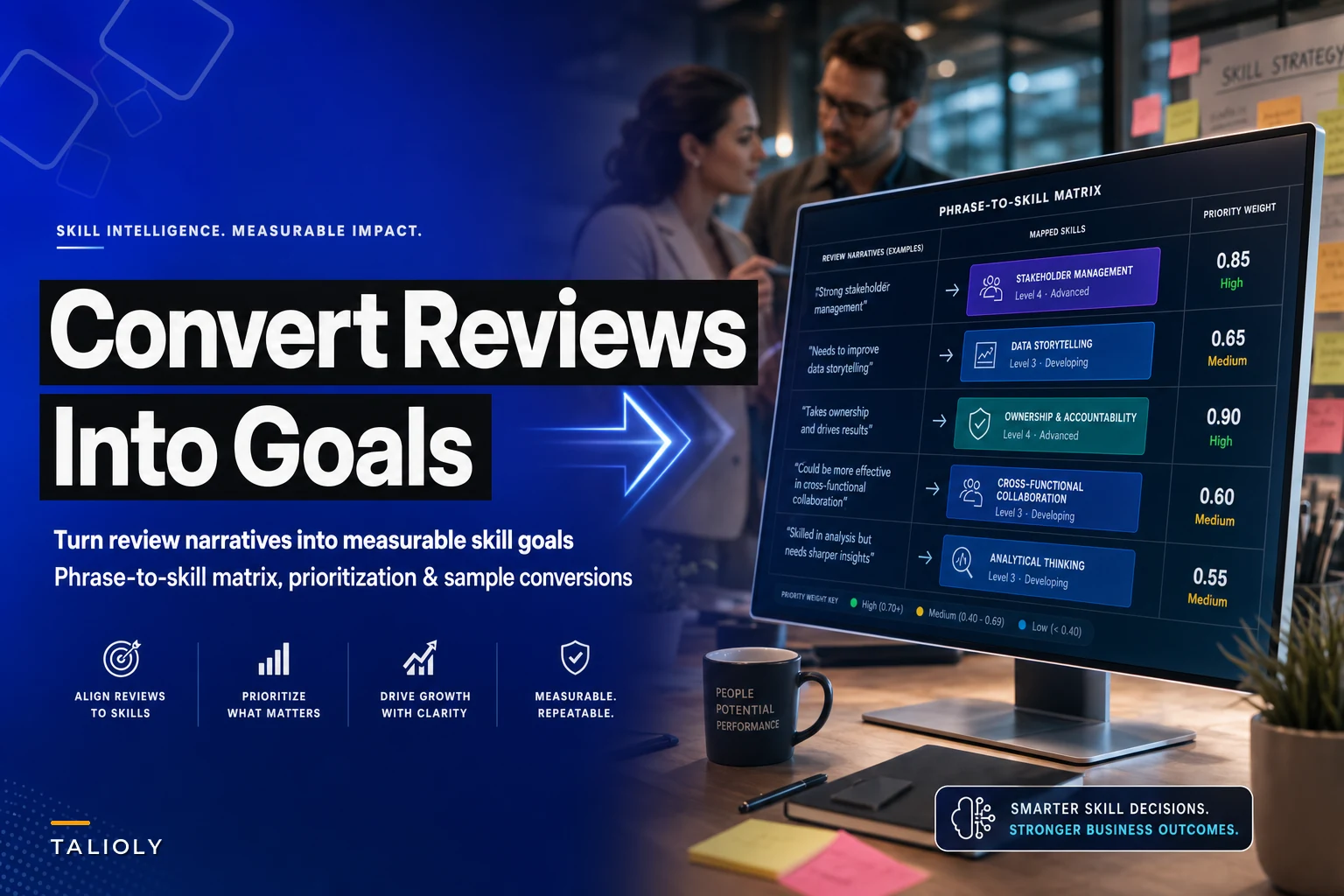

Performance reviews generate thousands of words every cycle, yet most employees finish reading them without knowing which skills to actually work on or how they'd measure progress. That gap is where development momentum dies.
The disconnect between what managers write and what employees need
Performance reviews generate thousands of words every cycle, yet most employees finish reading them without knowing which skills to actually work on or how they'd measure progress. That gap is where development momentum dies.
Take a typical review comment: "Jessica needs to improve her strategic thinking and become more proactive in client relationships." Sounds reasonable. But what specific skills should Jessica develop? How does she measure "strategic thinking"? What does "proactive" even look like in client management day-to-day? Without clearer skill targets, she spends the next six months guessing.
The cost compounds from there. Development budgets get burned on generic training that doesn't match actual gaps. High-potential employees plateau because they can't decode vague feedback into real growth steps. Managers write the same fuzzy comments year after year because nothing visibly changes.
Why narrative reviews rarely drive real skill development
Traditional performance reviews evolved from academic grading, not operational skill frameworks. Managers learned to write evaluative prose about overall performance rather than specific capability assessments—and most review templates reinforce that habit by pushing toward broad categories like "communication," "leadership," or "technical skills."
Stop losing track of critical skills.
Talioly helps you track, develop, and certify your workforce efficiently.
- Centralized skill profiles
- Automated training reminders
- Competency gap analysis
No credit card required
A manager might write three full paragraphs about communication challenges without ever pinning down whether the issue is presentation skills, written clarity, active listening, stakeholder management, or conflict resolution. Each of those requires a completely different development approach.
Annual cycles make it worse. Managers compress twelve months of observations into rushed narratives under deadline pressure, defaulting to safe, generic language that sounds professional but lacks operational specificity. "Could benefit from additional leadership development" slides in where "needs to develop delegation skills, specifically around task prioritization and follow-up accountability" would actually help someone.
HR platforms reinforce the pattern too. Most review systems are built for compliance and documentation, not skill extraction. The narrative sits in the system—legally complete, operationally useless.
The hidden cost of unmapped reviews
Organizations lose a significant chunk of their development investment when reviews don't connect to specific skills. Training gets purchased based on general themes rather than precise gaps. Employees attend leadership workshops when what they actually need is project planning fundamentals. Technical teams sit through communication training when the real issue is code review practices.
Career progression stalls without clear targets. An employee receives feedback about "executive presence" three years running but never understands which specific behaviors to change—whether they need data storytelling skills, meeting facilitation capabilities, or stakeholder management techniques. Without mapping, they never know which to prioritize.
Retention impact tends to show up somewhere around 18 to 24 months later. High performers leave when they can't see clear development paths. They read vague reviews, attend generic training, see no measurable improvement, and eventually conclude the organization doesn't invest in real growth. Meanwhile, competitors with clearer skill frameworks attract them with something more concrete.
Manager effectiveness drops too. They spend hours writing detailed narratives that produce no behavioral change. Next cycle, same skill gaps, similar feedback, nothing improves. Eventually they just start writing shorter, vaguer comments—which makes the whole cycle worse.
Building your phrase-to-skill conversion matrix
A functional review-to-skill mapping system starts with a phrase library that links common review language to specific capabilities. This isn't keyword matching—it's about extracting actionable skills from narrative feedback based on context.
Start by pulling your last batch of reviews, somewhere around 80 to 100. Extract all developmental feedback and look for language patterns. You'll notice managers repeat certain phrases:
-
"Needs to think more strategically"
-
"Should be more detail-oriented"
-
"Could improve collaboration"
-
"Requires better time management"
For each phrase pattern, define the underlying skills. "Think more strategically" might decompose into:
-
Systems thinking
connecting departmental initiatives to organizational goals
-
Scenario planning
developing multiple outcome projections
-
Resource allocation
optimizing limited resources across competing priorities
-
Stakeholder mapping
identifying and engaging key decision influencers
Build in role-based modifiers. "Leadership" for a team lead might mean task delegation and daily standups. For a director, it involves vision setting and organizational design. "Communication" means different skills for engineers versus salespeople—an engineer might need technical documentation or architecture explanation capabilities, while a salesperson needs discovery questioning or objection handling. Your matrix has to account for these variations or you'll end up with mappings that frustrate everyone trying to use them.
Pull a representative sample of 80 to 100 reviews first—it's enough to capture common phrase patterns without overwhelming your team.
Your matrix has to account for these variations or you'll end up with mappings that frustrate everyone trying to use them.
Prioritization rules that focus development efforts
Not all skills deserve equal attention. Some directly impact current performance, others prepare for future roles, and many sit outside the critical path entirely.
Apply the performance gap multiplier first. Skills causing immediate performance issues get higher priority. If poor project planning is delaying deliverables every month, that ranks higher than presentation skills used a few times a quarter. Measure the operational impact—delayed projects, customer complaints, quality issues—and weight accordingly.
Factor in role criticality. Core skills for the current position get more weight than adjacent capabilities. A financial analyst needs Excel modeling more than public speaking, even if both appear in their review.
Consider organizational trajectory. If the company is moving toward data-driven decision making, analytical skills rank higher even where current performance is acceptable. Skills aligned with where the organization is going deserve a priority bump.
Add frequency modifiers—skills used daily outrank those used monthly. And don't overlook downstream dependencies. Data analysis skills enable evidence-based presentation. Project planning supports delegation effectiveness. Prioritizing foundational skills that unlock others usually pays off faster.
Converting narrative to measurable development plans
Take this review excerpt: "Marcus needs to improve his ability to influence without authority and build better cross-functional relationships."
The conversion process breaks this into components:
Skill 1: Influence without authority
-
Behavioral indicator
Gains buy-in from peer teams for initiatives
-
Measurement
Track initiative acceptance rate by other departments
-
Target
Achieve 70% acceptance rate within 6 months
-
Development action
Complete influence mapping exercise for next three initiatives
Skill 2: Cross-functional relationship building
-
Behavioral indicator
Maintains regular touchpoints with key stakeholders
-
Measurement
Document stakeholder interaction frequency
-
Target
Monthly 1:1s with 5 key cross-functional partners
-
Development action
Create stakeholder engagement calendar and tracking system
Each skill needs observable behaviors, not subjective assessments. "Better relationships" becomes "schedules monthly syncs with 5 key partners." "Improved influence" becomes "achieves 70% initiative buy-in rate." The measurement might feel crude at first, but crude measurement beats no measurement.
Set progressive milestones at 30, 60, and 90-day intervals. For influence skills, that might look like:
-
30 days
Complete stakeholder mapping for current initiatives
-
60 days
Apply influence tactics to one initiative, document outcomes
-
90 days
Achieve target acceptance rate across three initiatives
Create feedback loops between managers and employees. Weekly check-ins verify skill development activities occurred. Monthly reviews assess behavioral changes. Quarterly evaluations measure outcome improvements. Without these loops, development plans become wish lists that get ignored until the next cycle.
Sample conversion scenarios
Scenario 1: Tech startup with vague leadership feedback
-
Review comment
"Sarah needs to step up as a technical leader and drive more innovation in the team."
-
Mapped skills
-
- Technical mentoring
Conducts weekly code reviews with junior developers
-
- Innovation facilitation
Runs monthly sessions generating at least 3 implementable ideas
-
- Technical decision documentation
Creates decision docs for major architectural choices
-
- Knowledge sharing
Delivers bi-weekly tech talks on emerging technologies
Prioritization: Technical mentoring gets highest weight due to immediate team skill gaps. Innovation facilitation ranks second based on company OKRs around product differentiation.
Scenario 2: Retail manager with customer service feedback
-
Review comment
"David should work on creating better customer experiences and managing difficult situations."
-
Mapped skills
-
- Service recovery
Resolves escalated complaints within one interaction roughly 80% of the time
-
- Experience design
Maps and improves three customer journey touchpoints quarterly
-
- De-escalation techniques
Reduces complaint escalation rate by around 30%
-
- Team coaching
Conducts weekly service scenarios with staff
Prioritization: De-escalation ranks first due to immediate revenue impact from lost customers. Team coaching second because of the multiplier effect across a dozen staff members.
Scenario 3: Finance analyst with communication feedback
-
Review comment
"Jennifer needs to communicate complex financial information more effectively to non-finance stakeholders."
-
Mapped skills
-
- Data visualization
Creates executive dashboards with 5-second comprehension time
-
- Financial storytelling
Presents monthly results using narrative structure, not just numbers
-
- Stakeholder translation
Develops finance glossary and teaches a couple concepts per presentation
-
- Question handling
Answers stakeholder queries without finance jargon
Prioritization: Data visualization first because it affects daily reporting. Financial storytelling second based on monthly board presentation requirements.
Below is a simple overview of how the full conversion process flows from review narrative to active development plan:
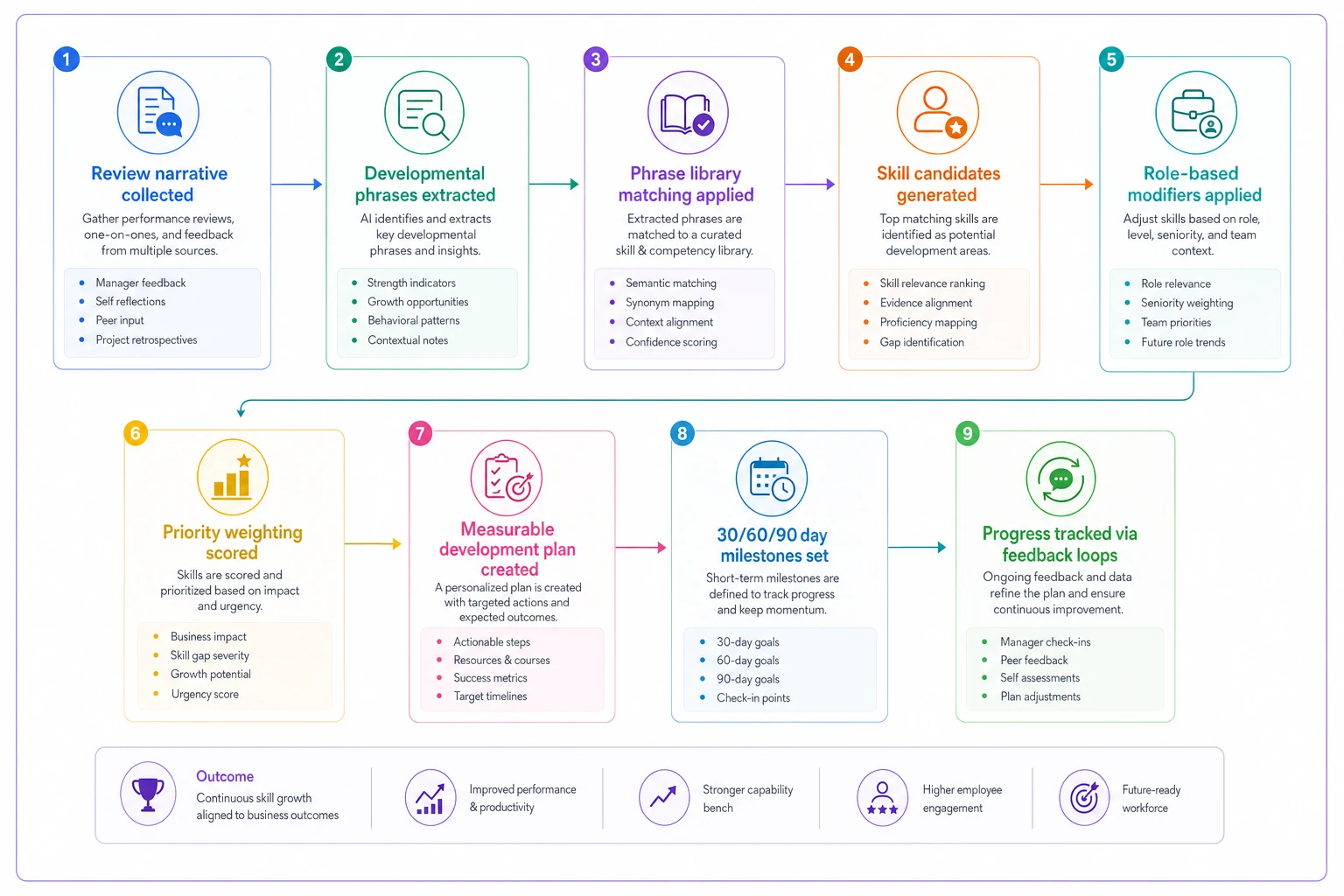
This flow summarizes the main stages from raw review text to a tracked development plan.
Phrase-to-skill conversion reference
The table below captures common review phrases, the specific skills they typically map to, and suggested measurement approaches.
| Review phrase | Mapped skill(s) | Measurement approach |
|---|---|---|
| "Needs to think more strategically" | Systems thinking, scenario planning, resource allocation | Initiative acceptance rate, OKR alignment score |
| "Improve collaboration" | Stakeholder management, cross-functional relationship building | Monthly touchpoint frequency, peer feedback scores |
| "Better time management" | Task prioritization, deadline management, delegation | On-time delivery rate, task completion rate |
| "Step up as a leader" | Team mentoring, decision documentation, delegation | Direct report skill improvement, decision turnaround time |
| "Communicate more effectively" | Data visualization, narrative structuring, stakeholder translation | Comprehension time on dashboards, stakeholder satisfaction surveys |
| "More detail-oriented" | Quality control, documentation, process adherence | Error rate, rework frequency |
| "More proactive" | Anticipation skills, stakeholder outreach, initiative tracking | Number of self-initiated actions per quarter |
The phrase library will never be fully complete—new managers bring new language patterns, roles evolve, and organizational priorities shift. Treat it as a living document, not a finished product. Reviewing it twice a year with a sample of recent reviews is usually enough to keep it current.
Where automation actually helps
Manual review-to-skill mapping works fine for small teams. It breaks down at scale. A 500-person organization generating quarterly reviews is looking at roughly 2,000 narratives annually. Processing those manually takes weeks and introduces inconsistency depending on who does the parsing.
AI-powered operational software can parse review narratives and suggest skill mappings based on your phrase library—identifying developmental feedback within longer narratives, extracting relevant sentences, matching against phrase patterns, and proposing specific skills. It's not perfect out of the gate, and you'll need to refine the library over time, but the consistency improvement alone is worth it.
When five different managers write variations of "needs better project management," pattern recognition maps all five to the same core skills instead of creating five slightly different development tracks that mean essentially the same thing.
Automated prioritization applies your rules across all reviews simultaneously rather than relying on each manager to apply the same logic independently. Integration with learning systems connects mapped skills to available development resources—relevant training, mentorship opportunities, stretch assignments—so employees get something specific rather than a generic training catalog.
Progress tracking shifts from sporadic to systematic. Instead of waiting for annual reviews to discover skills haven't developed, the platform monitors development activities, collects evidence of capability improvement, and flags milestones that pass without progress. Workflow automation handles the administrative side—sending skill mapping proposals to managers for validation, scheduling planning meetings, tracking completion—so HR teams can focus on strategy instead of spreadsheet management.
Measuring conversion quality and development ROI
Review-to-skill mapping quality depends on three things: coverage, accuracy, and actionability.
Coverage measures what percentage of developmental feedback converts to specific skills. Somewhere around 85% is a reasonable target—some feedback genuinely lacks skill implications.
Accuracy tracks whether mapped skills reflect actual development needs. Survey employees and managers quarterly: did the identified skills address real capability gaps? Below roughly 70% accuracy usually points to phrase library problems or conversion rule errors.
Actionability measures whether employees can actually develop the identified skills. If a large share of mapped skills lack available development resources or clear improvement paths, the mapping might be technically accurate but operationally worthless.
Track skill development velocity—how quickly employees progress through capability levels. Technical skills might advance monthly, leadership capabilities quarterly. Slower-than-baseline progression suggests either incorrect skill mapping or inadequate development resources.
Watch behavioral change indicators too. If communication skills improve on paper but meeting effectiveness doesn't change, the mapping might be targeting the wrong specific capabilities. Use operational metrics to validate that skill development actually produces performance improvement. Development ROI becomes calculable when you map training investment to capability improvement to performance outcomes. Without skill mapping, that connection stays invisible.
Moving from annual cycles to continuous skill development
Annual cycles create bottlenecks. Employees wait months for feedback, rush through development planning, then forget the plan until next cycle.
Quarterly narrative sprints replace annual novels. Managers write brief, specific feedback about recent performance. Smaller scope enables more precise skill identification. "Last quarter Alex struggled with stakeholder alignment on the pricing project" beats "Alex needs to improve communication skills" written about vague memories from eight months ago.
Monthly skill pulse checks track development progress and allow quick adjustments. If data visualization skills aren't improving through self-study, pivot to mentorship or formal training—don't wait until year-end.
Weekly evidence collection prevents the year-end scramble. Employees log work artifacts demonstrating capability application: code reviews showing improved technical skills, meeting recordings demonstrating better facilitation, project plans indicating enhanced planning. Real-time feedback also triggers immediate skill mapping—when performance issues surface, relevant skills can be extracted and development actions suggested within days rather than waiting for the next cycle.
Conclusion
Review-to-skill mapping turns performance narratives from organizational theater into actual development tools. It requires upfront investment in phrase libraries, conversion rules, and prioritization logic—but once established, it converts thousands of review hours into measurable capability improvement.
Your first phrase library will miss nuances. Initial conversion rules will occasionally map incorrectly. Priority weights need adjustment based on results. That's fine—even crude skill mapping beats vague development wishes.
Start small with one department or team. Analyze their last reviews, build a focused phrase library, create basic conversion rules. Map skills, prioritize development, measure progress. Learn what works, refine the system, then expand.
The goal isn't to generate skill databases—it's to give people clear development paths. When employees know exactly which capabilities to build and how to measure progress, they actually invest in growth. When managers see skills improve after reviews, they write better feedback. When organizations can connect capability development to performance outcomes, they fund real training instead of compliance checkboxes.
Your performance reviews already contain valuable development intelligence. It's just trapped in narrative form. Build the phrase library, establish conversion rules, and start mapping reviews to measurable skills—the development clarity your employees deserve is hiding in the reviews you're already writing.
Review-to-skill mapping turns performance narratives from organizational theater into actual development tools. It requires upfront investment in phrase libraries, conversion rules, and prioritization logic—but once established, it converts thousands of review hours into measurable capability improvement.
Ready to elevate your team's skills?
Join 500+ companies using Talioly to boost skill visibility, streamline training, and drive performance growth.