


Most companies build product roadmaps completely detached from talent planning. Product says "we need these features by Q3," HR scrambles to find people, Finance asks why headcount keeps shifting, and everyone blames each other when deadlines slip. The disconnect isn't just poor communication—it's two departments running on completely different planning cycles with incompatible metrics.
A fintech startup burned through roughly $400k trying to hire for capabilities they wouldn't actually need for another eight months. Their product team had mapped out an ambitious payments infrastructure, HR started recruiting specialized engineers immediately, but nobody flagged that regulatory approval alone would take six months. By the time they could actually build anything, half those new hires had already left for companies with real work ready.
The operational gap becomes obvious when you trace how decisions actually flow. Product teams think in sprints and quarters—features, technical debt, velocity. HR thinks in annual cycles—headcount, development programs, retention. Finance sits in between trying to reconcile budgets that shift every time someone realizes they need different skills than planned. Without a unified governance model, you end up with reactive hiring, mistimed training investments, and talent sitting idle while critical work goes unstaffed.
The committee structure nobody wants but everyone needs
Setting up talent allocation governance starts with creating a cross-functional committee that actually has teeth. Not another advisory group meeting quarterly to review slide decks, but an operational body with real budget authority and clear decision rights.
The committee needs three core members: a product operations lead who understands the technical roadmap, an HR leader who knows current capabilities and hiring pipelines, and a finance partner who controls the budget. Some companies add a fourth seat for engineering or operations leadership, but keep it small enough to make decisions quickly.
What separates this from typical steering committees is the operating rhythm. They meet every two weeks, not quarterly. They review actual skills inventory against upcoming milestones, not just headcount numbers. And they have pre-approved budget bands and hiring triggers that don't require endless escalation chains.
A mid-sized logistics software company started with monthly meetings and quickly moved to biweekly after missing two critical hiring windows. Their committee now operates on a simple rule: any product milestone triggers an automatic skills review 90 days before the work starts. No milestone gets approved without a corresponding skills budget and sourcing plan.
The committee owns three specific decisions that typically fall through organizational cracks.
First, they determine whether to build, buy, or borrow capabilities. When the product roadmap calls for machine learning features, do you hire data scientists, contract with a specialized firm, or upskill existing engineers? The committee makes this call based on timeline, budget, and strategic importance.
Second, they set skills investment priorities when resources are limited. If you can only fund training for either cloud architecture or data engineering this quarter, which unlocks more value? The committee uses product milestone dependencies to make these trade-offs explicit.
Third, they approve exceptions to standard hiring and development timelines. When product needs to accelerate a feature, the committee decides whether to pay for expedited recruiting, approve contractor premiums, or delay something else to free up talent.
Mapping milestones to actual skills needs (not job titles)
The biggest planning failure happens when companies translate product requirements directly into job requisitions. "We need to build a recommendation engine" becomes "hire 3 senior engineers" without anyone asking what specific skills that work actually requires.
Stop losing track of critical skills.
Talioly helps you track, develop, and certify your workforce efficiently.
- Centralized skill profiles
- Automated training reminders
- Competency gap analysis
No credit card required
Real talent allocation governance breaks each product milestone into discrete capabilities. A recommendation engine might need someone who understands collaborative filtering algorithms, another person who can build data pipelines at scale, and someone who knows how to A/B test user interfaces. Those capabilities might already exist across your team in different combinations—you just haven't looked.
One approach that works: build a simple skills matrix for each major product initiative. List the specific technical and domain capabilities required, estimate the hours needed per capability, then map against your current talent inventory. The gaps tell you exactly what to hire, develop, or contract for.
Build the skills matrix to estimate hours per capability before recruiting to avoid hiring too early or too late.
Timing matters more than most teams realize. A mobile app redesign might need UX research capabilities heavily in months 1-2, front-end development in months 2-4, and QA automation in months 3-5. Hiring everyone at the start wastes money. Hiring too late causes delays. The committee sequences these investments based on actual work dependencies.
Companies that map skills needs three months ahead of product milestones typically see their emergency hiring requests drop significantly. The panic largely disappears when everyone can see what's coming. AI-powered operational platforms can track skill requirements against your talent pipeline automatically, flagging gaps before they become emergencies and surfacing internal candidates you might have missed.
Decision gates that prevent the expensive scrambles
Traditional hiring treats every requisition as equally urgent. A talent allocation governance model introduces decision gates that force real priority discussions before money gets spent.
Gate 1 happens when product proposes a new milestone. Before it gets approved, they must identify required capabilities and confirm whether those skills exist internally. No more discovering three weeks into development that nobody on the team knows GraphQL.
Gate 2 triggers when the committee approves a skills investment—whether hiring, training, or contracting. The decision includes specific success criteria and a fallback plan. What happens if the hire takes longer than expected? Who provides temporary coverage? These contingencies get documented upfront, not figured out during a crisis.
Gate 3 occurs at predetermined checkpoints during execution. If a product milestone slips by more than two weeks, the committee reviews whether to maintain, defer, or cancel the associated talent investments. This prevents the common scenario where HR keeps recruiting for roles that no longer match shifted timelines.
A retail analytics platform used this gate system to avoid a roughly $200k mistake. They were two weeks into recruiting for specialized inventory optimization engineers when a Gate 3 review revealed their main customer had pushed implementation back six months. Instead of continuing the expensive search, they redirected those funds to upskilling existing staff who could handle the preliminary work.
The gates also create natural documentation points. Each decision captures why certain skills were prioritized, what alternatives were considered, and what assumptions drove timing. This builds institutional memory that most companies lack around talent decisions.
| Gate | Trigger | Key Question | Output |
|---|---|---|---|
| Gate 1 | New milestone proposed | Do we have the skills internally? | Capability gap assessment |
| Gate 2 | Skills investment approved | What's the fallback if timing slips? | Contingency plan + success criteria |
| Gate 3 | Milestone checkpoint | Should we maintain, defer, or cancel? | Reallocation decision |
Below is how the three gates typically map to the milestone lifecycle:
The budget model that stops the finger-pointing
Traditional budgeting separates product development costs from talent costs, creating constant arguments about whose budget covers what. Talent allocation governance requires a unified funding model where skills investments are tied directly to product outcomes.
Start by allocating a percentage of each product initiative's budget specifically for skills development—not headcount, skills. This might be 15-20% for technically complex features or 5-10% for iterations on existing capabilities. The committee controls this pool and moves funds between initiatives based on actual needs.
This shifts the conversation from "HR wants to hire more people" to "this product feature requires these capabilities." Product owns the outcome, HR owns the capability delivery, and Finance finally sees a clear link between spending and value creation.
The funding model should include three buckets:
Committed skills spend: Approved hires and training directly tied to roadmap items already in flight. Locked in, not available for raiding.
Contingent skills spend: Budget held for likely-but-not-certain needs based on product milestones 3-6 months out. The committee deploys this quickly when Gate 1 decisions confirm the need.
Strategic skills reserve: Usually 10-15% of total skills budget, held for unexpected opportunities or critical gaps that emerge. Only the full committee can authorize spending from this reserve.
Companies that implement this model tend to see their emergency contractor spending drop by roughly 40% in the first year. The panicked scrambles that drive premium rates mostly disappear when skills investments are planned alongside product decisions rather than after them.
SLAs that keep the machine running
Every part of the talent allocation process needs clear service level agreements, or the governance model becomes another bureaucratic layer that just slows things down.
Skill assessment SLAs: When product identifies a capability need, HR commits to assessing internal availability within 3 business days. Not a perfect audit—just a directional answer about whether the skill exists and who might have it.
Hiring timeline SLAs: For approved positions, HR provides realistic timeline estimates within 48 hours, including best-case, likely-case, and worst-case scenarios. The committee uses these to make informed trade-offs between internal development and external hiring.
Budget decision SLAs: The committee commits to funding decisions within one meeting cycle (maximum 2 weeks) for any request under $50k. Larger requests might need additional analysis but never more than 4 weeks total.
Reallocation SLAs: When priorities shift, the committee can redeploy approved-but-unspent skills budget within 5 business days. This agility prevents the hoarding behavior that typically emerges in annual budget cycles.
A healthcare software company tracked SLA performance for six months and found that roughly 90% of delays came from unclear requirements, not slow decision-making. They added a simple requirements checklist that product teams complete before requesting skills investments, cutting average decision time from 18 days to 6.
The SLAs also need escape hatches for genuine emergencies. If a critical production issue requires immediate expertise, a fast-track process bypasses normal gates. Those exceptions get reviewed monthly to prevent abuse and to identify systematic gaps.
Building the operating rhythm
The governance model only works with consistent rhythm. Random meetings when someone panics don't create the predictability teams need for planning.
-
Biweekly committee meetings — review new milestone proposals, approve skills investments, and handle escalations. Keep these under 90 minutes by requiring pre-reads and focusing on decisions, not status updates.
-
Monthly skills inventory updates — capture what capabilities currently exist, who's developing new skills, and where gaps are emerging. This isn't about perfect data—it's about directional accuracy that improves decisions.
-
Quarterly calibration sessions — align the committee on priorities for the next 90 days, review what's working, and adjust SLAs based on actual performance. These longer sessions (usually half-day) create space for strategic discussions beyond immediate tactical needs.
-
Annual skills strategy review — connects talent allocation to company strategy, reviews total return on skills investments, and sets funding levels for the coming year.
Between these formal touchpoints, automated workflows handle routine decisions. When a product milestone gets approved in your project management system, it automatically triggers a skills review request. When a training program completes, participant skills profiles update without manual intervention. These automations reduce the administrative burden that usually kills governance initiatives before they gain traction.
The rhythm matters less than the consistency. A committee that meets on a predictable schedule—even biweekly for 60 minutes—will outperform one that meets for three hours whenever a crisis forces it.
The triggers that actually drive action
Most governance models fail because they rely on people remembering to follow process. Talent allocation governance needs automatic triggers that fire regardless of whether someone remembers to check.
Milestone triggers: Every product milestone in your roadmap system automatically generates a skills assessment request 90 days before work starts. No assessment, no milestone approval.
Budget triggers: When skills spending for any initiative exceeds 80% of allocation, the committee gets an alert to review trajectory and approve additional funds or scope reduction.
Timeline triggers: If any approved hire remains open for more than 45 days, it automatically escalates to the committee. Either the requirements are unrealistic, the budget is insufficient, or the need has changed.
Utilization triggers: When skilled resources sit below 70% utilization for two consecutive weeks, the system flags them as available for redeployment. This prevents the hoarding that happens when managers grab talent "just in case."
Skills decay triggers: Technical skills degrade without use. When someone hasn't applied a critical skill in six months, they get flagged for either refresher training or reassignment to maintain the capability.
A marketing automation company discovered their biggest waste came from what they called "zombie requisitions"—approved positions that stayed open for months without real urgency. Their triggers now automatically sunset any requisition that doesn't show weekly progress, forcing conscious decisions about whether to keep investing in the search.
Below is a simplified view of how these triggers flow through the governance cycle:
Product Roadmap Updated ↓ Milestone Trigger Fires (90 days out) ↓ Skills Assessment Requested → Gap Identified? ↓ ↓ No Gap Gate 1 Review (proceed) ↓ Build / Buy / Borrow Decision ↓ Budget Allocated (Gate 2) ↓ Execution + Monitoring Triggers ↓ Gate 3 Checkpoint at Milestone
Here is a visual depiction of that trigger workflow.
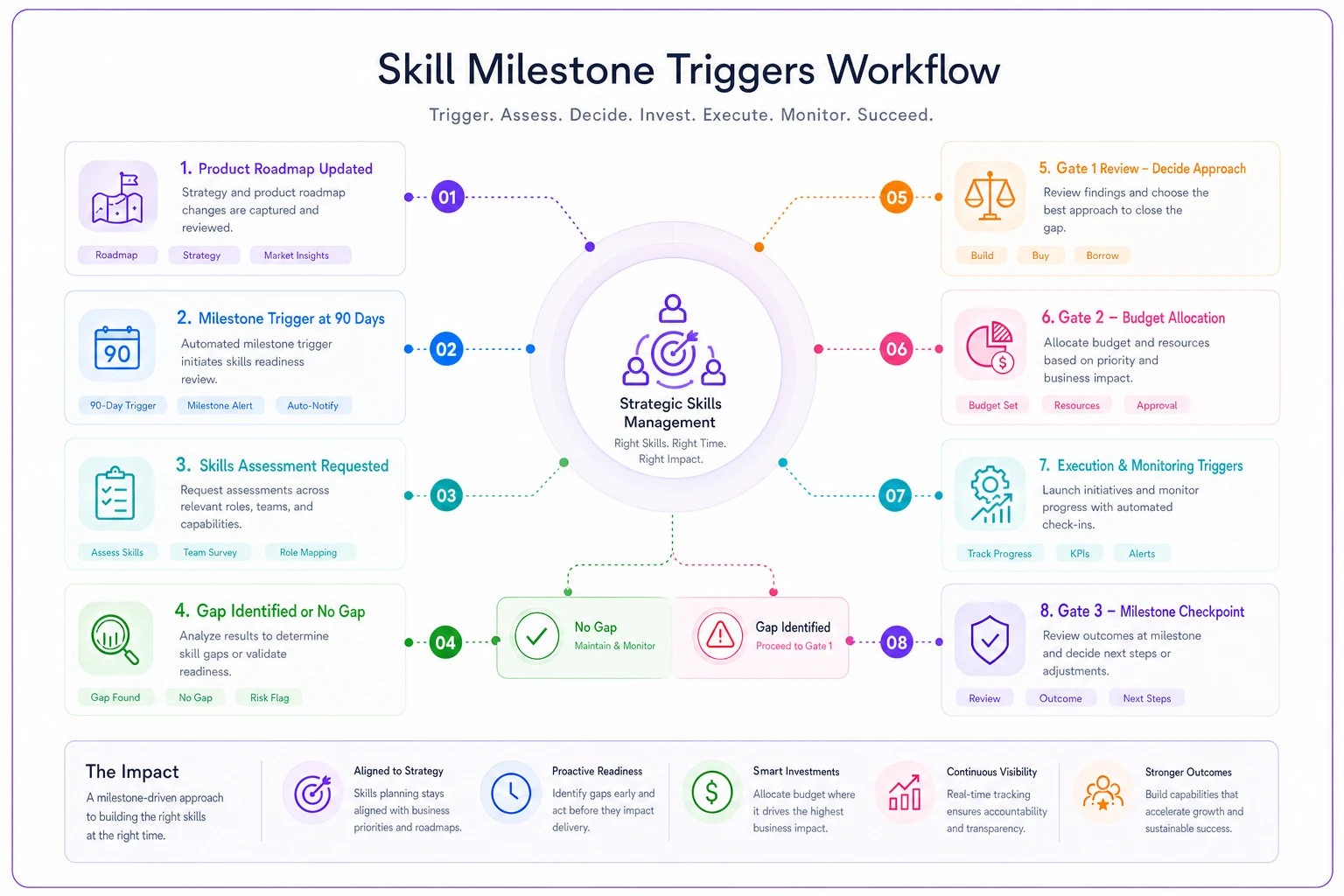
This sequence ensures triggers run without relying on memory and creates automatic escalation points for budget, timelines, and utilization.
Common failure modes and fixes
Even well-designed governance models break in predictable ways. Knowing these patterns helps you build preventive measures from the start.
The product steamroller: Product teams declare everything urgent and try to bypass the committee for "just this one critical hire." Fix: Create clear escalation criteria that define real emergencies versus poor planning. Track how often each product leader uses emergency escalations and review the patterns quarterly.
The HR fortress: HR becomes overly protective of process, slowing everything down in the name of proper talent management. Fix: Measure cycle times consistently and tie HR incentives to delivering against SLAs, not just filling positions or completing training programs.
The finance veto: Finance starts rejecting skills investments without understanding technical trade-offs, optimizing for cost over capability. Fix: Require finance to propose alternatives when they reject funding requests. If they won't approve hiring a senior engineer, what's their proposal for delivering the capability?
The skills inflation: Every role suddenly requires "expert-level" capabilities because nobody wants to admit the work could be done by someone mid-level. Fix: Create a skills leveling framework with clear definitions and require evidence for any "expert" designation. Most work needs solid practitioners, not world-class specialists.
The proxy metric trap: The committee starts optimizing for what's easy to measure—headcount, training hours—rather than what actually matters: capability delivery and milestone achievement. Fix: Every quarter, review whether your metrics are driving the right behaviors. If not, change them.
These failure modes aren't hypothetical. Most of them show up within the first few months. Building in the fixes early saves a lot of political friction later.
Making it sustainable
The difference between governance that lasts and governance that gets quietly abandoned after six months comes down to sustainment mechanics.
Keep the administrative burden low. If the committee needs a full-time coordinator just to function, you've built too much process. Modern AI-assisted platforms can automate most coordination tasks—scheduling, data collection, notification routing—leaving humans to focus on actual decisions.
Regular simplification passes matter. Every quarter, review what decisions the committee made and ask: could any of these be automated or delegated? The committee should focus on strategic trade-offs, not routine approvals that follow clear rules.
Build constituency gradually. Start with one product line and one HR team, prove the model works, then expand. Organizations resist big-bang governance changes but will adopt proven practices that demonstrably reduce pain.
Document decisions, not just process. When people understand why certain trade-offs were made, they're more likely to support the governance model even when decisions don't go their way. A simple decision log capturing context, alternatives considered, and rationale creates real organizational learning over time.
Celebrate wins publicly. When the governance model prevents a crisis or enables faster delivery, make sure people know about it. The marketing automation company mentioned earlier shares a monthly "crisis avoided" story showing how proactive skills planning prevented a deadline miss or budget overrun.
The measurable difference
Companies that implement talent allocation governance typically see specific improvements within 6-12 months:
| Metric | Before Governance | After Governance |
|---|---|---|
| Time-to-capability | 60–90 days | 30–45 days |
| Emergency hiring requests | Baseline | Down ~50–70% |
| Skills utilization | Baseline | Up ~20–30% |
| Training ROI visibility | None | Measurable per milestone |
The less obvious benefit is reduced organizational friction. When product and HR operate from the same plan with the same priorities, the finger-pointing largely stops. Everyone knows what capabilities are needed when, what the backup plans are, and who makes decisions when plans change.
Building your first governance charter
Starting talent allocation governance doesn't require massive organizational change. Begin with a simple charter that defines:
Scope: Which product lines and talent pools fall under governance initially? Start narrow and expand based on success.
Authority: What decisions can the committee make independently versus what requires escalation? Be specific about dollar amounts and timeline impacts.
Membership: Who sits on the committee and what happens when they can't attend? Designate explicit delegates with full decision authority.
Operating rhythm: When does the committee meet and what triggers emergency sessions? Lock in recurring calendar time immediately.
Success metrics: How will you know if governance is working? Pick 3-5 measurable outcomes and review monthly.
Sunset clause: When will you evaluate whether to continue, modify, or eliminate the governance model? Six months usually gives enough time to see real results.
A logistics software company started with a two-page charter focused only on their mobile development team. Eight months later, they expanded to cover all product development with a charter that's still only four pages. The key wasn't perfect documentation—it was clear decision rights and consistent execution.
From reactive scrambling to predictable delivery
Talent allocation governance sounds like another layer of bureaucracy until you've watched a company burn through millions on mistimed hires and emergency contractors. The real cost isn't just money—it's the product delays, quality issues, and burned-out teams that come from constantly operating in crisis mode.
The companies getting this right share three characteristics: they plan skills and products together rather than separately; they make talent decisions based on future capability needs rather than just current headcount; and they've built operational rhythms that prevent surprises rather than just reacting faster when surprises happen.
You don't need sophisticated software or a major organizational transformation to start. Pick one product line, create a simple committee structure with clear decision rights, map upcoming milestones to required capabilities, and establish basic SLAs for critical processes. Let the model prove itself on a small scale before expanding.
What makes this sustainable is treating talent allocation as an operational discipline—not an HR initiative, not a product process. When skills planning becomes as routine as sprint planning or budget reviews, the expensive fire drills that plague most companies simply stop happening. The governance model becomes invisible infrastructure that keeps talent aligned with business needs, quarter after quarter.
What makes this sustainable is treating talent allocation as an operational discipline—not an HR initiative, not a product process. When skills planning becomes as routine as sprint planning or budget reviews, the expensive fire drills that plague most companies simply stop happening. The governance model becomes invisible infrastructure that keeps talent aligned with business needs, quarter after quarter.
Ready to elevate your team's skills?
Join 500+ companies using Talioly to boost skill visibility, streamline training, and drive performance growth.