


Your skills taxonomy launched with 200 carefully defined competencies. Finance had their accounting standards mapped. Engineering documented their tech stack. Marketing outlined their campaign capabilities. Everyone agreed on definitions, proficiency levels looked clean, and the steering committee celebrated a successful rollout.
Eighteen months later, you're staring at 1,400 skills entries. "JavaScript" appears 11 different ways. Finance built a parallel taxonomy for budget planning that doesn't match HR's version. Product teams are using skill tags that don't exist in the official system. That taxonomy you launched? It's become a sprawling mess that nobody trusts and everyone quietly works around.
This breakdown pattern shows up across organizations attempting enterprise skills taxonomy governance. The problem isn't the initial design — most taxonomies start reasonably well-structured. The real failure happens in the ungoverned months that follow, when everyday operational pressures slowly corrupt your data until the entire system becomes unusable.
Why taxonomies degrade faster than anyone expects
Skills taxonomies face a governance challenge that most data systems don't encounter. Unlike customer records or financial data that have clear owners and update patterns, skills data gets touched by dozens of different stakeholders with competing priorities.
Your learning team needs granular technical skills to map training paths. Workforce planning wants broad capability buckets for headcount projections. Individual managers create their own skill variations for team assignments. Employees add skills during performance reviews that don't match any standard. External recruiters dump job posting requirements into the system using industry terms that conflict with internal language.
Each group has valid operational reasons for their approach. The learning team genuinely needs to distinguish between "React 16" and "React 18" for certification tracking. Workforce planning can't forecast with 500 micro-skills — they need 30 strategic capabilities. Managers know their team's actual work better than any central taxonomy. But without governance, these competing needs create data chaos.
The degradation accelerates through ordinary business operations. When engineering adopts a new framework, who updates the taxonomy? When two departments merge, whose skill definitions win? When a project needs a hybrid skill that doesn't exist, does the project manager wait for approval or just create something new? The answer, consistently, is that people create workarounds. And those workarounds compound into systemic breakdown.
The versioning nightmare that nobody plans for
There's a governance gap that catches most organizations completely unprepared: skill definition versioning. Your "Project Management" competency meant something specific in 2021. By 2023, the role has evolved to include agile ceremonies, stakeholder analytics, and resource optimization tools. But you have three years of employee assessments against the old definition, performance reviews tied to outdated proficiency scales, and learning paths built on deprecated skill components.
Stop losing track of critical skills.
Talioly helps you track, develop, and certify your workforce efficiently.
- Centralized skill profiles
- Automated training reminders
- Competency gap analysis
No credit card required
Without versioning rules, you face an impossible choice. Update the definition and invalidate historical data, making year-over-year comparisons meaningless. Or keep the old definition and watch it become increasingly disconnected from actual work. Most organizations try to split the difference — partially updating definitions without documenting changes — creating a hybrid mess where nobody knows what any skill actually means anymore.
The versioning problem multiplies across hierarchy levels. A high-level "Data Analysis" capability might remain stable, but its component skills — SQL, Python, Tableau, Power BI — evolve constantly. When Python 2 skills become obsolete and Python 3 becomes standard, do you retire the old skill? Merge them? Maintain both? Without clear versioning governance, different departments make different choices, fragmenting your data.
Even simple business changes trigger versioning cascades. Your company acquires a competitor with their own skills taxonomy. They call it "Customer Success" while you use "Client Management." Their proficiency scale runs 1-5, yours uses beginner to expert. They track 40 customer service micro-skills, you have 8 broad categories. Merging these taxonomies without versioning rules means either losing years of data or maintaining duplicate systems indefinitely.
RACI breakdown: when everyone and no one owns the taxonomy
The most common governance structure for skills taxonomies is no structure at all. HR nominally owns the system, but they lack the technical expertise to evaluate engineering skills. Business units control their functional skills, but they don't coordinate with each other. IT maintains the platform, but they don't make content decisions. The result is a RACI matrix where every cell contains "Consulted" and nobody has clear accountability.
This ownership vacuum creates predictable failures. Marketing decides to restructure their skills around customer journey stages instead of traditional disciplines. They make the change in isolation, breaking integration with the learning management system that still uses the old structure. Six months later, marketing employees can't find relevant training because the skills don't map. IT blames marketing for changing taxonomies without notice. Marketing blames IT for not updating integrations. HR blames both for not following process. Nobody fixes the problem because nobody clearly owns it.
Taxonomy architecture level: Someone must own the overall structure, hierarchy rules, and relationship definitions. This isn't about specific skills — it's about how skills connect, how many levels the taxonomy supports, and what constitutes a valid parent-child relationship. This owner prevents the taxonomy from morphing into incompatible structures across departments.
Domain expertise level: Functional leaders must own their specific skill definitions and proficiency standards. Engineering owns technical skills. Finance owns accounting competencies. But this ownership comes with constraints — they can't change hierarchical structures or create redundant skills that exist elsewhere.
Operational maintenance level: Someone must own the day-to-day governance tasks. Reviewing new skill requests, identifying duplicates, managing deprecation schedules, enforcing naming conventions. This role needs enough authority to reject requests from senior stakeholders when they violate taxonomy standards.
Without this three-tier ownership model, your taxonomy governance depends on voluntary compliance. And voluntary compliance in enterprise systems means gradual decay into chaos.
Migration rules that preserve value while fixing problems
Every organization with a mature skills taxonomy eventually hits the same realization: the current structure has fundamental problems that incremental fixes can't solve. Maybe you started with job-based skills that don't support skill-based career paths. Perhaps your flat skill list needs hierarchical organization. Or your department-specific taxonomies require enterprise standardization.
The migration challenge isn't technical — moving data between structures is straightforward. The challenge is operational. You have employees with two years of assessment data against current skills. Learning paths tied to existing competencies. Performance goals linked to skill proficiency targets. Compensation decisions based on skill portfolios. Destroying this historical context through migration causes immediate operational damage.
Successful migration requires parallel run periods with clear crosswalk rules. You maintain both old and new taxonomies simultaneously, with mapped relationships between them. An employee assessed as "Advanced" in the old "Project Management" skill automatically maps to "Level 4" in the new "Delivery Leadership" competency, with clear documentation of the conversion logic.
Parallel runs create their own governance burden, though. New employees get assessed against the new taxonomy while tenured employees still use the old system. Training courses must tag both skill versions. Reporting needs to aggregate across incompatible structures. The migration period typically stretches from a planned three months to an actual twelve as edge cases multiply.
The trap that kills most taxonomy overhauls is attempting perfection before cutover. Teams spend months debating whether "Data Visualization" belongs under "Analytics" or "Communication." Meanwhile, the old taxonomy keeps degrading and the new one never launches. Better to migrate to an 80% solution with clear governance for iterative improvement than to pursue a perfect taxonomy that never ships.
Measurable SLAs that prevent governance theater
Most skills taxonomy governance operates through quarterly steering committees reviewing PowerPoint decks about data quality while the actual taxonomy rots between meetings. The committee agrees that governance matters, creates subcommittees to draft policies, schedules follow-up sessions to review recommendations, and accomplishes nothing measurable.
New skill request processing: 5 business days maximum. When a department needs a new skill added for an urgent hiring requirement or training program, they can't wait three weeks for the next committee meeting. Clear SLA: submit request Monday, receive approval or rejection by Friday. Miss the SLA three times in a quarter, and it escalates to the CHRO.
Duplicate detection and resolution: Monthly automated scans with 10-day remediation. Your taxonomy will accumulate duplicates — "Excel Analytics," "Analytics (Excel)," "Microsoft Excel Analysis." Automated detection runs monthly, identifies potential duplicates through fuzzy matching, and assigns resolution to domain owners. They have 10 days to merge, differentiate, or justify maintaining both. Unresolved duplicates after 10 days get automatically flagged in executive reporting.
Orphan skill cleanup: Quarterly review with 30-day sunset notice. Skills with no associated employees, no linked training, and no open requirements for 6 months get marked for deprecation. Stakeholders have 30 days to justify retention or the skill gets archived. This prevents the accumulation of obsolete skills that clutter searches and confuse users.
Cross-functional alignment review: Bi-annual validation with 15-day response requirement. Every six months, domain owners must validate that their skills align with enterprise standards — naming conventions, hierarchy placement, relationship mappings. They have 15 days to complete validation or their domain gets flagged as non-compliant in governance scorecards.
| SLA Type | Frequency | Response Window | Escalation Trigger |
|---|---|---|---|
| New skill request processing | Ongoing | 5 business days | 3 misses per quarter → CHRO |
| Duplicate detection & resolution | Monthly | 10 days | Auto-flag in executive reporting |
| Orphan skill cleanup | Quarterly | 30-day sunset notice | Auto-archive after deadline |
| Cross-functional alignment review | Bi-annual | 15 days | Non-compliant flag in scorecards |
Automate SLA breach detection to trigger immediate escalations rather than relying on manual reporting.
These SLAs need teeth. A governance committee that reviews violations quarterly and issues stern reminders accomplishes nothing. SLA breaches should trigger automatic holds on new skill requests from that department, lock their ability to modify existing skills, or escalate to performance discussions. Without consequences, SLAs become governance theater that everybody ignores.
The compound cost of ungoverned taxonomy chaos
Here's what actually happens when enterprise skills taxonomy governance fails — not abstract data quality issues, but operational damage that compounds daily.
Your talent acquisition team spends around 3 hours per role manually translating hiring manager requirements into searchable skills because the taxonomy contains seven versions of "cloud architecture" that don't connect. Multiply that across 200 annual openings and you're burning roughly 600 hours yearly on taxonomy translation alone. That's somewhere around $30,000 in recruiter time just working around bad data.
Employees miss internal opportunities because the skills they've documented don't match how roles get posted. A data engineer with "Python," "SQL," and "Airflow" skills misses a perfect analytics engineer opening because it requires "Programming - Python," "Database Query Languages," and "Workflow Orchestration." The employee leaves for an external opportunity, triggering replacement costs that better taxonomy governance would have prevented.
Your L&D team commissions redundant training because they can't determine existing coverage. They build a new "Advanced Excel for Finance" course while "Financial Modeling in Excel" already exists, tagged under different skills. Duplicate content, wasted budget, because the taxonomy doesn't connect related competencies.
Managers can't build effective teams because skill assessments are incomparable. One team rates "Communication" on technical documentation ability. Another rates it on stakeholder presentation skills. A third focuses on written clarity. During resource planning, these ratings appear equivalent but represent completely different capabilities. Projects fail because the "expert communicator" can't actually do technical writing.
The compound effect is organizational capability blindness. You can't identify skill gaps because the data is too messy to analyze. You can't plan workforce development because historical trends are meaningless with constantly changing definitions. You can't make strategic talent decisions because you don't actually know what skills you have.
Building governance that scales with organizational growth
The governance model that works at 500 employees breaks at 5,000. The taxonomy that supports one business unit fails when you expand to five. Growth multiplies complexity exponentially, and governance must evolve to match.
Start with governance automation foundations that reduce manual overhead. Duplicate detection algorithms that run continuously, not quarterly. Natural language processing that suggests skill consolidation based on usage patterns. Integration validators that flag when connected systems have taxonomy mismatches. These automated controls prevent small inconsistencies from becoming major problems.
Implement graduated governance based on skill criticality. Your 50 core strategic capabilities need strict change control with executive approval. The 200 important functional skills require domain owner sign-off with central review. The long tail of specialized skills can use lighter governance with post-facto audits. This tiered approach focuses governance effort where it matters most while avoiding bureaucratic paralysis.
Create clear taxonomy boundary rules that preserve flexibility within constraints. Departments can create sub-skills within their domain but can't create new top-level categories. They can define proficiency indicators but must use standard proficiency scales. They can add skill metadata but can't change core skill properties. These boundaries let teams adapt to their needs while maintaining system integrity.
The governance structure must also handle predictable scale challenges proactively. What happens when you acquire a company with its own taxonomy? When you expand internationally with local skill requirements? When new job families emerge that don't fit existing categories? Build these scenarios into governance processes before they become urgent problems — not after.
Most critically, governance must be operational, not administrative. It should enable better talent decisions, not create approval bottlenecks. It should improve data quality through smart defaults, not manual review. When governance starts feeling like a compliance burden rather than operational support, you've already lost the organization's buy-in.
The migration pathway from chaos to control
If you're reading this while staring at an already-broken taxonomy, you need a recovery plan that doesn't require stopping business operations for a massive cleanup project. The path from taxonomy chaos to governance control requires staged interventions that deliver immediate value while building toward systematic improvement.
-
Freeze the bleeding first. Implement basic governance controls on new skill creation immediately, even while the existing taxonomy remains messy. Require new skills to follow naming conventions, provide clear definitions, and specify parent categories. This won't fix historical problems, but it stops additional chaos while you plan broader remediation.
-
Identify and protect your core skills. Instead of trying to fix all 1,400 skills simultaneously, identify the 50-100 that drive strategic workforce decisions. Clean these thoroughly, establish clear ownership, implement strict governance, and build reporting that depends only on this trusted core. This creates an island of data quality that provides immediate value and demonstrates what good governance actually enables.
-
Run shadow taxonomy pilots in parallel. Select one forward-thinking department to pilot your new governance model while maintaining their old data. They use the new structure for upcoming initiatives while historical reporting continues on legacy skills. This proves the governance model works before forcing enterprise-wide adoption.
-
Build migration bridges progressively. Create skill mappings between old and new taxonomies for your core skills first, then expand outward. Document conversion rules explicitly — "Advanced Project Management (old) maps to Delivery Leadership Level 4 (new) when combined with Team Management Intermediate or higher." This lets you migrate incrementally instead of requiring a big-bang cutover.
The timeline reality check: full taxonomy rehabilitation takes 18-24 months in organizations with over 1,000 employees. Six months to establish governance and stop degradation. Six months to clean core skills and prove value. Six months to migrate departments systematically. Six months to reach steady-state operations. Organizations that try to compress this timeline typically fail around month nine when the complexity overwhelms their resources.
Below is a visual workflow for the staged migration process.
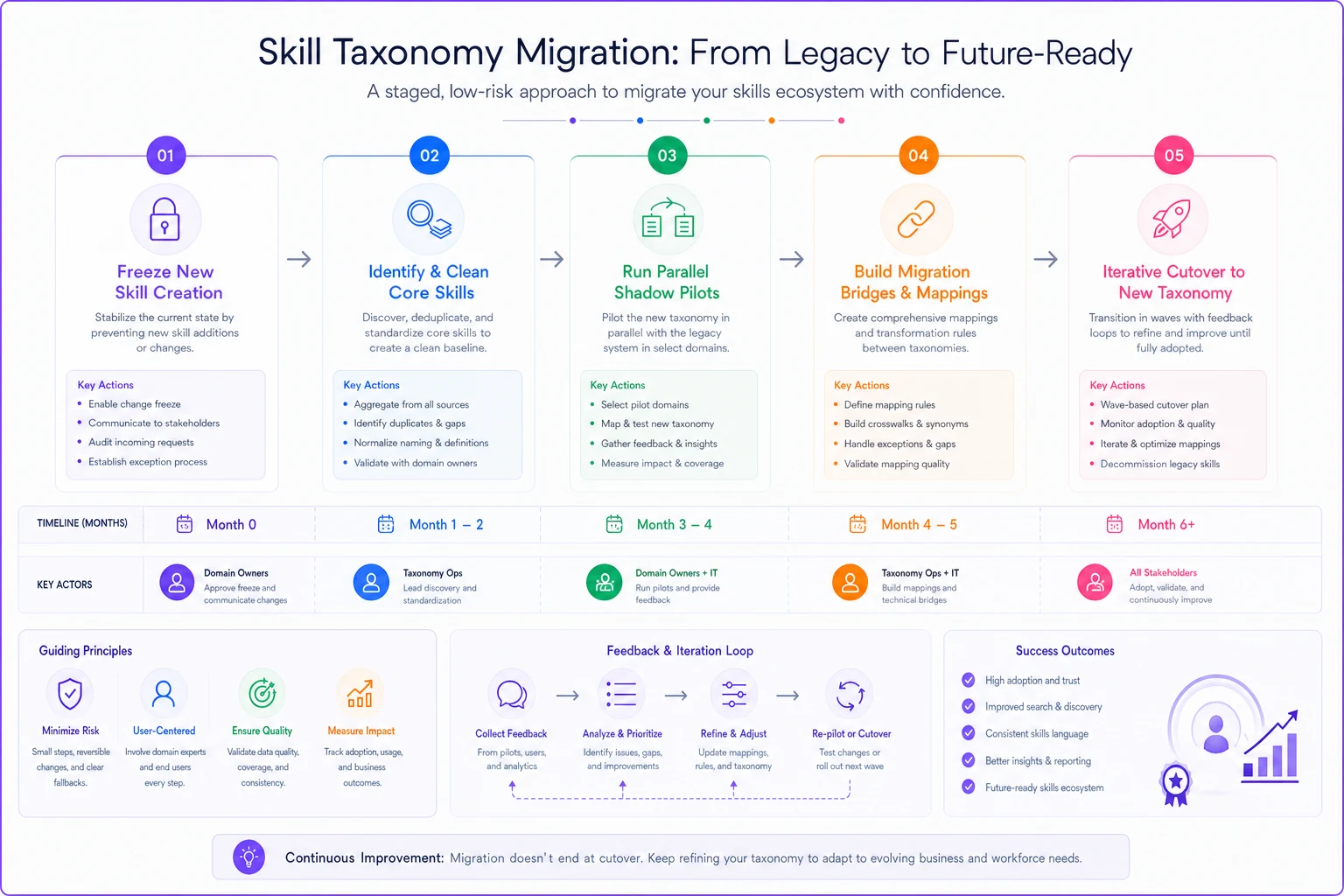
Use this workflow as a simple reference during planning — it highlights staged actions, ownership checkpoints, and iterative feedback loops to avoid big-bang failures.
AI automation opportunities in taxonomy governance
Modern AI-powered operational software transforms taxonomy governance from manual administration into something that actually runs itself to a reasonable degree. Instead of quarterly committee reviews of spreadsheet reports, these platforms continuously monitor taxonomy health and automatically resolve common issues.
Natural language processing identifies duplicate skills through semantic similarity, not just text matching. When departments separately create "JavaScript Programming," "JS Development," and "JavaScript Coding," the system recognizes these as duplicates and proposes consolidation automatically. It learns from past consolidation decisions to improve future recommendations.
Machine learning models can predict taxonomy drift before it becomes a real problem. By analyzing skill creation patterns, search failures, and user workarounds, the platform identifies when current taxonomy structures no longer match organizational needs. You get early warnings that "Cloud Architecture" needs sub-division into platform-specific skills before users create dozens of informal variations on their own.
Automated governance workflows cut administrative overhead significantly. When someone requests a new skill, the system checks for duplicates, suggests appropriate parent categories, validates naming conventions, and routes to the right approver based on domain and criticality. Simple requests get approved automatically. Complex requests include impact analysis showing which systems and processes are affected.
The real value comes from connecting taxonomy governance to operational data streams. The platform monitors job postings to identify emerging skills before they're formally requested. It analyzes project outcomes to validate whether skill assessments predict performance. It tracks learning completion to identify which skills actually get used after training. This operational integration shifts governance from reactive to predictive — instead of discovering taxonomy problems through user complaints, you prevent them through intelligent automation. The system handles routine maintenance while humans focus on strategic decisions about capability development rather than administrative cleanup.
Governance as competitive advantage
Most organizations treat skills taxonomy governance as a necessary evil — administrative overhead required to maintain data quality. This defensive mindset guarantees governance failure. When governance only prevents problems rather than enabling capabilities, it gets minimal resources and attention until breakdown forces emergency intervention.
The organizations that actually thrive with skills-based talent strategies view taxonomy governance differently. They recognize that trusted skills data enables faster talent deployment, more effective development investment, and better workforce planning. Their governance doesn't just prevent decay — it actively improves organizational capability visibility and utilization.
The path forward is clear. Establish three-tier ownership with real accountability. Implement measurable SLAs with consequences. Build automation that reduces manual overhead. Create migration pathways that preserve value while fixing problems. And position governance as operational enablement rather than compliance burden.
The next time someone proposes a skills initiative that depends on taxonomy data — whether internal mobility, strategic workforce planning, or skills-based development — ask about the governance model. Without it, you're building on sand. With it, you're creating sustainable competitive advantage through superior talent deployment.
Your skills taxonomy will either become a strategic asset that enables talent agility, or it will decay into an expensive database that everyone works around. The difference isn't the initial taxonomy design or the technology platform. The difference is whether you implement governance that scales with organizational reality rather than hoping good intentions will maintain data quality.
The next time someone proposes a skills initiative that depends on taxonomy data — whether internal mobility, strategic workforce planning, or skills-based development — ask about the governance model. Without it, you're building on sand. With it, you're creating sustainable competitive advantage through superior talent deployment.
Ready to elevate your team's skills?
Join 500+ companies using Talioly to boost skill visibility, streamline training, and drive performance growth.