

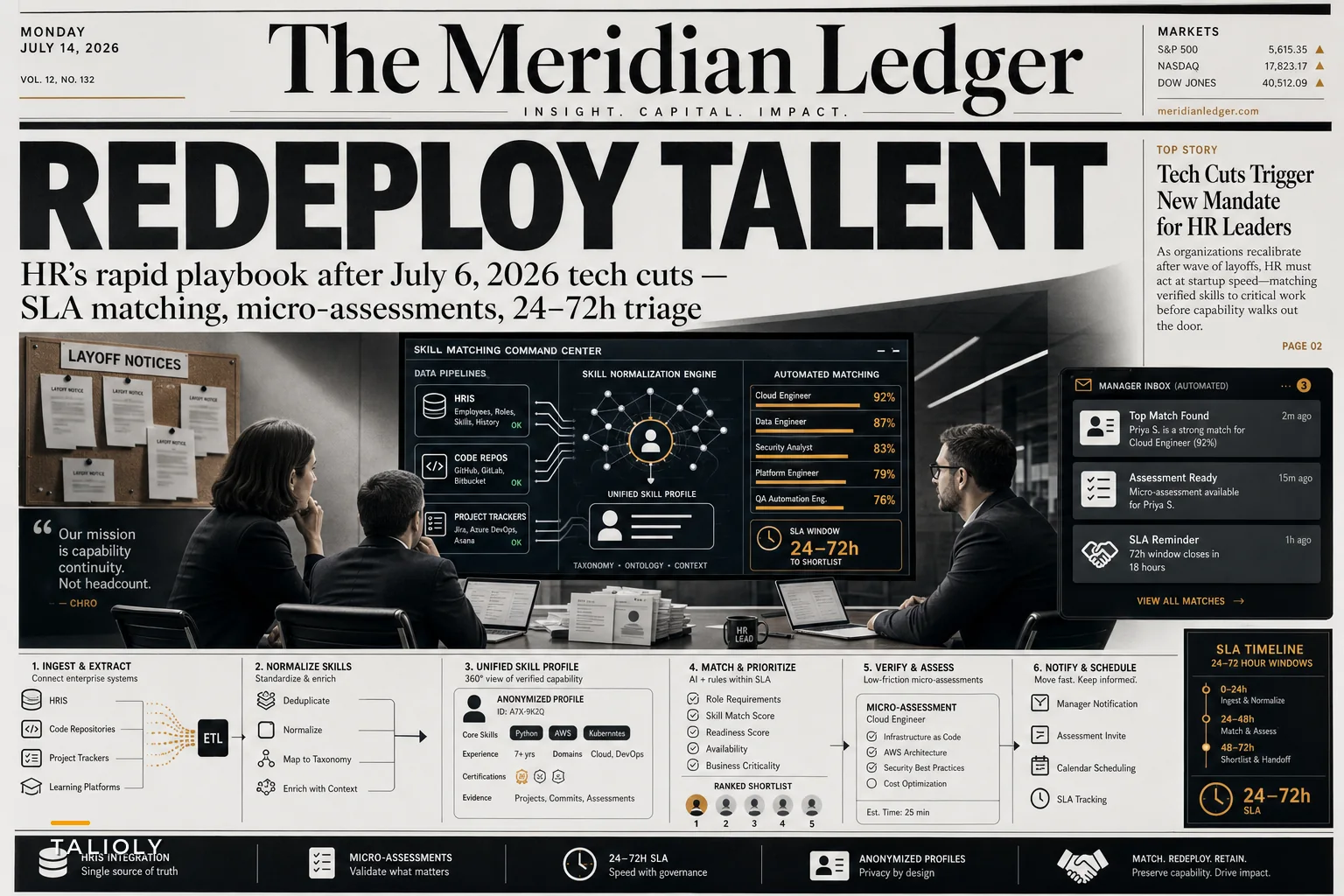

Microsoft's July 6th announcement hit the tech world hard: 4,800 jobs cut across Commercial and Xbox divisions, with entire teams restructured around AI priorities. The internal memo, reported by Business Insider, outlined redeployment commitments — but what they didn't mention is that most HR teams have maybe 72 hours to identify where displaced talent can land before those people start interviewing elsewhere.
The operational reality gets messy fast. You've got senior engineers from Xbox who could absolutely handle cloud infrastructure roles, but their skill profiles say "game engine optimization" instead of "distributed systems." Marketing managers from Commercial could transition to product marketing, except nobody verified their actual campaign performance numbers. Meanwhile, your talent acquisition team is posting external requisitions for roles these people could fill — if only someone had a clean way to match verified skills to open positions.
What follows is the operational sequence that actually works when you need to redeploy talent after layoffs, built from watching companies scramble through this exact scenario more times than I'd like.
The skill verification sprint: 48 hours to build profiles that matter
Forget the three-month skill mapping project your consultants pitched last year. When layoffs hit, you need verified skill profiles in two days, not two quarters.
Start with work artifacts, not self-assessments. Pull git commits for engineers, campaign dashboards for marketers, project deliverables for product managers. An Xbox engineer who shipped performance improvements for Halo Infinite has demonstrable optimization skills that are redeployable to any system that needs speed improvements. You'll never surface this if you're relying on their outdated LinkedIn profile or a manager assessment from eighteen months ago.
The verification framework looks like this:
| Role Type | Primary Evidence Source | Secondary Validation | Redeployment Signal |
|---|---|---|---|
| Engineers | Code commits, PR reviews | Peer nominations | Language overlap, architecture patterns |
| Marketers | Campaign metrics, content samples | Budget management records | Channel expertise, conversion rates |
| Sales | CRM activity, deal closures | Customer feedback scores | Industry knowledge, deal size experience |
| Product | Feature launches, user metrics | Cross-functional ratings | Market segment, technical depth |
| Support | Ticket resolution, escalation handling | Internal knowledge base contributions | Technical specialty, customer segment |
Run micro-assessments only where evidence gaps exist. If someone claims Python expertise but has no commits, give them a 30-minute coding challenge. If a marketer says they understand demand generation but shows no campaign history, have them work through a funnel problem. Keep these under an hour — you're validating competency for redeployment, not running a full hiring process.
The trick that saves the most time is parallel processing. While displaced employees complete assessments, your HR ops team extracts evidence from existing systems. Most companies already have the data — it's just scattered across Workday, Jira, Salesforce, and SharePoint. A simple extraction script can pull 80% of what you need in roughly four hours.
Match velocity: from displaced to deployed in 72 hours
Traditional internal mobility takes around 45 days on average. During layoffs, you have 72 hours before your best people accept external offers.
Stop losing track of critical skills.
Talioly helps you track, develop, and certify your workforce efficiently.
- Centralized skill profiles
- Automated training reminders
- Competency gap analysis
No credit card required
The matching process needs three inputs: verified skills from displaced talent, must-have requirements from open roles, and growth potential indicators. That third one matters more than most HR teams give it credit for — someone who learned React in six months can probably pick up Vue in three weeks, but only if you actually know they have that learning velocity.
This is also where shortlisting rules actually work without relying on job titles. A senior game designer from Xbox might match perfectly to a UX role in Office based on user research skills and design thinking capability, even though the titles share zero overlap.
Build your shortlist with this priority stack:
-
Immediate fits — 80%+ skill match, can start tomorrow
-
Quick ramps — 60% skill match, productive in 2 weeks with targeted training
-
Stretch placements — 40% skill match, high learning velocity, productive in 4–6 weeks
-
Development paths — Lower match but strong cultural fit, 3-month ramp with structured support
Notice what's missing? Job titles, years of experience, degree requirements. An Xbox gameplay programmer with five years of C++ can handle enterprise backend development. Traditional ATS filters would never surface this match because the keywords don't align.
The manager conversation that actually happens
Receiving managers will push back. They had headcount approved for a "Senior Cloud Architect" and now you're suggesting they take a gaming platform engineer who "probably could figure out Kubernetes."
Skip the philosophical argument about skills-based hiring. Show them the operational evidence instead. Pull up the engineer's actual code reviews. Show the distributed systems work they did for Xbox Live. Display the performance improvements they delivered at scale. Then add: "Or we can wait eight weeks for external recruiting to maybe find someone, and another four weeks for them to start."
The resistance usually shifts to logistics: "But who's going to train them?" This is where pre-built ramp plans matter. Standard 30-day templates for common transitions:
-
Backend to Cloud
Week 1 AWS/Azure basics, Week 2 containerization, Week 3 orchestration, Week 4 shadow deployments
-
B2C Marketing to B2B
Week 1 longer sales cycles, Week 2 account-based strategies, Week 3 stakeholder mapping, Week 4 first campaign launch
-
Consumer Support to Enterprise
Week 1 SLA differences, Week 2 escalation protocols, Week 3 technical depth requirements, Week 4 first account ownership
The smartest organizations pre-negotiate these transitions with receiving managers before layoffs ever hit. Get agreement upfront on which skill gaps they'll accept in exchange for faster fills. A manager who agreed beforehand to take someone at 70% skill match moves much faster than one who's surprised by the suggestion mid-crisis.
Reskilling economics during budget freezes
Layoffs and training budget freezes usually arrive together. The same company cutting 4,800 jobs isn't approving $5,000 per person for reskilling programs. This forces brutal prioritization.
Focus reskilling spend on multiplier skills — capabilities that unlock multiple role options, not single positions. Teaching cloud basics opens doors across infrastructure, DevOps, and platform engineering. Training on data analysis enables transitions to product, marketing analytics, or operations roles.
The economics roughly break down like this:
| Training Type | Approximate Cost | Roles Unlocked |
|---|---|---|
| Generic cloud certification | ~$2,000 | 10–15 role types |
| Specific tool training | ~$1,500 | 2–3 roles |
| Industry certification | ~$3,000 | 5–7 roles, higher comp ceiling |
| Soft skills workshop | ~$500 | Marginal placement impact |
The operational insight most teams miss: peer-led reskilling costs almost nothing and works better for technical transitions. That Xbox engineer learning Kubernetes? Pair them with your existing cloud team for two weeks. They'll learn faster from real codebase exposure than from any training course.
Structure peer programs with clear expectations:
-
2 hours daily paired work
-
1 hour daily self-study
-
Weekly checkpoint on specific skills acquired
-
End goal
solo PR within 14 days
The receiving team gets extra hands immediately, the transitioning employee learns in context, and you spend nothing on external training.
Outplacement coordination that preserves reputation
Not everyone can be redeployed internally. The math rarely works out — you'll have specialized roles with no internal matches, or more displaced talent than open positions.
Modern outplacement isn't just career coaching and resume reviews. It's operational coordination between your company, the displaced employee, and potential landing spots. Companies that handle this well tend to see roughly 70% of displaced employees land within 60 days. Companies that don't see Glassdoor disasters and occasionally worse.
Build an outplacement control tower with four workstreams:
Internal advocacy — HR partners who can provide honest references, not just employment verification
Skills documentation — Verified portfolios that travel with the employee
Warm introductions — Leveraging leadership networks for direct connections
Transition support — Extending benefits, maintaining system access for portfolio building
The difference between decent and good outplacement shows up in the details. Good programs let engineers keep GitHub access for 30 days to clean up their code samples. They provide marketers with performance data they can share in interviews. They coordinate reference calls so managers know what to emphasize.
Microsoft mentioned redeployment commitments in their memo, but operational reality matters more than the promise. Employees need to see movement within 72 hours or they assume it's corporate PR.
The automation layer that makes this scale
Manual skill verification and matching breaks down around 100 employees. Excel sheets with VLOOKUP formulas might handle a small department reorg, but company-wide redeployment needs operational software that can process thousands of profiles at once.
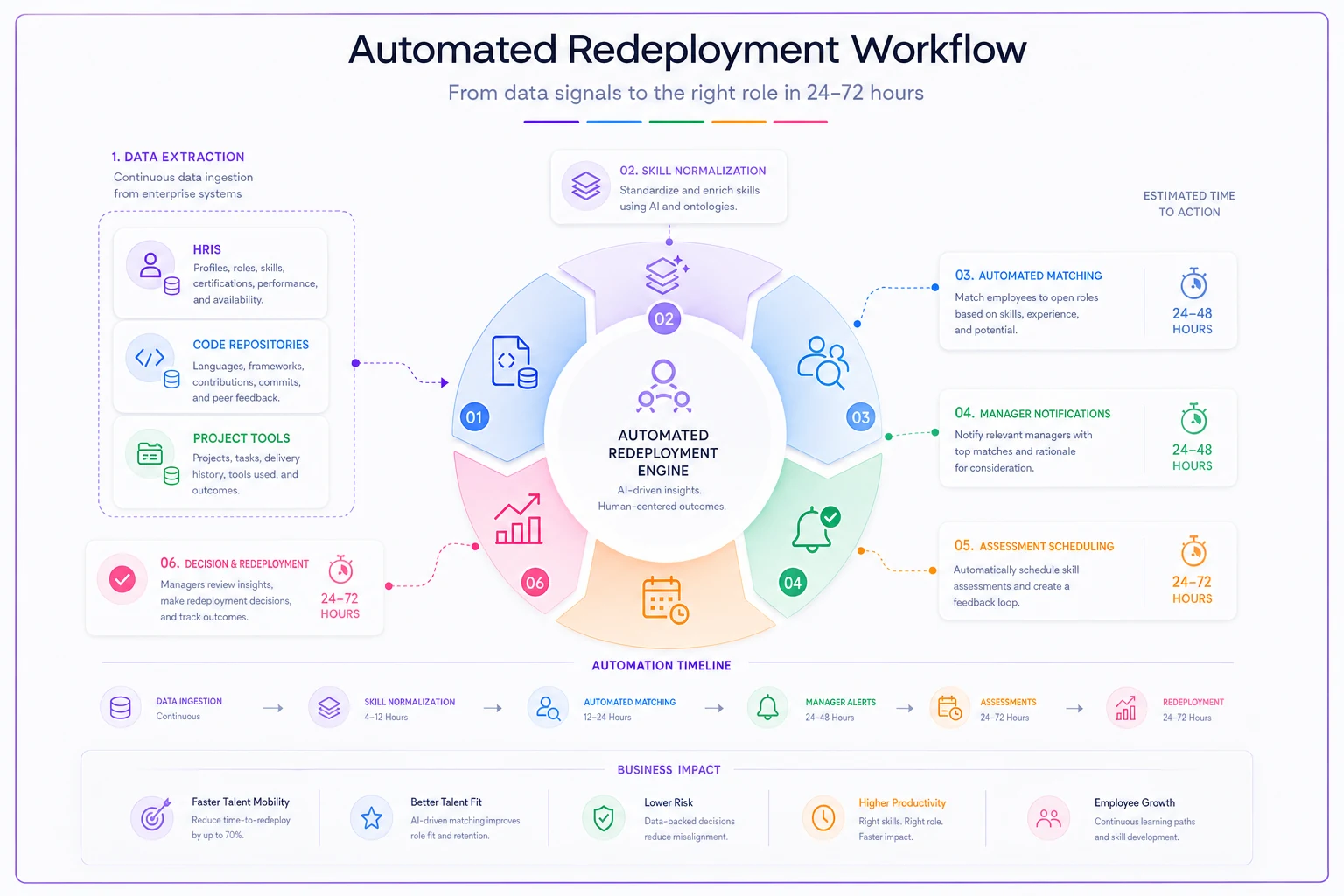
The technical architecture isn't the hard part — it's the operational workflows underneath that need careful design. Your skill verification system needs to pull from multiple sources (HRIS, code repos, project management tools), normalize the data into consistent skill taxonomies, and update in near real-time as new evidence surfaces.
AI automation handles a lot of the heavy lifting here: scanning code commits for technology signals, analyzing project documents for skill indicators, parsing performance reviews for capability mentions. The real value comes from workflow automation — automatically notifying managers when matches appear, scheduling assessment slots without manual back-and-forth, tracking response rates and adjusting outreach accordingly.
One pattern worth building is a triggered skill refresh workflow. When a layoff announcement hits, the sequence looks roughly like this:
-
System pulls fresh data from all source platforms simultaneously
-
Profiles with stale or incomplete information get flagged automatically
-
Personalized evidence requests go out to affected employees
-
Short validation calls get scheduled for critical or high-priority roles
-
Reviewed, match-ready profiles are generated within 24 hours
Here's a simple illustration of that triggered workflow.
This isn't about replacing HR judgment. It's about giving HR teams clean data so they can make fast decisions.
When you're trying to redeploy thousands of people, the difference between 5 minutes and 30 minutes per profile review compounds into weeks of additional processing time. That's not a small thing — that's the difference between keeping your best people and watching them sign offers elsewhere.
The hard conversation about who can't be placed
Some displaced talent won't find internal homes. The skill gap might be too large, the role too specialized, or the business direction too different.
Early identification matters. Run your matching process within 24 hours of the layoff announcement. Anyone with less than 30% skill match to any open role needs different support — don't make them sit through internal interview rounds that won't succeed.
For these employees, shift immediately to external placement support:
-
Enhanced severance for longer runway
-
Immediate outplacement services activation
-
Priority access to employee assistance programs
-
Extended healthcare coverage
-
Equipment purchase options
The rough operational split: spend about 80% of effort on the 60% of employees you can confidently place internally, 15% on the 20% who might make it with reskilling, and the remaining time on smooth external transitions for everyone else.
This sounds harsh, but false hope does more damage than honest assessment. An Xbox game designer with no transferable skills to cloud infrastructure needs to start their external search immediately — not waste two weeks in internal interviews that were never going to work out.
Building institutional memory for next time
Tech layoffs run in cycles. The companies that handle them well document everything: which skill transitions worked, which assessments predicted success, which managers embraced displaced talent, which reskilling programs actually delivered ROI.
Build a redeployment playbook that captures:
-
Skill transition success rates (Game Dev → Cloud
~65–70% success)
-
Average ramp times by transition type
-
Manager feedback on redeployed talent performance
-
Cost per successful internal placement
-
External placement rates by role type
-
Legal claims and settlements from poor handling
This institutional memory pays dividends during the next cycle. When layoffs hit again — and they will — you'll know that mobile developers transition well to web development, that finance managers can handle operations roles, that customer success skills transfer surprisingly well to product management.
The playbook also speeds up execution. Instead of debating whether to attempt certain transitions, you have data. Instead of guessing at ramp times, you have benchmarks. Instead of hoping managers will cooperate, you know exactly who embraced displaced talent before and who dragged their feet.
The bottom line on redeployment after layoffs
Microsoft's 4,800 job cuts represent a pattern that'll keep repeating as companies restructure around AI priorities. The HR teams that successfully redeploy talent will be the ones with operational systems ready to activate within hours, not weeks.
The timeline is unforgiving: 48 hours to build verified skill profiles, 72 hours to generate matches, 96 hours to secure manager buy-in, one week to begin transitions. Miss these windows and your best displaced talent takes external offers, leaving you with harder placements and higher recruiting costs to backfill roles you already had internal candidates for.
When the operational pieces align — clean skill verification, solid matching, pre-negotiated transitions, peer-led reskilling, coordinated outplacement — you can successfully redeploy 60–70% of displaced talent internally. That's not just cost savings. It's maintaining institutional knowledge, preserving culture, and showing the people who stayed that the company actually takes care of its own.
The companies getting this right aren't running complex transformation programs. They're building operational infrastructure that treats redeployment like any other business process: clear timelines, defined workflows, quality metrics, and automation where it makes sense. They're ready before layoffs hit, not scrambling to build systems in the middle of a crisis.
Next time your CEO mentions "restructuring" or "rightsizing," you'll either have a playbook ready to execute, or you'll be building skill profiles in Excel while your best talent updates their LinkedIn. That choice happens now, not when the announcement drops.
Ready to elevate your team's skills?
Join 500+ companies using Talioly to boost skill visibility, streamline training, and drive performance growth.