


Your CFO just announced they're leaving in six weeks. The board meeting is tomorrow. You pull up your succession plan spreadsheet and there it is — three names marked "ready" from last year's talent review.
But are they actually ready? When did anyone last validate these candidates against real job requirements? What gaps need closing, and how do you test readiness without putting the entire finance operation at risk?
This is the succession bench problem that hits every HR team eventually. Names on paper, no real system behind them, and a development process that's more hopeful than structured.
Most organizations treat succession planning like a once-a-year checkbox — update a spreadsheet, run a calibration meeting, forget about it until someone actually leaves. Meanwhile your "ready now" candidates might have skill gaps nobody's looked at in 18 months, and your high-potentials aren't getting the targeted development they need.
Building genuine bench readiness takes more than annual talent reviews and optimistic labels. You need operational infrastructure that continuously validates readiness, identifies specific gaps, and creates targeted development paths.
The readiness rubric framework that actually predicts success
Traditional succession planning uses vague labels — "ready now," "ready in 1-2 years" — without ever defining what ready means. Without specific criteria tied to verified capabilities, you're guessing. Most HR teams are doing exactly that.
A working readiness rubric breaks each critical role into three capability tiers: Tier 1: Core technical capabilities — The non-negotiable skills needed to execute the role's primary functions. For a VP of Engineering, this might include system architecture, deployment pipeline management, and vendor contract negotiation. Tier 2: Leadership scope capabilities — The ability to operate at the required organizational level. Managing teams of a certain size, handling specific budget ranges, navigating particular stakeholder groups. Tier 3: Context-specific capabilities — The unique requirements of your organization. Maybe your VP Engineering needs to manage FDA compliance, coordinate offshore teams across time zones, or integrate acquired companies' tech stacks.
Here's what this looks like for a Director of Sales role at a mid-size SaaS company:
| Capability Tier | Specific Requirements | Validation Method | Minimum Score |
|---|---|---|---|
| Core Technical | Enterprise deal negotiation ($250k+ contracts) | Deal history review | 5+ closed deals |
| Core Technical | Sales team coaching | 360 feedback from direct reports | 7/10 average |
| Core Technical | Pipeline forecasting accuracy | Historical forecast vs. actual | Within 15% for 3 quarters |
| Leadership Scope | Managing 15+ person team | Current or stretch assignment | 6+ months experience |
| Leadership Scope | $10M+ annual quota ownership | Progressive quota history | Achieved 90%+ for 2 years |
| Context-Specific | Healthcare vertical expertise | Customer reference checks | 3 healthcare clients managed |
| Context-Specific | Channel partner management | Partner feedback survey | 8/10 satisfaction score |
The piece most companies miss: each capability needs a specific validation method and a minimum threshold. "Good at sales" isn't measurable. "Closed 5+ enterprise deals above $250k with 90-day sales cycles" is.
Without that specificity, you end up promoting people who interview well but can't do the job. Or you overlook strong candidates because their readiness isn't visible through traditional assessments.
Stretch assignments that actually develop successors (not just test them)
This is where succession planning usually falls apart. HR identifies high-potentials, managers nod along in talent reviews, and then nothing actually happens. Candidates keep doing their current jobs, maybe get sent to a leadership workshop, and are somehow supposed to become ready for the next level.
Stop losing track of critical skills.
Talioly helps you track, develop, and certify your workforce efficiently.
- Centralized skill profiles
- Automated training reminders
- Competency gap analysis
No credit card required
Real readiness comes from progressive stretch assignments that close specific capability gaps. Most stretch assignments fail because they're either too big — setting people up to fail — or too vague to develop anything concrete.
A graduated system with three levels of exposure tends to work better:
Observer assignments — The candidate shadows or assists without direct accountability. A potential CFO candidate might sit in on board meeting prep, review investor materials, or observe quarterly earnings calls. Low risk, high learning. Supported assignments — The candidate takes ownership of a specific deliverable with coaching and backup available. That same CFO candidate might lead one section of the board deck, run a subsidiary's monthly close, or negotiate a single vendor contract while the current CFO stays in the loop. Independent assignments — The candidate fully owns a meaningful piece of the role's responsibilities. Covering temporarily during the CFO's absence, leading annual budget planning for one division, or managing due diligence on a smaller acquisition.
A financial services company used this model to develop their Controller into CFO readiness over about a year and a half. It wasn't a clean process — there were a few months where the supported assignments overlapped awkwardly with a regulatory audit, and some of the observer phase got compressed. But the progression worked.
Months 1-3 (Observer):
-
Attended all board meetings as note-taker
-
Shadowed investor relations calls
-
Reviewed all external audit communications
Months 4-9 (Supported):
-
Prepared regulatory filings with CFO review
-
Led monthly business reviews for one product line
-
Managed relationship with one institutional investor
Months 10-18 (Independent):
-
Acted as interim CFO during a three-week leave
-
Led Q3 earnings call prep and execution
-
Negotiated and closed a credit facility renewal
Design each stretch assignment with a single measurable deliverable aligned to the readiness rubric.
By month 18, they had validated readiness across roughly 80% of CFO capability requirements through actual work performance — not hypothetical assessments. The remaining gaps were things they'd intentionally deferred until the role was live, which in hindsight was probably fine for that situation but wouldn't be for every hire.
Each assignment should target specific gaps from the readiness rubric, with clear success metrics and a feedback loop back into the succession process. Without that connection, stretch assignments become feel-good experiences with no operational output.
Fast-path validation rules that separate ready from "maybe ready"
The biggest problem with most "ready now" designations is that they're based on manager opinion and maybe a competency assessment from a couple years back. When the moment actually comes to make the call, everyone gets nervous — because nobody really verified anything.
Fast-path validation rules create objective gates candidates must pass to maintain their succession status. Think of it like maintaining a pilot's license. You need recent flight hours, current certifications, periodic check rides. Past credentials alone don't keep you in the cockpit.
For succession candidates, this means time-bound requirements:
Recency rules — Critical capabilities must be demonstrated within specific timeframes. A CFO successor needs to have managed investor relations within the last 12 months, not five years ago at a different company.
Progression rules — Candidates must show expanding capability over time, not lateral moves. A succession-ready VP of Sales should show increasing deal sizes, team sizes, or territory complexity year over year.
Consistency rules — One-time success isn't enough. The Director of Operations who saved the day during a crisis three years ago needs to show consistent performance across multiple quarters.
Here's a validation ruleset for a VP of Marketing succession candidate:
Every 6 months, must demonstrate:
-
Launch of one major campaign with measurable ROI
-
Presentation to executive team or board
-
Management of at least $500k in program spend
Every 12 months, must demonstrate:
-
Successful hire and onboarding of at least 2 team members
-
Ownership of annual planning cycle for at least one channel
-
Cross-functional project leadership with Sales, Product, or Customer Success
Every 18 months, must demonstrate:
-
Strategic initiative that impacts company-level metrics
-
External visibility (conference speaking, published content, analyst briefings)
-
Budget management within 5% of plan
If a candidate fails to meet these validations, they drop from "ready now" to "ready with development" status. This prevents the common problem of succession lists going stale — full of people who were ready a few years back but haven't kept pace since.
There's a real automation opportunity here. Instead of manually tracking whether candidates meet validation requirements, AI-powered operational software can monitor work artifacts, project outcomes, and performance data to automatically flag when someone falls out of compliance — keeping your bench current without constant manual reviews.
The maintenance cadence that keeps your bench from going stale
Most succession plans get updated once a year during talent review season, then sit untouched while the actual organization changes around them. People leave, strategies shift, role requirements evolve — but the spreadsheet stays frozen.
A manufacturing company learned this the hard way. Their "ready now" plant manager successor had quietly moved into a desk role about two years earlier due to a back injury. Nobody updated the succession plan. When the current plant manager had a health emergency, they scrambled to fill the role externally — while a capable internal candidate in another facility wasn't even on their radar. That one cost them a few months and a fair amount of goodwill with the internal teams who felt overlooked.
Maintaining a genuinely ready bench requires a cadence that goes beyond annual reviews:
-
Quarterly validation cycles — Every three months, check that your "ready now" candidates still meet recency and progression requirements. Not a full assessment, just a quick pass against your validation rules.
-
Monthly capability updates — As candidates complete stretch assignments, training, or new projects, update their profiles. This is where skills development operating models become critical — you need a systematic way to track capability development, not just job titles.
-
Weekly assignment tracking — Monitor active stretch assignments to make sure they're on track and developing the intended capabilities. If something isn't working, pivot early rather than burning months on ineffective development.
-
Triggered reviews — Certain events should automatically kick off a succession plan update:
-
When a key role holder gives notice
-
When organizational structure changes
-
When strategy shifts require new capabilities
-
When a succession candidate's performance drops
-
When external market conditions change role requirements
A retail company automated much of this through their operational platform. Their system tracked stretch assignment progress through project management tools, capability demonstrations through work artifacts, and performance trends through regular business metrics — with readiness scores updated automatically based on validation rule checks.
When their COO unexpectedly resigned, they had three validated internal candidates with current readiness scores, specific gap analyses, and documented stretch assignment results. The board approved an internal promotion in 48 hours instead of launching a months-long executive search.
Converting readiness data into development investments
Most succession programs get this backwards. They identify high-potentials, label them as successors, then hope they somehow develop into ready candidates. That's like planting seeds and never watering them.
Your readiness rubric and validation rules generate specific data about capability gaps. The question is whether you act on that data with targeted investments rather than generic leadership programs.
A technology company found through their validation process that four of their five C-suite succession candidates lacked acquisition integration experience — a critical gap given their growth strategy. Instead of sending everyone to an executive education program, they:
-
Partnered with their corp dev team to involve successors in active due diligence
-
Created a simulation exercise based on their most recent acquisition
-
Brought in the former integration lead from a similar company they'd benchmarked against
-
Assigned each successor to lead workstreams in their next smaller acquisition
Total investment was somewhere in the $40k-$50k range across all candidates. When they didn't need to hire external executives for their next two acquisitions, the avoided search fees and sign-on packages more than justified it — though honestly, the faster integration timelines were probably the bigger win.
The point is connecting specific gaps to specific development investments:
| Gap Identified | Traditional Approach | Targeted Investment | Validation Method |
|---|---|---|---|
| Board presentation skills | Executive communication course | Present monthly metrics to board committee | Board member feedback scores |
| P&L management | MBA courses | Own division P&L for 6 months | Actual P&L performance |
| M&A experience | M&A workshop | Lead integration workstream | Integration milestone delivery |
| Crisis management | Leadership seminar | Lead incident response team | Crisis simulation results |
| Stakeholder management | 360 feedback | Manage key customer escalation | Customer satisfaction scores |
Every development dollar should directly address a validated succession gap — not vague "leadership development."
The verification problem hiding in your succession plans
Most succession plans are built on self-reported capabilities and manager opinions. "Sarah's great with numbers, she should be ready for CFO." But has Sarah actually closed the books for a public company? Managed investor relations during a downturn? Negotiated debt covenants with institutional lenders?
The gap between perceived readiness and verified readiness gets painfully visible during actual transitions. A consumer goods company found this out when they promoted their "ready now" CMO successor. His supposed "digital marketing expertise" turned out to be oversight of an agency relationship. When that agency contract ended, their digital marketing fell apart because he'd never actually built or run campaigns himself. The company spent most of the following year recovering, and the exec eventually moved on — which was probably best for everyone.
This is where verified skills profiles become essential for succession planning. Instead of relying on assumptions, you need:
-
Work artifact validation — Actual deliverables that prove capability. Not "good at financial modeling" but "built the model that secured Series C funding."
-
Progressive complexity evidence — Documented proof of increasing capability over time. Managing a team of 3, then 10, then 30, with performance records at each level.
-
External validation — Third-party confirmation through customer feedback, audit results, or regulatory compliance records.
-
Contextual verification — Proof that capabilities transfer to your specific environment. That VP Sales might have crushed quotas at a large enterprise software company, but can they sell a technical product to SMBs?
An insurance company built verification directly into their succession process:
-
Every capability claim required supporting evidence
-
Stretch assignments included specific deliverables for validation
-
Quarterly reviews collected work artifacts, not just ratings
-
External stakeholders provided capability feedback through structured surveys
When their Chief Risk Officer retired, the succession candidate had well over a hundred validated work artifacts demonstrating readiness across all critical capabilities. The board approved the promotion in one meeting. That's what verified readiness looks like compared to a name on a spreadsheet.
The succession bench system that actually works
After watching organizations struggle with this repeatedly, the pattern is pretty consistent: you need operational infrastructure, not annual talent reviews.
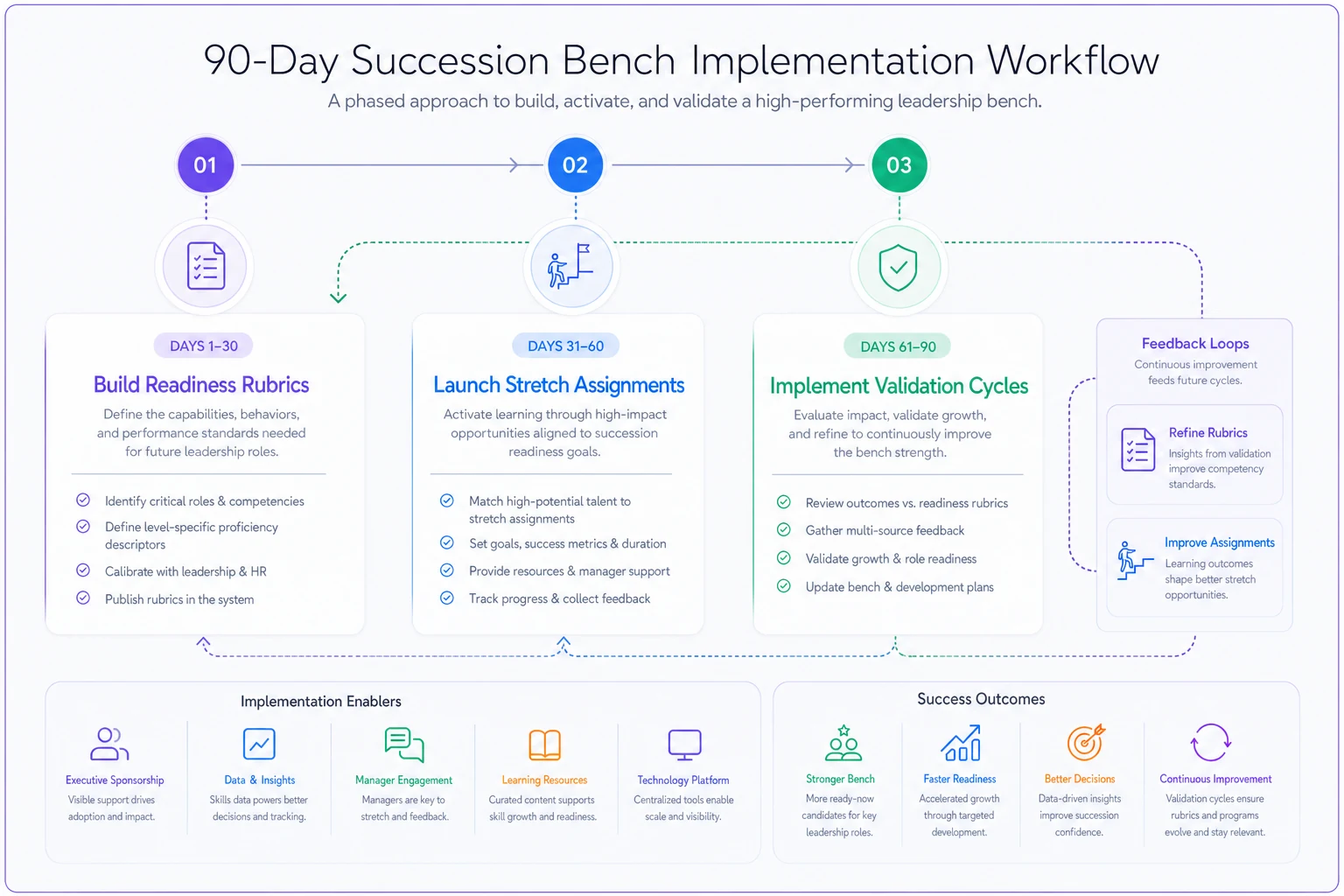
A phased 90-day implementation tends to work, though the exact timing will shift depending on how much organizational buy-in you're working with:
-
Days 1-30
Build your readiness rubrics
— Map critical roles to specific capabilities, define validation methods for each one, set minimum thresholds for "ready now" status, and create gap analysis templates. -
Days 31-60
Launch stretch assignments
— Identify the top 3 gaps for each succession candidate, design graduated assignments moving from observer to supported to independent, set up tracking mechanisms, and brief managers on what coaching is actually required. -
Days 61-90
Implement validation cycles
— Create quarterly validation checklists, set up monthly capability tracking, build triggered review workflows, and establish feedback loops back into development planning.
Companies that succeed with succession planning treat it like an operational system, not an HR exercise. Clear standards, systematic development, continuous validation, regular maintenance — these aren't complicated concepts, but most organizations don't operationalize them.
Visual workflow of the 90-day implementation:
Succession planning fails when it lives in spreadsheets and annual reviews. It works when it's embedded in daily operations through systematic capability development and validation. The difference between having names on a list and having genuinely ready successors is the operational infrastructure you build around them.
AI-powered operational platforms can automate a significant portion of this — tracking capability demonstrations through work artifacts, monitoring stretch assignment progress, validating readiness requirements, keeping succession bench status current without someone manually chasing it down. But even without full automation, the frameworks here will move you from "hopefully ready" to "verified ready."
AI-powered operational platforms can automate a significant portion of this — tracking capability demonstrations through work artifacts, monitoring stretch assignment progress, validating readiness requirements, keeping succession bench status current without someone manually chasing it down. But even without full automation, the frameworks here will move you from "hopefully ready" to "verified ready."
Your next leadership transition is coming. The question is whether you'll scramble to figure out who's ready, or walk into it with candidates whose readiness has been systematically built and validated.
Ready to elevate your team's skills?
Join 500+ companies using Talioly to boost skill visibility, streamline training, and drive performance growth.