

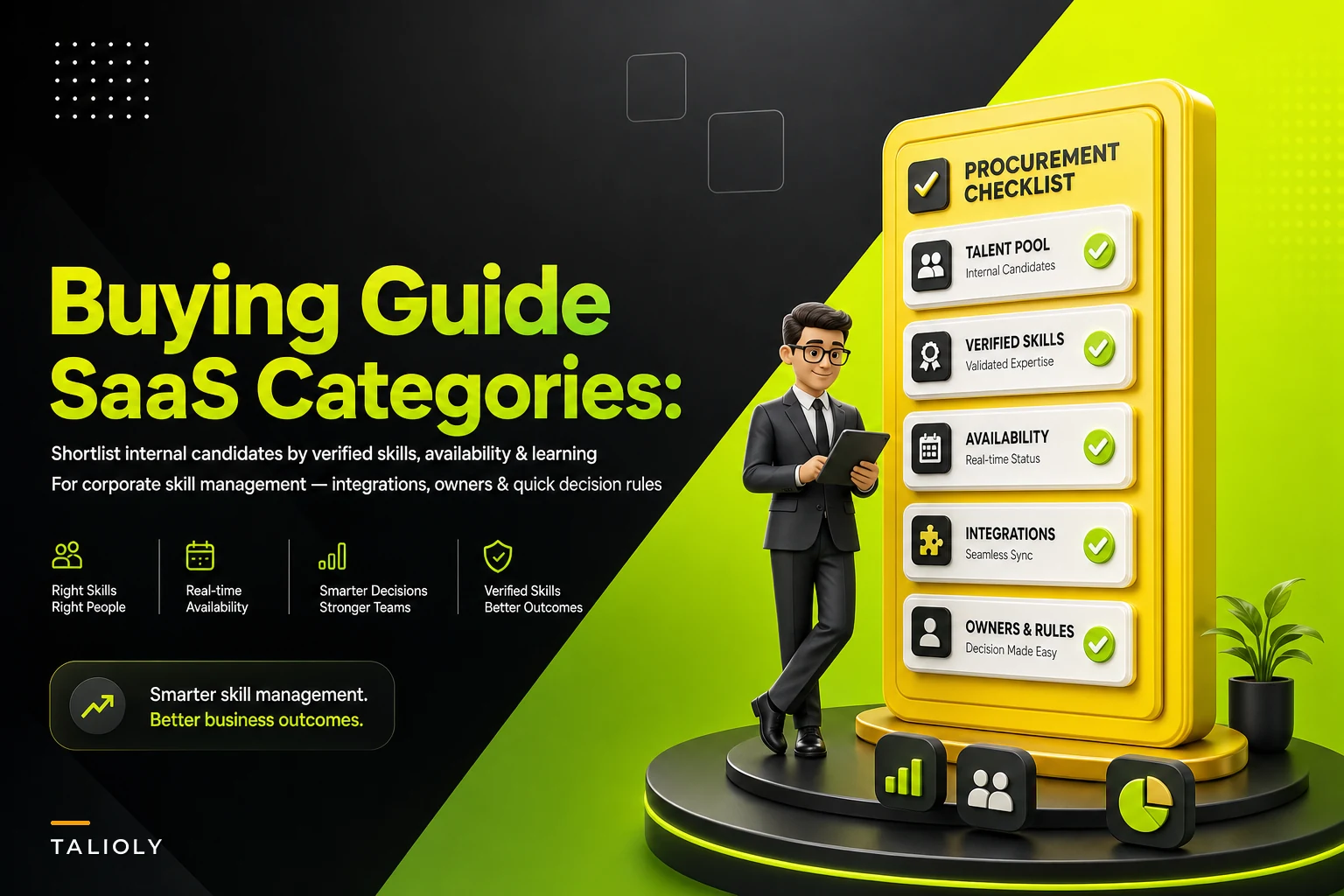

Most buying guides for internal mobility read like feature checklists. They list 40 "must-have" capabilities, half of which overlap, and you end up more confused than when you started. The real problem HR teams run into isn't "what features exist" — it's "which category of tool actually owns which job, who in the org should drive that purchase, and when does buying it even make sense."
So this guide is organized differently. Instead of ranking products, it maps the internal mobility software categories you'll realistically evaluate when your goal is to shortlist internal candidates by three things people constantly conflate: verified skills (not self-reported), real-time availability (not "probably free next quarter"), and learning potential (whether someone can close a gap fast enough to matter).
For each category you'll get the typical integrations it needs to be useful, the owner who should lead procurement, and a one-sentence decision rule. If you're here because budgets tightened and you're trying to do more redeployment with less hiring, the Fed pause guidance on protecting skill pipelines pairs well with this — that piece covers why, this one covers what to buy next.
The three signals, and why no single product nails all three
Before the categories, one framing point worth establishing — it saves a lot of wasted demos.
The three things you're trying to assemble — verified skills, availability, learning potential — live in three different systems and rarely talk to each other cleanly:
-
Verified skills come from assessments, work artifacts, certifications, and manager validation. That data is messy and scattered.
-
Availability lives in resourcing tools, project systems, and sometimes just a staffing spreadsheet someone updates on Fridays.
-
Learning potential is the fuzziest — it's inferred from learning history, prior ramp speed, assessment trajectory, and adjacency between what someone knows and what the role needs.
What tends to happen across a lot of HR stacks is that teams buy one platform expecting it to cover all three, then quietly fall back to spreadsheets for the two it doesn't handle well. The trick is knowing which category is your anchor purchase and which ones just need to integrate with it.
Here's the quick map before we go deep:
| Category | Primary signal it owns | Should lead procurement | Buy it when… |
|---|---|---|---|
| Talent Marketplace / Internal Mobility Platform | Matching + availability | HR Talent Mobility lead | You have open internal roles/gigs going unseen |
| Skills Intelligence / Skills Cloud | Verified skills + learning potential | HR Skills/Workforce Planning | Your skills data is scattered and untrusted |
| Assessment & Validation Platform | Verified skills (depth) | L&D + HR | Self-reported skills keep burning you |
| LXP / Learning Platform | Learning potential + gap closing | L&D | Shortlisted "almost-fits" need fast upskilling |
| Resource / Capacity Management | Real-time availability | PMO or IT/Delivery | Availability is your actual bottleneck |
| Integration / Identity Layer | Connective tissue | IT | Data lives in 5+ systems that don't sync |
Now the detail.
1. Talent Marketplace / Internal Mobility Platform
This is the category people think of first, and it's often the right anchor — but only under specific conditions.
Stop losing track of critical skills.
Talioly helps you track, develop, and certify your workforce efficiently.
- Centralized skill profiles
- Automated training reminders
- Competency gap analysis
No credit card required
A talent marketplace is the matching engine: it surfaces open roles, projects, gigs, and mentorships, then matches them to employees based on skills and interest. The good ones factor in availability so you're not matching someone who's booked solid for two quarters.
Where it usually breaks: marketplaces are only as good as the skill profiles feeding them. Buy one on top of thin, self-reported profiles and you get a job board with a nicer UI. A typical failure pattern: a 1,200-person company launches a marketplace, adoption spikes for about six weeks, then managers stop trusting the matches because half the "qualified" candidates can't actually do the work. The matching wasn't wrong — the underlying skill data was garbage in.
Typical integrations:
-
HRIS (Workday, SAP SuccessFactors, Bamboo) for employee master data
-
Your skills platform or taxonomy source
-
Project/resourcing tool for availability
-
SSO/identity for access and consent
Who should lead procurement: the HR Talent Mobility or Internal Mobility lead — not IT, and not a generic "HR tech" committee. This tool lives or dies on adoption and matching quality, which is an HR operational problem.
Decision rule: Buy a talent marketplace when you have real internal demand (open roles, projects) going unfilled or unseen — not when you're trying to fix skills data.
2. Skills Intelligence / Skills Cloud
If the marketplace is the storefront, this is the inventory system. A skills intelligence platform builds and maintains verified skill profiles, infers adjacent skills, and often scores learning potential by looking at skill adjacency and learning history.
This is usually the category that makes the other two signals — verified skills and learning potential — actually trustworthy. It's also the one buyers underestimate the most, because the value shows up slowly. You don't feel the benefit on day one; you feel it the quarter your matches stop being embarrassing.
One thing worth flagging: many of these platforms will cheerfully "infer" skills from job titles and resumes. That's fine as a starting hypothesis, but inferred skills need governance or they drift into fiction over time. Treat inference as a draft, not a fact, and make sure manager or evidence validation is part of the process.
Treat inferred skills as drafts and require manager or evidence validation.
Typical integrations:
-
HRIS and ATS
-
LMS/LXP (completed courses, certifications)
-
Assessment platforms (verified results)
-
Project tools and code repos / design tools (work artifacts as evidence)
-
Performance management
Who should lead procurement: HR Skills or Workforce Planning, ideally someone who owns the taxonomy. This is a data-governance purchase disguised as a talent tool.
Decision rule: Buy skills intelligence when your skill data is scattered across multiple systems and nobody trusts it enough to make a promotion or redeployment decision on it.
3. Assessment & Validation Platform
Skills intelligence tells you what skills probably exist. Assessment tools tell you whether they actually exist at the depth the role needs. This is the category that converts "claims a skill" into "demonstrated the skill."
The distinction matters most for shortlisting, because a verified profile with no validation layer is still partly guesswork. A common scenario: an internal candidate shows "advanced SQL" on their profile because they took a course two years ago. A 25-minute scenario-based assessment reveals they're solid on queries but have never touched performance tuning — which happens to be exactly what the open role needs. That's a shortlist you'd otherwise have gotten wrong.
Where buyers overspend: they purchase heavyweight assessment suites for roles that don't need them. Not every skill needs a proctored exam. Short, job-relevant micro-assessments catch most of the "profile says yes, reality says no" cases at a fraction of the cost and candidate friction.
Typical integrations:
-
Skills intelligence platform (push verified results back to the profile)
-
LMS/LXP
-
Marketplace (so validated skills gate matches)
Who should lead procurement: L&D in partnership with HR. L&D usually owns assessment quality; HR owns how results get used in mobility decisions.
Decision rule: Buy a validation platform when self-reported or inferred skills have burned you at least once on a real staffing decision.
4. LXP / Learning Platform (for closing the gap on near-fits)
This is a category most mobility-focused buyers forget to connect to shortlisting, even though it's central to the learning potential signal.
Shortlisting rarely produces perfect matches. More often you get a cluster of "80% fits" — people who could do the role after closing one or two gaps. The question isn't just "can they learn it?" but "can they learn it fast enough, and do we have the content ready?" A learning platform with good pathway and progress data answers both.
A near-fit candidate who ramps in six weeks is frequently a better hire than the "perfect match" who's unavailable for two quarters. Learning potential plus availability often beats raw skill match — but only if your learning platform can actually show a credible ramp path, not just a catalog of courses nobody finishes.
Typical integrations:
-
Skills intelligence (gap → recommended learning)
-
Marketplace (learning tied to target roles)
-
HRIS for completion records
Who should lead procurement: L&D, full stop.
Decision rule: Buy or upgrade your learning platform when your shortlists keep producing near-fits you have no structured way to close the gap for.
5. Resource / Capacity Management
Availability is the signal everyone says they care about and almost nobody has clean data on. In a lot of orgs it lives in a resourcing spreadsheet, a PMO tool, or the heads of a few overworked delivery managers.
If availability is your actual constraint — you have the skills internally but can never find anyone who's free — this is your anchor purchase, not the marketplace. The mistake is buying matching tech when the real bottleneck is that nobody knows who's actually available next sprint.
A realistic example: a professional services team had the SQL and reporting skills in-house to staff a client project but spent roughly two weeks every month reshuffling people because availability lived in a spreadsheet updated once a week. The fix wasn't better matching — it was real-time capacity visibility feeding the shortlist.
Typical integrations:
-
Project/portfolio tools (Jira, Smartsheet, MS Project)
-
HRIS for FTE/contract status
-
Marketplace (availability as a hard filter on matches)
Who should lead procurement: PMO or the delivery/IT org that owns resourcing, with HR as a stakeholder — not the other way around.
Decision rule: Buy capacity management when you consistently have the right skills internally but can't reliably tell who's free in the next two to six weeks.
6. Integration / Identity Layer (the category nobody wants to own)
Not a glamorous purchase, but skip it and the other five underperform. Verified skills, availability, and learning data only become a usable shortlist when they flow between systems reliably and respect consent rules.
The quiet failure here is usually consent and access. Pulling work artifacts and assessment data into a profile without clear consent and retention handling is how a mobility program turns into a compliance problem. Identity and integration tooling isn't just plumbing — it's where consent flows and access controls actually get enforced.
Typical integrations: this is the integration — iPaaS/middleware, SSO/SCIM for identity, API connectors between HRIS, skills, assessment, learning, and resourcing.
Who should lead procurement: IT, clearly. HR specifies the data flows and consent requirements; IT owns the build and security.
Decision rule: Buy dedicated integration/identity tooling when your signals live in five or more systems and manual syncing is already causing stale or inconsistent profiles.
A short procurement sequence that avoids the usual trap
The most common buying mistake is purchasing in the wrong order — marketplace first, data last. Here's a sequence that holds up:
-
Audit which of the three signals is actually broken. Don't assume. If availability is fine but skills data is untrusted, you have a data problem, not a matching problem.
-
Fix the anchor signal first. Usually that's skills intelligence or capacity management, rarely the marketplace.
-
Add validation before you add matching. A marketplace built on unvalidated data erodes trust fast, and trust is hard to rebuild.
-
Connect learning to the gaps your shortlists expose, not as a standalone initiative.
-
Layer the marketplace on top once the underlying signals are trustworthy.
-
Formalize integration and consent before you scale — not after someone flags a compliance gap.
Here's a simple visual workflow of that purchase sequence.
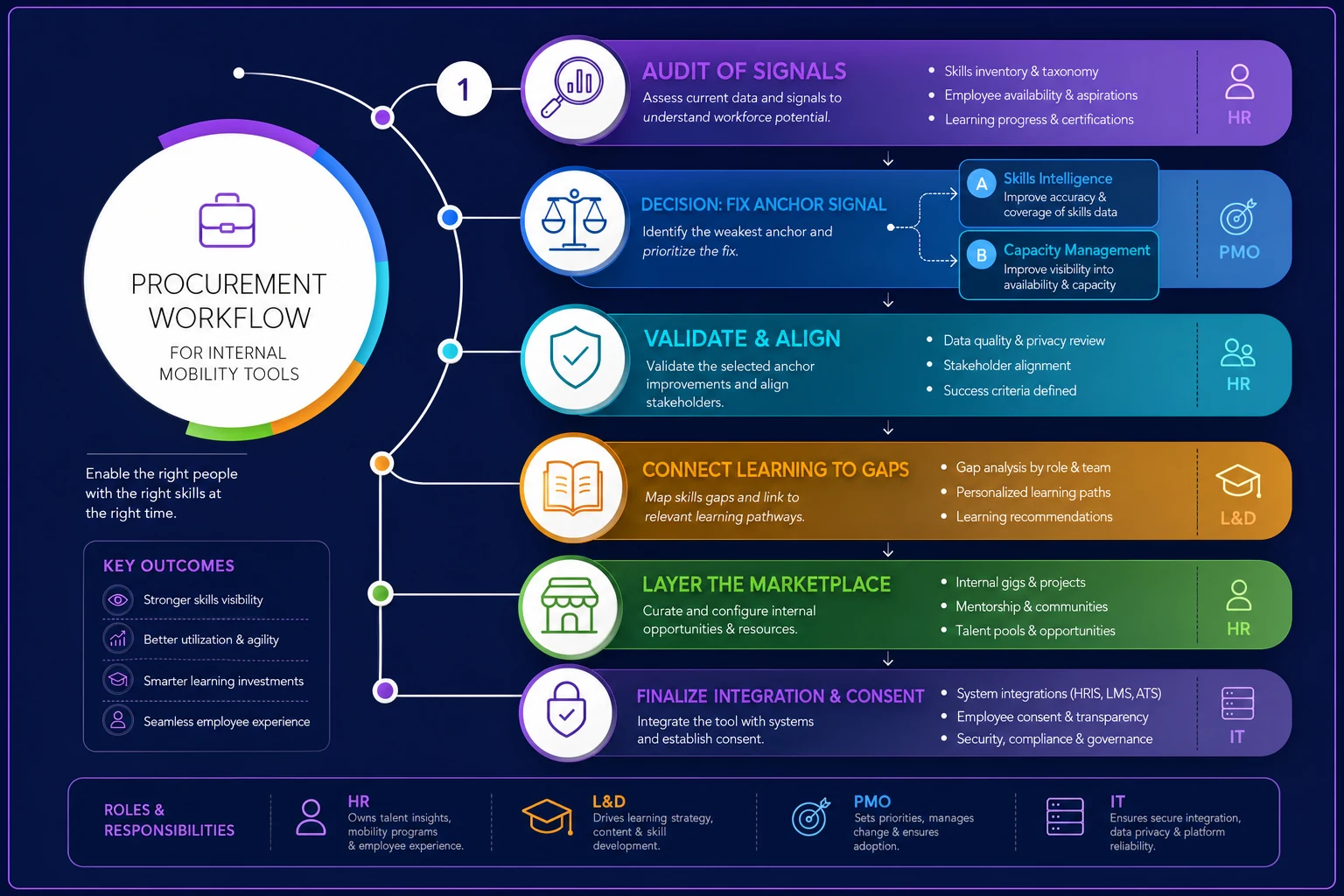
Formalize integration and consent before you scale — not after someone flags a compliance gap.
A quick buyer's checklist before any demo
Can the vendor show verified vs self-reported vs inferred skills as distinct states?
-
Can the vendor show verified vs self-reported vs inferred skills as distinct states?
-
Does availability data refresh in near-real-time, or is it a weekly snapshot?
-
How is learning potential actually calculated — is it defensible or a black box?
-
What's the consent and retention model for work-artifact evidence?
-
Which systems does it read from, and which does it write back to?
-
What happens to match quality if 30% of profiles are stale?
-
Who on your side owns this after purchase — and do they have the authority to drive adoption?
Who on your side owns this after purchase — and do they have the authority to drive adoption?
When buying more tools is the wrong move
Not every org needs all six categories. If you're under a few hundred employees, a solid skills intelligence platform with decent matching built in, plus your existing resourcing tool, often covers you. Stacking six specialized platforms on a small team creates integration overhead that eats the benefit.
Buying is also the wrong move when the real problem is governance, not tooling — managers hoarding talent, no agreed consent model, no owner for the taxonomy. New software won't fix an ownership vacuum; it'll just give the vacuum a dashboard.
The teams that get internal mobility right tend to buy fewer categories, in the right order, with a clear owner on each — then let the data earn trust before they put it in front of hiring managers. Get the sequence right and the shortlist starts producing candidates people actually act on. Get it wrong, and you've bought a very expensive job board nobody believes.
Ready to elevate your team's skills?
Join 500+ companies using Talioly to boost skill visibility, streamline training, and drive performance growth.