

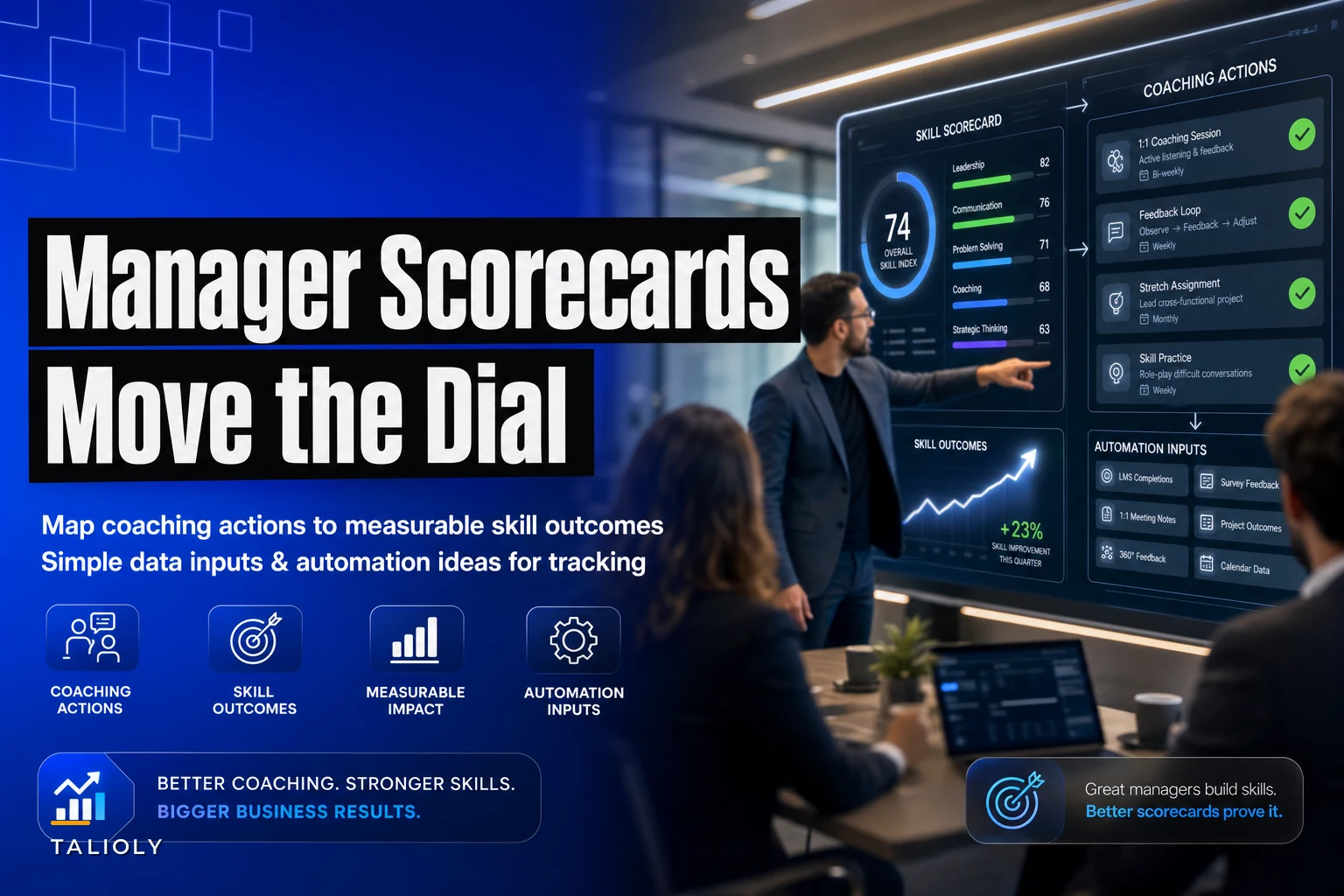

Most manager scorecards track activity metrics. Number of 1:1s held. Performance reviews completed. Training hours logged. But the disconnect I keep seeing — none of these activities connect to actual skill development outcomes. You end up with managers who hit their scorecard targets while their teams stay stuck at the same capability level for years.
The real problem isn't tracking coaching activities. It's the missing link between what managers do and what skills actually improve. A manager can have perfect 1:1 attendance and still produce zero skill growth if those conversations don't translate into deliberate development actions.
The broken scorecard pattern playing out everywhere
Picture a mid-sized financial services company with 85 employees. Their L&D team built what looked like a comprehensive manager scorecard. Monthly 1:1 requirements. Quarterly skill assessments. Annual development planning. Every manager hit their targets. The dashboards showed green across the board.
Six months later, they ran a skills audit. Technical competencies hadn't budged. Leadership capabilities remained flat. The only thing that increased was meeting fatigue.
This happens because traditional manager scorecards measure inputs without connecting them to outputs. It's like tracking how many times someone goes to the gym without checking if they're getting stronger. The activities become performative rather than productive.
Why coaching activities disconnect from skill outcomes
The disconnect happens at three specific points in the coaching workflow. Understanding these breaks helps explain why even well-intentioned manager scorecards fail to drive real development.
Stop losing track of critical skills.
Talioly helps you track, develop, and certify your workforce efficiently.
- Centralized skill profiles
- Automated training reminders
- Competency gap analysis
No credit card required
Point 1: Generic coaching targets Most scorecards set blanket requirements. "Hold monthly 1:1s with each direct report." But a junior analyst learning SQL needs completely different coaching than a senior engineer developing architecture skills. The scorecard doesn't differentiate, so managers default to generic check-ins.
Point 2: Missing skill baselines Without knowing where someone starts, you can't measure progress. A manager might spend three months coaching presentation skills, but if there's no baseline capability on record, how do you know if those sessions actually worked? The scorecard shows completed activities but can't prove impact.
Point 3: No feedback loops Traditional scorecards operate in one direction. Manager completes activity, checks box, moves on. There's no mechanism to verify whether the coaching actually landed. Did the stretch assignment build the intended skill? Did the feedback session change behavior? The scorecard stays silent on what matters most.
Building the connective tissue between actions and outcomes
The fix isn't complicated, but it requires rethinking how manager scorecards capture data. Instead of just tracking activities, you need to map specific coaching actions to measurable skill changes. Here's the operational framework that actually works.
Start with skill-specific coaching plans. Each direct report gets a focused development area tied to a business need. Not "improve communication" but "deliver technical findings to non-technical stakeholders." The specificity matters because it makes the outcome measurable.
Next, define observable checkpoints. If the skill is "technical documentation," the checkpoints might be:
-
Writes clear README files for code repositories
-
Creates architecture diagrams others can follow
-
Documents API endpoints with complete examples
-
Produces runbooks that new team members can execute
These aren't subjective assessments. They're binary. Either the documentation exists at the required standard or it doesn't.
Then connect coaching activities to these checkpoints. A 1:1 discussing documentation best practices links directly to the README checkpoint. A stretch assignment to document a legacy system maps to the architecture diagram skill. The manager scorecard now shows which activities drive which outcomes.
Required data inputs that actually exist
The biggest objection about outcome-based manager scorecards is data availability. "We don't have sophisticated skill tracking systems." You don't need them. The data already exists in your current tools.
From calendar systems:
-
1
1 meeting frequency and duration
-
Skip-level session attendance
-
Training workshop participation
-
Mentoring session consistency
From project management tools:
-
Stretch assignment completion rates
-
Task complexity progression over time
-
Cross-functional project participation
-
Ownership of deliverables by skill level
From communication platforms:
-
Feedback given in writing (searchable in Slack/Teams)
-
Public recognition tied to specific skills
-
Knowledge sharing contributions
-
Peer coaching interactions
From performance data:
-
Quarterly objective completion related to skill areas
-
Project outcomes requiring specific competencies
-
Customer feedback on skill-dependent deliverables
-
Error rates in skill-specific tasks
The trick is connecting these disparate data points to tell a coherent story about skill development. That's where simple automation makes the difference.
Simple automation that connects the dots
You don't need complex AI to make this work. A few basic automation rules can transform scattered data into meaningful manager scorecards. Here's what tends to work across different organizations.
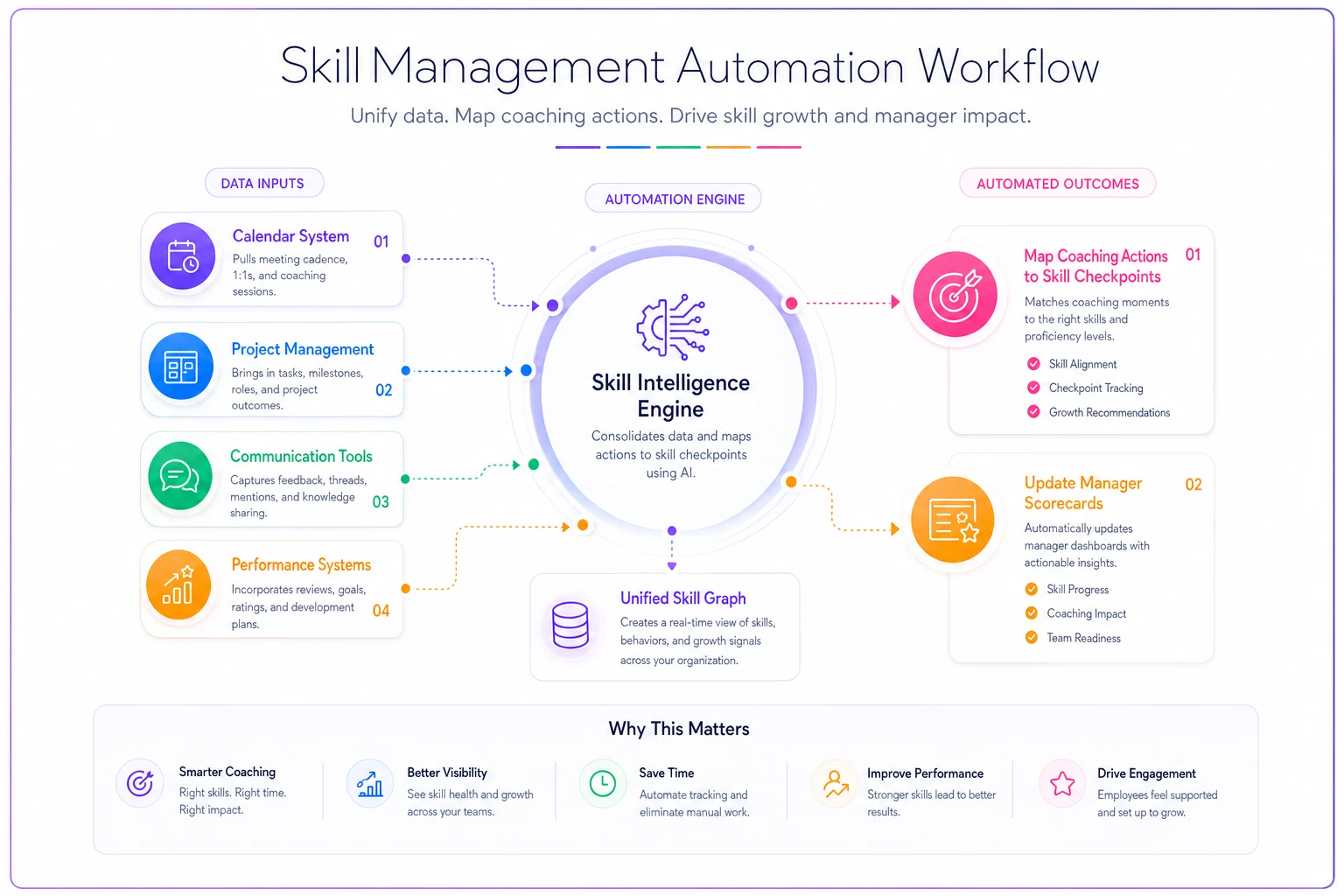
Weekly aggregation scripts Pull calendar data to identify which 1:1s discussed skill development (based on meeting notes keywords). Match these discussions to subsequent stretch assignments in project tools. Track whether assignments were completed and at what quality level.
Checkpoint verification workflows When someone claims a skill checkpoint is complete, trigger a simple review process. Send the evidence (code, document, presentation) to a peer for validation. Log the result back to the manager scorecard. This creates accountability without manual tracking.
Progress alerting rules Set thresholds for skill development pace. If someone hasn't hit a checkpoint in 60 days, alert their manager. If coaching activities aren't mapping to skill areas, flag it. These simple rules catch development gaps before annual reviews.
Automated skill gap analysis Compare required skills for upcoming projects against current team capabilities. Identify which skills need immediate coaching focus. Push these priorities directly into manager scorecards as targeted development areas.
Here's a simple workflow for how basic automations connect data sources to manager scorecards.
Start with a single keyword list for meeting notes to reduce false positives.
This graphic summarizes the flow from raw data to scorecard updates.
The automation doesn't need to be perfect. Even basic connections between coaching activities and skill outcomes transform how managers approach development.
A real scorecard in action
Here's an actual implementation at a consulting firm with around 120 employees. They had the typical problem — lots of coaching activity, minimal skill progression. Here's how they restructured their manager scorecards.
Previous scorecard metrics:
-
Number of 1
1s held
-
Development plans created
-
Training hours completed
-
Performance reviews submitted
New scorecard structure:
| Coaching Activity | Skill Target | Measurement Method | Automation Support |
|---|---|---|---|
| Weekly 1:1s with Sarah | Data visualization in Tableau | Dashboard complexity score (1-5) | Pull from Tableau server metadata |
| Stretch assignment for Marcus | Python scripting for automation | Scripts deployed to production | Git commit history + deployment logs |
| Feedback sessions with Jamie | Client presentation skills | Customer satisfaction scores post-presentation | CRM integration for feedback data |
| Peer mentoring arrangement | SQL query optimization | Query performance improvements | Database monitoring tools |
The firm built simple Google Apps Script automations to pull data from their existing tools. Calendar events tagged with #skilldev fed into a central sheet. Jira tickets marked as "stretch assignments" linked to specific skill areas. Slack messages in the #feedback channel got parsed for skill mentions.
Within four months, they saw measurable improvements. Not because managers suddenly became better coaches, but because the scorecard created clarity about which coaching activities actually developed skills.
Sarah's Tableau skills progressed from basic charts to interactive dashboards with calculated fields. Marcus went from copying Python snippets to writing original automation scripts. The manager scorecard showed exactly which coaching interventions drove these improvements.
Common pitfalls when linking coaching to outcomes
Even with the right framework, several patterns derail manager scorecard initiatives. Recognizing these saves a lot of wasted effort.
Over-automating the human elements Some organizations try to automate skill assessment itself. They build algorithms to evaluate competency from activity data. This consistently fails. Micro-assessments need human validation to remain credible. Automation should handle data aggregation, not judgment calls.
Creating too many skill targets Enthusiasm leads to tracking dozens of skills per person. The scorecard becomes overwhelming and managers can't coach effectively across that many areas simultaneously. Stick to 2-3 priority skills per quarter. The focus drives better outcomes than spreading thin.
Ignoring manager capability gaps Not every manager knows how to develop every skill. A technical manager might struggle coaching business development capabilities. The scorecard should account for this, either through peer coaching arrangements or external resources.
Forcing identical rhythms Some skills develop through consistent weekly practice. Others need intensive project-based learning. Scorecards that mandate uniform coaching cadences miss this entirely. Let the skill dictate the coaching rhythm, not the scorecard template.
The data inputs you're probably missing
Most organizations capture the obvious data but miss critical inputs that make manager scorecards actually useful. Here's what typically gets overlooked.
Skill application context It's not enough to know someone completed Python training. You need to track where they applied it. Did they use Python for data analysis? Process automation? API development? The context determines whether the skill truly developed or just got checked off.
Peer observation data Managers aren't the only ones who observe skill development. Teammates see capabilities in action daily. Simple peer feedback forms — even monthly one-question surveys — provide useful calibration for manager assessments.
Failure patterns Traditional scorecards only capture successful skill development. But failures teach more. When stretch assignments go wrong, what skill gap caused it? This data shapes future coaching priorities more than the success stories do.
Skill decay indicators Skills atrophy without practice. If someone learned advanced Excel but hasn't used it in six months, that capability has probably degraded. Scorecards need to track skill usage, not just acquisition.
Quick wins with basic automation
You can start improving manager scorecards with simple automation that takes hours to implement, not months. Three quick wins that demonstrate the concept:
Win 1: Calendar-to-skills mapper Export 1:1 calendar events to a spreadsheet. Use basic text matching to identify skill-related discussions (look for keywords like "learning," "development," specific skill names). Create a simple dashboard showing which skills get discussed most. This alone reveals coaching blind spots.
Win 2: Assignment outcome tracker Pull completed assignments from your project tool. Match them against a skill complexity rubric (basic/intermediate/advanced). Calculate the progression rate for each team member. Managers immediately see who's advancing and who's stuck.
Win 3: Feedback aggregator Scan written feedback channels for skill mentions. Compile them into a weekly digest for each manager. They see exactly what skills their team demonstrated that week. No manual logging required.
These aren't perfect solutions. But they prove the concept that manager scorecards can connect coaching activities to measurable skill outcomes without significant technical overhead.
When this approach doesn't work
Outcome-based manager scorecards aren't universally applicable. Some situations make this methodology more trouble than it's worth.
High-turnover environments If average tenure is under 12 months, skill development tracking becomes pointless. The investment in measurement infrastructure won't pay off before people leave. Focus on immediate performance instead.
Undefined skill requirements Some organizations genuinely don't know what skills they need. Startups pivoting frequently, companies in regulatory flux, or teams with unclear mandates can't define skill targets. Fix the strategic clarity first before building scorecards.
Manager resistance to measurement When managers view scorecards as punitive rather than supportive, no amount of automation helps. The cultural work has to happen before the technical implementation.
Purely creative roles Some capabilities resist measurement. Creative direction, innovative thinking, or artistic judgment don't fit neatly into checkpoint frameworks. These roles need different development approaches entirely.
Making scorecards operational
The gap between coaching activities and skill outcomes isn't a technology problem. It's an operational design challenge. Manager scorecards fail when they track the wrong things, or track the right things without connecting them to anything meaningful.
Start small. Pick one team, three priority skills, and basic data inputs. Build simple automation to connect coaching activities to skill progression. Prove the model works before scaling.
Organizations that get this right tend to share a common pattern — they treat manager scorecards as operational tools, not compliance checklists. They iterate based on what actually drives skill development. They use automation to reduce manual tracking burden while keeping humans in the assessment loop.
The shift from activity-based to outcome-based scorecards takes real effort. But tracking meaningless metrics while skills stagnate wastes everyone's time. Build the connections between coaching and capabilities. Turn manager scorecards into tools that actually develop talent rather than just document that conversations happened.
The data exists. The automation is simple. The only question is whether you'll keep tracking activities that don't matter or start measuring the skill outcomes that do.
Ready to elevate your team's skills?
Join 500+ companies using Talioly to boost skill visibility, streamline training, and drive performance growth.