


After reviewing skills tracking across roughly 200 companies this past year, the pattern was hard to miss. The same companies struggling with manager accountability for skills development were also the ones with the fuzziest expectations — not because they lacked training budgets or L&D teams, but because nobody actually knew what managers were supposed to do beyond "develop their people." More coaching training isn't the fix. Operational clarity is.
Why manager accountability breaks at exactly 50 employees
Small companies don't have this problem. When you've got 12 employees, the founder knows who's learning what. They see Sarah struggling with Excel pivot tables. They notice when Mike starts handling client escalations better. Skills development happens through osmosis and daily interaction.
Somewhere between 40 and 60 employees, that changes. Suddenly you've got three layers of management, the founder doesn't know half the team's names, and middle managers are juggling their old individual contributor work plus seven direct reports. That informal skills development system? Gone.
What replaces it is usually nothing. Or worse — a vague performance review item that says "develops team capabilities" worth 10% of the manager's rating. No wonder skills development stalls.
Companies that successfully scale past this point do something different. They build explicit accountability systems that make skill development as clear as hitting revenue targets. Not through complex competency matrices or expensive LMS platforms. Through basic operational discipline.
The RACI that actually drives skill development
Most RACI charts for talent development look impressive and accomplish nothing. They'll show HR as "Responsible" for everything, managers as "Consulted," and executives as "Informed." Then everyone wonders why skill gaps persist.
Stop losing track of critical skills.
Talioly helps you track, develop, and certify your workforce efficiently.
- Centralized skill profiles
- Automated training reminders
- Competency gap analysis
No credit card required
Weekly Skill Development Activities
-
Manager
Responsible (owns the 1:1 agenda item)
-
Employee
Accountable (brings evidence of practice)
-
HR
Consulted (provides resources when requested)
-
Skip-level
Informed (sees quarterly progress)
Skill Gap Identification
-
Manager
Accountable (must document gaps quarterly)
-
Employee
Responsible (self-assesses first)
-
HR
Consulted (validates against role requirements)
-
Department head
Informed (aggregated view)
Development Plan Creation
-
Manager + Employee
Jointly Responsible
-
HR
Consulted (ensures resources exist)
-
Skip-level
Approves (signs off on time allocation)
-
Finance
Informed (budget impact only)
Progress Tracking
-
Employee
Responsible (logs activities weekly)
-
Manager
Accountable (reviews monthly)
-
HR
Informed (dashboard visibility)
-
Skip-level
Reviews (quarterly check-ins)
The critical difference is that managers are Accountable — not just Responsible — for gap identification and progress review. If skill gaps persist, it's their problem to solve, not HR's.
One mid-sized tech company implemented this RACI after losing three key engineers who felt stuck. Within six months, internal mobility applications increased by 4x. Not because they added programs, but because managers finally understood they owned the outcome.
Manager scorecards that measure what matters
Traditional manager scorecards measure everything except actual skill development. They track employee satisfaction scores, retention rates, performance review completion — all lagging indicators that tell you nothing about whether Sarah is getting better at Python or Mike is ready for a promotion.
A scorecard built around leading indicators looks more like this:
Weekly Development Metrics
-
% of 1
1s with documented skill discussion: Target 80%
-
Average time spent on skill topics per 1
1: Target 15 minutes
-
Number of specific development actions assigned
Target 2 per employee per month
Monthly Skill Progress Metrics
-
% of team with active development plans
Target 100%
-
% of development actions completed on time
Target 70%
-
Number of skill demonstrations observed
Target 1 per employee
-
Micro-assessment scores improvement rate: Target +10% quarterly
Quarterly Outcome Metrics
-
Number of employees who gained a new certifiable skill
Target 40%
-
% of identified gaps closed
Target 25%
-
Internal mobility readiness score
Target 60% promotable
Annual Strategic Metrics
-
Skill coverage ratio for critical capabilities
Target 2.5x
-
Time to competency for new skills
Target under 90 days
-
Cost per skill developed
Target under $800
A logistics company with 340 employees rolled this out after discovering only 12% of their warehouse leads could train others on their new inventory system. They tied 30% of manager bonuses to these skill KPIs. Within a year, 78% of leads were certified trainers and they'd cut external training costs by roughly $180k.
Perfection isn't the point — measurement is. Once managers see skill development metrics sitting next to their operational KPIs, behavior shifts pretty quickly.
Coaching rituals that create consistency without bureaucracy
The biggest mistake companies make with coaching is treating it like a special event. They send managers to expensive two-day workshops, then wonder why nothing changes back at work.
Effective skill development happens through repetitive micro-interactions, not quarterly career conversations. Here's a ritual framework that embeds coaching into regular workflow:
The Monday Morning Skill Check (5 minutes per direct report)
-
What skill did you practice last week?
-
What blocked your practice?
-
What will you practice this week?
Document answers in a shared spreadsheet. No fancy tools needed. One retail chain with 60 stores implemented just this ritual and saw skill assessment scores improve by 23% in four months.
The Wednesday Observation Window (30 minutes total)
Managers block Wednesday 2–3pm to observe actual work. Not meetings. Not presentations. Real work — watching someone handle a customer call, reviewing code they're writing, sitting in on their client presentation prep.
Document one strength and one growth area. Share it immediately. A software company found this single ritual generated 5x more actionable feedback than annual reviews.
The Friday Skills Retrospective (15 minutes per team)
-
Who tried something new?
-
What did we learn?
-
Who can teach others?
Keep it light. No presentations. One marketing agency tracks these in a simple "Skills Tried" column on their project board. Team members added 47 new capabilities to their profiles in six months, compared to 8 the prior year.
The Monthly Deep Dive (45 minutes per direct report)
-
Review skill tracking data (10 min)
-
Practice or demonstrate one skill (20 min)
-
Plan next month's focus (15 min)
This replaces the vague "development discussion" with actual skill work. A healthcare company tied this to their operating model for skills development and reduced time-to-competency for new nurses by 40%.
How these rituals layer across a typical week looks roughly like this:
Monday Wednesday Friday Monthly ──────────── ──────────────── ──────────── ────────────────── Skill Check Observation Skills Retro Deep Dive (45 min) (5 min/person) Window (15 min/team) per direct report (30 min total) ──────────── ──────────────── ──────────── ────────────────── "What did Watch real work. Who tried Review data → you practice?" Document 1 something new? Practice → "What strength + What did we Plan next month blocked you?" 1 growth area. learn? "What's next?"
A simple visual can make it obvious how these rituals fit together each week.
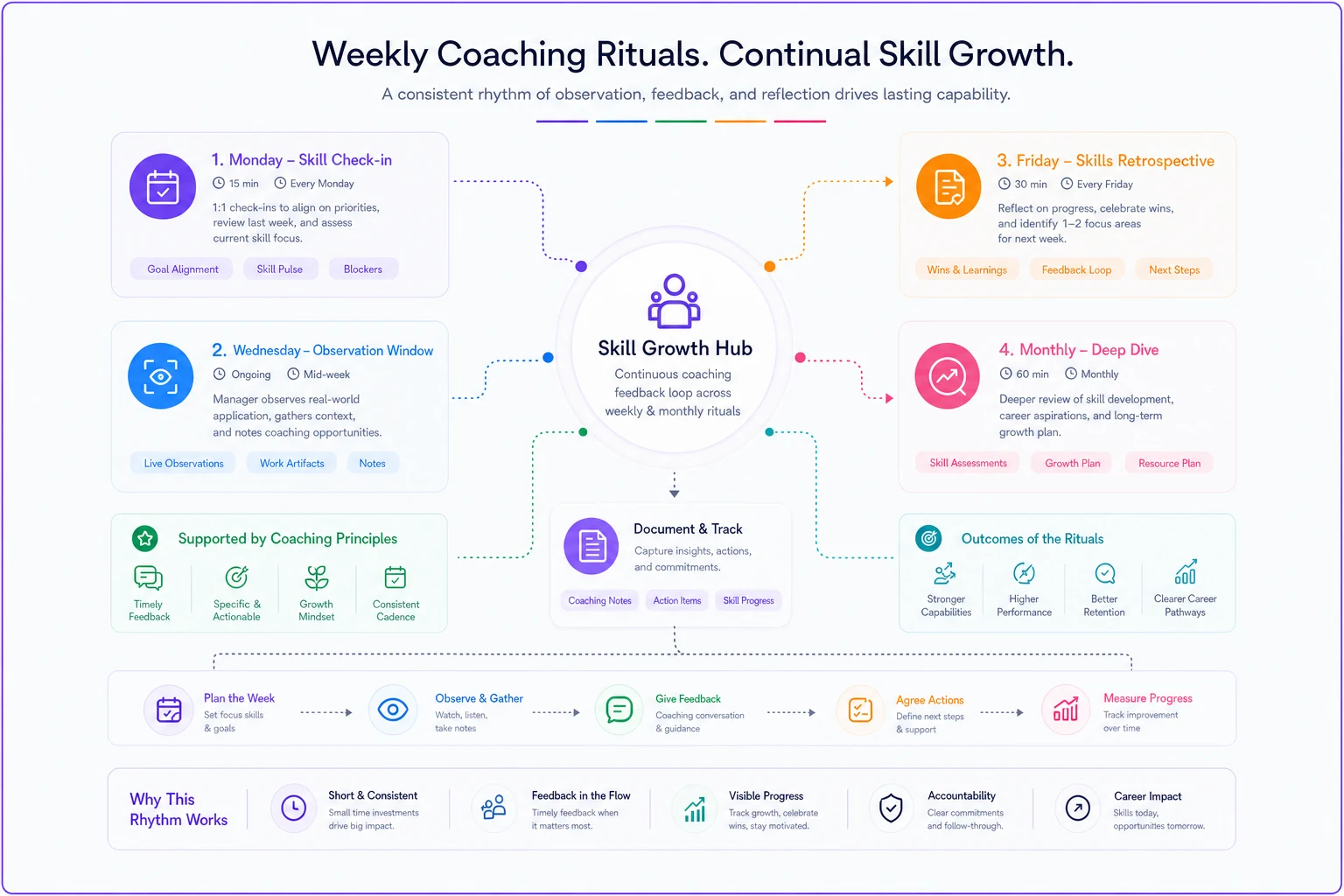
Document the one strength and one growth area immediately after observations to keep feedback actionable.
Frequent, brief, documented touchpoints beat sporadic, lengthy, unstructured conversations every time.
Incentive structures that actually change behavior
Money alone doesn't drive manager behavior around skills development. If it did, adding a "talent development" component to bonuses would solve everything. Most managers treat it as a tax — do the minimum, check the box, move on.
Real behavior change needs three layers.
Layer 1: Personal Pain Reduction
Make skill development reduce a manager's daily friction. If developing Sarah's SQL skills means the manager stops getting pulled into data requests, that's immediate value. One operations team created a "Skills = Hours Saved" calculator showing managers exactly how much time they'd reclaim by upskilling their team. Participation in development activities jumped from 30% to 85%.
Layer 2: Visible Progress Metrics
Public scoreboards change behavior faster than private reviews. Post weekly skill development metrics where everyone can see them — not to shame anyone, but to create positive peer pressure. A distribution company posts their "Manager Development Dashboard" on break room screens. Managers who were ignoring development suddenly started scheduling regular skill sessions when their 0% participation appeared next to peers at 80%.
Layer 3: Career Progression Gates
Make developing others a requirement for advancement. Not a nice-to-have — a gate. One tech company requires managers to develop at least two successors with documented skill progression before being considered for director roles. Internal promotion rates increased by 60% while external senior hires dropped by half.
Here's a practical incentive framework to implement:
| Timeframe | Incentive Type | Details |
|---|---|---|
| Weekly/Monthly | Immediate Rewards | First to complete all skill check-ins gets Friday lunch; highest improvement gets public recognition; best development idea gets $100 implementation budget |
| Quarterly | Bonuses | 10% tied to skill KPI achievement; 10% tied to team skill assessment improvements; 10% tied to internal mobility/promotion readiness |
| Annual | Consequences | Below 60% on skill KPIs = no merit increase; below 40% = performance improvement plan; above 80% = eligibility for "Manager Excellence" program |
| Promotion | Requirements | Must have developed at least 1 person into a promotion; must maintain >70% skill KPIs for 12 months; must have taught at least 3 skills to others |
The companies getting this right don't rely on any single incentive. They stack multiple layers so managers feel both pushed and pulled toward skill development.
The micro-playbook for measurable behaviors
Vague expectations produce vague results. Telling managers to "develop their people" without defining specific behaviors is like telling salespeople to "build relationships" without tracking calls, meetings, or pipeline. Here's a behavior playbook that makes skill development concrete:
Daily Behaviors (Track via calendar audit)
-
Spend 10 minutes reviewing team skill tracking dashboard
-
Ask one skill-related question in team standup
-
Provide one piece of skill feedback in Slack or Teams
-
Forward one learning resource to a relevant team member
Weekly Behaviors (Track via documentation)
-
Conduct skill check-in with each direct report (5 min each)
-
Observe and document one skill demonstration
-
Update team skill matrix with progress notes
-
Share one skill win in manager meeting
Monthly Behaviors (Track via deliverables)
-
Complete formal skill assessment for one team member
-
Create or update one development plan
-
Facilitate one peer learning session
-
Document skill gaps affecting team performance
Quarterly Behaviors (Track via outcomes)
-
Present team skill progress to leadership
-
Nominate team members for stretch assignments
-
Identify successors for key roles with skill requirements
-
Update role requirements based on skill evolution
A financial services firm with 450 employees implemented this playbook after finding that 70% of managers couldn't name a single skill their reports had developed in the past year. They built simple tracking into their existing HR system — checkboxes for daily behaviors, mandatory fields for weekly documentation, automated monthly reminders.
Six months later, the results were hard to argue with: 89% of employees had active development plans (up from 22%), the average skills gained per employee climbed from 0.7 to 3.2, internal fill rate for openings went from 31% to 64%, and manager satisfaction with HR support jumped from 41% to 78%.
The breakthrough wasn't sophisticated technology or complex competency models. It was making abstract expectations concrete and tracked.
Technology that reinforces without replacing human accountability
When accountability fails, the reflex is to buy more software — another LMS, a talent marketplace, an AI coaching assistant. But technology can't create accountability that doesn't exist. It can only amplify what's already there.
Smart companies use technology as reinforcement, not replacement.
Automated Nudges, Not Automated Decisions
Set up simple reminders for the behaviors that matter. A Monday morning email listing who needs skill check-ins. A Thursday alert about missing observation notes. A month-end report showing skill KPI trends. One company reduced missed check-ins by 73% with just daily Slack reminders.
Visible Dashboards, Not Hidden Reports
Make skill data as visible as sales pipelines. Display team skill coverage on TV screens. Share weekly skill wins in all-hands emails. Auto-generate monthly skill scorecards for leadership reviews. When managers know everyone sees their metrics, behavior adjusts.
Workflow Integration, Not Separate Systems
Embed skill tracking into existing tools. Add skill fields to your 1:1 templates. Include skill discussions in project retrospectives. Track skill demonstrations in your task manager. The less managers have to switch contexts, the more likely they'll stick with the habits.
Pattern Recognition, Not Automated Decisions
Use automation to surface trends humans might miss. Which skills show up most in exit interviews? Which managers consistently develop promotable talent? Which skill gaps correlate with project delays? Surfacing those patterns is useful — but humans still need to own the action.
A manufacturing company with 800 employees built this reinforcement layer into their operations platform. They didn't replace human judgment — they made it easier to exercise consistently. Managers still own skill development, but now they get automated weekly summaries of skill activities, dashboard views during 1:1s, and monthly pattern analyses showing which development activities actually move performance.
Manager engagement with skill development increased by 4x, while time spent on administrative tracking dropped by 60%. More accountability, less bureaucracy — that's the target.
Making it stick when everything else competes for attention
Most manager accountability systems fail not because of poor design, but poor adoption. Skills development always loses to urgent operational fires — unless you make it operationally impossible to ignore.
Start with one team. Pick a manager who's already decent at development and make them visibly successful. Document everything. Share wins loudly. Other managers will notice when that team starts promoting from within while they're scrambling to hire externally.
Connect skill development to problems managers already care about. Can't find qualified candidates? Track the internal skill pipeline. Too many escalations? Measure capability gaps. Losing deals? Map skill requirements to win rates. When development solves immediate pain, adoption follows.
Build accountability gradually. Don't deploy all scorecards, rituals, and incentives at once. Start with Monday skill check-ins. Once those are habit, add Wednesday observations. Layer in monthly assessments after behaviors are routine. Companies that phase rollout over six months see roughly 3x better adoption than those attempting full implementation on day one.
Also worth noting — measure what actually drives behavior in your specific culture. Some companies find public dashboards motivating; others find them demotivating. Some managers respond to financial incentives; others to development opportunities. The framework stays consistent, but calibration varies.
The difference between companies that talk about skills and companies that build them
Every company says managers should develop their people. The ones actually doing it have turned that expectation into operational reality — clear ownership through RACI, measured behaviors through scorecards, consistent rituals that embed coaching into workflow, and incentives aligned with outcomes.
The companies struggling with manager accountability for skills development don't need more training programs or better coaches. They need operational discipline. The same discipline they apply to revenue targets and operational efficiency.
Skill development isn't an HR initiative. It's an operational capability that either exists in your management system or doesn't.
Pick one element — maybe the Monday skill check-in or the quarterly scorecard. Implement with one team. Measure for 90 days. Adjust. Then expand. Your managers aren't blocking skill growth because they're bad managers. They're blocking it because the system makes accountability optional. Make it operational, make it measured, and watch how quickly "we don't have the skills" stops being an excuse for missing targets.
Ready to elevate your team's skills?
Join 500+ companies using Talioly to boost skill visibility, streamline training, and drive performance growth.