

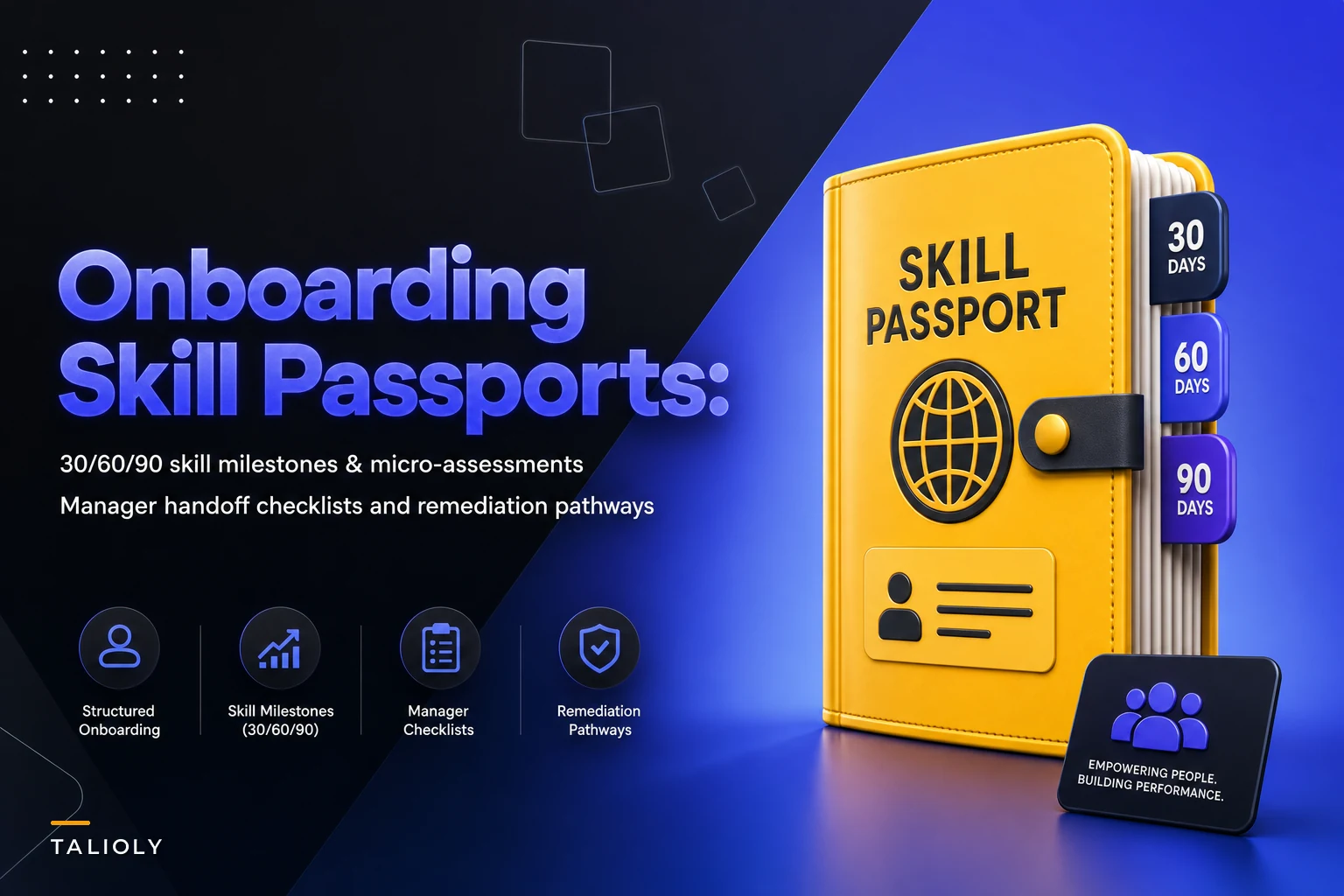

Most companies treat onboarding like orientation week at college—here's your login, here's the bathroom, good luck figuring out the rest. Then they wonder why new hires take four months to contribute anything meaningful.
The onboarding skill passport fixes this. It's a concrete document that maps exactly what skills someone needs at 30, 60, and 90 days, with micro-assessments that verify competence before they move forward. Not vague goals or feel-good check-ins—actual skill verification tied to real work outputs.
Why traditional onboarding produces six-month ramp times
Traditional onboarding relies on managers remembering what to teach, when to teach it, and somehow tracking whether the new hire actually learned it. Most managers are juggling a dozen other priorities, so onboarding becomes background noise. The new hire sits through generic HR videos, shadows a few meetings, then gets thrown into projects they're not ready for.
The problems compound fast. Without clear milestones, managers can't tell if someone is progressing normally or falling behind until it's obvious. New hires pretend they understand things they don't because no one's checking. Critical handoffs between training phases get missed. Three months in, everyone realizes the new hire still can't handle basic tasks, but nobody knows exactly what gaps exist or how to fix them.
This plays out constantly. A logistics company hired eight warehouse supervisors in one quarter. Six months later, only two could run a shift independently. The other six still needed constant oversight because nobody documented which specific operational skills they'd actually mastered versus which they'd only heard about in some training session.
Building the 30-day foundation milestone
The first 30 days determine whether someone succeeds or struggles for months. Your onboarding skill passport starts with foundational skills that everything else builds on. These aren't "nice to have" skills—they're the absolute minimum for someone to function without constant hand-holding.
Stop losing track of critical skills.
Talioly helps you track, develop, and certify your workforce efficiently.
- Centralized skill profiles
- Automated training reminders
- Competency gap analysis
No credit card required
-
Navigate three core systems to find customer data (verified by pulling specific reports)
-
Handle tier-1 support tickets independently (assessed through ticket review)
-
Run a basic QBR prep session (demonstrated with actual client data)
-
Identify upsell signals in customer usage patterns (tested with real account scenarios)
Each skill gets a micro-assessment attached. Not a multiple-choice quiz—actual work output that proves competency. The assessment for "navigate core systems" might require pulling customer health scores for ten specific accounts within five minutes. Real task, measurable outcome, clear pass/fail.
The passport documents exactly how to verify each skill. No interpretation needed. Either they can pull those reports in five minutes or they can't. This removes the guesswork that makes onboarding so inconsistent across managers and cohorts.
Structuring 60-day expansion skills
By day 60, new hires should handle routine work independently while building toward more complex responsibilities. The passport expands to include skills that require judgment, not just execution.
-
Write release notes that engineering approves without major revisions
-
Create competitor battlecards using actual win/loss data
-
Run customer interviews that produce actionable insights
-
Build messaging frameworks that sales actually uses
The micro-assessments get more sophisticated here. Instead of "did they complete the task," you're measuring quality and judgment. The release notes assessment might require writing notes for three different feature types, with engineering scoring them on technical accuracy and customer clarity.
This is where remediation pathways become critical. When someone fails an assessment, the passport provides specific remediation steps. Failed the battlecard assessment? Complete modules X and Y, shadow two competitive deals, then reassess. The pathway isn't punitive—it's a clear route to competency.
The 90-day autonomy checkpoint
At 90 days, the passport shifts from "can they do the work" to "can they improve the work." This milestone separates people who execute tasks from people who actually drive outcomes.
-
Identify pipeline bottlenecks without being asked
-
Propose process improvements with ROI calculations
-
Build dashboards that managers actually check daily
-
Spot data quality issues before they impact forecasts
The assessments here often involve presenting to stakeholders or delivering work that gets implemented. It's not enough to identify a bottleneck—they need to present it to sales leadership and get buy-in on a solution.
Manager handoff mechanics that prevent dropped balls
The passport includes explicit handoff checklists between training phases. When someone completes their 30-day milestone, their manager can't just assume the next phase kicks off automatically. The handoff checklist ensures nothing falls through the cracks.
-
Review of all completed assessments with scores
-
Documentation of any failed assessments and remediation status
-
Confirmation that system access for the next phase is provisioned
-
Introduction to new stakeholders they'll work with
-
Clear ownership transfer for specific responsibilities
One tech company saw time-to-productivity drop by about six weeks after implementing structured handoffs. Previously, new engineers would finish initial training then wait weeks for production access because nobody remembered to request it. The handoff checklist caught these gaps before they caused delays.
Micro-assessment design that predicts real performance
Generic quizzes tell you nothing about job performance. Your micro-assessments need to mirror actual work as closely as possible—real data, real systems, real scenarios.
Skill: Build monthly variance reports Assessment: Using Q3 actuals, create variance analysis for marketing spend Success criteria: Identifies top 3 variances, explains drivers, suggests corrections Time limit: 90 minutes Evaluator: Finance manager or senior analyst Pass threshold: 7/10 on rubric covering accuracy, insights, and presentation
Have evaluators calibrate on one sample assessment together so scoring stays consistent across hires.
This level of specificity prevents the subjectivity that makes most onboarding evaluations useless. Either they identified the marketing overspend in paid search and explained why it happened, or they didn't.
Creating remediation pathways that actually work
When someone fails an assessment, most companies either ignore it or panic. The passport provides a middle path—structured remediation that addresses specific gaps without derailing the entire onboarding timeline.
Remediation pathways work best when they're:
-
Specific to the failed skill (not generic retraining)
-
Time-boxed (complete within 5-7 days)
-
Supported by clear resources
-
Followed by immediate reassessment
A customer service rep who fails the "handle escalations" assessment might follow this path:
-
Review three recorded escalation calls with annotations
-
Shadow a senior rep for two live escalations
-
Role-play three escalation scenarios with their manager
-
Handle the next escalation with a senior rep listening
-
Reassess with a new escalation scenario
Most people pass reassessment after targeted remediation because the pathway addresses exactly what they missed—not some broad retraining program that covers things they already know.
Operational reality: passport implementation at scale
Building one passport is straightforward. Building passports for every role while keeping them updated is where it gets harder. Companies that succeed treat passports as living documents with clear ownership.
Each passport needs an owner—usually the hiring manager or team lead for that role. They're responsible for updating assessments when job requirements change, reviewing assessment scores for patterns, and adjusting timelines based on actual performance data.
| Component | Traditional Onboarding | Skill Passport Approach | Operational Impact |
|---|---|---|---|
| Milestones | Vague goals like "understand product" | Specific skills like "configure enterprise deployment" | Clear progress tracking |
| Assessment | Manager's gut feel | Scored work samples | Objective competency verification |
| Timeline | "Take your time" | 30/60/90 day requirements | Predictable ramp schedule |
| Remediation | "Work with your manager" | Documented pathway with resources | Faster gap closure |
| Handoffs | Hope someone remembers | Explicit checklist with sign-offs | No dropped responsibilities |
The remediation and handoff rows are where most companies leak the most time. Both problems are entirely preventable with a documented process—they just rarely get one.
When passports solve problems vs create bureaucracy
Skill passports work well for roles with clear competency requirements and measurable outputs—customer success, sales, operations, technical roles where you can actually define what "good" looks like.
They create friction in highly creative or strategic roles where success is inherently subjective. Don't try to build a passport for your VP of Brand Strategy with assessments for "develops compelling vision." That's not what this framework is for.
The passport also assumes you have people who can evaluate assessments consistently. If your managers can't agree on what good performance looks like, the passport won't fix that. It just documents your confusion more neatly.
Tracking passport metrics that matter
Most companies track onboarding completion rates, which tells you almost nothing useful. Track metrics that connect to actual business outcomes:
-
Days to first independent deliverable
-
Assessment pass rates by milestone
-
Remediation success rates
-
Manager time spent on onboarding per hire
-
New hire retention at 6 months
One retail company tracked these metrics across around 200 store manager hires. Stores where managers completed all passport milestones had roughly 40% higher sales in months 4-6 compared to stores where managers skipped assessments. The passport didn't just track progress—it predicted performance.
The handoff checklist that prevents new hire limbo
The manager handoff checklist prevents one of the worst onboarding failures: the new hire who finishes training but never gets real work. It happens constantly. Someone completes orientation, their manager is traveling, and they spend two weeks reading documentation because nobody officially transitioned them to actual responsibilities.
Pre-handoff verification:
-
All 30-day assessments completed and passed
-
System access for next phase confirmed
-
Workspace and tools provisioned
-
Calendar holds for 60-day training sessions
Handoff meeting agenda:
-
Review assessment results and any watch areas
-
Introduce 60-day milestone requirements
-
Assign first real project with clear deliverables
-
Schedule weekly check-ins for the first month
-
Identify the go-to person for questions
Post-handoff confirmation:
-
New hire acknowledges understanding of expectations
-
Manager documents any concerns or adjustments
-
Both parties sign off on the transition
-
Copy sent to HR for tracking
This seems like overkill until you've watched a high-potential hire quit after spending their second month doing nothing meaningful because their manager forgot to assign them actual work.
Software automation that makes passports scalable
Managing passports manually works fine for a handful of hires. At fifty hires, you need operational software that handles the repetitive parts while preserving human judgment where it matters.
AI-powered platforms can handle assessment scheduling, automatically route completed assessments to evaluators, track remediation timelines, and flag when someone falls behind on milestone targets. The software doesn't replace managers—it keeps them focused on evaluation and coaching instead of chasing spreadsheets.
Here's a simple workflow for how automation supports the passport process:
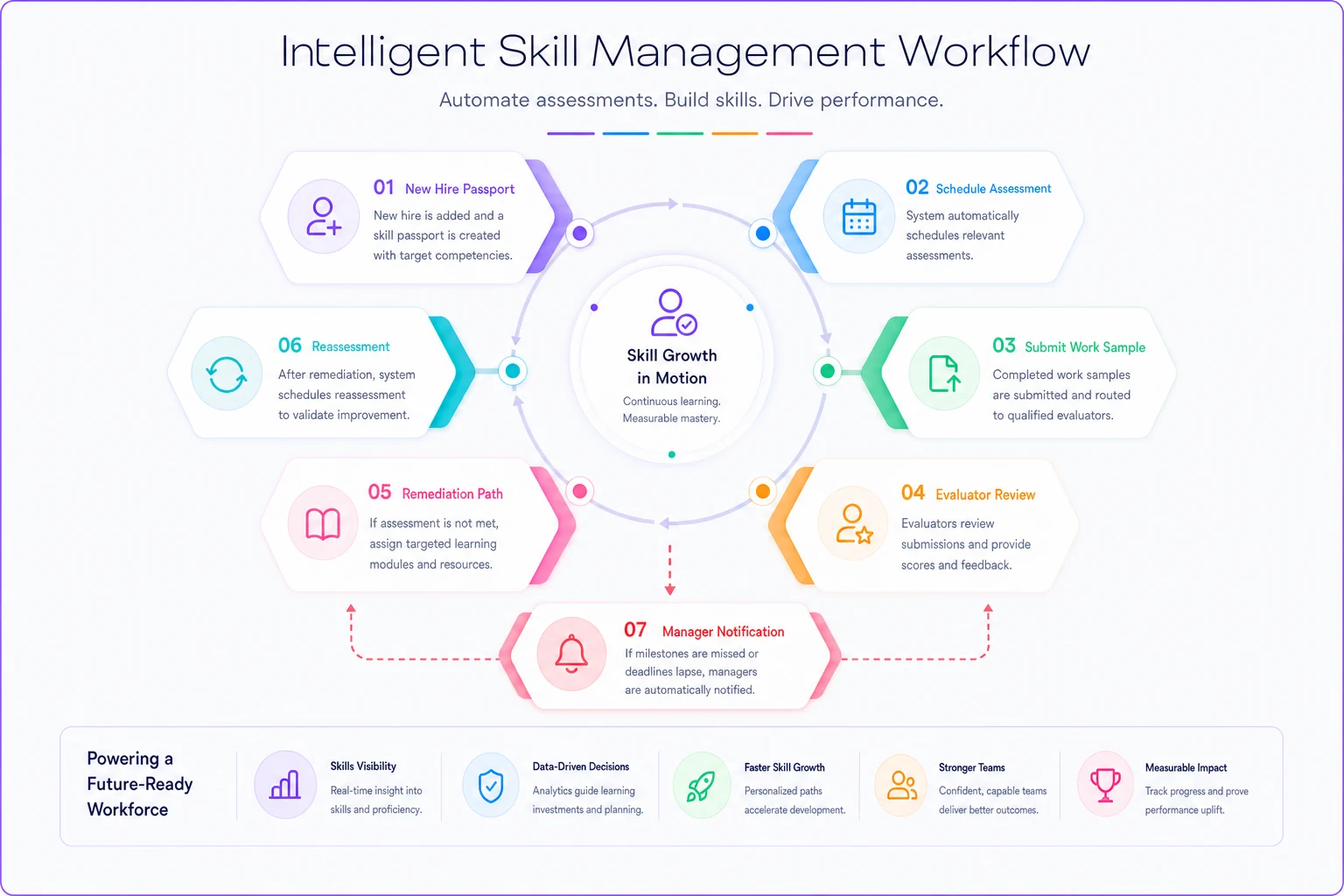
The automation particularly helps with remediation. When someone fails an assessment, the system can automatically assign the appropriate resources, schedule the reassessment, and notify their manager. This removes the awkwardness of managers following up repeatedly on missed assessments while still making sure gaps actually get addressed.
More capable platforms can also surface patterns across cohorts. If every new sales rep struggles with the same CRM assessment, the system flags that for the training team—turning individual onboarding data into something actually useful at the organizational level, where you can see which skill gaps keep appearing and why.
The onboarding skill passport turns fuzzy "getting up to speed" into concrete, measurable progression toward productivity. It's not about creating more paperwork—it's about ensuring every new hire develops the exact skills they need, when they need them, with clear verification that they can actually do the work.
Companies using structured passports consistently see time-to-productivity drop by four to eight weeks. Not because the passport makes people learn faster, but because it eliminates the confusion, gaps, and wasted time that plague traditional onboarding.
The real value is operationalizing what great managers do intuitively—breaking down role requirements into learnable chunks, verifying competency before moving forward, and providing clear paths to improvement when someone struggles. The passport makes this approach consistent and trackable across your entire organization instead of dependent on which manager a new hire happens to report to.
When new hires know exactly what's expected at each milestone, when managers have clear frameworks for evaluation, and when HR can track actual skill development instead of just training attendance, onboarding stops being a prayer and starts being a predictable operation. That predictability is worth every hour invested in building the passports.
Ready to elevate your team's skills?
Join 500+ companies using Talioly to boost skill visibility, streamline training, and drive performance growth.