

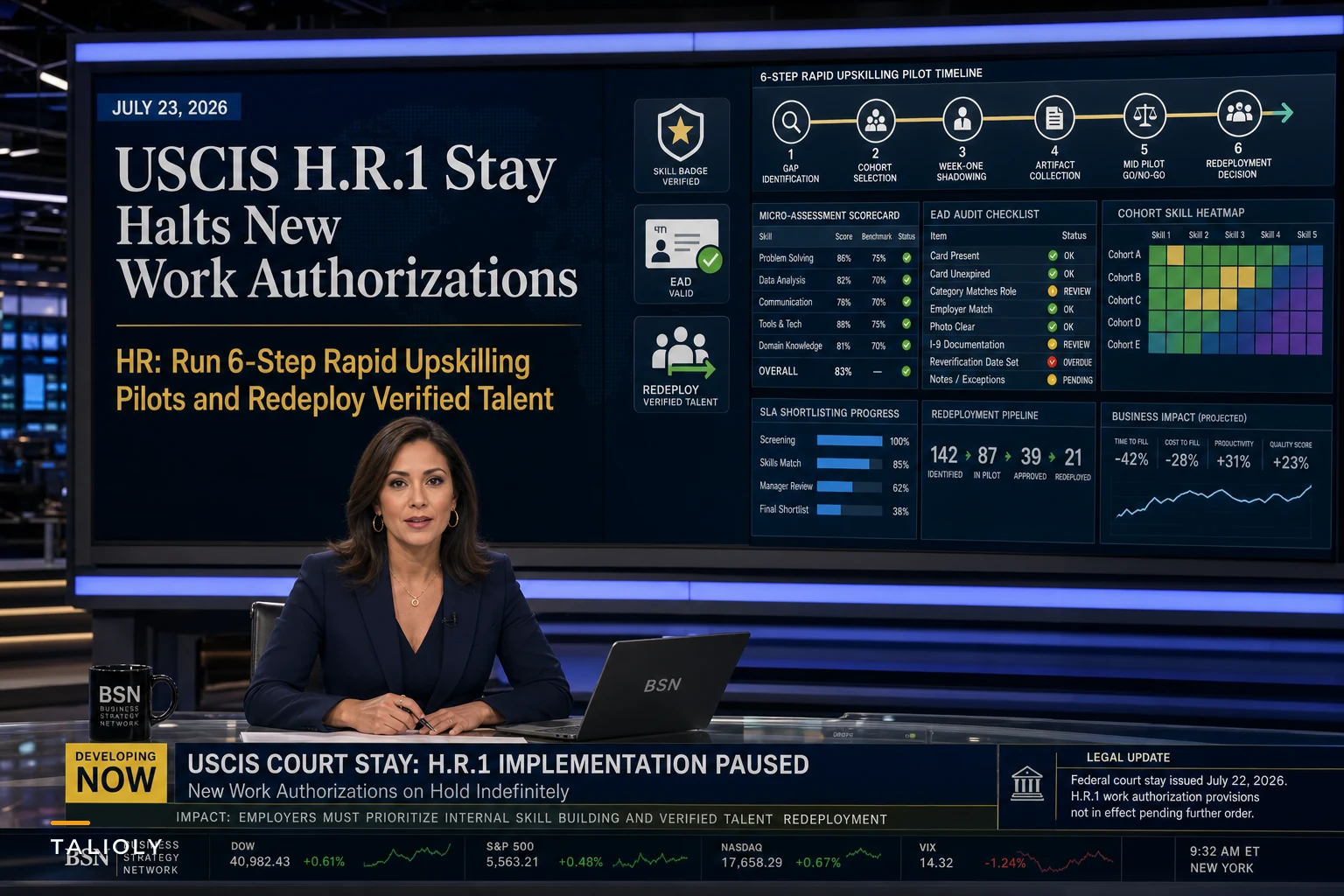

The administrative stay on USCIS H.R.1 implementation dropped like a bomb on Tuesday morning conference calls. If you're managing talent for any organization with TPS or asylum-based workers, you probably spent the last 48 hours in emergency meetings with legal, trying to figure out what this court order actually means for your workforce.
The basics: a federal court blocked several pieces of the H.R.1 enforcement mechanisms while litigation continues. USCIS can still collect the Annual Asylum Fee, but they can't reject applications or terminate work authorizations based solely on non-payment. TPS-based EAD expiration adjustments are paused too.
For HR teams, that translates to this: the contractor you were planning to convert next month might not have stable work authorization. The external hire pipeline you were counting on for Q4 tech roles just became a compliance minefield. And those succession moves built around H-1B assumptions? Time to tear up the playbook.
What this regulatory chaos exposes about workforce planning
Every HR leader dealing with this right now is asking the same question: how exposed are we if work authorizations suddenly shift again?
The answer usually isn't pretty. Most organizations have maybe 30% visibility into which employees rely on what type of work authorization. The data sits scattered across HRIS systems, I-9 folders, and spreadsheets maintained by different teams. Nobody has a real-time view of expiration dates, renewal statuses, or backup coverage plans.
What makes this worse is that even companies with decent immigration tracking have zero operational redundancy for these roles. When your senior data engineer's work authorization gets caught in regulatory limbo, who steps in? The typical answer involves frantic external recruiting, expensive contractors, or just letting critical work pile up.
The USCIS H.R.1 stay didn't create this problem. It exposed how fragile talent pipelines already were. Organizations have been running like just-in-time manufacturing lines, assuming the external hiring market would always be there as a safety valve. That assumption just blew up.
The compliance scramble happening right now
Walk through any HR department this week and you'll see the same thing. Legal teams sending urgent memos about EAD reverification requirements. Payroll flagging employees whose work authorization might expire under the old rules versus the stayed rules. Managers panicking about project timelines if key contributors suddenly can't work.
Stop losing track of critical skills.
Talioly helps you track, develop, and certify your workforce efficiently.
- Centralized skill profiles
- Automated training reminders
- Competency gap analysis
No credit card required
-
Audit all current employees with TPS or asylum-based work authorization
-
Flag anyone with EADs expiring in the next 90 days
-
Create contingency staffing plans for each flagged role
-
Document all reverification attempts and outcomes
-
Brief managers on what they can and cannot ask employees
But compliance is just damage control. The real question is how you maintain business continuity when your external hiring assumptions keep shifting every few months.
Why internal mobility just became mission-critical
Most internal mobility programs are still running like it's 2015 — post jobs on an internal board, hope someone qualified applies, then spend weeks figuring out if they can actually do the role.
That's not going to cut it when you need to backfill a critical position in 72 hours because someone's work authorization hit a regulatory snag.
The organizations handling this reasonably well tend to have three things in common. They know which skills exist in their workforce — not job titles, but actual verified capabilities. They can identify internal candidates for a role within hours, not weeks. And they've already proven their upskilling programs can close skill gaps fast enough to matter in an actual emergency.
That third point is where most companies fall apart. They have "leadership development programs" and "career pathing initiatives," but no operational proof these programs can rapidly prepare someone for a different role. No baseline metrics, no clear success criteria, no real way to know if that marketing analyst can handle the data engineering tasks you desperately need covered.
Building emergency upskilling capacity that actually works
The fastest way to de-risk your workforce isn't hiring freezes or contractor armies — it's proving you can develop the skills you need internally. But that requires a fundamentally different approach than what most L&D teams are built for.
Traditional upskilling fails in crisis situations because it's designed for steady-state operations. Six-month development plans. Annual skill assessments. Quarterly review cycles. By the time you've identified a gap and put together a training plan, the regulatory landscape has shifted three more times.
What works is running focused pilots that prove specific skill development in weeks, not months. Pick one critical skill gap exposed by the H.R.1 stay — maybe Python programming for data roles, or specific compliance expertise. Identify five to ten employees who are one skill away from being able to cover these positions. Then run an intensive pilot with clear, measurable outcomes.
The operational mechanics of rapid skill verification
Most companies sabotage internal mobility before it starts by relying on self-reported skills and manager opinions. When you're scrambling to backfill a role affected by immigration uncertainty, you need objective proof someone can actually handle the work.
A 400-person fintech ran into this recently. They had three engineers on TPS-based work authorization handling critical payment processing systems. When H.R.1 uncertainty hit, they tried to identify internal backups. The skills database showed 12 people with "Python experience." But only two had touched production code in the last year, and neither had worked with their specific payment frameworks.
The fix isn't a more sophisticated skills taxonomy — it's capturing actual work artifacts as evidence. Pull git commits, support ticket resolutions, project deliverables. Map those to specific skills. Suddenly you know who has real, recent, relevant experience versus who completed a Python course three years ago and retained maybe half of it.
This artifact-based approach also speeds up pilot validation. Instead of waiting for end-of-pilot assessments, you're collecting evidence continuously. Every code review, every problem solved, every deliverable completed feeds the skill profile in real time. Managers can track skill development day by day.
| Dimension | Self-Reported Skills | Artifact-Based Verification |
|---|---|---|
| Data freshness | Annual or ad hoc | Continuous |
| Evidence quality | Subjective | Objective work output |
| Time to identify backup candidates | Days to weeks | Hours |
| False positive rate | High | Low |
| Manager confidence | Low | High |
Artifact-based verification isn't perfect either — it requires someone to actually build the collection infrastructure — but it beats every alternative when speed matters.
Running pilots under crisis conditions
Urgency without structure creates chaos. The companies successfully spinning up rapid upskilling right now tend to follow a consistent operational pattern:
-
Define ultra-specific success criteria. Not "improve Python skills," but "able to debug and modify our payment processing webhook handlers within our existing AWS infrastructure." The narrower the scope, the faster you can prove success.
-
Set aggressive but realistic timelines. Two-week sprints for basic capability. Four weeks for production-ready skills. Six weeks for full autonomy. Each timeline has clear checkpoints and stop/go decision points.
-
Pivot fast when someone isn't hitting milestones. If a candidate isn't clearing week-one checkpoints, move to another person immediately — not at the end of the program.
-
Pair candidates with current role holders. The person whose work authorization is at risk becomes the trainer, transferring knowledge while they still can. That creates natural urgency and practical focus.
-
Document operationally, not bureaucratically. Daily logs of what was taught, practiced, and completed independently — these become your evidence base for redeployment decisions.
> GRAPH: Rapid Upskilling Pilot Timeline — a workflow showing the sequence from role gap identification, through candidate selection, week-one shadowing milestones, mid-pilot go/no-go checkpoint, and final redeployment decision
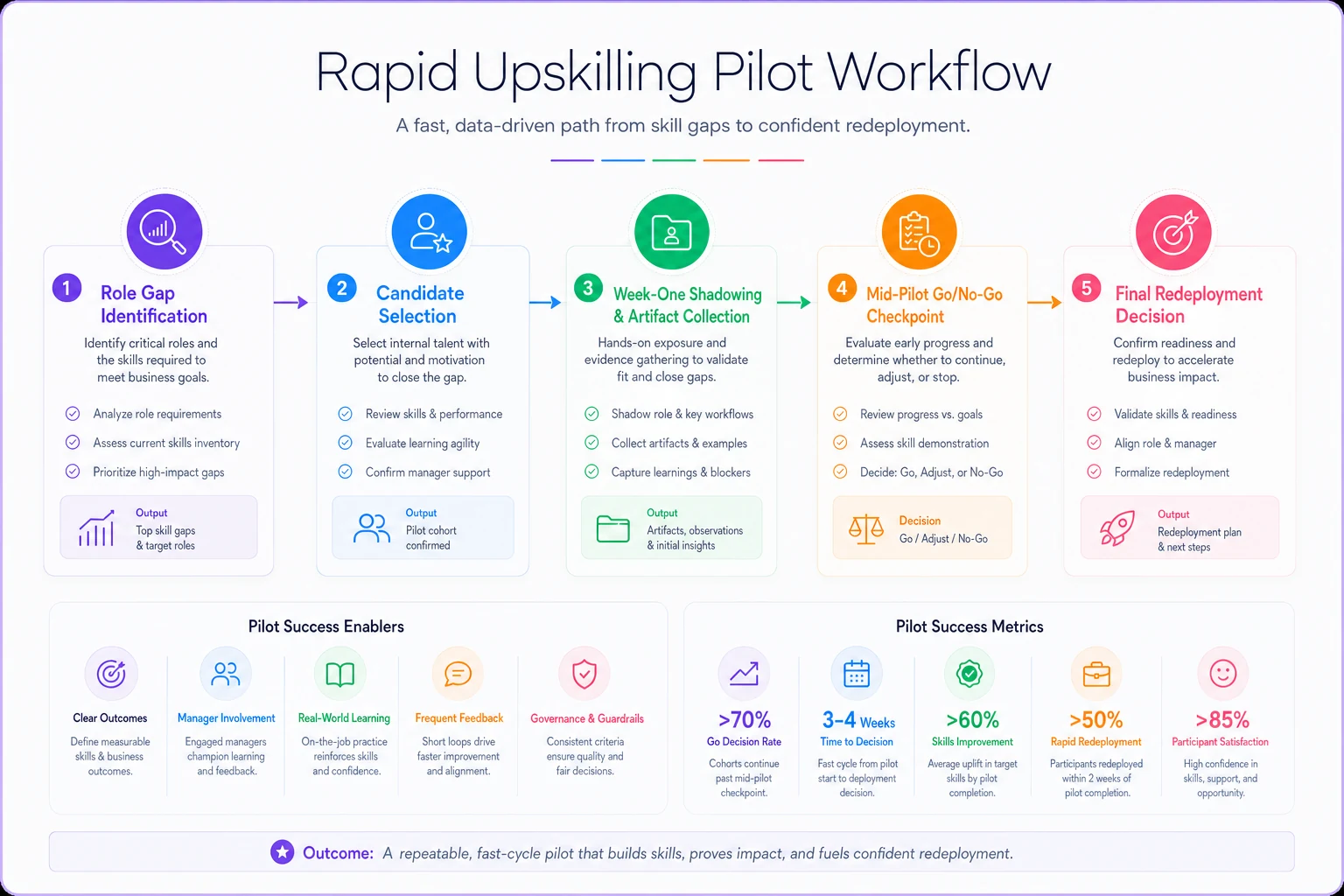
These aren't complicated steps, but most organizations never get past step one because they can't agree on what "success" means before they start.
What success actually looks like
A west coast software company ran this model under real pressure. When the USCIS announcement hit, they had four senior engineers on affected work authorizations, each supporting a different product area. Traditional replacement would require four to six months of external recruiting plus onboarding time.
Instead, they identified eight internal candidates with adjacent skills — QA engineers, junior developers, one technical product manager with a coding background. Each senior engineer got paired with two potential backups for a three-week intensive pilot.
Week one: shadow and document every task the senior engineer handles. Week two: handle routine tasks with supervision, tackle one complex problem with guidance. Week three: own a full sprint's worth of work with the senior engineer only reviewing output.
Five of the eight candidates successfully covered their assigned roles. The three who didn't were quickly redirected to different pilots based on what the first week revealed about their actual capabilities. Total time from crisis to coverage: 22 days.
The SLA and handoff infrastructure you need
Rapid redeployment falls apart without clear operational handoffs. Saying "Sarah can now cover David's role" isn't enough. You need specific service-level agreements and transition protocols, or you'll create more chaos than you solve.
Start with role-specific SLAs that define minimum acceptable performance during transition periods. If the original role holder responds to critical bugs within 2 hours, can the backup maintain a 4-hour response window during their first month? Which tasks can be delayed? What escalation paths exist when the backup gets stuck?
Manager handoff checklists prevent the common failure mode where someone gets redeployed but their previous manager won't release them. Define exactly what work transitions, what gets delegated, what gets postponed. Include specific dates and decision authorities.
The verification infrastructure needs to stay lightweight but rigorous. Not six-month performance reviews — weekly capability checkpoints. Can they complete core tasks independently? Are they maintaining SLAs? Are downstream teams getting what they need? Binary go/no-go decisions, not subjective evaluations.
Connecting rapid pilots to your existing programs
Emergency pilots need to run outside normal channels to maintain speed and focus. Plugging them into existing program governance just slows everything down.
But successful pilots become templates for improving your standard programs. That three-week intensive that produced five backup engineers? Those techniques can be embedded into your regular upskilling pilot framework. The artifact-based verification that proved someone could handle payment systems? That becomes your new standard for skill validation across all roles.
The key is capturing what worked while it's fresh. Which pairing structures actually accelerated learning? What documentation got used during handoffs versus ignored? Which verification methods predicted real performance? These lessons become your operational playbook for the next disruption — because with immigration policy, there's always a next disruption.
The automation layer that makes this scale
Running one emergency pilot is exhausting. Running ten simultaneously while maintaining normal operations is nearly impossible without some operational infrastructure underneath it.
The coordination complexity alone is brutal. Who's shadowing whom this week? Which milestones are complete? What evidence has been collected? Which handoffs are scheduled? Multiply this across every affected role and backup candidate and you've created a tracking problem that no spreadsheet handles well.
AI-powered operational platforms can automate the coordination without requiring dedicated program managers. Task assignments flow based on pilot timelines. Evidence collection happens through existing work systems. Progress dashboards update in real time. Managers get alerts when decisions are needed rather than fielding constant status requests.
The skill profile maintenance alone justifies some automation. Every pilot generates significant capability data — work artifacts, completion records, verification results. Manually updating skill profiles takes weeks and goes stale almost immediately. Automated capture and categorization keeps profiles current without the administrative overhead that quietly kills most internal mobility programs.
The USCIS H.R.1 stay is the latest immigration disruption, not the last. The organizations that come out ahead will be the ones that stop treating workforce planning as a stable-state optimization problem and start building rapid response capabilities instead.
That means accepting some uncomfortable realities. Your external hiring pipeline is no longer reliable. Your succession plans need multiple contingency layers. Your skills data needs to be real-time and evidence-based, not annual and self-reported. And your upskilling programs need to prove they can develop critical capabilities in weeks, not months.
The companies adapting fastest aren't waiting for regulatory clarity. They're running pilots right now, building internal mobility muscle, and creating operational systems that work regardless of what immigration policy does next. The H.R.1 stay forced everyone's hand — but the organizations using this moment to build real rapid redeployment capabilities will be far better positioned for whatever comes after it.
Ready to elevate your team's skills?
Join 500+ companies using Talioly to boost skill visibility, streamline training, and drive performance growth.