


Most HR teams approach upskilling pilots backwards. They pick a hot skill, enroll 50 people in Coursera, wait three months, then scramble to explain why completion rates are sitting at 12% and nobody's using what they learned. The CFO kills the budget. The business goes back to hiring externally at three times the cost.
The real problem isn't training quality or employee motivation. It's running pilots without clear hypotheses, baseline metrics, or stop/go checkpoints. You're running an uncontrolled experiment with company money and people's time.
The hidden cost of unstructured pilots
A mid-sized insurance company needed data analytics capability across their claims department. They bought enterprise Tableau licenses, enrolled 200 claims processors in a six-week bootcamp, and waited for transformation. Eight months later, four employees were creating dashboards regularly. The other 196 went back to Excel within weeks.
Total damage: $180,000 in licenses, $65,000 in training costs, roughly 1,600 hours of lost productivity, and a CFO who now rejects every L&D request with "remember the Tableau disaster?"
This pattern repeats constantly. Manufacturing companies train operators on robotics programming, then realize the shop floor systems can't support new automation. Banks upskill tellers on advisory conversations without updating their transaction-focused KPIs. Tech companies teach business analysts SQL without providing database access or actual use cases.
A structured pilot changes this. Instead of hope-based initiatives, you run controlled experiments with clear hypotheses, measurable baselines, and predetermined decision criteria.
Step 1: Build testable hypotheses (not wish lists)
Generic hypothesis: "Employees need digital skills."
Stop losing track of critical skills.
Talioly helps you track, develop, and certify your workforce efficiently.
- Centralized skill profiles
- Automated training reminders
- Competency gap analysis
No credit card required
Testable hypothesis: "Training 10 customer service reps in Zendesk automation will reduce average ticket resolution time from 47 minutes to 35 minutes within 60 days."
The difference matters. A testable hypothesis forces you to define a specific skill application, a measurable business outcome, a realistic timeframe, and a direct cause-and-effect relationship.
Most pilots fall apart here because HR defaults to broad capability statements. "We need more data-driven decision making" isn't testable. "Financial analysts who complete Power BI training will reduce monthly reporting cycle time by two days" gives you something to actually measure.
Your hypothesis template:
``
IF we train [specific role] in [specific skill]
THEN they will [specific behavior change]
RESULTING IN [measurable business metric] changing from [baseline] to [target] within [timeframe]
``
This forces uncomfortable but necessary conversations upfront. Can employees apply this skill immediately? Do they have the tools? Will managers back the new approach? Does the workflow even allow for skill application?
When a retail chain tested "store managers trained in workforce analytics will optimize scheduling to reduce overtime by 15%," they discovered managers had no access to historical scheduling data. The hypothesis exposed the blocker before they wasted a dollar on training.
Step 2: Design minimum viable cohorts
The instinct is to go big — train entire departments to show scale. This maximizes risk and makes results nearly impossible to interpret. Start with 8 to 12 people, split into test and control groups.
Cohort selection criteria:
-
Similar baseline performance metrics
-
Same manager or department
-
Equal access to tools and systems
-
Comparable workload and project types
-
Voluntary participation where possible
A logistics company testing supply chain modeling skills picked their cohort wrong the first time. They selected top performers spread across different warehouses with different systems and different levels of manager support. Results were uninterpretable.
When possible, pick participants who will apply the skill in their day-to-day work within two weeks of training to surface blockers early.
Their second attempt worked: 10 inventory planners from the same distribution center, same systems, two managers who agreed to actively support the pilot. Five got training, five continued as normal. Clear comparison, controlled variables.
The control group is non-negotiable. Without it, you can't separate training impact from seasonal variation, system changes, or normal performance fluctuations. That inventory planning team saw 20% productivity improvement in the trained group — but the control group improved 18% due to a new scanning system rolled out simultaneously. Real training impact: roughly 2%. Not worth scaling.
Step 3: Establish baseline metrics and confidence thresholds
Before anyone opens a training module, you need 90 days of baseline performance data. Not averages — full distributions showing variance, seasonality, and outliers.
Essential baseline components:
Performance metrics (system-captured, not self-reported):
-
Current output and quality measures
-
Time-to-complete on standard tasks
-
Error rates or rework frequency
-
System data showing actual skill application (queries run, reports created, tools used)
Confidence thresholds:
-
Minimum improvement to justify scaling (typically 15-20% lift)
-
Statistical significance level (p < 0.05 for most business cases)
-
Sustained performance period (improvements must hold for 60+ days)
A pharmaceutical company learned this the hard way. They trained quality inspectors on advanced statistical process control without capturing baseline inspection accuracy. Post-training, inspectors caught 23% more defects. Looked like a win — until they realized inspection rates naturally fluctuate 20-30% based on production schedules. Without baseline variance data, they couldn't prove training drove the change.
Your baseline tracking template:
| Metric | Data Source | Collection Method | 90-Day Average | Standard Deviation | Seasonal Pattern |
|---|---|---|---|---|---|
| Task completion time | ERP timestamps | Automated pull | 47 min | ±8 min | 15% slower in Q4 |
| Quality score | QA system | Manual audit | 91% | ±3% | No pattern |
| Tool usage | Software logs | API export | 3.2 hrs/day | ±1.1 hrs | Lower on Mondays |
This level of detail seems like overkill until you're defending ROI to finance. They'll ask about seasonality, variance, and statistical significance. Better to have it ready than scramble for historical data that doesn't exist.
Here's a simple workflow that ties baseline collection to decision checkpoints.
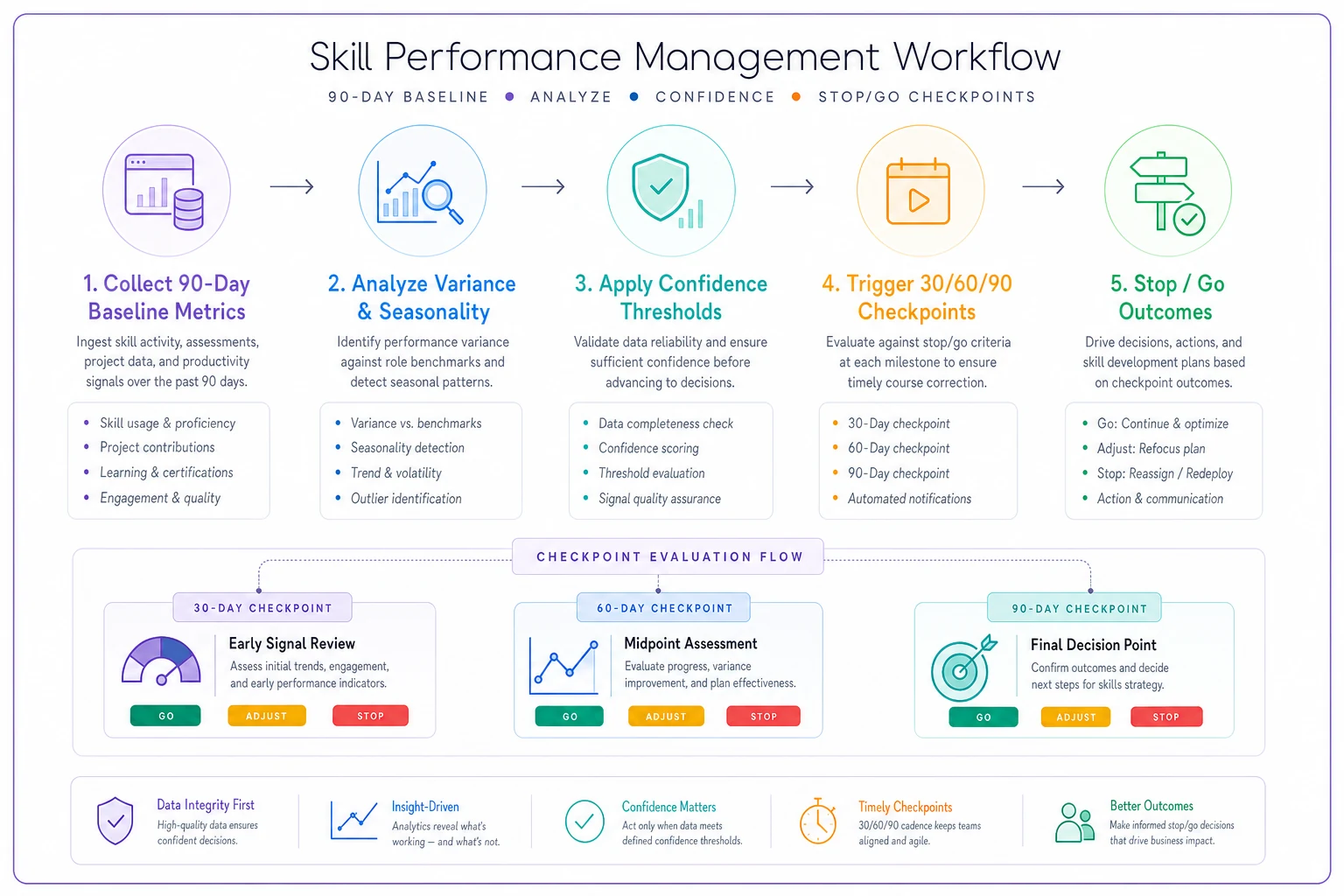
Use this to show stakeholders how data flows from raw metrics to go/stop recommendations.
Step 4: Create stop/go decision criteria
Most pilots drift into zombie status — not clearly successful, not obviously failed, just quietly consuming resources while everyone avoids the hard conversation. Pre-determined stop/go criteria fix this.
Your decision framework needs three checkpoints:
30-day check: Are people actually using the training?
Stop if fewer than 70% have attempted skill application. Stop if tool or system blockers haven't been resolved. Continue if adoption is on track.
60-day check: Are behaviors changing?
Stop if there's no measurable difference vs. control group. Stop if performance is declining. Pivot if different skills are being applied than expected.
90-day check: Is business impact visible?
Go if metrics improved more than 15% vs. baseline. Stop if improvement is under 5%. Extend the pilot if improvement lands between 5-15% — you need more data before you can call it either way.
A financial services firm skipped these checkpoints during their automation training pilot. Six months in, they found participants were using the RPA tools — but only for personal productivity shortcuts, not the customer onboarding workflows they'd targeted. A 30-day check would have caught this and allowed course correction.
Stop/go thresholds must be documented and agreed on before launch. Get specific:
"We will stop the pilot if:
-
Week 4 usage data shows fewer than 6 hours of Python IDE time per participant
-
Week 8 productivity metrics show less than 5% improvement over the control group
-
Any participant requests removal due to workload conflicts
This feels harsh. It's supposed to. Every week you continue a failing pilot delays finding what actually works.
Step 5: Build stakeholder communication cadence
Pilot communication usually swings between two extremes: radio silence until the final report, or constant updates that exhaust everyone involved. You need structured touchpoints with predetermined content.
Your communication checklist:
Pre-launch briefing (all stakeholders):
-
Hypothesis and success metrics
-
Participant names and roles
-
Timeline and checkpoints
-
Stop/go criteria
-
Required stakeholder actions
Weekly participant pulse (email survey):
-
Hours spent learning
-
Skills attempted at work
-
Blockers encountered
-
Manager support received
-
Confidence level (1-5 scale)
Checkpoint reports (30/60/90 days):
-
Metrics vs. baseline
-
Test vs. control group comparison
-
Stop/go recommendation
-
Participant feedback themes
-
Next 30-day actions
Manager check-ins (bi-weekly):
-
Observed behavior changes
-
Support provided
-
Workflow adjustments made
-
Team impact (positive or negative)
A tech hardware company ran a solid cloud architecture upskilling pilot but never briefed the participants' managers. Engineers completed AWS certifications, returned to their teams, and found managers who had no idea about the training, hadn't adjusted project assignments, and had no way to evaluate skill application. Three months of investment, zero implementation — because one stakeholder group was skipped.
The communication template prevents these gaps:
| Stakeholder | Frequency | Format | Key Messages | Action Required |
|---|---|---|---|---|
| CFO | Monthly | Dashboard | ROI projection, cost tracking | Budget approval |
| Direct managers | Bi-weekly | 15-min call | Participant progress, support needs | Adjust workload |
| Participants | Weekly | Survey + office hours | Skill application, blockers | Complete practice |
| IT | As needed | Ticket system | Tool access, system requirements | Provision access |
Getting this cadence agreed on before launch is worth the extra planning time. Stakeholders who feel informed are far less likely to pull support when early results look messy.
Step 6: Document the playbook for replication
The pilot's real value isn't just proving ROI for one skill — it's building a repeatable process for testing any capability investment. Your documentation needs to capture what worked and what didn't, honestly.
Essential documentation elements:
Pilot design decisions:
-
Why this skill, population, and timeframe
-
How the hypothesis evolved
-
Cohort selection rationale
-
Baseline metric choices
Execution reality:
-
Actual vs. planned timeline
-
Unexpected blockers
-
Stakeholder resistance
-
Resource requirements vs. estimates
Results analysis:
-
Raw performance data
-
Statistical significance calculations
-
Participant feedback themes
-
Manager observations
-
Control group variations
Scaling recommendations:
-
Minimum viable cohort size
-
Required support structures
-
System and tool prerequisites
-
Change management needs
An e-commerce company ran a successful customer analytics pilot with their merchandising team. Eight participants showed 22% improvement in product selection accuracy. When they tried scaling to 100 merchandisers, results collapsed.
Their pilot documentation told them exactly why: the original eight had daily huddles with a data scientist, access to a sandbox environment, and reduced regular duties during training. The scaled version had none of that. The documentation was there — they just didn't follow it.
Common pilot failures and how to prevent them
The volunteer bias trap: Pilot volunteers are motivated early adopters. They'll outperform the broader population. Include two or three "voluntold" participants to test with average motivation levels.
The tool access disaster: Participants complete training then spend six weeks waiting for IT to provision software access. Provision everything before training starts, and test with real work scenarios.
The measurement drift: You start measuring "training engagement" instead of business outcomes because it's easier to track. Lock your success metrics in the hypothesis and don't move them.
The manager sabotage: Middle managers worry about losing headcount if productivity improves, or just don't see upskilling as their problem. Include them in hypothesis design, measure their support, and acknowledge their contribution when the pilot succeeds.
When to run pilots vs. direct implementation
Not everything needs a pilot.
Run pilots when:
-
Investment exceeds $50k or 500 person-hours
-
Skill application requires workflow changes
-
ROI is uncertain or disputed
-
Multiple skill options could address the same need
-
Previous similar initiatives have failed
Skip pilots when:
-
Regulatory compliance requires the training
-
Skills are replacing retired or departing employees
-
Technology changes make training mandatory
-
The cost of the pilot exceeds 30% of a full rollout
Not everything needs a pilot.
Connecting your pilot to operational infrastructure
The data you collect in a pilot feeds directly into broader talent operations. Performance baselines become skill benchmarks for micro-assessments that actually predict on-the-job competency. Successful pilot participants become skill champions within your operating model with clear owners and handoffs.
Smarter organizations are centralizing pilot results in operational software that tracks hypothesis-to-outcome across multiple upskilling experiments. Instead of scattered spreadsheets and PowerPoints, you build an evidence base of what actually drives performance in your specific context. Patterns start to emerge: certain roles respond better to self-paced formats, some skills require direct manager involvement to stick, leadership capabilities often need 90 or more days before measurable impact shows up.
AI-assisted platforms help here — not by automating training, but by tracking the complex web of metrics, participants, timelines, and outcomes across simultaneous pilots. Spotting that customer service skills stick better with peer coaching, or that technical skills need hands-on projects, becomes much faster when you're not manually reconciling data across a dozen Excel files.
Making pilots work in your organization
The upskilling pilot playbook isn't about perfection. It's about learning fast and cheap before committing big. Most organizations would save significant money running disciplined 90-day pilots instead of launching 18-month transformation programs based on vendor promises and executive gut feelings.
Start small. Pick one critical skill gap, form a hypothesis, get eight to ten willing participants, and run your first controlled experiment. Document everything. Share the results honestly — good or bad. Build credibility through transparency.
The CFO who killed your last training budget might approve the next one when you show up with baseline data, control group comparisons, and a clear stop/go framework. You're not asking for faith. You're proposing a controlled experiment with predetermined success criteria and exit ramps.
That's the shift — from "trust us, employees need these skills" to "here's our hypothesis, here's how we'll test it, and here's when we stop if it isn't working."
Your next upskilling investment doesn't have to be a gamble. Run the pilot, document the results, and let the data make the case.
Your next upskilling investment doesn't have to be a gamble. Run the pilot, document the results, and let the data make the case.
Ready to elevate your team's skills?
Join 500+ companies using Talioly to boost skill visibility, streamline training, and drive performance growth.