


Most org charts are stories about the past. They tell you who got hired, in what order, and which manager fought hardest for a req two budget cycles ago. What they almost never tell you is whether the shape of the team matches the work coming down the pipe.
That gap is where role-based org design earns its keep. Not the pretty-boxes-and-lines version, but the operational discipline of mapping capabilities to demand, deciding where to build versus buy versus borrow, and keeping that structure honest as the business grows. This is a systems problem, not an HR-forms problem, and the teams that treat it as a system are the ones that stop getting surprised every planning cycle.
Why org charts drift away from the work
The pattern that shows up over and over: a company plans headcount by looking at last year's team plus attrition plus a few "strategic" adds someone lobbied for. Nobody actually mapped the capabilities the next 12 months of roadmap will demand. So you end up with a team optimized for the product you already shipped.
A few forces push org design out of alignment, and they compound:
-
Titles become proxies for capability. "Senior Engineer" tells you a pay band, not whether the person can do event-driven architecture or just knows the legacy monolith cold.
-
Hiring happens role by role. Each req is defended in isolation, so nobody sees that you're about to have four people who can do the same thing and zero who can do the thing the Q3 launch requires.
-
Depth and breadth get confused. Teams stack specialists when they need generalists, or spread everyone thin when they actually needed one deep expert.
-
Roadmap changes, structure doesn't. The product pivots. The org lags 6–9 months behind because restructuring feels heavy and political.
The result is a team that looks fully staffed on the org chart and is somehow always short the exact capability the current sprint needs. That's not bad luck. That's a design failure hiding behind a headcount number.
Start with a capability heatmap, not a headcount number
Before you argue about how many people to hire, you need to see what capabilities you have versus what the roadmap demands. A capability heatmap is the cleanest tool for this, and it's dead simple to build once.
Stop losing track of critical skills.
Talioly helps you track, develop, and certify your workforce efficiently.
- Centralized skill profiles
- Automated training reminders
- Competency gap analysis
No credit card required
You list capabilities down one axis — not roles, actual capabilities, like "payments integration," "customer-facing incident response," "data pipeline design." Across the top you put teams or functions. Then you fill each cell with a rating for current depth: how many people can do this at what level.
A basic version looks like this:
| Capability | Current depth | Demand (next 2 quarters) | Gap | Risk if unfilled |
|---|---|---|---|---|
| Payments / billing integration | 1 person, deep | High | Single point of failure | Launch slips, revenue delay |
| Customer incident response | 4 people, shallow | Medium | Too broad, no owner | Slow escalations |
| Data pipeline design | 0 | High | Full gap | Analytics roadmap blocked |
| Legacy platform maintenance | 3 people, deep | Declining | Overstaffed | Trapped capacity |
The moment you look at this, the real problem jumps out. It's almost never "we need more people." It's "we have depth where demand is falling and gaps where demand is rising." That legacy-platform row with three deep people and declining demand? That's usually your redeployment answer for the data-pipeline gap sitting right below it.
The mistake most teams make here is rating people instead of capabilities. If you fill the grid with names and performance opinions, it turns into a review exercise and everyone gets defensive. Keep it about the work — what can the team collectively do, and how concentrated is that ability.
Role-cluster templates: stop designing roles one at a time
Once you can see capability supply and demand, the next move is grouping capabilities into role clusters rather than inventing bespoke job descriptions every time.
A role cluster is a repeatable bundle of capabilities that tend to travel together and can be staffed as a unit. Instead of writing a fresh JD each time a manager asks for headcount, you're pulling from a small library of clusters you've already thought through.
For example, a "platform reliability" cluster might bundle: incident response, observability tooling, capacity planning, and postmortem facilitation. You define it once — the capabilities inside, the depth needed for each, and the minimum viable version versus the fully-loaded version.
The operational payoff is significant for two reasons:
-
Planning gets faster. When a team lead says "I need reliability coverage," you're not starting from a blank page. You know the cluster, you know what "minimum" looks like versus "ideal," and you can price the trade-off immediately.
-
You catch duplication across teams. If three teams each want their own reliability cluster, you can see whether that's three real needs or one shared function you're about to fragment.
A pattern worth watching: as companies scale past roughly 150–200 people, they tend to spawn near-identical clusters inside every function because nobody's looking across the whole org. Payments has its own data person, marketing has its own data person, ops has its own data person — and none of them talk. Role clusters, viewed org-wide, surface that fragmentation before you've hired it into permanence.
Depth vs breadth: the metric nobody tracks but everyone feels
This is the part most org design work skips, and it's the part that actually determines whether a team can execute.
Depth is how far a capability goes — can someone architect the payments system, or just maintain it. Breadth is how many distinct capabilities a person or team can cover competently.
The trade-off is real and constant. Early-stage teams need breadth: generalists who can cover five things at 70%. Scaling teams need pockets of depth: specialists who can take one thing from 70% to 95% because that's now a competitive edge or a compliance requirement.
-
Depth ratio per capability number of people who can operate that capability at an "owner" level, not just "assist" level. Anything sitting at 1 is a bus-factor risk.
-
Breadth load per person how many active capabilities each person is currently responsible for. Above about 4–5 active responsibilities, quality and response time usually start slipping.
-
Coverage overlap for critical capabilities, do you have at least 2 people at owner level? If not, that's a resilience gap regardless of how "staffed" the team looks.
A team can be simultaneously overstaffed and under-covered. You can have twelve people and still have six critical capabilities held by exactly one person each. Headcount says you're fine. The depth-vs-breadth read says you're one resignation away from a stall.
Build, buy, or borrow: the decision matrix
Once you know your gaps and your depth/breadth picture, every gap becomes a decision: do you build the capability internally (train/develop), buy it (hire), or borrow it (contractors, agencies, internal loans from another team)?
Most orgs default to "buy" for everything because hiring is the muscle they know how to flex. That's expensive and slow, and it ignores the two cheaper options that are often better fits.
Here's a decision matrix that keeps these choices honest:
| Factor | Lean Build | Lean Buy | Lean Borrow |
|---|---|---|---|
| Time to need | 6+ months out | Needed now, permanent | Needed now, temporary |
| Capability durability | Core, long-term | Core, long-term | Spiky or one-time |
| Internal adjacent talent | Yes, someone's close | No close match | Doesn't matter |
| Cost tolerance | Lower ongoing | Highest | Highest short-term, zero long-term |
| Roadmap certainty | Confident | Confident | Uncertain / experimental |
Read it as a set of leanings, not hard rules. A gap that's core, durable, six months out, and has someone internally who's 70% there? That screams build — and it's usually the cheapest path, because you're growing depth from breadth you already paid for. A spiky, uncertain need tied to an experiment that might get killed? Borrow it, don't hire into it.
The connective tissue that makes this matrix work is a clear read on the roadmap. If you don't know what's coming and how firm it is, every gap looks like it needs a permanent hire. This is exactly why org design has to be wired to roadmap planning rather than sitting in a separate HR track — the same logic behind turning product roadmaps into time-phased skills demand, where the timing and confidence of upcoming work directly changes whether you build, buy, or borrow.
When build actually makes sense
When you have adjacent talent, a durable need, and enough runway. Building depth from existing breadth is the highest-leverage move most teams underuse. It also strengthens retention, because people can see a growth path rather than a ceiling.
When buy is the right call
When the capability is core, permanent, and you have no internal adjacency. Don't try to "build" a capability nobody on the team is close to — that's a slow, painful path to mediocre coverage. Just hire it.
When you should borrow — and when you shouldn't
Borrow for spiky, uncertain, or experimental needs. Don't borrow for anything that's genuinely core and long-term — you'll rent the capability forever, lose the institutional knowledge every time the contract ends, and pay more over three years than a hire would've cost.
What breaks at scale
Small teams get away with informal org design because everyone can see everyone's work. That breaks predictably as you grow, and it breaks in stages.
Around 50 people: capability knowledge lives in managers' heads. Planning is a series of hallway negotiations. It mostly works, but nobody can see the whole picture.
Around 150 people: the fragmentation kicks in. Duplicate role clusters spawn across functions. Depth risks hide because no single manager can see that a capability is held by one person across the whole org. Build/buy/borrow decisions get made locally and inconsistently — one team hires, another team ignores a contractor sitting idle two doors down.
Around 300+ people: the org chart and the actual capability distribution have fully diverged. You're running annual planning off headcount and titles because that's all you can see at scale, and the capability reality underneath is a black box. This is when companies chronically over-hire in some areas and stay perpetually short in others.
The through-line is visibility, not intent. Nobody's making bad decisions on purpose. They just can't see across the whole system, so local optimization wins and global alignment loses.
A workflow for keeping structure aligned to demand
The fix isn't a one-time reorg. It's a recurring loop that keeps org design synced with the roadmap. Here's a workflow that holds up as teams scale:
Refresh capability heatmap (quarterly) ↓ Flag gaps AND overstaffed / declining-demand capabilities ↓ Run each gap through build / buy / borrow matrix ↓ Check redeployment supply before opening any external req ↓ Convert decisions into role clusters (not bespoke JDs) ↓ Tie budget to identified gaps — not last year's baseline ↓ Review depth ratios for resilience on critical capabilities ↓ Repeat next quarter
-
Refresh the capability heatmap quarterly. Update current depth and re-rate demand against the latest roadmap. This is the single input everything else runs on.
-
Flag the gaps and the overstaffs. Don't just look for holes — look for declining-demand capabilities with trapped depth. Those are your redeployment supply.
-
Run each gap through the build/buy/borrow matrix. Decide the path per gap, tied to timing and roadmap confidence.
-
Match redeployment supply to build opportunities first. Before opening a req, check whether trapped depth elsewhere can be redirected. Almost always cheaper and faster than external hiring.
-
Convert decisions into role clusters, not bespoke JDs. Pull from your cluster library so planning stays fast and duplication stays visible.
-
Tie the budget to the decisions, not to last year's baseline. Fund the actual gaps.
-
Review depth ratios for resilience. Any critical capability sitting at a depth of 1 gets a plan — even if there's no immediate demand gap.
Visualizing this loop can make it easier to keep the rhythm.
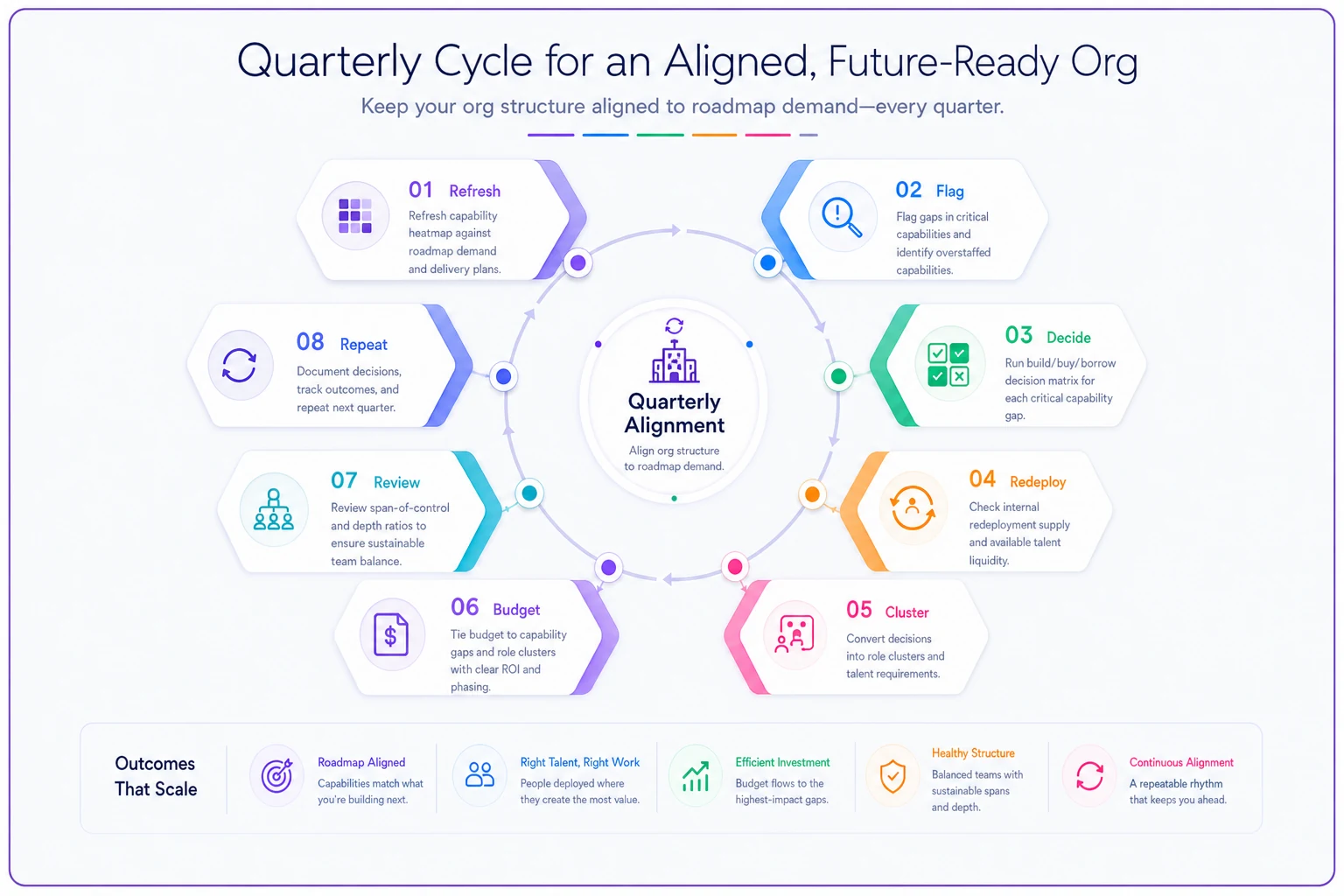
Running this every quarter beats a heroic annual reorg for one simple reason: the roadmap moves continuously, and a once-a-year restructure is always chasing a target that already shifted. The funding side of this loop only holds together when skills budgets flex with the roadmap instead of freezing on a calendar — which is the whole point of a cross-functional funding model that ties product roadmaps to skills budgets.
A quick operational checklist
Before your next planning cycle, run through this:
-
- [ ] Do we have a capability heatmap that's not organized by title?
-
- [ ] Can we name every critical capability held by exactly one person?
-
- [ ] Do we have a role-cluster library, or are we still writing JDs from scratch each time?
-
- [ ] Have we checked for duplicate clusters across functions?
-
- [ ] Is every open gap explicitly tagged build, buy, or borrow — with a reason?
-
- [ ] Did we check redeployment supply before opening external reqs?
-
- [ ] Is our headcount budget tied to roadmap-driven gaps, or to last year plus attrition?
Surface heatmap changes in your quarterly planning deck so funding reviewers see capability shifts, not just headcount deltas.
If you can't check most of those, you're designing your org off the past, not the demand.
Real scenario: a 90-person B2B software company
A B2B software company, roughly 90 people, kept missing roadmap dates despite hiring steadily. On paper the engineering org looked healthy — around 40 people, low attrition, decent budget.
The heatmap told a different story. They had three engineers deep in a legacy reporting module whose demand was flat and declining, and zero people who could build the data pipeline their next two flagship features depended on. Payments integration — the thing tied to a launch worth a meaningful chunk of new ARR — sat with one person, who was also the only one who understood the billing edge cases.
Their instinct was to open two senior reqs and hope to fill them in a quarter. Realistic time-to-productive for those hires was closer to 5–6 months, which would've blown the launch window entirely.
Running the gaps through build/buy/borrow changed the plan:
-
Build two of the three legacy-module engineers were adjacent enough to move into data-pipeline work with about 6–8 weeks of focused ramp. Cheaper and faster than hiring.
-
Buy they still opened one senior req — but only one, for genuine long-term depth.
-
Borrow a contractor covered a spiky migration task that would've ended in a few months anyway.
The billing single-point-of-failure got its own fix: they cross-trained a second engineer to owner level over the following quarter, so the launch wasn't hostage to one person's calendar.
The outcome wasn't dramatic. It was quieter and more useful — the flagship features shipped roughly on schedule, they avoided one unnecessary senior hire (somewhere in the $150k–$180k range in fully-loaded annual cost), and the team stopped feeling perpetually short-staffed even though total headcount barely changed. The problem was never how many people they had. It was how the capabilities were distributed against the work.
The real shift
Role-based org design isn't about drawing better boxes. It's about treating team structure as a living function of demand — something you re-read against the roadmap every quarter, using capability heatmaps to see supply, role clusters to plan efficiently, depth-and-breadth metrics to catch hidden fragility, and a build/buy/borrow discipline to spend headcount where it actually pays off.
The teams that get stuck plan from the org chart. The teams that stay aligned plan from the work — and let the structure follow.
Role-based org design isn't about drawing better boxes. It's about treating team structure as a living function of demand — something you re-read against the roadmap every quarter, using capability heatmaps to see supply, role clusters to plan efficiently, depth-and-breadth metrics to catch hidden fragility, and a build/buy/borrow discipline to spend headcount where it actually pays off.
The teams that get stuck plan from the org chart. The teams that stay aligned plan from the work — and let the structure follow.
Ready to elevate your team's skills?
Join 500+ companies using Talioly to boost skill visibility, streamline training, and drive performance growth.