

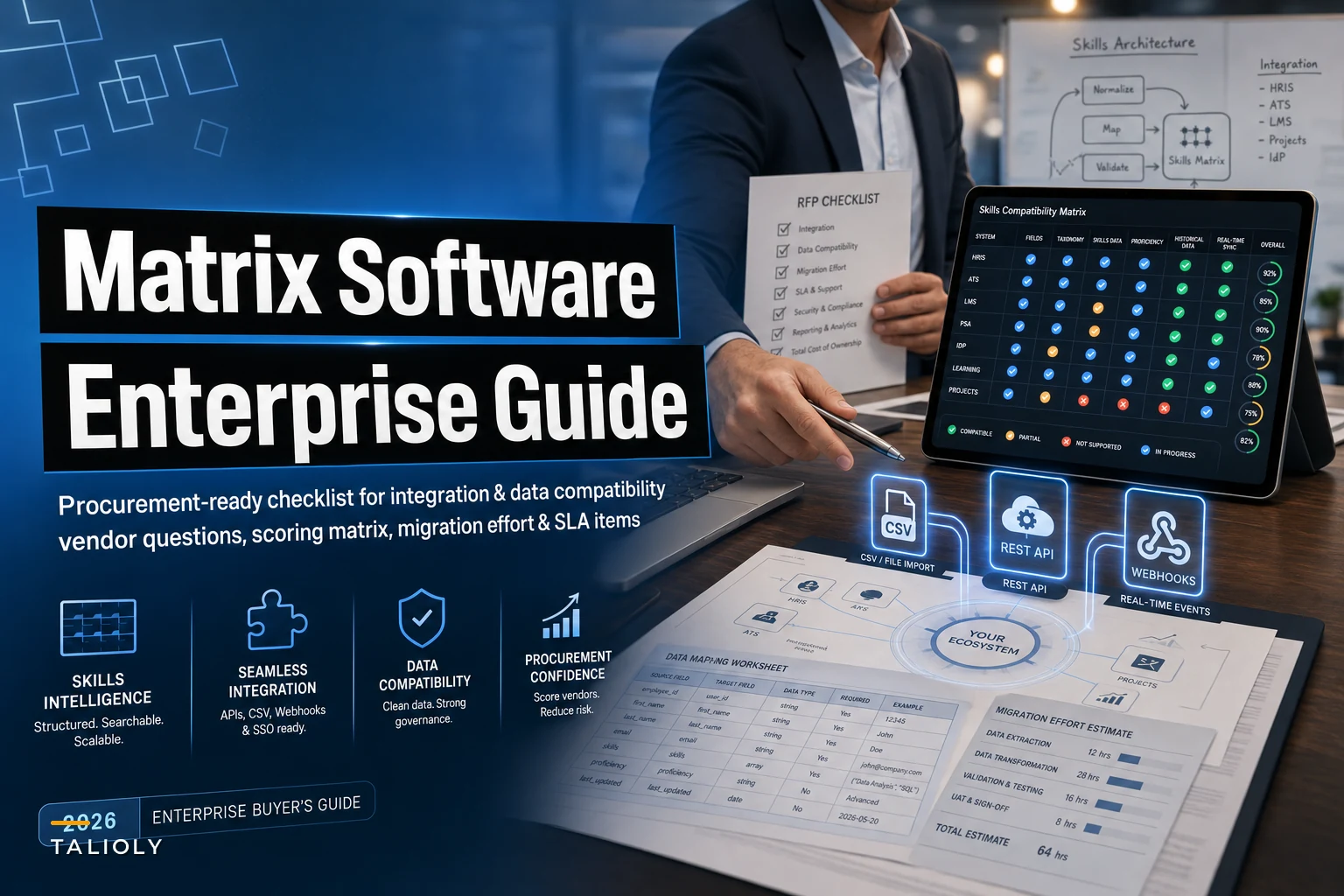

Most skills matrix evaluations go sideways in the same place. The shortlist gets built around demos — pretty heatmaps, slick gap dashboards, a role-fit visualization that makes everyone in the room nod. Then eighteen months later the thing is half-abandoned because nobody can get competency data out of it in a shape that matches the rest of the HR stack, and the "single source of truth" quietly became yet another island.
The feature list almost never predicts this failure. Data-model compatibility does. This guide focuses on the parts of the decision that rarely make it into vendor scorecards: how the platform represents a skill, how it maps to your canonical profile, how it moves data in and out, how it behaves at scale, and what it's going to cost you in migration effort when you inevitably outgrow the first version of your taxonomy.
If you want the deeper architecture reasoning behind canonical profiles and migration sequencing, that lives in our companion piece on enterprise skills data architecture patterns. This article assumes you've either read it or already have a canonical profile model in mind, and focuses purely on selecting a tool that won't fight it.
Start with the data model, not the dashboard
Before you talk to a single vendor, internalize this: every skills matrix tool has an opinion about what a skill is, and that opinion is baked into its schema. Some treat a skill as a flat tag. Some treat it as a node in a hierarchy with parent-child inheritance. Some bundle proficiency, evidence, and expiry into one object; others split them. None of this shows up in the demo, and all of it determines whether the tool slots into your architecture or becomes a translation headache.
A typical example: a vendor stores proficiency as a 1–5 integer with no separate confidence or evidence field. Your canonical profile separates self-assessed level, verified level, evidence source, and confidence score — because you learned the hard way that mixing those creates stale, untrustworthy data. Now every sync requires lossy transformation. You either flatten your rich model down to their integer and lose governance signal, or you stand up a middleware layer to reconstruct the richness on the way back out. Both are expensive, and nobody priced them during procurement.
The first question isn't "what can it show me." It's "what is the smallest unit of data it stores, and does that unit survive a round-trip through my canonical profile without losing meaning?"
The three data-model mismatches that cause the most pain
-
Granularity mismatch. Their skill atom is coarser or finer than yours. You track "React component testing"; they only model "Front-end development." Re-aggregating is lossy and the mapping is many-to-one, which breaks reporting.
-
Attribute collapse. They fold proficiency, recency, and evidence into a single field. You can't tell a verified-last-month expert from a self-rated-two-years-ago guess.
-
Identity instability. Skills have no stable IDs — they're keyed on display name. Someone renames "Kubernetes" to "K8s" and every historical record orphans.
Identity instability is the sleeper issue. It usually surfaces during the first taxonomy cleanup, roughly a year in, when someone rationalizes duplicate skills and discovers the tool has no concept of a merge that preserves history. Insist on stable, immutable skill IDs and documented merge/split behavior. If a vendor can't explain what happens to historical assessments when two skills are merged, that's a real red flag.
The integration patterns that actually matter
Vendors love to list integrations. "We connect to Workday, SAP, 50+ LMS platforms." That tells you almost nothing about whether the integration preserves your data model or just dumps records across a bridge. What you need to interrogate is the pattern of integration, not the logo count.
Stop losing track of critical skills.
Talioly helps you track, develop, and certify your workforce efficiently.
- Centralized skill profiles
- Automated training reminders
- Competency gap analysis
No credit card required
| Integration pattern | What it's good for | Where it breaks | What to ask |
|---|---|---|---|
| Flat file / scheduled CSV | Initial load, low-frequency HRIS sync | No real-time updates; silent failures on schema drift | How are rejected rows surfaced and reprocessed? |
| REST API (read + write) | Operational sync with your canonical store | Rate limits, pagination quirks, partial writes | Can I write back verified levels and evidence, not just read? |
| Event / webhook stream | Keeping profiles current as evidence arrives | Ordering, retries, idempotency gaps | Are events idempotent and replayable? |
| Pre-built connector (Workday, etc.) | Fast time-to-value on a named system | Opaque field mapping you can't customize | Can I see and edit the field map, or is it a black box? |
A simple integration workflow can clarify how data moves between systems.
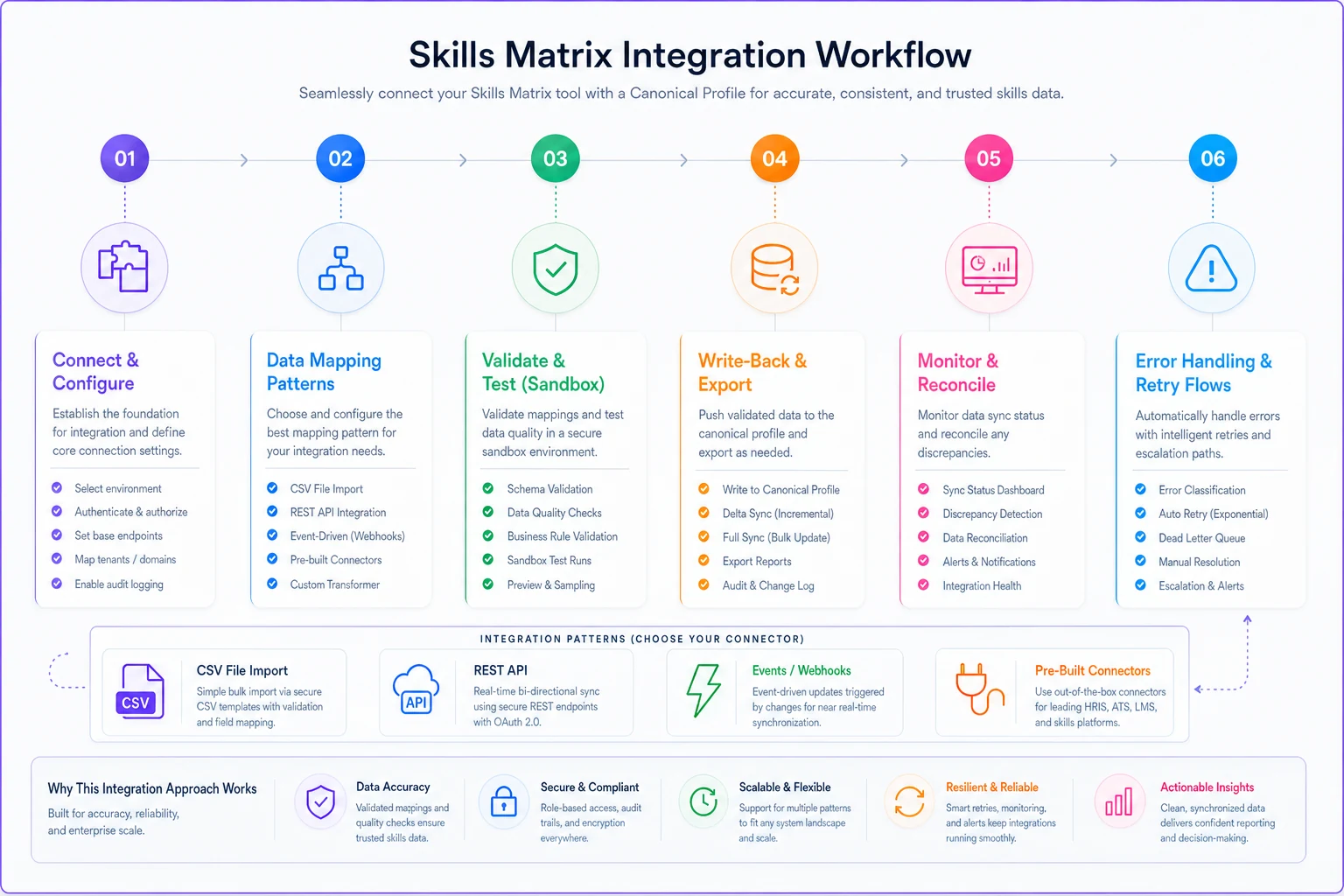
The question most teams forget to ask: can I write back? A large number of skills matrix tools are read-happy and write-shy. They'll happily ingest your HRIS org data and training logs, but when their internal assessments or inferred skills need to flow back into your canonical profile, the only option is a CSV export on a schedule. If your architecture treats the canonical profile as the system of record and the matrix tool as a contributor, a read-only tool quietly inverts that — the matrix becomes the de facto master because its data can't leave cleanly.
A short integration/mapping checklist to the canonical profile
-
- [ ] Every skill in the tool maps to exactly one canonical skill ID (or a documented, lossless aggregation rule)
-
- [ ] Proficiency, evidence, confidence, and recency are separable fields on export
-
- [ ] Skill IDs are stable across renames; merges/splits preserve historical assessments
-
- [ ] Write-back of verified levels and evidence links is supported via API, not just import
-
- [ ] Field mappings in pre-built connectors are inspectable and editable
-
- [ ] Deletions and merges propagate as events, not silent overwrites
-
- [ ] Export includes source attribution (who/what asserted each skill level)
-
- [ ] API rate limits support your full population refresh within your sync window
-
- [ ] There's a sandbox environment for testing mapping changes before production
If a vendor can't provide a sandbox for mapping tests, treat that as a serious integration risk.
That last point sounds minor until you're doing a taxonomy migration against a live system with no sandbox. Mapping mistakes become production incidents, and in skills data, a bad mapping doesn't crash anything — it just quietly produces wrong gap reports that someone makes a hiring decision on.
The 10-criteria scoring matrix
Feature grids with 80 rows all weighted equally produce mush. The tool that wins is usually the one that checked the most trivial boxes. Collapse the decision into ten criteria that actually move the needle, weight them, and force the uncomfortable tradeoffs into the open.
| # | Criterion | Weight | What a 5 looks like | What a 1 looks like |
|---|---|---|---|---|
| 1 | Data-model compatibility with canonical profile | 18% | Rich, separable attributes; stable IDs; lossless round-trip | Flat tags, name-keyed, collapsed attributes |
| 2 | Write-back / bidirectional sync | 14% | Full API write of levels + evidence | CSV export only |
| 3 | Taxonomy governance support (merge/split/versioning) | 12% | History-preserving merges, versioned taxonomy | No versioning, destructive edits |
| 4 | Scale (population + skills × assessments) | 11% | Tested at your headcount × 2 with acceptable latency | Degrades past a few thousand records |
| 5 | Integration pattern fit | 10% | Events + editable connectors + sandbox | Black-box connectors, no sandbox |
| 6 | Evidence & source attribution | 9% | Every assertion traceable to a source | Levels with no provenance |
| 7 | Access control & data governance | 8% | Field-level permissions, consent flags, audit log | Role-only, no audit trail |
| 8 | Migration/export completeness | 7% | Full export incl. history and metadata | Export loses history or attribution |
| 9 | Reporting flexibility against your model | 6% | Query your canonical dimensions | Only vendor's fixed reports |
| 10 | Admin usability for taxonomy ops | 5% | Non-technical admins manage mappings | Needs vendor services for every change |
Two notes on using this. First, weights 1–3 together are 44% of the score — that's deliberate. If a tool scores a 2 on data-model compatibility, no amount of dashboard polish rescues it. Second, treat criterion 8 (migration/export completeness) as a near-veto. A tool you can't fully exit is a tool that owns you, and skills data has a long enough lifespan that you will change vendors at least once. Score your exit on day one.
A worked example
Say you score two finalists. Vendor A dazzles on reporting and usability but stores collapsed proficiency and exports without history. Vendor B is plainer but has separable attributes, stable IDs, and full write-back.
Vendor A: data-model 2 (×18=36), write-back 2 (×14=28), governance 3 (×12=36), scale 4, integration 3, evidence 2, access 4, migration 2 (×7=14), reporting 5 (×6=30), usability 5 (×5=25) → roughly 271 of 500.
Vendor B: data-model 5 (×18=90), write-back 5 (×14=70), governance 4 (×12=48), scale 4, integration 4, evidence 5, access 4, migration 5 (×7=35), reporting 3 (×6=18), usability 3 (×5=15) → roughly 419 of 500.
The room wanted Vendor A after the demo. The weighted model says Vendor B, and it's not close — because the weighting reflects where real cost accrues over a five-year horizon, not where first impressions land.
The RFP template that filters out the wrong vendors fast
Skip the 200-question RFP. It generates marketing-department prose nobody reads. Use a tight one organized around what you can't recover from. Here's the structure:
-
1. Data model. Describe your smallest unit of skill data. List every field you store per skill assertion. Ask the vendor to show, field by field, how each maps into and out of their schema. Require a sample export of a single enriched skill record.
-
2. Identity & lifecycle. How are skills identified? What happens on rename, merge, split, and deprecation? Provide a before/after export of a merge.
-
3. Integration. Which patterns are supported (file, REST, events, connectors)? Is write-back available for assessment levels and evidence links? Is there a sandbox?
-
4. Scale. State your headcount and skills-per-person. Ask for documented performance at 2× that volume — full-population refresh time, API throughput, report-generation latency.
-
5. Governance & access. Field-level permissions? Consent tracking? Immutable audit log of who changed what?
-
6. Exit. Full export format and contents, including history and source attribution. Deletion and data-return terms on termination.
Make vendors answer with artifacts — sample exports, API docs, a sandbox login — not assurances. The ones who can't produce a sample enriched record in a week are telling you something about how the integration project will go.
Sample contract and SLA items worth insisting on
Procurement teams tend to lift SLA language from generic SaaS templates, which cover uptime and support response but miss everything specific to skills data. The clauses that save you later:
-
Data portability guarantee. Full export, including historical assessments, evidence links, and source attribution, in a documented machine-readable format, available on demand and within a fixed window on termination.
-
Schema change notice. Advance written notice (30–60 days) before any breaking change to their data model or API, with a migration path.
-
API availability and throughput SLA. Not just "99.9% uptime" — commit to rate limits sufficient for full-population sync within your window, with credits if throttling blocks a scheduled refresh.
-
Mapping accuracy during onboarding. If the vendor performs initial taxonomy mapping, define an accuracy acceptance threshold and a remediation obligation.
-
Deletion and return on exit. Certified deletion of your data after export confirmation, with a defined retention tail for legal holds.
The goal here is narrow — make sure the data-model and portability clauses are present, because standard SaaS agreements almost never include them.
Vendor interview questions that expose the truth
Demos are rehearsed. Live questions aren't. Ask these in a working session, screen shared:
-
"Rename a skill right now and show me what happens to the historical assessments attached to it."
-
"Merge these two duplicate skills live. Where does the history go?"
-
"Export one person's full profile and walk me through every field — I want to see proficiency, evidence, source, and recency as separate values."
-
"Push a verified skill level from an external system back into a profile via your API. Show me the call."
-
"How many records are in your largest production customer, and what's their full-population refresh time?"
The merge question alone sorts vendors fast. The strong ones answer calmly and demonstrate. The weak ones get vague, promise to "follow up with engineering," or reveal that merging is destructive. You just saved yourself a year of pain for the price of one awkward pause on the call.
A real scenario
A mid-size engineering org — a bit over 3,000 employees — ran a conventional procurement a few years back. They scored heavily on reporting and manager usability, picked the flashy option, and rolled it out. For about a year it looked fine.
The trouble started when they tried to feed verified skills from the matrix tool back into their central profile store to drive internal mobility. The tool only exported scheduled CSVs, proficiency came through as a single collapsed number with no evidence or recency, and skills were keyed on name — so a taxonomy cleanup that merged roughly 400 duplicate skills orphaned a large chunk of historical assessments. Gap reports stopped being trustworthy, managers quietly reverted to resumes and gut feel, and the "single source of truth" got demoted to a reporting silo.
The re-selection used a weighted model close to the one above, with data-model compatibility and write-back carrying the most weight. The replacement wasn't the prettiest tool in the shortlist, but it had stable IDs, separable attributes, and full API write-back. Re-integration took somewhere in the range of four to five months — and would've been far cleaner if they'd scored exit and portability the first time around.
The qualitative outcome mattered more than any single metric: profiles became trustworthy enough that mobility decisions actually ran off them again. That's the whole point of the exercise.
When this rigor makes sense — and when it's overkill
When it makes sense: You maintain (or are building) a canonical skills profile as a system of record, you have multiple systems that need to read and write skills data, and you expect your taxonomy to evolve. At enterprise scale, the integration and migration costs dwarf the license fee, so the data-model lens pays for itself many times over.
When it's overkill: A small org running a self-contained skills matrix for one team, with no ambition to integrate it into a broader data architecture, doesn't need a 10-criteria weighted model and a portability clause. If the tool is an island by design and will stay that way, buy on usability and move on.
Who should not lead this evaluation on features alone: Anyone who's only seen the demo. The demo is optimized for the parts of the decision that don't predict failure. Whoever owns your data architecture needs a real vote — not a sign-off at the end, but a seat during scoring.
The teams that get this right treat skills matrix selection as a data-architecture decision that happens to have a nice UI, not a UI decision that happens to involve data. That reframe alone changes who's in the room and what gets weighted.
Closing thought
The tools that survive in enterprise skills programs aren't the ones that demo best. They're the ones whose data model respects yours, that let data flow both ways without losing meaning, and that you can walk away from with your history intact.
Score for that — weight it heavily, test it live, and write it into the contract — and you'll avoid the eighteen-month disillusionment cycle that quietly claims most skills matrix deployments. If you haven't yet nailed down the canonical profile that everything maps to, start there with the architecture and migration playbook, then come back to this guide and shortlist against it.
The tools that survive in enterprise skills programs aren't the ones that demo best. They're the ones whose data model respects yours, that let data flow both ways without losing meaning, and that you can walk away from with your history intact.
Score for that — weight it heavily, test it live, and write it into the contract — and you'll avoid the eighteen-month disillusionment cycle that quietly claims most skills matrix deployments. If you haven't yet nailed down the canonical profile that everything maps to, start there with the architecture and migration playbook, then come back to this guide and shortlist against it.
Ready to elevate your team's skills?
Join 500+ companies using Talioly to boost skill visibility, streamline training, and drive performance growth.