

Most skills programs don't fail because someone picked the wrong competency framework. They fail because the data underneath them was never built to survive contact with a real HR stack. Assessment scores live in one system, learning completions in another, project history buried in a PM tool, and the "skills profile" is really just a spreadsheet someone updates when they remember to.
Everyone knows it's a mess. What people underestimate is how fast it compounds as the organization grows. A 400-person company can survive on manual reconciliation. A 12,000-person company running skills-based staffing across regions cannot. The data model you get away with early becomes the thing blocking every downstream decision later — internal mobility, workforce planning, redeployment, all of it.
This is a systems piece. Not "here are five tools to buy," but how the pieces connect, where the pressure points are, and how to migrate without torching your existing HR ecosystem.
The core problem: skills data has no natural home
Payroll has a system of record. So does headcount, benefits, and time tracking. Skills data doesn't. It's generated everywhere and owned by no one.
Think about where a single employee's skill signals actually originate:
-
The LMS knows what they completed
-
The performance system knows what their manager wrote
-
The ATS knows what they claimed when hired
-
Jira, GitHub, Salesforce, or the CRM knows what they actually did
-
A certification vendor knows what they passed
-
The internal mobility tool knows what they applied for
Each of these systems thinks it owns a piece of the truth. None of them agree on employee identity, none of them use the same skill labels, and none of them were designed to hand data to each other cleanly. So the "skill profile" becomes whatever the last integration happened to write.
The pattern worth noticing: organizations don't have a skills data problem, they have a skills reconciliation problem. The raw signals exist. What's missing is an architecture that decides which signal wins, how fresh it needs to be, and how confident you are in it. Get that wrong and you'll spend the next two years arguing about why the dashboard says a senior engineer has "no cloud skills" when she's been running your Kubernetes migration.
Pattern 1: The canonical profile model
The canonical profile is the single, authoritative representation of an employee's skills — the thing every downstream system reads from instead of building its own version. Not the source of every signal, but the agreed-upon output after all signals are merged.
Stop losing track of critical skills.
Talioly helps you track, develop, and certify your workforce efficiently.
- Centralized skill profiles
- Automated training reminders
- Competency gap analysis
No credit card required
A workable canonical profile has a few structural properties most homegrown versions skip:
Separation of raw signals from resolved state. You keep the individual evidence events (completed course, passed assessment, shipped project) and the computed conclusion (proficiency level 3 in "data modeling"). If you only store the conclusion, you can never re-derive it when your logic improves or when someone challenges the score.
A stable identity layer. Every signal has to resolve to one person. Sounds obvious until you realize the LMS uses employee email, the HRIS uses employee ID, and the contractor system uses a vendor-assigned code. If identity resolution isn't a deliberate layer, profiles fracture the moment someone changes their name or moves between worker types.
Confidence and provenance on every skill claim. A skill inferred from three shipped projects is not the same as a skill someone checked a box for. The canonical model has to carry where a claim came from and how much you trust it, or every consumer downstream treats a self-rating and a validated assessment as equal — which is how you end up promoting the wrong people.
A temporal dimension. Skills decay. A cloud certification from 2019 is not current evidence. The profile needs to know when each signal was captured so staleness can be reasoned about instead of ignored.
The mistake that shows up most often at this layer: teams model the canonical profile as a flat list of skills with levels, then bolt on confidence and dates later as an afterthought. It never works. Those attributes are structural. Retrofitting them means reprocessing your entire signal history, and by then you have millions of records.
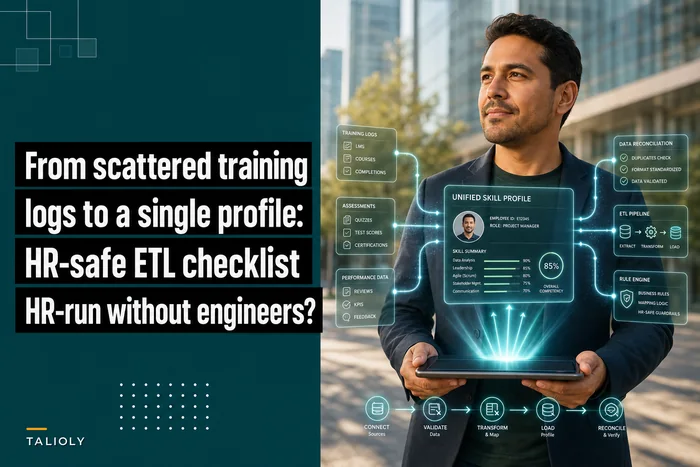
If you're still consolidating raw sources into anything resembling a single profile, the sequencing matters a lot — this walkthrough of moving from scattered training logs to a single employee skill profile covers the ETL groundwork that has to happen before a canonical model is even worth attempting.
Pattern 2: Event vs batch — the tradeoff nobody costs out properly
Once you have sources feeding a canonical profile, you have to decide how data moves. This is where a lot of architectures quietly choose the expensive option by accident.
Batch means you pull from each source on a schedule — nightly, weekly — reprocess, and rewrite profiles. Event-driven means each source pushes a change the moment it happens (course completed → event fires → profile updates within seconds).
| Dimension | Batch | Event-driven |
|---|---|---|
| Freshness | Hours to a day | Seconds |
| Engineering complexity | Low–moderate | High |
| Cost to operate | Predictable, lower | Higher, ongoing |
| Debuggability | Easy — rerun the batch | Hard — trace individual events |
| Best for | Learning, certs, performance data | Access provisioning, marketplace matching |
| Reconciliation ease | Simpler | Requires careful ordering logic |
The pattern that actually holds up at scale is hybrid, chosen per source based on decision latency. Ask a blunt question for each signal: what decision depends on this being fresh? If the answer is "someone might get matched to a project tomorrow," nightly batch is fine. If the answer is "system access should revoke the moment a contractor's engagement ends," that's a genuine event-driven case.
Default to nightly batch for slow-moving talent signals and reserve event-driven only where sub-minute freshness changes a decision.
A useful example: a company with around 6,000 employees piped every skills signal through an event stream because a vendor recommended it. Two engineers spent most of a year babysitting the pipeline — reprocessing out-of-order events, chasing why some profiles updated and others didn't. When they moved learning and performance data back to nightly batch and reserved events only for access and marketplace matching, the on-call load dropped to almost nothing and profile accuracy actually went up, because batch made reconciliation deterministic.
Where teams go wrong: they pick one mode for the whole system. The right unit of decision is the individual data source, not the platform.
Pattern 3: The reconciliation layer
This is the part that separates a skills architecture that works from one that generates constant arguments. When two sources disagree — the assessment says level 2, the shipped work implies level 4 — something has to decide. That "something" should be an explicit, inspectable layer, not logic scattered across whichever integration ran last.
A reconciliation layer does four jobs:
-
Identity resolution — collapse all the source-specific IDs into one person.
-
Skill mapping — translate each source's vocabulary into your canonical taxonomy (the LMS's "Advanced Excel" and the assessment's "Spreadsheet Modeling" resolving to the same node).
-
Conflict resolution — apply rules for which signal wins when sources disagree, weighted by confidence and recency.
-
Staleness handling — downgrade or flag claims that have aged past their useful life.
The single biggest failure mode here is hidden reconciliation logic. When the "which source wins" rules live inside an integration script nobody documented, every skills dispute becomes an archaeology project. Someone challenges their profile and it takes an engineer half a day to reconstruct why the system concluded what it concluded.
Make the rules explicit and legible to HR. Something like: validated assessment beats manager rating beats self-report; work-artifact evidence can raise a level but only with two or more corroborating signals; anything older than 18 months drops one confidence tier. Whether or not those exact thresholds fit your situation, the point is that a talent professional should be able to read the rules and predict the outcome. If only engineering can explain a profile, you don't have an architecture, you have a black box.
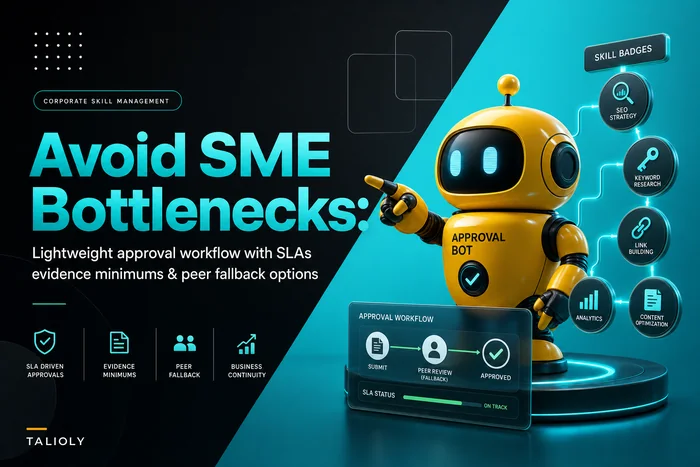
There's also a human bottleneck hiding in reconciliation: edge cases that rules can't settle need a person to adjudicate. If you don't design that path deliberately, it defaults to "email the L&D team and wait." A lightweight approval flow with clear ownership keeps it from becoming a swamp — the same logic behind avoiding SME bottlenecks with SLAs and peer fallback applies directly to skill-claim exceptions.
A decision matrix for common HR stacks
The right architecture depends heavily on what you're already running. Below is how the patterns tend to shake out across common setups. Treat it as a starting orientation, not gospel — your integration maturity matters as much as the vendor names.
| Your stack looks like… | Canonical profile approach | Integration mode | Biggest risk to watch |
|---|---|---|---|
| Single big HCM suite (Workday, SAP SuccessFactors) with skills add-on | Use the suite's skills object as canonical, augment with external evidence | Batch for most, API for the suite | Vendor lock-in; weak confidence/provenance modeling |
| Best-of-breed (separate LMS, ATS, performance, mobility tools) | Build an independent canonical layer outside all of them | Hybrid per source | Identity resolution across five vendors |
| Lightweight / mostly spreadsheets and one LMS | Start with a simple resolved profile store; skip events entirely | Batch only | Over-engineering before you have volume |
| Suite + heavy homegrown internal tools | Canonical layer that treats the suite as one source among many | Events for internal tools, batch for suite | Reconciliation rules sprawling across custom code |
| Post-merger, two of everything | Canonical layer is non-negotiable; it's the only neutral ground | Batch first, stabilize, then selectively event | Duplicate identities and conflicting taxonomies |
When a standalone canonical layer makes sense: you're best-of-breed, mid-merger, or your suite's native skills model can't carry confidence and provenance. If three or more systems generate meaningful skill signals, build the neutral layer.
When it's overkill: you're under a few hundred people with one or two sources. A resolved profile table with clear update rules will serve you fine, and building a reconciliation engine you don't need is a classic way to burn a year producing infrastructure instead of outcomes.
Who should NOT do this yet: organizations whose taxonomy still changes every quarter. If the canonical vocabulary isn't stable, every mapping you build gets invalidated. Stabilize the taxonomy first — the architecture assumes it as a foundation.
The migration playbook: aligning engineering and HR
Migrations die in the gap between HR and engineering. HR describes outcomes ("we need accurate profiles"), engineering hears requirements that keep shifting, and six months in nobody can agree on whether the project is on track. The fix is to make the migration a shared, staged sequence with checkpoints both sides can actually read.
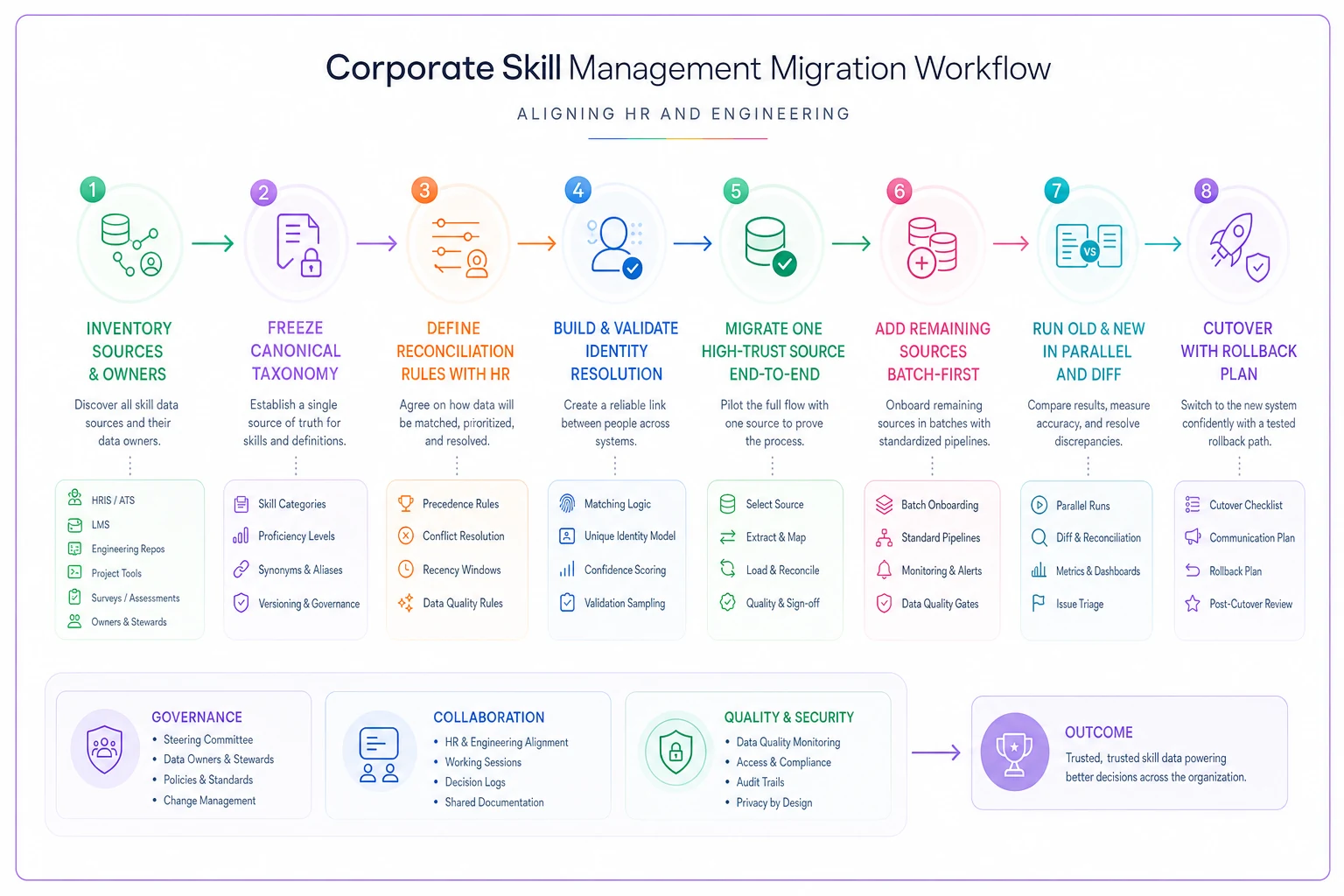
Here's a sequence that's held up across messy environments:
-
Inventory every signal source and its owner. Not just the system — the human who owns the data quality. If a source has no owner, that's your first problem, and it's not a technical one.
-
Freeze the canonical taxonomy. Lock the version you'll map against. Migrating onto a moving target is the most common reason these projects stall out.
-
Define reconciliation rules in plain language, with HR in the room. Precedence, confidence tiers, staleness thresholds. Write them so a non-engineer can predict outcomes. This document is the contract between the two teams.
-
Build identity resolution first, and validate it in isolation. Nothing else works if people don't resolve correctly. Sample a few hundred employees across worker types and verify each resolves to exactly one profile before you build anything on top.
-
Migrate one source end-to-end as a vertical slice. Pick the highest-trust source (usually validated assessments or certifications), run it all the way through reconciliation into a canonical profile, and have HR review a real cohort. Prove the pipeline on one source before fanning out.
-
Add remaining sources one at a time, batch by default. Only promote a source to event-driven when a specific decision demands the freshness. Resist doing them in parallel — that's how you lose the ability to tell which source introduced a bug.
-
Run old and new in parallel before cutover. Keep the legacy profiles alive and diff them against the new ones for a few weeks. Investigate every meaningful disagreement. Most will teach you something about a reconciliation rule you got slightly wrong.
-
Cut over with a documented rollback. Boring but essential. Skills data feeds staffing and mobility decisions — you don't want a bad migration silently misrouting people for a pay cycle.
The coordination insight underneath all of this: HR owns the rules, engineering owns the plumbing, and the reconciliation-rules document is where they meet. When those rules live only in code, HR can't validate outcomes and engineering gets blamed for business decisions they never made. When the rules are written down and legible, disputes become "let's check the rule" instead of "let's open a ticket."
A simple diagram captures the staged migration flow.
A checklist before you cut over
-
[ ] Every source has a named data owner
-
[ ] Canonical taxonomy version is frozen and documented
-
[ ] Reconciliation rules are written in plain language HR has signed off on
-
[ ] Identity resolution validated against a real sample across all worker types
-
[ ] At least one source proven end-to-end before others were added
-
[ ] Confidence and provenance stored on every skill claim
-
[ ] Staleness handling is active, not theoretical
-
[ ] Parallel-run diffs reviewed and explained
-
[ ] Rollback path documented and tested
Running through this checklist as a team — not just as an engineering sign-off — is what actually surfaces the gaps before cutover rather than after.
Real scenario: a best-of-breed manufacturer untangling five sources
A manufacturing company, roughly 8,000 employees across several plants, was running an LMS, a separate performance platform, an ATS, a certifications vendor, and a homegrown project-staffing tool. Each had its own interpretation of what "welding certification level 2" or "PLC programming" meant. Their internal mobility team couldn't trust any single profile, so they were manually vetting candidates for every open role — someone estimated it was eating a day or two of a coordinator's week per plant, on top of roles going unfilled because qualified people never surfaced.
The turning point wasn't buying a new tool. It was building a thin reconciliation layer, writing the precedence rules down (certs beat self-report, project history could raise a level with corroboration, anything over roughly 18 months lost a confidence tier), and validating identity resolution first — which immediately exposed several hundred employees who existed as duplicate records because contractors had been converted to full-time without merging IDs.
They migrated the certifications source first, then added the rest on nightly batch over about a quarter, reserving event-driven updates only for the staffing tool where match freshness actually mattered. After parallel-running for a few weeks and chasing down the diffs, the mobility team stopped manually vetting and started trusting the canonical profile for shortlisting. Time-to-fill on internal roles improved noticeably, and — the quieter win — the arguments about "why does the system say this" mostly stopped, because anyone could read the rules and follow the logic.
Where this leaves you
Skills data architecture isn't a modeling exercise you finish once. It's an operating system for every talent decision that depends on knowing who can do what — and like any system, it's only as good as its weakest connection.
The canonical profile gives you one truth to read from. Event-versus-batch decisions, made per source, keep you from over-building. And the reconciliation layer, with rules written in language HR can actually read, is what keeps the whole thing honest as it scales.
The organizations that get this right aren't the ones with the fanciest infrastructure. They're the ones who decided early that reconciliation logic belongs in the open, that identity resolution comes before everything else, and that HR and engineering share one document instead of two separate mental models. Do that, and the migration stops being a two-year slog and starts being a sequence you can actually finish.
Skills data architecture isn't a modeling exercise you finish once. It's an operating system for every talent decision that depends on knowing who can do what — and like any system, it's only as good as its weakest connection.
The canonical profile gives you one truth to read from. Event-versus-batch decisions, made per source, keep you from over-building. And the reconciliation layer, with rules written in language HR can actually read, is what keeps the whole thing honest as it scales.
The organizations that get this right aren't the ones with the fanciest infrastructure. They're the ones who decided early that reconciliation logic belongs in the open, that identity resolution comes before everything else, and that HR and engineering share one document instead of two separate mental models. Do that, and the migration stops being a two-year slog and starts being a sequence you can actually finish.
Ready to elevate your team's skills?
Join 500+ companies using Talioly to boost skill visibility, streamline training, and drive performance growth.