



The July core PCE reading landed at 3.3% year-over-year, and if you work in talent development, that number is going to reach your budget before the headlines fade. When the Fed's preferred inflation gauge stays sticky, the CNBC report on July's core prices basically signals that rates stay higher for longer, corporate budgets tighten, and someone in Finance circles your L&D line item asking what it actually returns.
This isn't a forecast. It's a pattern. And the labor picture underneath it makes the squeeze worse—the Reuters coverage of the BLS revisions showed the economy added 79,000 fewer jobs over the year through March than first reported. Softer hiring means fewer external hires get approved, which pushes more capability demand onto internal development at exactly the moment your budget is under review. You're being asked to do more with less, and prove it.
This piece isn't about the macro. It's about what you actually do in the next 30 to 60 days to protect capability without a bigger budget—and how to talk about upskilling ROI in a way that survives a spreadsheet audit.
The real problem isn't the budget cut—it's that you can't prove where the money goes
The uncomfortable part most talent teams don't say out loud: when Finance asks "what's the ROI on training?", most L&D leaders can't answer with numbers. They can show completion rates, satisfaction scores, hours delivered. None of that is ROI. It's activity.
Budgets get cut first in a downturn not because leadership hates development, but because development spend is one of the few large line items with no defensible return attached to it. Sales has pipeline. Marketing has attribution (even if it's shaky). L&D has "94% of participants found the workshop valuable." That gets cut.
The deeper issue tightening budgets expose is that most organizations fund training by category rather than by outcome. You have a leadership program, a compliance track, a technical academy—each with a budget line, each renewed annually out of habit. Nobody knows which specific skills, developed in which specific people, actually moved a business result. When money is loose, that vagueness is tolerated. When core inflation stays at 3.3% and rates hold, it isn't.
That's the gap you need to close. Not with a better dashboard—with triage.
Triage first: separate must-fund from nice-to-fund before anyone forces you to
When budget pressure hits, the instinct is to cut evenly—shave 15% off everything. That's the worst possible move. Even cuts weaken your highest-return work as much as your lowest, and they signal to leadership that you don't know which is which.
Stop losing track of critical skills.
Talioly helps you track, develop, and certify your workforce efficiently.
- Centralized skill profiles
- Automated training reminders
- Competency gap analysis
No credit card required
Run a fast triage against two questions instead: Does this skill map to a near-term business risk or revenue driver? And can we verify who actually has it?
| Tier | Criteria | Budget stance | Example |
|---|---|---|---|
| Protect | Skill tied to a committed roadmap item, revenue function, or compliance exposure in the next 2 quarters | Fully fund, measure hard | Cloud migration skills for a team shipping infra work in Q4 |
| Redeploy | Capability already exists internally but is misallocated or invisible | Near-zero cost—verify and move people | A team of five who did automation work on a shelved project |
| Defer | Broad "good to have" development with no near-term demand signal | Pause without apology | General leadership workshops with no attached role opening |
| Cut | Legacy programs renewed by habit, low usage, no verified outcome | End it, redirect the dollars | The annual off-site nobody could tie to a result |
The single biggest win here is usually the Redeploy tier, and it's the one most teams skip. When hiring slows, the cheapest capability you can get is the capability you already paid for and forgot about. But that only works if you can actually see who has what skill—verified, not self-reported.
Prioritize verifying redeployable talent first—it's often the highest ROI and costs nothing new.
One pattern worth naming: teams over-invest in the Protect tier and under-invest in verification. They'll fund the training but never confirm who came out the other side with a usable skill. That's how you end up spending money and still not being able to answer the ROI question three months later.
Why verified skill profiles are the whole game right now
You cannot triage what you can't see. And you cannot redeploy people whose actual capabilities live in a manager's memory, a LinkedIn profile, or a training log that says "completed."
A verified skill profile means the skill is backed by evidence—a work artifact, a peer-reviewed assessment, a shipped project—not a checkbox. The difference matters enormously when budgets tighten, because redeployment decisions and shortlist decisions are only as good as the data underneath them.
-
Post externally—blocked by the freeze.
-
Ask around—slow, biased toward whoever managers happen to remember.
-
Query verified skill profiles—surface the four people across other teams who've shipped comparable pipeline work in the last 18 months.
Only the third option is fast and defensible. And it costs nothing in new headcount. Organizations that get through a tightening cycle without losing capability are the ones who treated their skill data like an operational asset before they needed it.
This is where operational software with AI automation earns its place quietly—not as a magic answer, but as the thing that keeps profiles current. Skill data rots fast; people learn things, ship projects, and move on without anyone updating a record. Automation that captures work artifacts—merged code, closed tickets, published designs—and attaches them to profiles as evidence is what keeps the data trustworthy enough to act on. Without that, verified profiles decay into the same stale logs you were trying to escape.
The rapid upskilling pilot: prove one number, defend the whole budget
Triage tells you where to spend. A pilot proves the spend works. And in a budget review, one clean pilot with a real before/after beats a hundred slides of activity metrics.
-
Pick one skill tied to a Protect-tier need. Something with a business metric already attached—cycle time, error rate, deal velocity. If you can't name the metric, pick a different skill.
-
Baseline it before you train anyone. Measure current performance on that metric for the target group. Skip this and your ROI number is guesswork.
-
Define a stop/go threshold up front. Decide now what result justifies scaling and what result kills it. Writing this before you start is what makes the pilot honest.
-
Train a tight cohort—8 to 15 people. Small enough to support properly, big enough that the result isn't noise.
-
Verify the skill, don't assume it. Confirm the capability with a work artifact or assessment, not a completion record.
-
Compare, report, decide. Measure the same metric after. Report the delta in plain business language. Scale or stop.
If you want the fuller version of this with baseline templates and stakeholder-communication scaffolding, the 6-step plan for running an upskilling pilot that proves ROI walks through each step in more depth. The core idea is the same: prove one number cleanly, then use it as leverage.
Here's a quick visual of the pilot sequence.
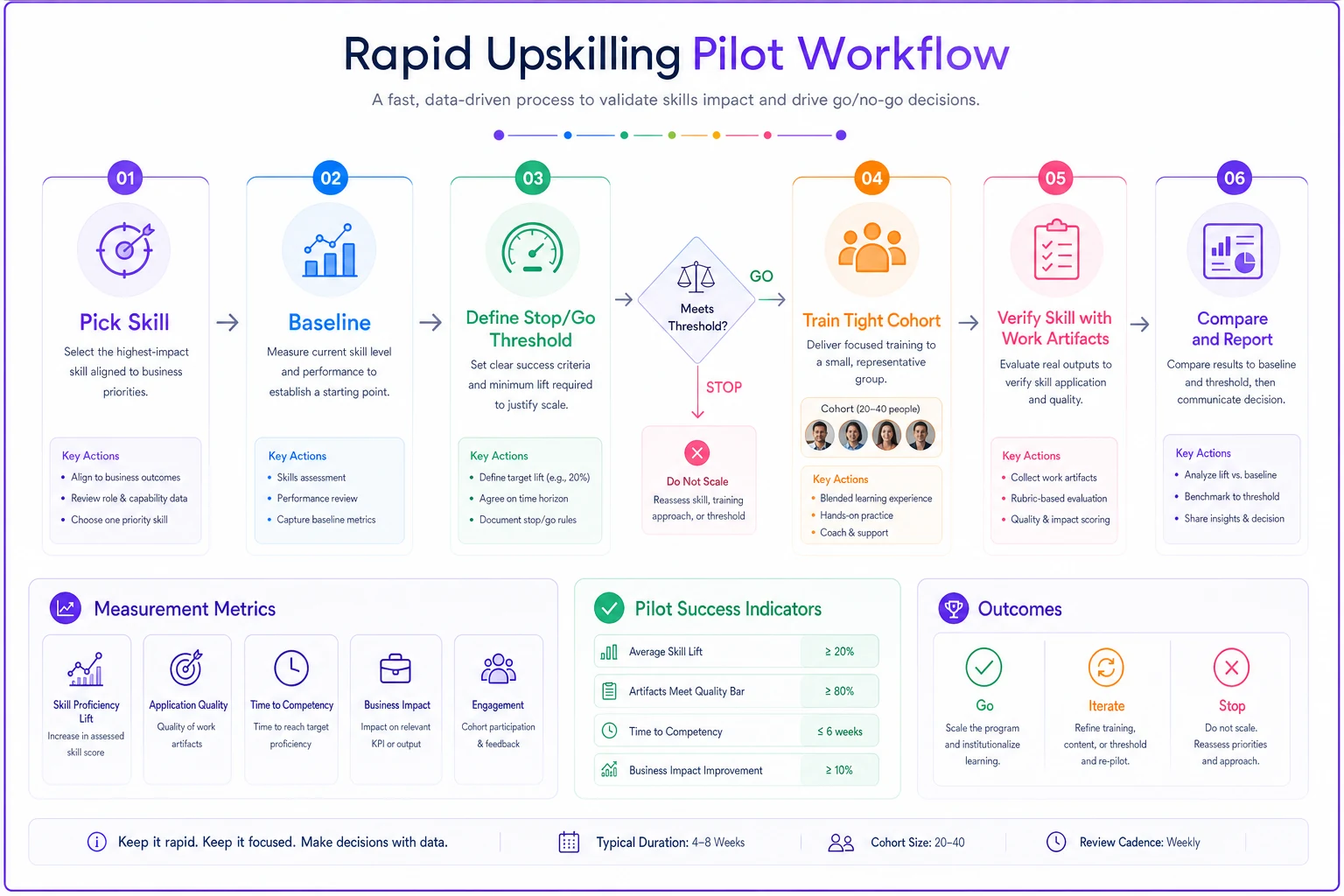
The mistake most teams make is running the pilot too big. They try to upskill 200 people across four skills and end up with results too noisy to attribute to anything. Keep it small enough to measure and short enough to report before the next budget cycle.
A real scenario: what a defensible pilot actually looks like
A regional insurance operations team—roughly 60 people in claims processing—was told to cut L&D by about a third heading into a tight quarter. Instead of trimming evenly, the talent lead ran a triage and found that claims handling errors were driving costly rework and adjuster escalations.
They picked one skill: a specific documentation-and-adjudication workflow where errors clustered. Baseline: the target cohort was rework-flagged on roughly 18% of files. They trained a cohort of about a dozen adjusters over three weeks, then verified competency by reviewing actual processed files rather than quiz scores.
Six weeks later, the cohort's rework rate had dropped to somewhere around 9–10%. Not perfect, not a miracle—but a clear, roughly halved error rate on a metric Finance already tracked. Translated into avoided rework hours and reduced escalations, the pilot paid for itself several times over within the quarter.
The point wasn't the exact number. It was that when the budget meeting came, the talent lead didn't argue about the value of learning. They pointed at a rework rate that moved and said: fund the next cohort. That conversation is completely different from defending "hours delivered."
Shortlisting rules that produce proof, not politics
Redeployment falls apart when it becomes a popularity contest. Managers recommend people they know, titles get treated as proxies for skill, and the actually-qualified person on another team never surfaces. Under budget pressure, that waste is expensive—you're paying to hire or train capability you already own.
-
Match on verified skills, not job titles. A title tells you what someone was hired to do, not what they can do now. Query the skill, backed by evidence.
-
Require at least one work artifact per shortlisted skill. No artifact, no shortlist. This kills self-reporting inflation instantly.
-
Cap the shortlist and log the reasons. Five candidates, each with the evidence that put them there. Auditable and fast.
-
Time-box manager review with an SLA. A shortlist that sits for three weeks isn't redeployment, it's a bottleneck. Give managers a few days to respond or the slot moves on.
-
Check skill freshness. A skill used four years ago isn't the same as one used last quarter. Weight recent, verified evidence higher.
The teams that get redeployment right treat it like an operational service with rules and SLAs, not a favor exchanged between managers.
When this playbook makes sense—and when it doesn't
When it makes sense: You're facing real budget scrutiny, you have at least some skill data to work with, and you have one or two business metrics you can baseline against. That's the situation most talent teams are walking into this quarter.
When it's a bad idea: If your skill data is entirely self-reported and unverified, don't rush a redeployment campaign on top of it—you'll move the wrong people and burn credibility. Fix data quality on your top few critical skills first, then redeploy. A small set of trustworthy profiles beats a large set of guesses.
Who should not do this: If leadership hasn't actually signaled budget pressure, resist running defensive pilots preemptively. Over-measuring low-stakes programs wastes your team's time and trains stakeholders to tune out your numbers. Save the rigor for the work that's genuinely under threat.
What to do in the next 30 days
The macro isn't going to hand you a clearer quarter. Sticky core inflation means the budget conversation is coming, and the teams that walk into it with triage tiers, one clean pilot result, and evidence-backed shortlists are the ones that keep their capability intact.
Start narrow. Triage your programs into protect, redeploy, defer, and cut. Pick one Protect-tier skill and baseline it this week. Run a tight pilot with a stop/go threshold you commit to in advance. And clean up verification on your handful of most critical skills so redeployment is an option instead of a wish.
None of this requires a bigger budget. It requires knowing—precisely, with evidence—where your capability lives and what it returns. That's the difference between being the line item that gets cut and being the function leadership asks how to do more with what's already there.
Ready to elevate your team's skills?
Join 500+ companies using Talioly to boost skill visibility, streamline training, and drive performance growth.