


Most heatmaps die the same way. Someone builds a beautiful grid of skills versus quarters, colors it red-yellow-green, presents it in a workforce planning review, everyone nods, and then nothing moves. Three months later the same reds are still red, except now two of the people who could have filled those gaps have left, and a role you could've filled internally got posted to an agency at a 25% markup.
The problem isn't the visualization. A talent supply demand heatmap is easy to make. The hard part is wiring it to decisions — so that a specific shade of red on a specific cell kicks off a specific action with a named owner and a deadline. That's what separates a reporting artifact from an operating system.
This workbook is about that wiring. Not the color scheme.
Why most heatmaps stall at "interesting"
The typical heatmap answers one question: where are we short? Useful for about ten minutes. But it doesn't answer the four questions that actually drive a decision:
-
How urgent is it? A skill gap you'll hit in Q4 is not the same as one you're bleeding on right now.
-
Can we build it or must we buy it? Redeployment potential changes everything about cost and timeline.
-
Is the "supply" number even real? Self-reported capacity inflates by 30–40% in most orgs.
-
Who owns the next move, and by when?
When a heatmap only shows demand versus rough headcount, it collapses all four into one flat color. So people argue about the color instead of acting on it. What happens in most workforce planning cycles is that the debate isn't "is this red?" — it's "what does red mean we do?" And nobody agreed on that upfront.
The fix is to stop treating the heatmap as a single layer. It's four layers stacked on the same grid.
The four layers that make heat actionable
A workbook that actually triggers action holds four data layers per skill-by-time-period cell. Keep them as separate columns feeding one visual, not a single blended score. Blended scores hide the reasoning, and hidden reasoning is what makes stakeholders distrust the whole thing.
Stop losing track of critical skills.
Talioly helps you track, develop, and certify your workforce efficiently.
- Centralized skill profiles
- Automated training reminders
- Competency gap analysis
No credit card required
| Layer | What it measures | Common failure |
|---|---|---|
| Time-phased demand | Skill units needed per quarter, tied to roadmap/pipeline | Static annual number instead of phased |
| Verified capacity | Confirmed skill supply, not self-reported | Counting stale or unproven proficiency |
| Redeployment potential | People one stretch away from covering the gap | Ignored entirely; defaults to hiring |
| Hiring urgency | Lead time vs. time-to-need | Treated as constant, so everything feels urgent |
The demand layer is where a lot of teams already have partial work done. If you've mapped your product or delivery plans into phased skill needs, you're most of the way there — this is exactly the kind of input covered in turning product roadmaps into time-phased skills demand, and the heatmap is really the consumption layer sitting on top of that planning.
The layer people skip is redeployment potential, and it's the one that saves the most money. A cell might look bright red on the demand-versus-capacity view, but if you have four people who are one 6-week stretch assignment away from covering it, that's not a hiring problem. It's a development problem with a much lower price tag.
Verified capacity: the number that quietly breaks everything
The operational pattern that wrecks heatmaps more than any other: the supply number is fiction.
A manager tells you the team "has cloud skills." What that actually means is two people are strong, one shipped something two years ago, and one took a course. If your heatmap counts all four as capacity, you've just painted a red cell green and told leadership you're covered on something you're not. Then Q3 hits, the work stalls, and you're hiring in a panic at premium rates — the most expensive kind of hire there is.
Verified capacity means the supply number only counts proficiency backed by something real: recent work artifacts, a validated assessment, a completed stretch assignment. Everything else gets a confidence discount or drops to zero.
-
Full count — verified in the last 12 months (artifact, assessment, or delivered work)
-
Half count — proficiency exists but evidence is 12–24 months old
-
Zero count — self-reported only, or older than 24 months
Apply that and watch what happens. In most orgs, "we're covered" cells start turning yellow. That's not the tool being pessimistic — that's you finally seeing the real gap before it becomes an emergency.
Turning heat into triggers
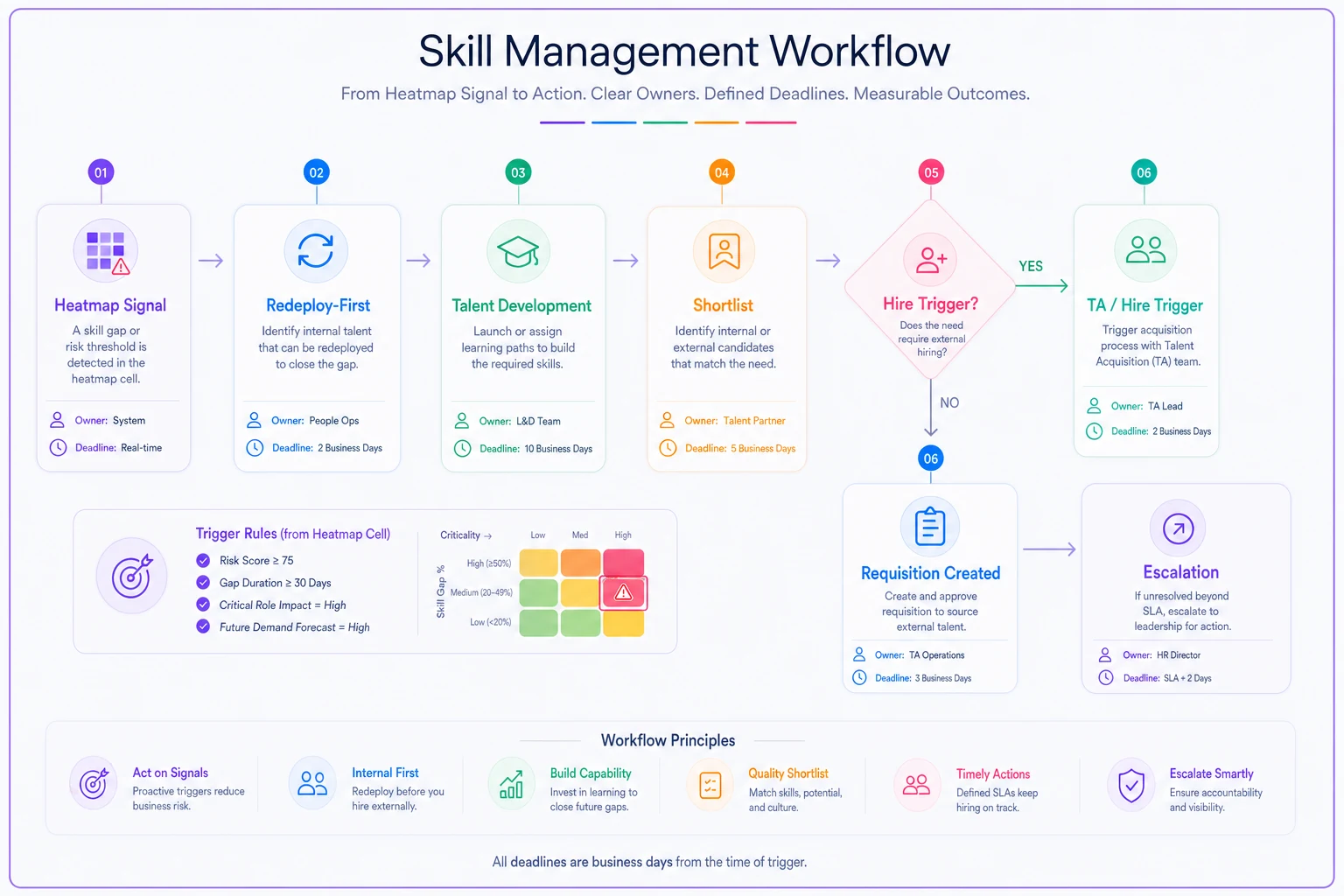
This is the whole point of the workbook. Each cell doesn't just get a color — it gets a trigger rule that fires an action when conditions are met. No monthly meeting required to decide whether to act. The rule already decided.
-
Redeploy-first trigger — Gap exists AND ≥2 people within one stretch assignment → open an internal development track before any external req. Owner: talent development. SLA: shortlist within 5 business days.
-
Hire trigger — Gap exists AND redeployment pool is empty AND time-to-need is shorter than average hiring lead time → open a requisition now. Owner: TA lead. Flag as urgent.
-
Watch trigger — Gap is forecast but ≥2 quarters out AND some redeployment potential exists → assign a monitor, revisit next cycle. No action yet, but a named owner.
-
Capacity-verification trigger — Cell shows green but rests on unverified supply → route to skills validation before trusting it. This one prevents the fake-green disaster above.
-
Escalation trigger — Same red cell survives two consecutive cycles unresolved → escalate to the funding conversation, because it's now a budget decision, not an ops decision.
Visual flow of triggers to actions.
The escalation trigger is where the heatmap connects to money. A red cell that won't die usually isn't a talent problem — it's an unfunded priority. Tying it back to a proper funding model, like the cross-functional approach in talent allocation governance, is what stops the heatmap from being a place where problems go to be admired.
Handoffs: the part everyone underbuilds
Triggers fire actions. Actions need owners. And owners need clean handoffs, or the whole thing stalls at the seam between two teams — exactly where most talent processes leak.
A handoff isn't "TA now owns this." It's a defined package: what's being handed over, what's already been decided, what the receiving team is expected to return, and by when. Without that, TA gets a vague "we need a data engineer maybe?" and burns a week clarifying what talent development already knew.
-
Talent development runs the redeploy-first trigger, confirms the pool is empty or too slow
-
They hand TA a package
the verified skill gap, the failed redeploy attempt (so nobody re-litigates it), the time-to-need date, and the internal comp band already benchmarked
-
TA owns sourcing; returns a candidate slate or an "unfillable in timeframe" flag by the SLA date
-
If unfillable, that flag routes straight to the escalation/funding trigger — no dead end
Every handoff should answer: what did the previous owner already rule out? Skipping this is why teams redo each other's work and why the same gap gets "discovered" three times in a quarter.
A real scenario
A mid-sized professional services firm — roughly 400 people, heavy project delivery — kept getting blindsided on data engineering capacity. Every planning cycle the heatmap showed green, and every other quarter a project slipped because the "available" engineers were either fully allocated or not actually current.
When they rebuilt the workbook with verified capacity, the green cell for data engineering dropped to about 60% of its previous number. Uncomfortable, but honest. Two of the six counted engineers hadn't shipped relevant work in over a year.
The redeployment layer surprised them more. Three analysts were one focused stretch assignment away from covering the near-term shortfall — something the old flat heatmap never surfaced because it only compared demand to headcount. They ran the redeploy-first trigger, stood up an 8-week development track, and covered the Q3 need internally.
Net effect over two cycles: two external hires avoided, one panic-hire eliminated, and the planning review went from a debate about colors to a 20-minute walkthrough of triggered actions with owners attached. Not a dramatic transformation — just fewer surprises and a couple of avoided six-figure agency spends.
Where a system beats a spreadsheet
You can start this in a spreadsheet, and honestly you should — prove the trigger logic works before automating anything. But the workbook hits a ceiling fast.
The ceiling is the verified capacity layer. Keeping supply numbers honest means continuously pulling evidence — recent work artifacts, assessment results, completed stretch assignments — and re-scoring confidence as things age. Done by hand, that's a full-time job, and it's the first thing that slips. Once it slips, your capacity numbers rot back into fiction and you're right back to fake-green cells.
This is where an operational skills platform earns its place: it keeps the evidence current underneath the heatmap, so when a cell says "verified capacity: 4," that number reflects reality this quarter, not last year's optimism. The trigger rules fire off fresh data instead of decayed data. The heatmap stays the same simple grid — what changes is that you can actually trust it.
That said, don't automate a process you haven't validated manually first. A triggered action based on bad data is worse than no trigger, because now the system is confidently wrong at scale.
When this makes sense — and when it doesn't
Worth building when:
-
You run rolling workforce planning with real time-phased demand, not a once-a-year headcount exercise
-
Redeployment is a genuine option — you have the internal mobility and development capacity to act on it
-
Hiring lead times are long enough that early warning actually changes outcomes
Probably overkill when:
-
You're under ~100 people and can hold the whole picture in a couple of managers' heads
-
Your skill needs are stable and generic enough that a simple staffing plan covers it
-
You don't yet have verified skills data — build that foundation first, or your heatmap is just colored guesses
Who should not do this: teams that will build the heatmap, present it, and have no authority to trigger anything. If the trigger rules can't actually open a req or fund a stretch assignment, you've built a very pretty report. Fix the decision rights before you build the grid.
The real shift
The heatmap itself was never the deliverable. The deliverable is a set of rules that convert a colored cell into a specific move — redeploy, hire, watch, verify, or escalate — with a named owner and a clock running. When you get that wiring right, the planning meeting stops being a place where you look at problems and becomes a place where you confirm the problems already got routed to someone.
Get the four layers honest, especially verified capacity. Wire the triggers. Build the handoffs so nothing dies at the seam between teams. That's what turns heat into action instead of into another slide everyone agrees is concerning right before they move on to the next agenda item.
The heatmap itself was never the deliverable. The deliverable is a set of rules that convert a colored cell into a specific move — redeploy, hire, watch, verify, or escalate — with a named owner and a clock running. When you get that wiring right, the planning meeting stops being a place where you look at problems and becomes a place where you confirm the problems already got routed to someone.
Get the four layers honest, especially verified capacity. Wire the triggers. Build the handoffs so nothing dies at the seam between teams. That's what turns heat into action instead of into another slide everyone agrees is concerning right before they move on to the next agenda item.
Ready to elevate your team's skills?
Join 500+ companies using Talioly to boost skill visibility, streamline training, and drive performance growth.