

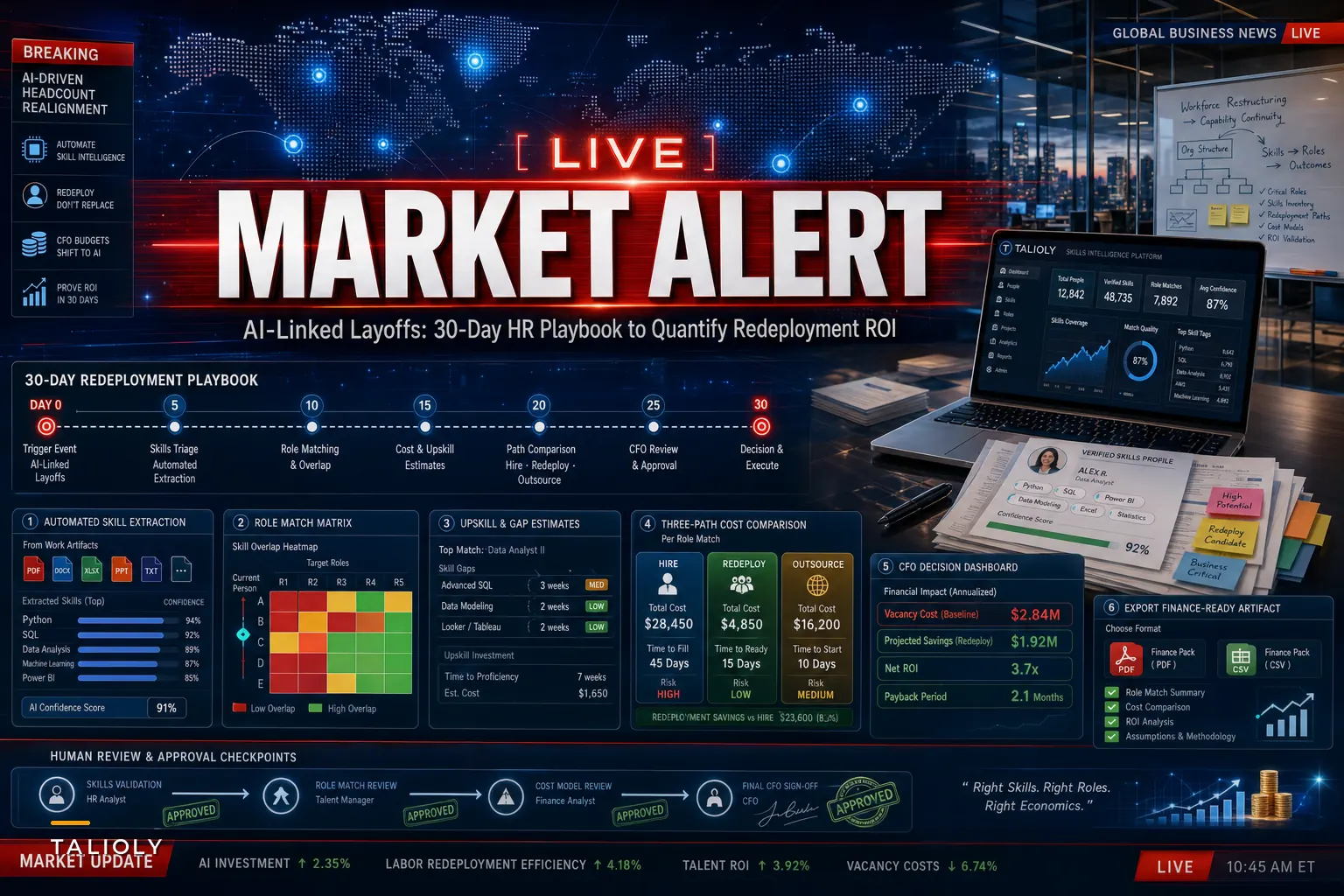

When finance shifts a big chunk of spend toward automation, HR usually finds out late and gets handed a math problem with no time to solve it. The job cuts are already decided. What's still open — and this is the part HR controls — is whether the affected people walk out the door or land in roles the company is about to understaff on.
Reuters reported on October 22, 2026 that companies across industries are cutting jobs and pointing to AI and automation investment as the reason. The same day, it covered Barclays announcing roughly 5,000 job cuts while leaning harder on technology to lower costs. You don't need to work at a bank to feel this. The pattern is boardroom-standard now: reallocate capital to AI, trim the roles automation is supposed to absorb, book the savings.
The uncomfortable operational truth is that the savings on the slide are gross. The real number depends on what happens next — severance paid out, roles backfilled externally six months later at a premium, institutional knowledge gone, rehire churn eating into projections. HR is the only function positioned to show finance the net picture. But most HR teams can't build that case in the window they're actually given, which tends to be two to four weeks.
This is a 30-day playbook to do exactly that: produce a defensible redeployment ROI that finance will accept, before the severance decisions are locked.
Why the "savings" number finance is using is almost always wrong
The restructuring deck says you're removing X roles at an average loaded cost of Y, so you save X times Y. Clean. Also incomplete in a way that consistently overstates the benefit.
-
Severance and transition costs that hit this quarter, not some abstract future one.
-
Rehire probability. A chunk of "eliminated" roles reappear within 9–12 months under a different title because the automation didn't absorb as much as projected. Replacing that person externally runs 1.5x to 2x their old salary once you factor in agency fees, ramp time, and lost productivity.
-
Adjacency loss. The person you cut knew three systems nobody documented. Their exit creates a slow leak in a team that wasn't even on the cut list.
Finance models headcount as if the work disappears cleanly. In real operations, it rarely does — it gets redistributed, deferred, or quietly outsourced at a worse rate. HR's job in these 30 days is to find the roles where redeployment beats elimination on finance's own terms, and leave the rest alone.
You're not trying to save everyone. You're trying to find the subset where the math obviously favors keeping and moving the person. That's a smaller, more winnable argument.
The 30-day timeline
Think of this in three roughly ten-day blocks. The pacing matters because finance's patience doesn't reset — you get one credible number, and it needs to land before the severance paperwork is irreversible.
Stop losing track of critical skills.
Talioly helps you track, develop, and certify your workforce efficiently.
- Centralized skill profiles
- Automated training reminders
- Competency gap analysis
No credit card required
Days 1–10: Inventory who's affected and what they can actually do
You need two lists fast: who is on the cut list, and what open or soon-to-open roles exist across the org that these people could plausibly fill.
The trap is relying on titles and self-reported skills. A "Reporting Analyst" being cut might have 70% of what an open "Risk Data Specialist" role needs, but nobody will see that if they're matching on job titles. What you want is verified, evidence-backed skill data — pulled from work artifacts, completed projects, certifications, assessment results — not a resume someone wrote four years ago.
Focus the first audit on evidence-backed artifacts (work outputs, certificates, assessments) rather than self-reported resumes.
Days 11–20: Build the match grid and cost each path
Now you line up affected people against real demand. For each plausible match, cost out three paths side by side.
| Path | What it costs | Time to productive | Hidden risks |
|---|---|---|---|
| Eliminate + external rehire later | Severance now + 1.5–2x salary to replace + agency fees | 3–5 months after rehire | Knowledge loss, role reopens anyway |
| Eliminate, absorb work into automation | Severance now + tooling cost | Varies, often slips | Automation under-delivers, work reappears |
| Redeploy + targeted upskill | Short upskill cost + temporary productivity dip | 4–8 weeks typical | Person needs real skill gap closed, not cosmetic training |
The redeploy path only wins when the skill gap is genuinely closeable in weeks, not quarters. That's the single most important filter. A reporting analyst moving to a risk data role with 80% skill overlap is a strong candidate. The same analyst moving into software engineering is not — that's a retraining project finance will correctly reject.
Days 21–30: Produce the finance artifact and get sign-off
The last block is about translation. Finance doesn't want a skills narrative. They want net cash impact, payback period, and a confidence level on your assumptions.
If you've never built one of these, the structure in a CFO-ready skills ROI model for executive decisions gives you the line items finance expects and keeps you from drowning them in HR language. Use it to frame redeployment as capital preservation, not as an HR favor.
A realistic redeployment case, with numbers
A mid-sized financial services firm — roughly 1,200 employees — was cutting an operations team of about 40 as workflow automation took over reconciliation tasks. The restructuring deck showed annual savings of around $3.4M from those cuts.
HR ran the 30-day audit on the 40 affected people. Here's what came up:
-
11 of the 40 had verified skills overlapping 75%+ with open or imminent roles in risk, compliance operations, and data quality — functions that were actually growing in the same reorg.
-
Replacing those 11 externally would have cost roughly $90k–$130k each once you added recruiting, ramp time, and the premium for scarce risk-ops talent. Call it around $1.1M–$1.3M in avoidable rehire cost over the following year.
-
Upskilling the 11 to full productivity in their new roles cost about $4k–$6k per person plus a short output dip — well under $80k all in.
The redeployment case didn't argue against the restructuring. It argued that eliminating these specific 11 and rehiring equivalents later would quietly erase a meaningful slice of the projected savings. Finance kept the 11, moved them, and the net savings number on the deck actually held up better than the original plan — because it stopped leaking into future recruiting spend.
The other 29? The math didn't favor redeployment, and HR didn't pretend otherwise. That honesty is what made finance trust the recommendation on the 11.
The matching problem nobody budgets time for
This is where most of these exercises fall apart operationally. The data needed to run a clean match — verified skills, confidence scores, adjacency, availability — rarely sits in one place. It's scattered across the LMS, performance reviews, certification records, and managers' heads.
In a normal quarter you'd fix that slowly. During a restructuring you have days. The teams that move fast are the ones who already maintained verified skill profiles as a regular habit — so when the cut list lands, they can query it instead of assembling it from scratch.
That's the quiet case for treating skills data as live operational infrastructure rather than an annual project. AI-assisted skills platforms help here mainly by doing the unglamorous work: pulling evidence from work artifacts, scoring confidence, flagging stale data, and surfacing adjacency matches that title-based matching misses entirely. The value isn't the dashboard — it's that when the 30-day clock starts, you're matching against trustworthy data instead of guessing.
A short workflow version of what good looks like:
-
Affected population flagged → pulled automatically into a working list
-
Each person's verified skills and confidence scores attached from existing evidence
-
Open and forecasted roles matched by skill overlap, not title
-
Gaps costed as upskill-time estimates
-
Three-path cost comparison generated per match
-
Finance artifact exported with assumptions and confidence flags
Without that pipeline, step 2 alone eats most of your 30 days.
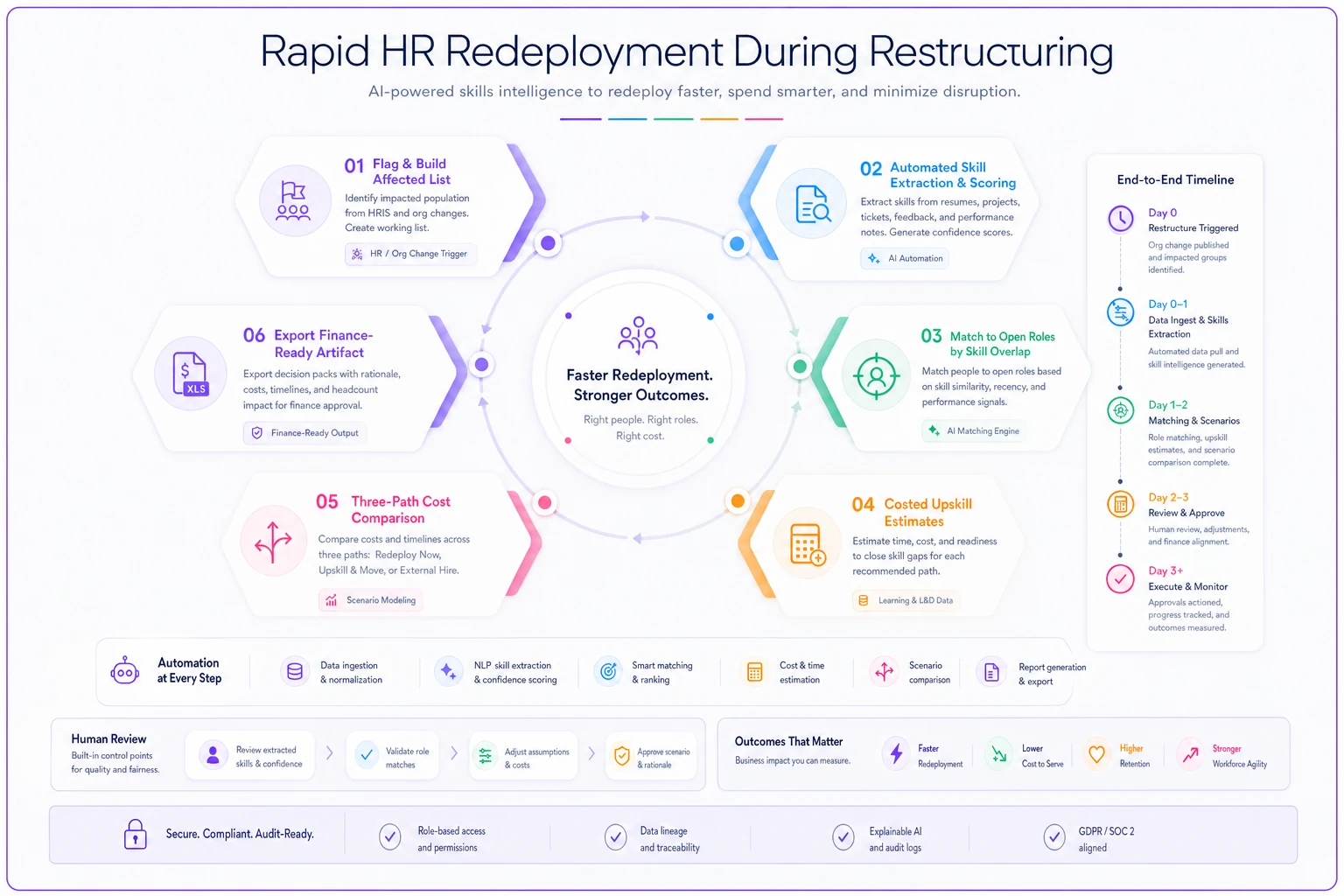
A compact visual like this helps teams run the workflow quickly when days are scarce.
When redeployment is the wrong call
Being honest about this is what gives your ROI case credibility. Redeployment doesn't make sense when:
-
The skill gap is structural, not incremental. If closing it takes two quarters of training, you're not redeploying — you're subsidizing a career change on finance's dime.
-
There's no real receiving role. Manufacturing a role to justify keeping someone is how HR loses credibility for the next five negotiations.
-
The automation genuinely absorbed the work. Sometimes the cut is correct. Fighting every elimination makes finance discount everything else you say.
-
The person's verified data is too thin to trust. If you can't evidence their skills, you can't defend the match, and you shouldn't stake your ROI case on it.
The strongest HR teams in a restructuring aren't the ones who save the most heads. They're the ones whose recommendations finance stops second-guessing — because every match they bring forward holds up under scrutiny.
A checklist for the first week
If a cut list just landed on your desk, start here:
-
[ ] Get the affected population list with loaded cost per role
-
[ ] Pull verified skill profiles for that population — flag anyone with thin or stale data
-
[ ] List every open and forecasted role across the org for the next two quarters
-
[ ] Filter to matches with 70%+ skill overlap and a closeable gap
-
[ ] Estimate external rehire cost for each matched role (use 1.5–2x salary as a defensible range)
-
[ ] Estimate upskill cost and time-to-productive per match
-
[ ] Draft the three-path comparison for the top candidates only
-
[ ] Align with finance on which assumptions they'll accept before building the full model
If a cut list just landed on your desk, start here:
The real shift this moment forces
The restructurings tied to AI spending aren't slowing down, and HR is going to keep getting pulled in after the capital decision is already made. The teams that stay relevant in these conversations are the ones who can convert scattered skills signals into a net cash number finance recognizes — in weeks, not quarters.
That capability isn't something you build during a crisis. You either have it running or you don't. The firms redeploying people successfully right now mostly did the boring work earlier: they kept verified skill profiles current, maintained a real view of internal demand, and had practiced translating skills into finance language before the pressure hit.
If this restructuring wave caught you assembling skill data by hand, that's the actual lesson. The next cut list is coming, and the 30-day clock will start again. The only question is whether you'll spend those days building infrastructure or building arguments.
Ready to elevate your team's skills?
Join 500+ companies using Talioly to boost skill visibility, streamline training, and drive performance growth.