



The seasonal hiring math changed this year, and most HR teams haven't updated their playbook to match. Challenger, Gray & Christmas is projecting U.S. seasonal retail hiring at roughly 450,000 roles for Q4 2026 — the thinnest season since 2008. Retail Dive, covering the same shift, described the new approach as "smaller and more surgical," with companies leaning harder on existing staff, on‑demand pools, and automation instead of flooding locations with temporary headcount.
If you run talent for a retailer, distributor, fulfillment operation, or any business that spikes in Q4, the implication is straightforward: the external labor pool you used to backfill with isn't there, and the budget to create net‑new roles isn't either. You're expected to hit peak throughput anyway.
The teams that handle this well aren't the ones with the biggest req budgets. They're the ones who already know, down to the person, who on their payroll can be moved into a different function next week with minimal ramp. That capability — seasonal hiring redeployment skills — is now the core Q4 competency, not a nice‑to‑have.
This post walks through six operations to run this quarter. They're ordered roughly the way you'd actually execute them, not by importance.
1. Lock down your real peak demand curve before you touch staffing
Most peak‑season staffing plans are built on last year's number plus a gut adjustment. That worked when you could hire your way out of a miss. It doesn't work when the external pool is thin, because by the time you realize you're short, there's no one to call.
The operation here is to convert your demand into a time‑phased curve, not a single peak number. There's a real difference between "we need 40 extra bodies in December" and "we need 12 extra in warehouse weeks 48–49, 25 in customer service weeks 49–51, and 8 in returns processing weeks 1–3 of January." The second version tells you exactly when to pull people and from where. The first just tells you to panic.
Demand almost never peaks uniformly across functions. Fulfillment spikes early, support spikes mid‑season, and returns spike after the holidays when everyone's attention has already drifted elsewhere. Staff for a single December peak and you overstaff the front half and get crushed in January.
Building that curve is exactly where a talent supply–demand heatmap workbook earns its keep. It forces you to lay demand against verified internal supply week by week, so the gaps that trigger a redeployment — versus the ones that genuinely require an external hire — show up early enough to act on.
A quick visual can help teams align on timing and sourcing.
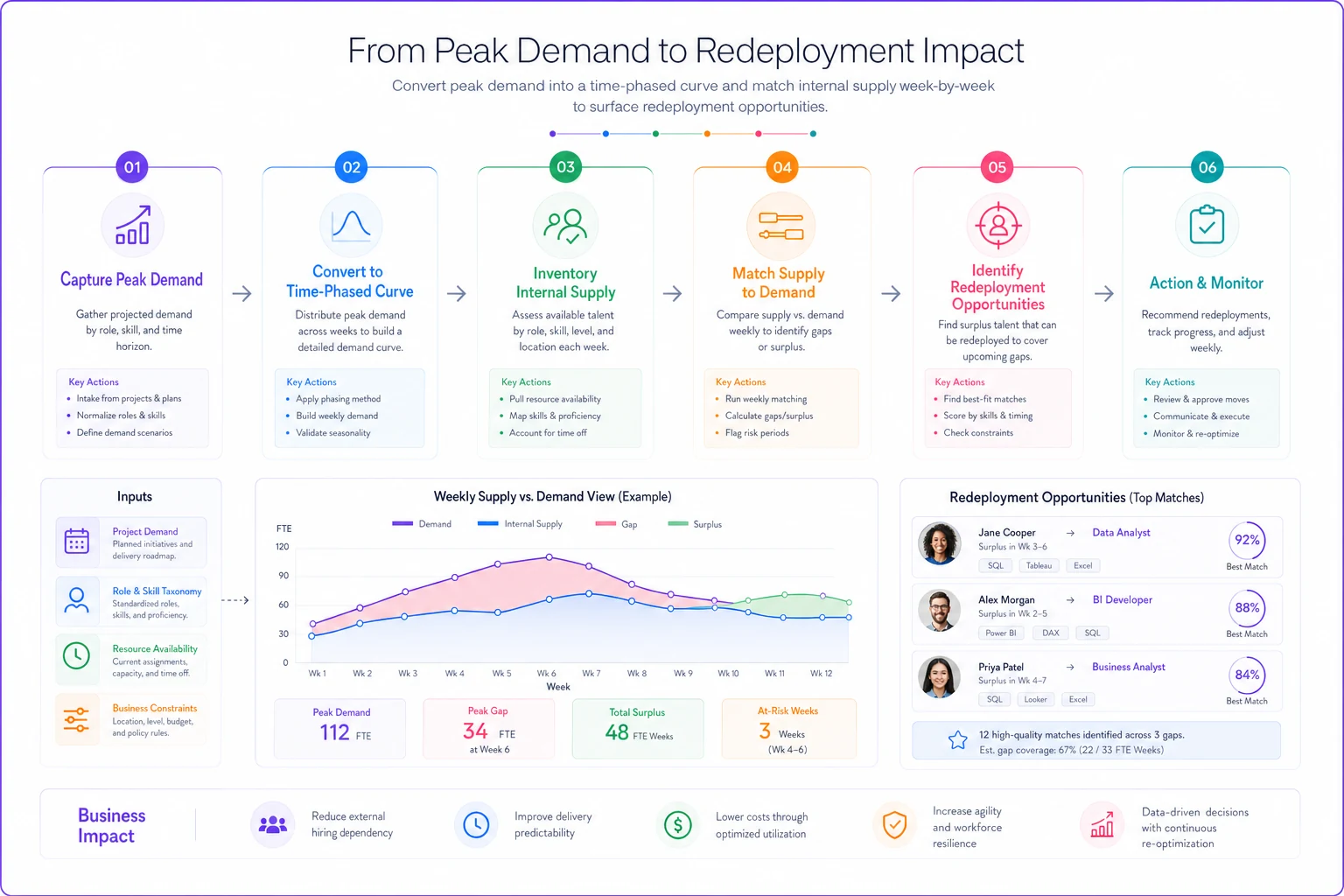
When this makes sense: any operation with multiple functions that peak at different times. When it doesn't: if you genuinely have one flat spike and one function, you can skip the phasing and just size the gap — but that's rarer than people think.
2. Shortlist internal candidates by verified skill, not by "who's available"
The mistake that quietly wrecks redeployment: managers pick who to move based on who looks least busy, not who can actually do the receiving job. You end up moving your calmest people instead of your most transferable ones, and the receiving team spends a week training someone who was never really a fit.
Stop losing track of critical skills.
Talioly helps you track, develop, and certify your workforce efficiently.
- Centralized skill profiles
- Automated training reminders
- Competency gap analysis
No credit card required
Redeployment shortlisting should run off evidence, not gut feel. The question isn't "who can we spare?" It's "who has demonstrated the two or three skills this role actually requires, and how recently?"
A practical breakdown of how to score candidates for a peak redeployment:
| Factor | What you're actually checking | Red flag |
|---|---|---|
| Core skill match | Has the person done the required task, with artifacts to prove it | Skill listed but never used on the job |
| Recency | Skill demonstrated in the last 6–12 months | Last evidence is 2+ years old |
| Ramp distance | How different the new role is from current work | "Totally new system, new team, new process" |
| Release cost | What breaks on their home team if they leave | They're the only one who can do X |
The ramp‑distance column is the one people skip. Moving a cashier to self‑checkout support is a short hop. Moving them to inventory reconciliation is a long one, no matter how capable they are. Short hops fill peak faster, so sort by ramp distance before you sort by raw skill.
In practice, this usually breaks down because skill data lives in three places — the LMS, a spreadsheet someone owns, and the manager's memory. If you can't pull a verified shortlist in an afternoon, that's your actual bottleneck, and it's worth fixing before December, not during it.
3. Validate fast with micro‑assessments, not full retraining
Once you've got a shortlist, the instinct is to run everyone through the standard onboarding module for the receiving role. During peak, you don't have time — and honestly, most of that training is wasted on people who already have 80% of the skill anyway.
The better move is a short, targeted validation: a 15‑to‑30 minute check that answers one question. Can this person safely do the specific tasks we're moving them into, right now? Not "are they fully trained," just "are they cleared for this task set."
A typical example: a distribution center redeploying associates from one line to packing. Instead of the full two‑day packing certification, they run a 20‑minute check — correct box selection, fragile‑item handling, label accuracy on five sample orders. People who pass start the next shift. People who miss on one dimension get a focused 30‑minute refresher on just that gap. That's it.
Validation and training are different jobs, and peak season is the one time you should separate them clearly. Training builds a skill. Validation confirms a skill is present and safe to deploy. When labor is tight, you want the fast lane that confirms, with a narrow remediation path for near‑misses.
Run validation checks on the most safety‑critical tasks first to minimize operational risk.
One caution: don't let micro‑assessments turn into theater. If everyone passes, it's not testing anything. A validation check with no fail cases is just a form.
4. Build an approval path that moves in hours, not weeks
You can have a perfect shortlist and a fast validation process, and still miss peak because the request to move a person sits in a manager's inbox for nine days. Redeployment lives or dies on approval speed, and approval is where most internal mobility quietly stalls out.
The problem is that releasing a person costs the sending manager something real, and the benefit lands on someone else's P&L. Left to goodwill, that negotiation drags. So you take it out of goodwill and put it on a clock.
-
Request is logged against a specific role, start date, and duration (two weeks, four weeks — always time‑boxed).
-
Sending manager gets a fixed window — say 48 hours — to approve or raise a documented blocker. Silence defaults to approved.
-
Blocker review goes to a single named decision‑maker, not a committee. One person breaks ties within 24 hours.
-
Backfill note is attached
how the sending team covers the gap (reduced hours on a non‑peak task, a peer pickup, or accepting a temporary slowdown).
-
Confirmation goes to both managers and the employee at once, so nobody's surprised on day one.
The two details that make this actually work: the silence‑defaults‑to‑approved rule and the single tiebreaker. Without the default, requests stall. Without a single tiebreaker, every disputed move becomes a meeting. Both are standard failure modes, and both are fixable with a written rule your leadership agrees to before peak hits.
5. Treat your contractor and on‑demand pool as a governed resource, not a scramble
With external seasonal hiring compressed, more teams are leaning on on‑demand and contractor pools — which Retail Dive flagged as part of the surgical approach. The catch: these pools tend to be the least‑governed part of the workforce. Nobody's sure who's verified for what, who's cleared for which systems, or whose certifications lapsed since last year.
If you're going to rely on flexible labor to cover peak, that pool needs the same evidence standard as internal staff — maybe more, because turnover is higher and context is thinner.
-
Every active contractor has a profile with verified (not self‑claimed) skills tied to the tasks they'll do.
-
System and facility access is scoped to the actual role and time‑boxed to the engagement, with a defined revoke date.
-
Any required certifications or clearances are current, with expiry dates visible, not buried.
-
There's a named internal owner for each pool — someone accountable for who's in it and whether they're ready.
-
Offboarding is as fast as onboarding
access ends when the engagement ends, on a schedule, not when someone gets around to it.
The pattern that bites teams here is access sprawl. You bring in 30 on‑demand workers for six weeks, and four months later a chunk of them still have badge or system access nobody cleaned up. During a high‑volume, high‑turnover period, that's both an operational mess and a real compliance risk. Scope tight, revoke on a schedule.
Who should NOT lean heavily on on‑demand pools: roles with long ramp times or deep institutional knowledge. If it takes three weeks to be useful, a two‑week contractor is a net drain. Save flexible labor for the genuinely short‑hop tasks.
6. Run a short debrief while the data is still warm
The operation everyone skips. Peak ends, everyone exhales, and all the hard‑won information about who redeployed well, which validation checks predicted real performance, and which approvals jammed — it evaporates. Next year you start from last year's number plus a gut adjustment, and the cycle repeats.
A tight debrief in the first week of January captures what you'll actually want in Q3 next year:
-
Which redeployments worked, and which ramp distances were too far in practice.
-
Which micro‑assessments predicted on‑the‑job performance and which ones passed people who then struggled.
-
Where approvals stalled, and whether the default‑approve rule held.
-
Which internal skills you wished you'd had verified before the season started.
That last point is usually the most useful output. The gaps you feel in December are the upskilling priorities for spring — when you have time and budget to build them at a reasonable pace, instead of scrambling mid‑peak.
A real scenario
A regional home‑goods retailer with around 900 employees across stores and a single distribution hub went into last Q4 planning to bring on roughly 120 seasonal workers. The external pool came up short and they landed closer to 70.
Instead of eating the 50‑person gap, they ran a redeployment pass. They mapped their peak curve by function, pulled a verified shortlist of internal staff whose skills matched the understaffed areas — mostly fulfillment and customer support — and ran short validation checks instead of full retraining. Around 40 employees were moved into higher‑pressure functions for three to five weeks, with time‑boxed approvals that cleared in about two days each.
The result wasn't dramatic in a press‑release way. It was just enough. They covered the peak without the extra 50 hires, overtime came in lower than the prior year, and the January returns surge — which they'd historically underplanned — was staffed on purpose for the first time. The biggest unexpected win was the debrief: they walked into spring with a short, specific list of skills to build, instead of a vague sense that things had been tight.
That's the shape of a good peak‑season redeployment program. Not flashy. Just people in the right place at the right time, backed by evidence instead of guesswork.
The underlying problem this season exposes
The shrinking seasonal pool isn't really the problem — it's the thing that reveals the problem. The teams scrambling right now are the ones who never built visibility into their own workforce. They know headcount and titles, but not who can actually do what, verified and recent.
When external hiring was easy, that blind spot was survivable. You patched it with temps. With that cushion gone, the internal picture has to be good enough to act on in days. Every one of the six operations above depends on the same foundation: a reliable, evidence‑based view of what your people can do. Build that, and redeployment becomes a fast, repeatable process. Skip it, and every peak is a fire drill.
The work you do this quarter doesn't expire in January. A verified skill base, a working approval clock, and a governed flexible‑labor pool pay off every peak, every reorg, and every time you need to move capacity faster than you can hire it — which, judging by where labor markets are heading, is going to keep happening.
Ready to elevate your team's skills?
Join 500+ companies using Talioly to boost skill visibility, streamline training, and drive performance growth.