

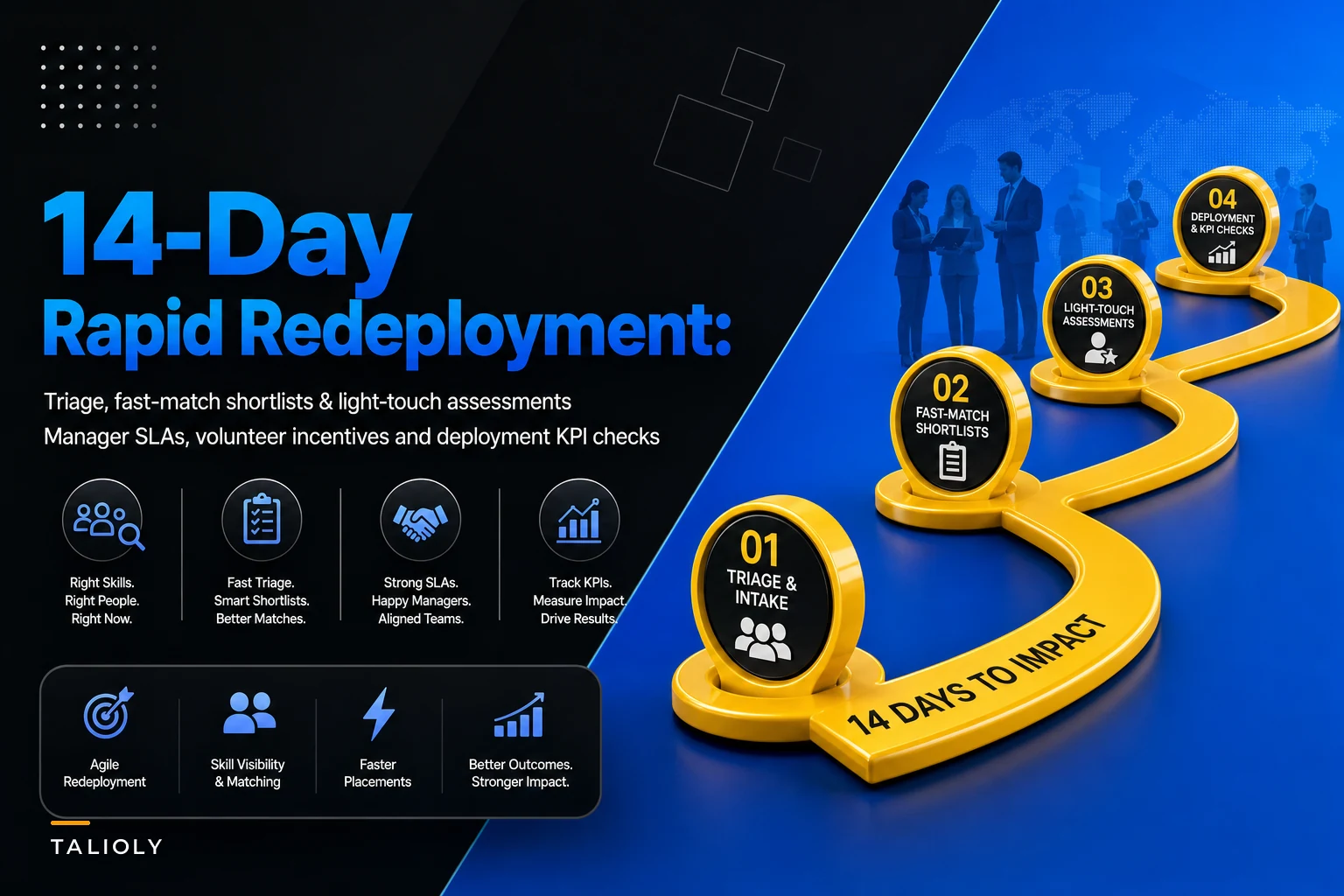

A senior payments integration engineer resigns on a Tuesday. Two days later, a regulatory deadline that depends on his work is still on the roadmap, unmoved. The hiring req will take five to eight weeks to fill if you're lucky, and onboarding eats another month on top of that. Meanwhile the work doesn't pause. This is the exact moment where most HR teams default to two bad options: quietly overload the surviving team members, or panic-hire a contractor at a premium who needs three weeks just to understand the codebase.
There's a third path, and it has a shot clock. Fourteen days, start to finish, to identify an internal person who can plausibly cover the gap, validate that they can actually do it, get their manager to release them, and put them into the role with performance checks already running. Not a permanent placement — a redeployment that buys you time and often turns into something better.
This playbook is that fourteen days, broken into moves you can actually run.
Why urgent gaps get botched even when the right person exists internally
The uncomfortable truth is that the person who could cover the gap usually already works there. What's missing is speed of identification and the authority to move them fast.
Three things go wrong, and they compound.
Nobody can search for capability, only for titles. When a role opens, the reflex is to look for someone with the same job title elsewhere in the org. But cross-functional coverage almost never comes from someone with a matching title. It comes from an adjacent person with 70% of the skills and the ability to close the rest quickly. If your only lens is titles, you miss them entirely — this is the same failure that keeps open roles ignored while talent gets overlooked, matching on labels instead of verified skills.
Manager hoarding kicks in immediately. The manager who could lend someone knows that lending means short-term pain for their own team. Without a pre-agreed release process and an SLA on approval, that conversation drags for a week while everyone's polite and nothing moves.
There's no lightweight way to confirm the match. Even when a name surfaces, the fear of putting an underprepared person into a critical role causes paralysis. Teams either over-assess — a full assessment center for a two-month gap is absurd — or don't assess at all and just hope. Both fail.
The cost of getting this wrong isn't abstract. A stalled critical role for two months can mean a missed compliance window, a delayed product launch, or a customer contract that slips. In one case — a mid-size fintech, roughly 400 people — a stalled integration handoff pushed a partner go-live by about six weeks, which cost them a chunk of the quarter's projected revenue from that partnership and a very awkward set of executive conversations.
The 14-day timeline at a glance
The whole point is timeboxing. Each phase has a hard exit, so you never sit in analysis. Here's the shape of it before we go deep.
Stop losing track of critical skills.
Talioly helps you track, develop, and certify your workforce efficiently.
- Centralized skill profiles
- Automated training reminders
- Competency gap analysis
No credit card required
| Days | Phase | Exit condition |
|---|---|---|
| 1–2 | Triage the gap | A one-page gap spec exists and is signed off |
| 3–5 | Fast-match shortlist | 3–6 candidates identified, ranked |
| 6–8 | Micro-assessment | 1–2 candidates validated as viable |
| 9–10 | Manager release + incentives | Written approval secured, terms agreed |
| 11–14 | Deploy + start KPI clock | Person in seat, baseline metrics captured |
There's no "wait for the perfect candidate" step. This is deliberately a good-enough-fast process, not an optimization process.
Here's a quick visual of the 14-day workflow.
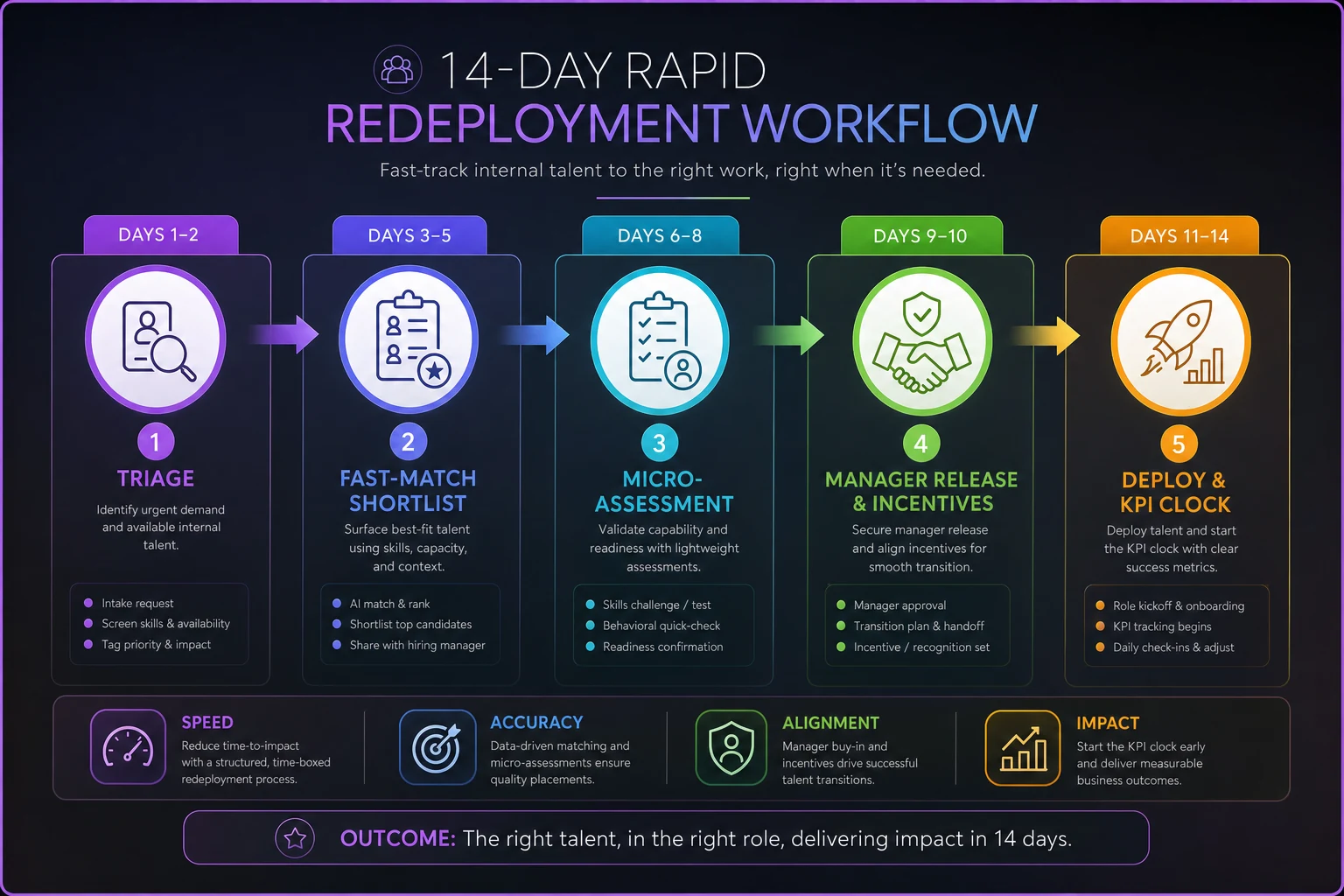
This is deliberately a good-enough-fast process, not an optimization process.
Days 1–2: Triage the gap (not the person)
Before you look for anyone, define exactly what hole you're filling. Most teams skip this, and it's why shortlists come back full of wrong people.
The mistake is describing the gap as "we need another [job title]." That's not a gap spec. A gap spec is: what must get done in the next 60–90 days, what skills are non-negotiable versus nice-to-have, and what the person absolutely does not need to do.
Use a triage template with these fields:
-
The 3–5 outcomes that must ship during the coverage window (specific deliverables, not responsibilities)
-
Must-have skills — the two or three things that cannot be learned on the job in this timeframe
-
Learnable-on-the-job skills — things a smart adjacent person can pick up in week one
-
Context load — how much institutional or tribal knowledge is required, high or low
-
Coverage duration — 30 days, 90 days, indefinite-until-hire
-
Blast radius — what breaks if the person underperforms
That last one, blast radius, quietly determines how much assessment rigor you need. A low-blast-radius internal gap barely needs validation. A high-blast-radius one — customer-facing, revenue-critical, compliance — needs the micro-assessment step to actually mean something.
Separating must-have from learnable is where most of the value hides. In practice, a role that looks like it needs a rare specialist often needs one rare skill and four common ones. Once you see that clearly, your candidate pool triples.
Days 3–5: Fast-match shortlisting heuristics
Now find people. The goal is a ranked shortlist of three to six names in three days — not a comprehensive search.
The core heuristic: rank by skill adjacency, not resume similarity. You're looking for people whose current skills overlap with your must-haves by roughly 60–80%, because those are the ones who can close the gap in days rather than weeks. Someone at 100% overlap is either unavailable or would be bored. Someone below 50% is a training project, not a redeployment.
-
Adjacent-team first. People one team over usually share tooling, vocabulary, and half the context already. Start there before going org-wide.
-
Recent-work evidence beats stated skills. Someone who shipped something similar in the last six months is a stronger bet than someone who lists the skill but hasn't touched it in two years. Weight recency heavily.
-
Downweight title, upweight demonstrated range. Generalists who've worked across two or three functions redeploy better than deep specialists, even for specialist gaps, because they ramp faster in unfamiliar territory.
-
Flag the flight-risk and the over-tenured-in-role. People who've been static for a while are often quietly ready for a move — and this doubles as retention. A redeployment can save someone who was three months from resigning.
If you maintain verified skill profiles, this shortlist takes an afternoon instead of a week of asking managers "who do you know who…". This is also where a real internal talent pipeline pays off — the kind of succession-ready bench built ahead of time means half your shortlist already exists before the gap appears.
Rank the shortlist on two axes only: fit (skill overlap) and availability (how releasable they realistically are). A perfect-fit person whose manager will never let them go is not actually on your shortlist.
Days 6–8: Light-touch micro-assessments
This is the step teams either skip or overdo. The right version is a scoped, realistic task that takes the candidate two to four hours and tells you whether they can actually do the work — not a personality test, not a generic skills quiz.
Design the micro-assessment straight from the "must-have skills" line on your gap spec. If the gap needs someone who can debug a specific class of integration issue, hand them a sanitized version of a real ticket and watch how they approach it. You're assessing method and speed, not perfection.
Keep it proportional to blast radius:
-
Low blast radius a 30-minute conversation walking through how they'd approach the first deliverable. That's it.
-
Medium a two-hour scoped task reviewed by the incumbent's manager or a peer.
-
High a half-day realistic task plus a review conversation, with a clear pass bar written before they start.
Write the pass threshold before you see the work so you avoid rationalizing decisions after the fact.
That last detail matters more than people think. Write the pass threshold before you see the work. Otherwise you'll rationalize a decision you already emotionally made, and the assessment becomes theater.
One pattern worth noting: candidates who ask sharp clarifying questions during the micro-assessment almost always outperform candidates who silently produce a polished-looking answer. The clarifying questions signal that they understand the ambiguity of the real role. Bake "quality of questions asked" into your scoring.
Exit this phase with one primary candidate and ideally one backup, both validated.
Days 9–10: Manager release SLAs and volunteer incentives
This is where redeployments die. You've found the person, they're validated, and their current manager stalls.
The fix is structural, and it has to exist before the gap opens — or at least be ratified fast. You need a manager-approval SLA: once a redeployment request is formally raised, the releasing manager has 48 hours to approve, propose modified terms, or escalate. Silence past 48 hours defaults to escalation, not to "no." Without a default, silence becomes a veto.
| Release term | What to specify |
|---|---|
| Allocation | Full-time, or split (e.g., 60/40) between old and new work |
| Duration | Hard end date or review date |
| Backfill support | What the releasing team gets in return |
| Return guarantee | Is the person's original seat held? |
The return guarantee is the single biggest unlock. Managers release people far more willingly when they know the person comes back, and employees volunteer far more willingly when they know they're not gambling their existing role.
On incentives — cash generally doesn't work here, and can actually distort the pool. What works better:
-
Explicit development framing the redeployment counts toward a stretch goal or a promotion case
-
A short return-and-recognition ritual visible acknowledgment when they come back, not a silent reabsorption
-
First-look on the permanent role if the gap converts to a hire
-
Protected time — the redeployed person's old KPIs are formally paused or reduced, not just informally "understood"
That last one prevents the most common quiet failure: someone gets redeployed but is still held to their old targets, burns out, and the whole thing sours the well for the next redeployment.
Days 11–14: Deploy and start the KPI clock immediately
The person is in the seat. Do not treat this as done. The final phase is about capturing a baseline and setting up performance checks so you can tell, within a couple of weeks, whether the redeployment is actually working.
The KPI you care about most is time-to-value — how long until the redeployed person is producing at a useful level on the critical deliverables. To measure it, you need a baseline captured in the first two days, before momentum blurs the picture.
-
Time-to-first-deliverable days from start to first meaningful output shipped
-
Coverage completeness what percent of the gap spec's must-do outcomes are on track by day 14, 30, 60
-
Ramp trajectory a simple weekly self-plus-manager rating of effectiveness (1–5 is fine — precision isn't the point, direction is)
-
Blast-radius incidents any errors or misses attributable to the coverage gap
-
Releasing-team health is the team that lent the person coping, or quietly drowning?
Set two checkpoints: a day-14 viability check (is this working at all — adjust or abort) and a day-30 trajectory check (is this converging toward full effectiveness or plateauing below it). The day-14 check is your cheap exit — if it's clearly not working, you've lost two weeks, not two months, and your backup candidate is still warm.
A real scenario: filling a data-engineering gap without a hire
A logistics company, around 250 employees, lost their only person who understood a nightly billing-reconciliation pipeline. It broke roughly twice a week and each break required manual fixes that delayed invoicing.
Rather than open a req and wait, they ran the fourteen-day version. Triage showed the must-have was pipeline debugging in a specific stack — but the "specialist" framing had been hiding the fact that two people on the analytics team already worked in that stack daily. Fast-match surfaced them in an afternoon. A three-hour micro-assessment using a real sanitized pipeline failure validated one of them cleanly. The release conversation took a day because there was a firm return date and the analytics manager got a junior analyst's time as backfill.
By day 12 the person was in seat. Time-to-first-fix was about four days. Within roughly three weeks the twice-weekly breaks dropped to something like once every couple of weeks, and invoicing stopped slipping. The redeployment ran ninety days, and by the end the company decided to make it permanent rather than hire externally — the ramp cost had already been paid.
The interesting part isn't the happy ending. It's that the whole thing hinged on the triage step reframing a "we need a rare specialist" panic into "we need one specific skill two people already have."
When this playbook makes sense — and when it doesn't
Run it when: the gap is urgent, coverage-oriented, and time-boxable; when the work can be scoped into concrete deliverables; and when you have even a rough sense of who has adjacent skills. It's ideal for bridging until a permanent hire, covering a leave, or absorbing a sudden departure on critical work.
Don't run it when the role genuinely requires deep, non-transferable expertise that no internal person is within striking distance of. Forcing a 40%-overlap person into a high-blast-radius role to hit a fourteen-day deadline is how you turn one problem into two.
Who should skip this entirely: organizations with no skill visibility at all. If you can't identify adjacency in days 3–5 because you have no idea who can do what beyond job titles, the shortlist step collapses and the whole timeline breaks. Fix the visibility problem first — even a lightweight version — before you rely on a 14-day process that assumes it.
The one thing that makes or breaks it
Everything above depends on being able to answer one question fast: who in this building has 60–80% of the skills this gap needs? If answering that takes a week of Slack messages and manager guesswork, your fourteen days evaporates before day five.
The teams that run redeployment well aren't smarter under pressure. They've done the boring work ahead of time — keeping some form of current, evidence-backed picture of who can do what — so that when the Tuesday resignation lands, the search takes an afternoon instead of a week of scrambling. The playbook is fast because the preparation was slow. Build the visibility during calm weeks, and the urgent gaps stop being emergencies.
The playbook is fast because the preparation was slow. Build the visibility during calm weeks, and the urgent gaps stop being emergencies.
Ready to elevate your team's skills?
Join 500+ companies using Talioly to boost skill visibility, streamline training, and drive performance growth.