

Most skills programs don't die because the work is bad. They die because nobody at the exec level can tell whether the thing is working, whether it's ready for more money, or whether it's still a science experiment eating headcount. You present a deck full of completion rates and engagement scores, the CFO nods politely, and the budget quietly flatlines next cycle.
A maturity model fixes that — but only if it's built the way finance thinks, not the way L&D thinks. Finance doesn't want to hear that "adoption is improving." They want to know: what triggers the next tranche of funding, what do we get for it, and what proves we got it. Everything below is structured around those three questions.
This isn't a capability ladder for its own sake. It's a gating instrument. Each level has entry criteria, exit criteria, sample KPIs, the artifacts a board will actually ask to see, and a realistic budget band. The point is to make the next dollar a decision, not a renewal.
Why skills programs stall at the funding layer
The common failure isn't technical. It's that the program and the people funding it are measuring two different things.
HR measures activity — courses delivered, badges issued, profiles created. Finance measures conversion — did the spend change a number they already track (time-to-fill, contractor spend, revenue per head, attrition in critical roles). When those two never get reconciled, the program lives in a permanent pilot state. Too big to kill, too unproven to scale.
The pattern that shows up repeatedly: year one gets emergency enthusiasm and a decent budget. Year two the sponsor asks "so what did we get?" and the answer is a dashboard nobody on the finance side trusts. Year three the budget gets cut to maintenance level, the taxonomy rots, and someone two years later proposes a "fresh skills initiative" — same thing, new vendor logos.
A skills maturity model breaks that loop by forcing a different conversation at each stage. Instead of "give us more money to do more," it becomes "here's the measurable gate we cleared, here's what the next gate unlocks, here's the budget tied to it." That's a language the board already speaks — it's how they fund everything else.
Worth naming separately: as the org grows, informal coordination stops working. At 200 people, one capable HRBP can hold the whole skills picture in their head. At 2,000, the picture lives in six systems, three spreadsheets, and a Slack channel. The maturity model has to account for that shift, because what counts as "mature" at small scale is naive at large scale.
The five levels
Read this as a gating sequence — you don't skip levels, and you don't fund level 4 work on a level 2 foundation.
Stop losing track of critical skills.
Talioly helps you track, develop, and certify your workforce efficiently.
- Centralized skill profiles
- Automated training reminders
- Competency gap analysis
No credit card required
| Level | What it means operationally | Primary KPI focus | Typical annual budget band |
|---|---|---|---|
| 1 — Ad hoc | Skills tracked in spreadsheets, self-reported, no owner | Coverage: % of workforce with any profile | $40k–$90k (mostly internal time) |
| 2 — Defined | A taxonomy exists, one source of truth, named owner | Data freshness, profile completeness | $120k–$250k |
| 3 — Verified | Skills backed by evidence, not self-claims | Verification rate, confidence scoring | $250k–$500k |
| 4 — Operational | Skills drive real decisions (staffing, pay, redeployment) | Decision influence, time-to-fill internal | $450k–$900k |
| 5 — Governed | Skills tied to financial planning, audited, bias-monitored | ROI per skill dollar, parity metrics | $700k–$1.5M+ |
The budget bands are deliberately wide because they scale with headcount. A 1,500-person org at level 3 and a 12,000-person org at level 3 are doing the same quality of work at very different costs. What stays constant is the ratio of spend to the decisions it influences — and that's what finance should watch, not the absolute number.
One mistake worth naming early: organizations love to claim they're further along than they are. "We have a taxonomy" (that nobody uses) gets called level 2. "We ran an assessment once" gets called level 3. The exit criteria below exist specifically to kill that self-grading. If you can't produce the artifact, you're not at that level.
Level 1 → 2: from scattered to defined
Entry (you're at level 1 if): skills data exists but lives in disconnected places — training logs, performance notes, a certification spreadsheet HR keeps. No single owner. Nobody can answer "how many people can do X" without a manual survey.
Exit criteria (what proves you've reached level 2):
-
A published taxonomy with a named owner and a change-control process
-
One consolidated profile per employee, not six fragments
-
Coverage above roughly 70% of the in-scope population
-
A documented refresh cadence (even if it's manual at this stage)
Sample KPIs: profile coverage %, taxonomy size vs. roles covered, data staleness (median age of last update).
Artifacts the board will ask for: the taxonomy document, a coverage report, and the ownership/RACI showing who maintains it.
Budget reality: this stage is cheap in software and expensive in cleanup. The real cost is the reconciliation work — getting "JavaScript," "JS," and "front-end dev" to resolve to one thing, de-duplicating skills, aligning definitions across teams. In practice this phase runs three to six months and most of the spend is internal hours, not licenses.
Prioritize a usable 150-skill taxonomy that people actually maintain rather than a comprehensive one that rots in a quarter.
The failure point here is scope creep. Teams try to build a 900-skill taxonomy covering every niche capability in the company. Don't. A usable 150-skill taxonomy that people actually maintain beats a comprehensive one that rots in a quarter. You can always extend. You can't easily un-rot.
Level 2 → 3: from claimed to verified
This is the gate where most programs reveal whether they're real. Level 2 data is still largely self-reported, and self-reported skills are optimistic by nature — people rate themselves generously, especially when they think it affects advancement.
Entry (you're at level 2 if): you have a clean taxonomy and consolidated profiles, but the underlying data is mostly self-assessment or manager guesswork.
Exit criteria (level 3):
-
A verification mechanism tied to evidence — work artifacts, assessments, peer validation, or completed projects
-
Confidence scoring on profiles so you can distinguish "verified expert" from "claimed familiarity"
-
Verification coverage on your critical roles above roughly 60%
-
A defined re-verification trigger so skills don't silently expire
Sample KPIs: verification rate on critical skills, average confidence score, gap between self-rating and verified rating (this delta is gold for the board — it quantifies how wrong your old data was).
Artifacts: a verification methodology doc, a sample audit trail for a handful of profiles, and the confidence-scoring logic.
Budget reality: this is where software spend climbs, because manual verification doesn't scale past a few hundred people. The cost sits in assessment design, evidence pipelines, and the operational load of validating claims.
A realistic finding from this stage: organizations routinely discover that 25–40% of self-reported "advanced" skills don't survive verification. That finding alone often justifies the entire program to a skeptical CFO — you were making staffing and promotion decisions on data that was wrong a significant portion of the time.
The mistake to avoid: treating verification as a one-time cleanse. Skills decay. A verified skill from three years ago isn't verified anymore. If you don't build re-verification triggers in at this level, you'll be back to level 2 quality within eighteen months and won't notice until a staffing decision goes bad.
Level 3 → 4: from verified to operational
Levels 1 through 3 build the asset. Level 4 is where the asset starts paying rent. Until skills data actually changes a decision, it's a cost center with good intentions.
Entry (you're at level 3 if): you have verified, confidence-scored profiles — but they're still mostly used for reporting, not for live decisions. The data is good and nobody's acting on it.
Exit criteria (level 4):
-
Skills data drives at least two operational decisions in production — internal mobility, project staffing, succession shortlisting, or skills-based pay inputs
-
A measurable shift in a metric finance already tracks (internal fill rate, time-to-fill, contractor dependency)
-
Manager adoption above a real threshold, not a vanity one — meaning managers actually use the data in staffing conversations
Sample KPIs: % of open roles shortlisted using verified skills, internal-fill rate change, time-to-fill delta, reduction in external contractor spend on skills you have internally.
Artifacts: decision logs showing skills data influenced specific staffing or mobility calls, and a before/after on at least one finance-tracked metric.
Budget reality: this is the most expensive transition, not because of software but because of change management. The data can be perfect and still ignored. Getting managers to actually consult verified profiles instead of defaulting to "who I already know" is the hard part — and it's an ongoing cost, not a one-time one.
This is the level where the skills maturity model connects directly to money. The work in a CFO-ready skills ROI model for executive decisions pairs tightly with this gate — the maturity level tells you where you are, the ROI model tells you what that position is worth. Present them together and the funding conversation gets considerably shorter.
A quick visual of how verified profiles should flow into operational decisions and finance metrics.
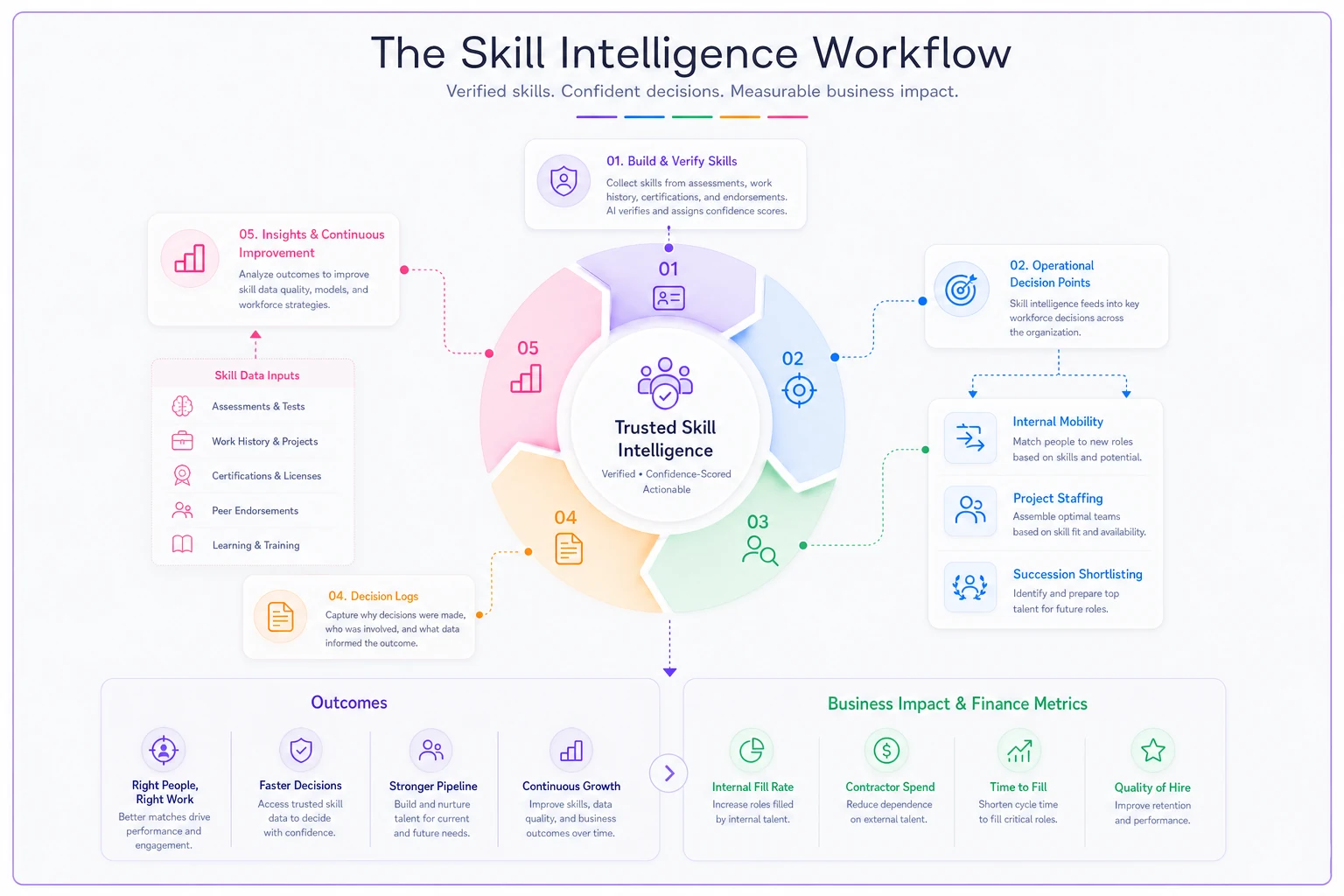
The failure pattern at level 4 is "shelf-ware with good data." You built the verified profiles, you built the dashboards, and managers keep staffing projects the old way. If you can't produce decision logs — actual records of skills data changing a call that was about to go another way — you're not at level 4. You're at level 3 with a nicer dashboard.
Level 4 → 5: from operational to governed
Level 5 is where skills stop being an HR program and become part of financial planning. This is the level boards fund without much friction, because it behaves like every other mature capability in the business — measured, audited, and tied to the P&L.
Entry (you're at level 4 if): skills data drives real decisions, but it's not yet integrated into workforce planning budgets, not formally audited, and not monitored for bias.
Exit criteria (level 5):
-
Skills demand tied to financial planning cycles — you can forecast capability gaps against the product roadmap and put a dollar figure on closing them
-
ROI tracked per skill investment, not per program
-
Bias and parity monitoring in place (promotion and pay equity against verified skills, not titles)
-
A governance body that reviews skills data quality on a cadence, with real authority
Sample KPIs: ROI per skills dollar, forecast accuracy on capability gaps, promotion/pay parity indices, data-quality audit scores.
Artifacts: a workforce plan with skills-based demand forecasting, audit reports, parity dashboards, and governance meeting records.
Budget reality: the spend here isn't dramatically higher than level 4 in software — it's higher in governance overhead. Audits, monitoring, review cadences, the people who run them.
Sustaining level 5 is genuinely hard because it depends on executive attention, not just tooling. Programs that reach level 5 and then lose their sponsor slide back fast. The rituals that keep it alive — regular review, visible accountability, adoption tracking at the top — are what hold it in place, and that's covered in scaling skills platforms with executive rituals and adoption KPIs. Level 5 isn't a finish line you cross once; it's a state you actively maintain.
How the levels connect — and where the system breaks between them
The temptation is to treat these as independent stages. They're not. Each level is load-bearing for the next, and the most expensive failures happen when an org tries to operate at one level on a foundation built for a lower one.
The connective logic:
-
Level 2 depends on cleanup. You can't define a taxonomy on data you haven't reconciled. Skip this and every later level inherits garbage.
-
Level 3 depends on the taxonomy being stable. You can't verify skills against definitions that keep shifting. If your taxonomy is still thrashing, verification is wasted effort.
-
Level 4 depends on verification being trusted. Managers won't stake a staffing decision on data they don't believe. One high-profile bad call from unverified data and adoption collapses for a year.
-
Level 5 depends on level 4 actually running. You can't tie skills to financial planning if skills aren't yet influencing operational decisions. Forecasting capability gaps is meaningless if nobody acts on the forecast.
The classic cross-level break: an exec team gets excited and tries to jump straight to level 4 or 5 — "we want skills-based pay and workforce forecasting" — on top of level 2 self-reported data. The forecasts are confidently wrong, someone's pay gets affected by a skill they overclaimed, and the whole program loses credibility it never recovers. Finance sees one bad outcome and permanently reclassifies the program as risk, not investment.
The other break happens going down. Orgs reach level 3 or 4, declare victory, and stop maintaining. Verification ages out, the taxonomy drifts as the business changes, coverage drops as new hires come in unverified. Eighteen months later you're operationally at level 2 while still reporting level 4 to the board. Nobody notices until a decision built on stale data goes sideways. Maturity isn't a ratchet — it reverses when you stop feeding it.
When to push to the next level — and when to hold
Not every organization should chase level 5. The gating logic cuts both ways: sometimes the right call is to hold at your current level and get the economics right before spending more.
Push to the next level when:
-
You've cleanly met the exit criteria — not approximately, actually
-
The current level's KPIs have stabilized, not just spiked once
-
You have a named sponsor who'll defend the next budget tranche
-
The next level's unlock maps to a business pressure that's real right now (hiring freeze forcing internal mobility, a transformation needing capability forecasting)
Hold at your current level when:
-
Your data quality is still wobbling — advancing on shaky data compounds the shakiness
-
You don't have executive attention to sustain what you've already built
-
The organization is mid-reorg and the taxonomy would need major rework anyway
-
You can't yet prove the current level paid for itself
Smaller organizations where informal coordination still genuinely works probably shouldn't pursue level 4 or 5 at all. If a few people can hold the whole capability picture in their heads and staffing decisions are good, the governance overhead of level 5 is pure cost. The maturity model scales with complexity — if you don't have the complexity, don't buy the machinery to manage it.
A realistic scenario
A mid-sized financial services firm, roughly 1,800 employees, came in sitting firmly at level 1 — skills tracked across a certification spreadsheet, an LMS export, and individual manager notes. Nobody could answer basic capability questions without a manual survey that took two weeks and was stale by the time it landed.
They ran the cleanup and taxonomy work over about four months and reached a defensible level 2: one profile per person, a 180-skill taxonomy, coverage around 75%. Cost was mostly internal hours plus modest tooling — low six figures all in.
The telling moment came at verification. When they started backing skills with evidence, roughly a third of the "advanced" self-ratings in two critical functions didn't hold up. That single finding changed the funding conversation entirely. The CFO had been treating the program as HR overhead; the verification gap reframed it as a risk they'd been carrying blind — staffing and promotion decisions made on data that was wrong a substantial portion of the time.
Over the following year they pushed into early level 4. Internal fill rate on mid-level roles improved from the high-20s percent to the low-40s, and contractor spend on skill areas they discovered they actually had in-house dropped noticeably. The numbers weren't dramatic month to month — it was a steady grind — but the direction was consistent enough that the next budget cycle funded the move toward governance without the usual fight.
What made it work wasn't the tooling. It was that each funding request mapped to a cleared gate and an unlocked outcome. Finance never had to take anything on faith.
The point of all this
A maturity model isn't a maturity model if it can't be audited. The whole value is in the exit criteria and the artifacts — the things that make "we're at level 3" a verifiable claim instead of a self-congratulatory one. If your levels are vibes, you've built a diagram, not a gating instrument.
Build it so the next dollar is always a decision. Each level earns the next by proving something measurable: cleaner data, verified claims, influenced decisions, financial integration. When you can walk into a board meeting and say "here's the gate we cleared, here's what it cost, here's the number it moved, here's what the next gate unlocks" — you've turned a program that used to beg for renewal into one that competes for investment on the same terms as everything else the business funds.
That's the real difference between a skills initiative that stalls in year three and one that becomes permanent infrastructure. Not the quality of the training. The quality of the gates.
Ready to elevate your team's skills?
Join 500+ companies using Talioly to boost skill visibility, streamline training, and drive performance growth.