

Most skills platforms don't fail because the technology is bad. They fail because the org above and below the platform never gets wired together. You've got an executive team that approved the budget and then went quiet, and a layer of managers who are supposed to run experiments but never got permission, air cover, or a reason to care. In the gap between those two groups, the platform quietly rots.
This is the part almost nobody plans for. Teams spend months on taxonomy design, data ingestion, and dashboard build, then treat "rollout" as a launch email and a couple of town halls. Six months later adoption is at 12%, the exec sponsor has moved on to the next priority, and someone's asking whether the whole thing was worth it.
What actually holds a skills program together at scale is a set of rituals — recurring, boring, scheduled moments where sponsorship gets renewed, manager experiments get reviewed, and adoption numbers get tied to something the business actually cares about. That's the real subject of a skills platform change management playbook: not the launch, but the operating rhythm that keeps the thing alive after launch.
Why the top and the bottom never connect
There's a pattern that shows up across large rollouts. Executive sponsorship exists on paper — there's a name in the deck, maybe a quote for the announcement. But sponsorship without a defined role decays into a logo. The sponsor doesn't know what they're supposed to do on a Tuesday in month three.
Meanwhile, the people who could generate real adoption are frontline and mid-level managers. They're the ones deciding whether their team logs skills, completes assessments, or updates profiles. And they're being asked to add work to their week with no clear payoff and no cover if it goes sideways. So they don't.
-
Top-down without bottom-up produces compliance theater. People update profiles the week before the audit and forget about it otherwise.
-
Bottom-up without top-down produces scattered enthusiasm that dies the moment a manager's priorities shift or they leave.
You need both, and you need them mechanically linked so that what happens in a manager's experiment actually travels up to the sponsor, and what the sponsor cares about actually travels down into how managers are measured. That linkage is the whole game.
Start with a sponsor RACI, not a sponsor name
The first thing that breaks at scale is accountability blur. Everyone assumes someone else owns the outcome. The fix is unglamorous: write down who's Responsible, Accountable, Consulted, and Informed for each part of the operating model — and be specific about the executive row, because that's the one people fudge.
Stop losing track of critical skills.
Talioly helps you track, develop, and certify your workforce efficiently.
- Centralized skill profiles
- Automated training reminders
- Competency gap analysis
No credit card required
A workable sponsor RACI for a skills platform looks something like this:
| Activity | Executive Sponsor | Program Lead (HR/L&D) | People Managers | Business Unit Leaders |
|---|---|---|---|---|
| Set adoption targets tied to outcomes | A | R | C | C |
| Approve manager experiment budget | A | R | I | C |
| Run monthly review cadence | R | R | C | I |
| Remove blockers escalated by managers | A | C | R (escalate) | R |
| Communicate "why this matters" | R | C | R | R |
| Report adoption KPIs to leadership | C | R | I | I |
The important detail: the sponsor is Accountable for targets and Responsible for showing up to the cadence and clearing blockers. Those aren't the same thing. Plenty of sponsors will accept accountability for a number but never do the actual work of unblocking a manager who's stuck. If the RACI doesn't force them into a recurring, active role, you've just documented a figurehead.
One thing worth flagging: when business unit leaders aren't in this RACI at all, the program becomes "an HR thing." That framing is fatal. Skills adoption competes for the same manager attention as revenue targets, and if the BU leader isn't visibly on the hook, HR always loses that competition.
The cadence that keeps sponsorship warm
Sponsorship is perishable. It goes stale in about a quarter if nothing forces it to renew. The counter is a fixed executive review cadence — same time, same format, same three questions.
A monthly executive review doesn't need to be long. Thirty minutes, tightly run, focused on decisions rather than status updates. A template that works:
-
Adoption snapshot (5 min) — one slide
current adoption KPI vs. target, trend line, nothing else.
-
Experiments in flight (10 min) — what managers are testing, early signal, what they need.
-
Blockers requiring executive action (10 min) — the whole reason the sponsor is in the room. Named blockers, named owners, decisions made live.
-
Next month's focus (5 min) — one commitment from the sponsor, one from the program lead.
The thing that makes this work is the blocker section being non-optional. If a review has no blockers to escalate, that's usually a warning sign, not a good sign — it means managers stopped bringing real problems because nothing happened last time. A healthy cadence surfaces friction. A dead one produces smooth green dashboards while adoption flatlines.
There's a quarterly layer above this too, where you zoom out to the business outcome — attrition in critical roles, internal fill rate, time-to-productivity for reskilled staff. The monthly keeps the machine running; the quarterly reminds everyone why the machine exists.
Manager experiments need SLAs, not just encouragement
The grassroots half of the playbook is where most of the actual learning happens, and it's the part that gets the least structure. "Managers, go experiment with the platform" is not a plan. It's a hope.
What managers actually need is a small, bounded contract: run a defined experiment, get a fast decision on support, and know exactly when and how to escalate. That's where SLAs come in — not customer-service SLAs, but internal ones that govern how the program responds to a manager who steps up.
-
Experiment approval within 5 business days of a manager proposing one. Slower than that and the energy dies.
-
Resource or budget decision within 10 business days, even if the answer is no. A fast no beats a slow maybe.
-
Blocker escalation acknowledged within 2 business days, resolved or routed to the exec cadence within one cycle.
-
Results reviewed and shared within two weeks of experiment close, so other managers can copy what worked.
Pro-tip: Treat blocker escalation acknowledgement times as a contractual SLA to keep manager momentum.
The escalation path deserves its own attention. When a manager hits a wall — data access, a peer team not cooperating, a policy question — they need a clear route up. In practice the path is: manager → program lead → executive cadence. If the program lead can resolve it, great. If not, it lands on the sponsor's blocker list at the next review. The point is that no blocker sits in limbo. The single fastest way to kill grassroots participation is to have a manager raise their hand, hit silence, and conclude the program isn't real.
If you want to go deeper on the experiment side specifically — designing the tests, setting SLAs, and running incentive trials — there's a full treatment in this adoption playbook built around manager experiments. This article is the layer above it: how executive rituals feed and protect those experiments.
Adoption KPIs that map to outcomes, not activity
The metric trap is easy to fall into. Logins, profiles completed, courses assigned — these feel like adoption but measure motion, not results. A sponsor staring at "1,400 profiles updated" has no idea whether the program is working.
The discipline is to map every adoption KPI to a downstream business outcome you can name. A rough mapping:
| Adoption KPI | Maps to Business Outcome |
|---|---|
| % of critical roles with verified skill profiles | Succession readiness / reduced key-person risk |
| Internal fill rate for open roles | Reduced external hiring cost and time |
| % of managers running active experiments | Program durability, distributed ownership |
| Time from skill gap identified → development started | Faster response to demand shifts |
| Reskilled employees redeployed into priority work | Direct workforce planning payoff |
None of these are "engagement" metrics in the vanity sense. Each one answers a question a CFO or BU leader would actually ask. When your adoption KPI is the internal fill rate, and internal fill rate is trending up, you can defend the budget in any room.
A subtle mistake teams make here: picking outcome KPIs that move too slowly to show progress in a review cycle. Attrition, for example, might take a year to shift meaningfully. So you pair a slow-moving outcome KPI with a faster-moving leading indicator — profiles verified, experiments launched — and you're honest in the review about which is which. The leading indicators tell you the machine is running; the outcome KPIs tell you it's producing.
A comms calendar that isn't just announcements
Communication for these programs usually means one big launch push and then nothing. That's backwards. The launch is the least important communication moment. What matters is the sustained drip that keeps the program visible after the novelty wears off.
-
Monthly
a short "what a manager tried and what happened" story — real experiments, real names, real results. These do more for adoption than any executive memo.
-
Quarterly
a sponsor-signed update tying adoption progress to a business outcome. This is where the exec's name gets used, sparingly and with weight.
-
Ad hoc
recognition moments — a manager or team that hit a milestone, a person who got redeployed into a better role through a verified skill match.
The mistake to avoid is making all comms flow from HR. When the only voice is the program office, the message reads as an HR initiative. When managers and BU leaders are the visible voices, it reads as how the business works now. Route the storytelling through them.
The workflow, start to finish
Here's how the whole system connects in a single loop, month over month:
A manager proposes an experiment. The program lead approves it within the SLA and confirms any resources. The manager runs it and hits a blocker — say, a partner team won't share the data needed to verify a skill. The manager escalates; the program lead can't resolve it because it's cross-functional. It goes onto the blocker list for the monthly executive review. The sponsor, sitting in that review, makes a call — assigns the BU leader to unblock it, with a date. That decision flows back down to the manager within days. The experiment finishes. Its results get shared in the monthly comms story. Other managers see it, copy it, and propose their own experiments. The adoption KPI ticks up. That KPI shows up on the sponsor's snapshot slide next month, mapped to the internal fill rate. The sponsor sees progress, stays engaged, and clears the next blocker faster.
This loop is best visualized as a single monthly cycle.
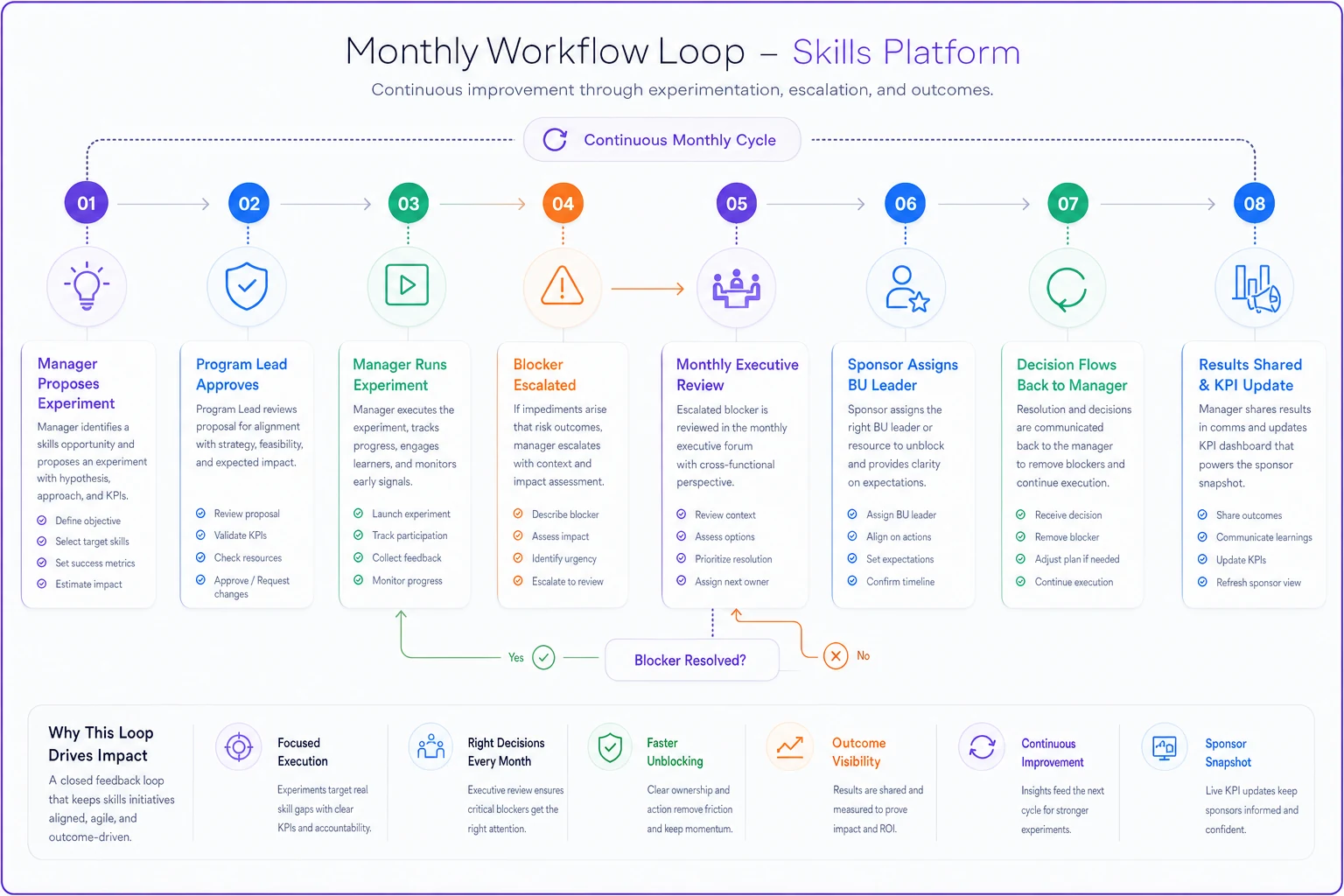
That loop is the entire playbook. Break any link — no SLA, no cadence, no escalation path, no outcome-mapped KPI — and the loop stalls at that point. The whole thing is only as strong as its weakest handoff.
This is also where funding discipline matters, because experiments cost real money and manager time. If the budget for these experiments isn't governed alongside the broader talent spend, they get raided the moment a quarter tightens. The mechanics of tying that funding to actual demand are worth reading separately in this piece on cross-functional talent allocation governance.
A real scenario
A mid-sized logistics company — around 2,200 employees, mostly operations and warehouse roles with a growing analytics function — rolled out a skills platform and stalled fast. Adoption sat near 15% after the first quarter. The exec sponsor, a VP of Ops, had approved it and then effectively disappeared. Managers had been told to "encourage their teams to use it," which nobody did.
They rebuilt the operating layer rather than touching the platform. A sponsor RACI put the VP on the hook for a monthly 30-minute review and for clearing escalated blockers. They set experiment SLAs — 5 days to approve, 2 days to acknowledge a blocker. They picked one outcome KPI to lead with: internal fill rate for supervisor roles, which had been sitting around 30% with most supervisor openings filled externally.
Over roughly two quarters, a handful of managers started running experiments — mostly around verifying supervisory-readiness skills so they could promote from within. The monthly comms stories about those promotions did more than any mandate; other managers wanted the same for their teams. Adoption climbed to somewhere in the 45–55% range across the operations group, and the internal fill rate for supervisor roles moved into the mid-40s. Not a miracle — but the difference between a program getting quietly killed and one the VP now defends in budget season.
The thing that changed wasn't the software. It was that the top and the bottom finally had a mechanical connection, and blockers stopped dying in silence.
When this playbook makes sense — and when it doesn't
This level of structure is overkill for a small pilot. If you're testing a skills platform with two teams and 40 people, you don't need a sponsor RACI and a comms calendar — you need one engaged manager and a spreadsheet. Formal rituals for a tiny pilot just add ceremony nobody has time for.
Where it makes sense: rollouts crossing multiple business units, several hundred-plus employees, where adoption depends on managers you don't directly control and outcomes that leadership will eventually question. Once coordination has to happen across teams that don't report to each other, informal enthusiasm can't carry it. You need the rituals to force alignment.
Where it's a bad idea: if you don't actually have executive sponsorship, don't fake it with a RACI. A named-but-absent sponsor is worse than no sponsor, because it lets everyone assume the top is covered when it isn't. Go get real sponsorship first, or run a smaller pilot that doesn't need it, and build the case with results.
Who should not run this yet: organizations whose skills data is still a mess. If profiles are half-empty and nobody trusts the underlying data, executive reviews just showcase how bad the data is, and managers escalate data problems the program can't fix. Clean the foundation enough that experiments have something real to work with — then build the operating rituals on top.
The part that actually matters
The tooling question — which platform, which dashboard, which automation to nudge managers or surface stale profiles — is real, and good software takes a lot of the manual load off running these cadences.
But it's downstream of the operating model. A great platform wired into a dead operating rhythm still dies. A mediocre platform inside a live rhythm of sponsor reviews, manager experiments, and outcome-mapped KPIs tends to survive and grow.
If there's one thing to take from all of this: stop treating rollout as a project with an end date and start treating it as an operating rhythm with owners, SLAs, and a monthly heartbeat. The executive rituals renew sponsorship before it goes stale. The manager experiments generate the real adoption. The KPIs tie both to something the business cares about. And the escalation path makes sure a manager who raises their hand actually gets an answer. Get that loop turning, and the platform mostly takes care of itself.
Ready to elevate your team's skills?
Join 500+ companies using Talioly to boost skill visibility, streamline training, and drive performance growth.