

Most skills programs don't fail because the content was bad. They fail because nobody actually changed how they work. You roll out a competency framework, a new assessment library, maybe an internal marketplace — and six weeks later usage flatlines. Managers are polite about it. HR reports "engagement." But the actual behavior underneath never moved.
Adoption is a systems problem, not a marketing problem. You can't email your way into behavior change. What separates programs that stick from ones that quietly die is whether HR treats adoption like an operational discipline — with owners, experiments, feedback loops, and consequences — or treats it like a launch event.
This is a playbook for running that discipline in-house. No external consultants, no six-figure change-management retainer. Just a repeatable loop of manager experiments, a communications rhythm that doesn't rely on hope, SLA-backed tests that tell you when something's actually working, and incentive designs that scale past the pilot team without breaking your budget.
Why adoption stalls even when the program is good
The pattern is remarkably consistent across organizations of very different sizes. A skills program launches with executive air cover. There's a kickoff, a portal, a slide deck. Adoption spikes for two weeks because everyone's curious. Then it decays.
What's happening underneath is a coordination failure. The people who designed the program — usually L&D or talent — are not the people who control whether it gets used — frontline managers. And managers have a rational reason to ignore it: their quarterly targets don't move based on whether their team logged skill evidence. So the program becomes optional work layered on top of mandatory work, and optional work loses every time.
A few structural reasons this keeps repeating:
-
The program owner has no authority over the adopters. HR can request behavior. Managers control it. That gap is where everything leaks.
-
Adoption gets measured by activity, not by whether anything downstream changed. Logins are not adoption. Skill profiles getting updated and then used in a staffing decision is adoption.
-
Everyone's waiting for a big-bang rollout instead of small tested loops. Big bangs are impossible to debug. When usage drops, you have no idea which of forty variables caused it.
-
There's no exception path. The first manager who says "this doesn't work for my team" gets a shrug, and the exception quietly becomes the norm.
In practice, this usually shows up around month three. The dashboard still looks fine because early adopters keep the average up. Meanwhile 70% of managers have quietly opted out and nobody's tracking who.
Start with manager experiments, not a rollout
The single biggest shift is to stop launching and start experimenting. Instead of pushing the program to everyone and hoping, you run small, controlled tests with individual managers, learn what actually drives usage in their context, and only scale what works.
Stop losing track of critical skills.
Talioly helps you track, develop, and certify your workforce efficiently.
- Centralized skill profiles
- Automated training reminders
- Competency gap analysis
No credit card required
A manager experiment is deliberately small: one manager, one team of maybe 6–12 people, one specific behavior you're trying to install, and a fixed 3–4 week window. You're not trying to transform the org. You're trying to answer one question: what makes this manager's team actually use the thing?
Here's what a clean experiment loop looks like:
-
Pick the behavior, not the tool. "Every direct report has a skill goal tied to a real project by Friday" beats "team uses the platform." Behaviors are testable; usage is vague.
-
Recruit 3–5 volunteer managers. Volunteers, not conscripts. Early experiments need people who want it to work, so you can separate "the design is broken" from "the person is resisting."
-
Give each a slightly different version. Manager A gets a weekly nudge from HR. Manager B gets a peer-shared template. Manager C gets nothing but a 15-minute kickoff and then silence. You're comparing approaches, not just testing one.
-
Define the success signal upfront. Something observable — "8 of 10 reports have a validated skill entry with a linked work artifact by day 21."
-
Run it for the fixed window, then debrief. No extending, no rescuing. If it didn't work in the window, that's data.
-
Kill, keep, or tweak. Only the versions that hit the signal graduate to the next wave.
The reason volunteers matter early: if you start with reluctant managers, you can't tell whether the design failed or the person just wasn't going to try. Once you know the design works with motivated people, then you test it against skeptics — and skeptic performance becomes your real scale signal.
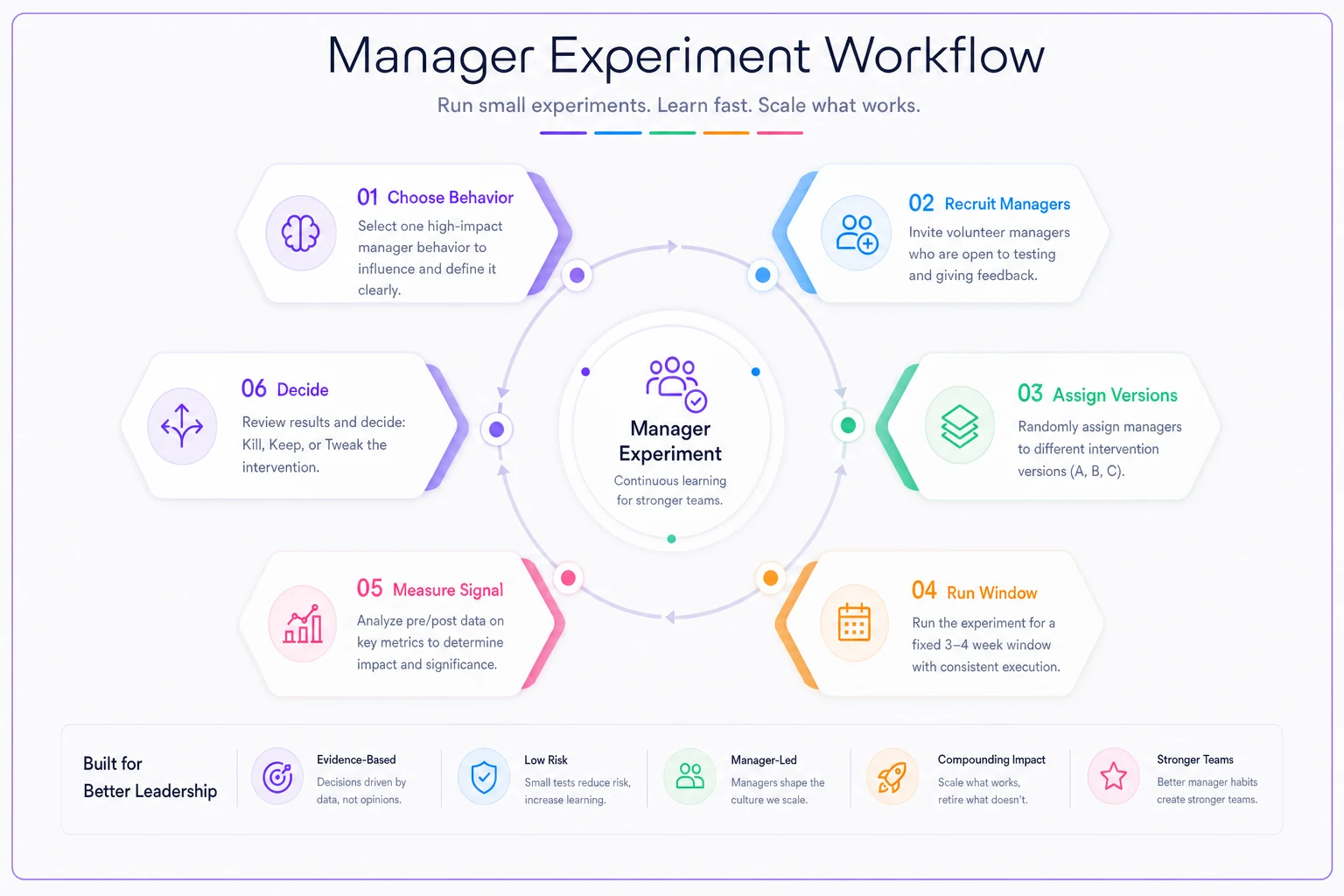
A simple visual of the experiment loop.
Use volunteers early to separate design failures from user resistance.
Something worth noticing: the experiments that succeed almost never rely on HR-generated nudges. They rely on the manager having a reason of their own. When a manager's team gets first access to a stretch project because their profiles are current, adoption sticks without anyone chasing it. That's the version you scale.
The comms calendar that doesn't rely on hope
Communication is where most programs quietly fail because it gets treated as a launch announcement instead of an operating rhythm. One big email at kickoff, then nothing until the "reminder" email when numbers drop. That's not a comms plan — that's an obituary.
A working comms calendar runs on a predictable cadence, targets specific audiences with specific asks, and is mostly triggered by events rather than the calendar alone. The difference between "it's the 1st, send the monthly update" and "this manager hasn't logged anything in 14 days, send the nudge" is the difference between noise and relevance.
Here's a simplified structure of what a quarter's rhythm actually contains:
| Audience | Cadence | The actual message | Who owns it |
|---|---|---|---|
| Executives | Monthly | What moved, what's stuck, one decision needed | Program owner |
| Managers (active) | Bi-weekly | A short win from a peer team + one specific ask | HRBP |
| Managers (stalled) | Event-triggered | "Your team dropped off — here's the 10-min fix" | HRBP |
| Employees | Monthly | What's in it for them this month, concretely | Comms |
| Skeptic managers | Ad hoc | 1:1, not broadcast | Program owner |
Two things people consistently get wrong. First, they send the same message to every audience. Executives don't care about the template library; they care about whether pipeline risk went down. Managers don't care about the strategy; they care about the 10-minute task in front of them. Second, they broadcast when they should be triggering. A stalled manager doesn't need the monthly newsletter. They need one message when they stall, tied to their specific gap.
The stalled-manager trigger is where automation quietly earns its keep. When your skill platform can flag "team X has had zero profile updates in 14 days" and route a pre-written nudge to the right HRBP automatically, you catch decay while it's still fixable instead of discovering it in the quarterly review. The system watches the leading indicator so a human doesn't have to babysit forty dashboards.
SLA-backed adoption tests: how you know it's real
This is the part almost everyone skips, and it's why programs "succeed" on paper and fail in reality. You need a small number of adoption tests with actual service-level commitments attached — so when a test fails, someone owns the failure and there's a defined response.
An SLA-backed test means three things are written down before you start: the promise, the measurement, and the consequence. Without all three, you have a hope, not a test.
A concrete example: the program promises "any manager who submits a skill-validation request gets it reviewed and approved within 3 business days." That's the SLA. The test is whether you actually hit it. If you don't, adoption dies fast — nothing kills a manager's willingness to participate like submitting evidence into a black hole. This ties directly into approval and handoff mechanics, which is worth reading more on in how to build an operating model with owners, SLAs and handoffs.
A few adoption tests worth running with SLAs attached:
-
Validation turnaround requests reviewed within X days, tracked per reviewer. Breach → escalate to peer fallback.
-
Manager response to nudge stalled-manager nudge acted on within one week, or it escalates to their HRBP for a 1:1.
-
Profile freshness every active employee's profile touched at least once per quarter. Breach flags the manager, not the employee.
-
Staffing usage at least one internal opportunity per month actually filled using skill profiles — because if the data never influences a decision, nobody will maintain it.
That last one is the real test. A skill program that never affects who gets which project is theater. The moment a real assignment goes to someone because their verified profile made them visible, managers start caring. Usage follows consequences, not communications.
Keep the measurement honest. It's tempting to declare victory on activity metrics. Resist it. The question isn't "did people log in." It's "did the logged information change a real decision, within the promised time."
Incentive designs that scale past the pilot
Incentives are where programs either become self-sustaining or collapse the second HR stops pushing. The mistake almost everyone makes: they design incentives that work for 10 managers and are impossible to fund or administer for 200.
Recognition incentives cost almost nothing and scale infinitely. A manager whose team has the most current profiles gets called out in the leadership meeting. A team that filled an internal role from within gets a visible win. These are cheap, status-based, and status doesn't run out of budget. Weak on their own, but excellent as a base layer.
Access incentives are the most durable and the most underused. Teams with current, verified skill profiles get first look at stretch assignments, high-visibility projects, or new headcount. This costs nothing extra — you were going to assign that work anyway — but it makes participation obviously worth it. The behavior you want (keep profiles current) is directly rewarded with the thing managers actually want (better access to talent and opportunity). This incentive survives budget cuts because it isn't a line item.
Financial incentives — spot bonuses, budget allocations, comp triggers — are powerful but dangerous to scale. They work well in a pilot and become a nightmare across the org: gaming, fairness complaints, and a recurring cost that finance eventually axes. Use them sparingly and tie them to genuinely hard-to-game outcomes.
| Incentive type | Cost to scale | Durability | Gaming risk |
|---|---|---|---|
| Recognition | Near zero | Low alone, good as base | Low |
| Access to opportunity | Near zero | High | Low–medium |
| Financial | High, recurring | Fragile under budget pressure | High |
The design that scales: recognition as the base layer for everyone, access incentives as the primary driver, and financial incentives reserved for a very small set of high-stakes behaviors. The whole thing should keep running even if the program budget gets cut in half — because most of the incentive engine costs nothing.
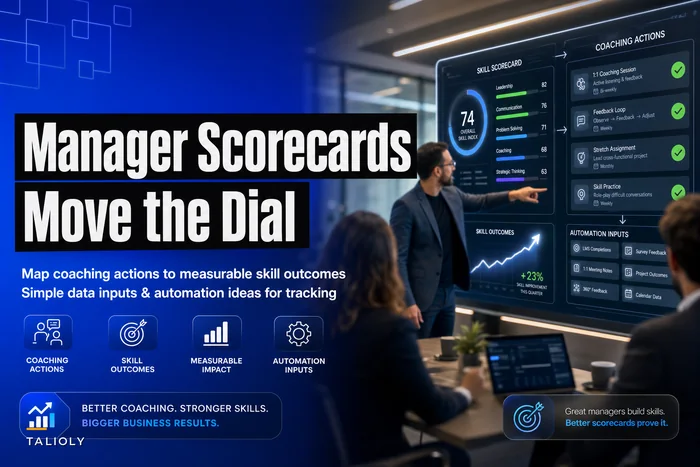
One thing worth flagging: incentives that reward the employee for updating their profile scale worse than incentives that reward the manager for their team's readiness. Individual incentives create thousands of tiny transactions to administer. Manager-level incentives create a few hundred accountable owners. Push accountability up to the manager and the whole system gets lighter to run. That accountability layer is its own discipline — worth pairing this with the RACI and scorecard mechanics in managers blocking skill growth, and the outcome-mapping approach in manager scorecards that move the dial.
A short checklist before you run your first wave
Before spinning up experiments, sanity-check the foundation. If these aren't in place, your experiments will measure the wrong thing.
-
- [ ] One named program owner with real air cover — not a committee
-
- [ ] 3–5 volunteer managers recruited for wave one
-
- [ ] A single, observable behavior defined per experiment
-
- [ ] A fixed experiment window (3–4 weeks) that you will not extend
-
- [ ] Validation SLA agreed and staffed, with a peer fallback for breaches
-
- [ ] A stalled-manager trigger defined (e.g., 14 days no activity → nudge)
-
- [ ] At least one access incentive that costs nothing to fund
-
- [ ] A "usage in a real decision" test — the profile must influence something real
-
- [ ] A debrief slot on the calendar for the end of each wave
If you can't check the SLA box and the "real decision" box, don't launch yet. Those two carry more weight than everything else combined.
A real scenario
A mid-sized software company — around 240 employees, mostly engineering and product — had a skills platform that finance was ready to cut. Active manager usage was sitting somewhere around 20% after a full-org launch nine months earlier. The data was stale, and it had never been used to make a single staffing decision.
Instead of relaunching, the talent team ran the experiment loop. Four volunteer managers, one behavior: every report gets a skill goal tied to a live project within three weeks. They attached one SLA — validation requests turned around in 2 business days — and one access incentive: teams with current profiles got first pick of an upcoming migration project that everyone wanted on their resume.
The migration project incentive did most of the work. Within the first wave, three of the four teams hit the target. Managers who'd ignored the platform for months updated profiles in a week because the access was real and immediate. The team then rolled the same design to the next 15 managers, including some skeptics, and kept the parts that survived contact with resistance.
Roughly four months in, active manager usage climbed from that ~20% to somewhere in the 60–65% range. More importantly, two internal roles got filled from verified profiles instead of external hires. That last part is what saved the budget — not the usage number, but the fact that the program produced a decision finance could actually see.
Where this makes sense — and where it doesn't
This playbook fits organizations where managers have real discretion over assignments and where there's something worth competing for — projects, visibility, headcount. The access incentive is the engine, and if managers control nothing worth wanting, the engine has no fuel.
It's a bad fit if leadership won't give the program owner any authority or air cover. Manager experiments only work when someone can protect the volunteers' time and enforce the SLAs. Run this under an owner with no teeth and you'll generate a nicer-looking version of the same stall.
And it's genuinely the wrong move if your underlying skill data is a mess. Adoption experiments assume the profiles mean something. If the data is unreliable, you'll get managers using the system, making bad decisions from bad data, and trusting it even less than before. Fix the data foundation first, then run adoption.
The core idea to hold onto: adoption is something you operate, not something you announce. Small tested loops beat big launches. SLAs turn promises into accountability. And the incentives that scale are almost always the ones that cost nothing — access, opportunity, and status — because those are the ones that survive the first budget cut and keep the whole system running without you standing over it.
Ready to elevate your team's skills?
Join 500+ companies using Talioly to boost skill visibility, streamline training, and drive performance growth.