
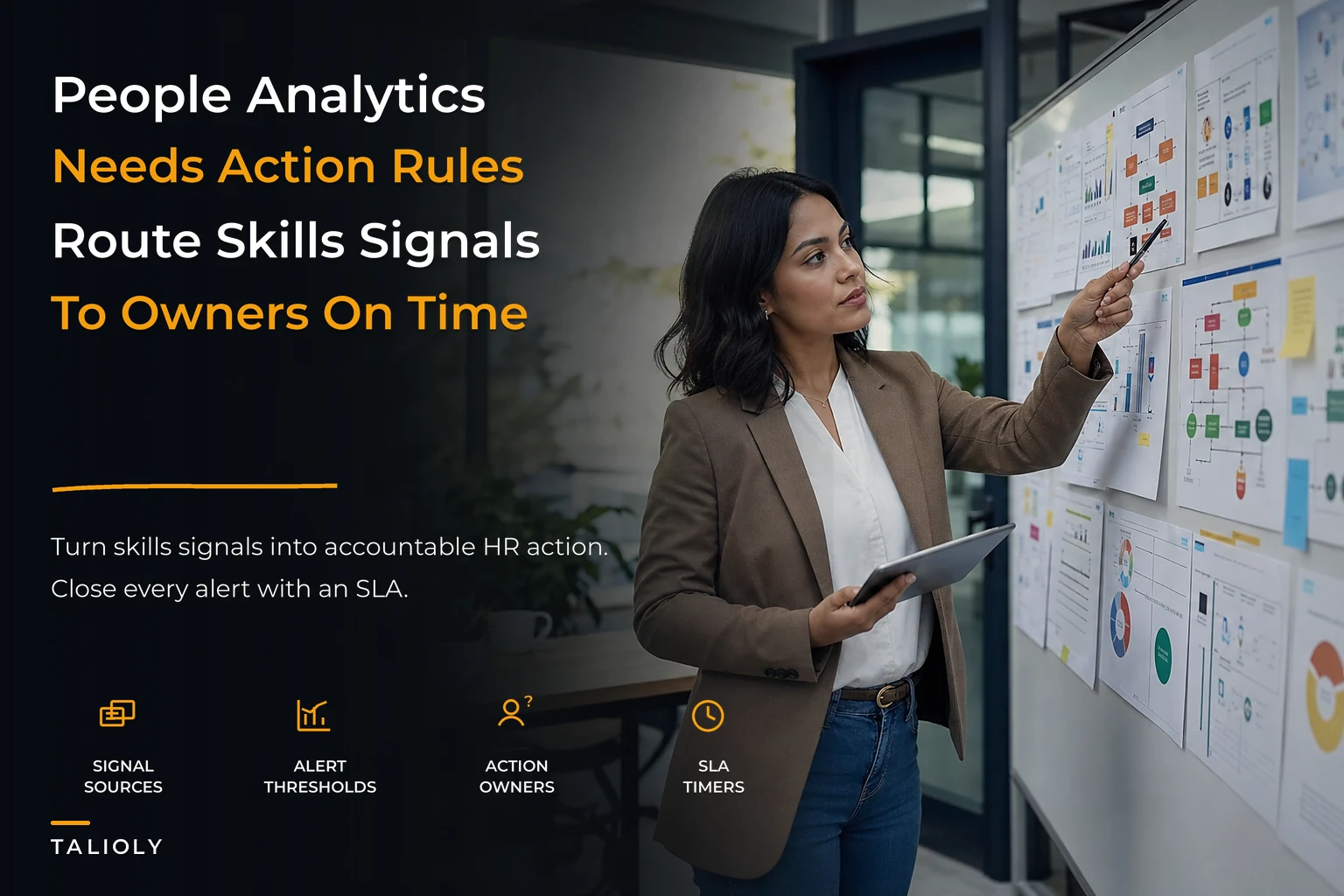

Most skills analytics programs fail at the same exact point: the moment an alert fires. The dashboard lights up red. Someone notices. And then nothing happens. Or something happens, but nobody tracks whether it closed. Six weeks later the same alert fires again, and now there are two tickets open for the same problem, each owned by somebody who assumed the other person had it.
The missing piece isn't more data or prettier charts. It's a people analytics charter — a written agreement that converts a signal into an owner, a deadline, a defined action, and a confirmed resolution. Without that, analytics is basically a smoke detector beeping into an empty house.
This is the operational layer almost nobody builds. Teams invest months stitching together skill profiles, confidence scores, and heatmaps, then run the whole thing on vibes and Slack reminders. The charter is what turns "we have interesting data" into "a gap got closed and we can prove it."
The real failure isn't detection — it's the handoff
Think about what actually happens between a signal and an action in most orgs.
An analytics tool flags that a critical skill cluster in the payments team dropped below readiness threshold — say three of five senior engineers lost currency on a key compliance framework because certifications lapsed. That's a clean, useful signal. Here's the chain it has to survive:
-
Someone has to see it.
-
Someone has to decide it matters.
-
Someone has to own it.
-
Someone has to decide what to do.
-
Someone has to do it within a sensible window.
-
Someone has to confirm it worked and close the loop.
Each step in that chain is a place where things die. In practice, steps 2 and 3 kill the most initiatives. The alert gets seen, everyone agrees it's concerning, and then it floats in a shared ambiguity where it's technically everyone's job and actually nobody's.
What you see across a lot of organizations is that the volume of signals quietly grows faster than the org's capacity to route them. At 200 employees you can run this out of one person's head. At 2,000 you can't, and the backlog becomes invisible because nothing is tracking un-actioned alerts. The data quality is usually fine. The routing is broken.
What a charter actually contains
A people analytics charter isn't a mission statement. It's an operating document with teeth. The useful ones share five components, and skipping any of them reintroduces the exact ambiguity you're trying to kill.
Stop losing track of critical skills.
Talioly helps you track, develop, and certify your workforce efficiently.
- Centralized skill profiles
- Automated training reminders
- Competency gap analysis
No credit card required
| Component | What it defines | Failure mode if missing |
|---|---|---|
| Signal pipeline | Which data sources feed which alerts, and the logic | Alerts fire on stale or duplicate data |
| Alert thresholds | The exact trigger values and severity tiers | Everything looks urgent, so nothing is |
| Owner RACI | Who's Responsible, Accountable, Consulted, Informed per alert type | Diffused ownership, nothing moves |
| SLA timers | Time-to-acknowledge and time-to-resolve by severity | Alerts age silently with no deadline |
| Runbooks | The pre-decided action steps for each alert type | Every incident gets re-debated from scratch |
This matters more as you grow. At small scale, a sharp HR lead compensates for every gap on this table through sheer attention. That person becomes a single point of failure. When they go on leave or leave the company, the whole informal routing system collapses — and leadership discovers there was never a real system at all, just one diligent human holding it together.
Designing the signal pipeline
Start with sources, not alerts. The common mistake is designing alerts first and then realizing the underlying data can't reliably support them. You end up with a threshold that triggers on noise.
A reasonable pipeline for skills signals pulls from a handful of inputs:
-
Skill profile confidence and staleness scores
-
Certification and credential expiry dates
-
Internal mobility and open-role match rates
-
Assessment results and revalidation outcomes
-
Team-level readiness against role requirements
For each source, write down one thing before you build any alert: how fresh does this data need to be for the alert to be trustworthy? A readiness alert built on skill data that's refreshed quarterly will fire on gaps that were already closed two months ago. That's how you train managers to ignore alerts — make them wrong often enough that dismissing them becomes the rational response.
Pro-tip: Record the required freshness for each source next to it so alert authors can't assume a faster cadence.
A common example: a company sets a threshold for "team critical-skill coverage below 2 qualified people." Sounds sensible. But the profiles feeding it were self-reported and roughly 40% stale. The alert fired constantly for teams that were actually fine, owners learned to swipe it away, and when a real coverage gap appeared, it got the same reflexive dismissal. The pipeline poisoned the whole program's credibility.
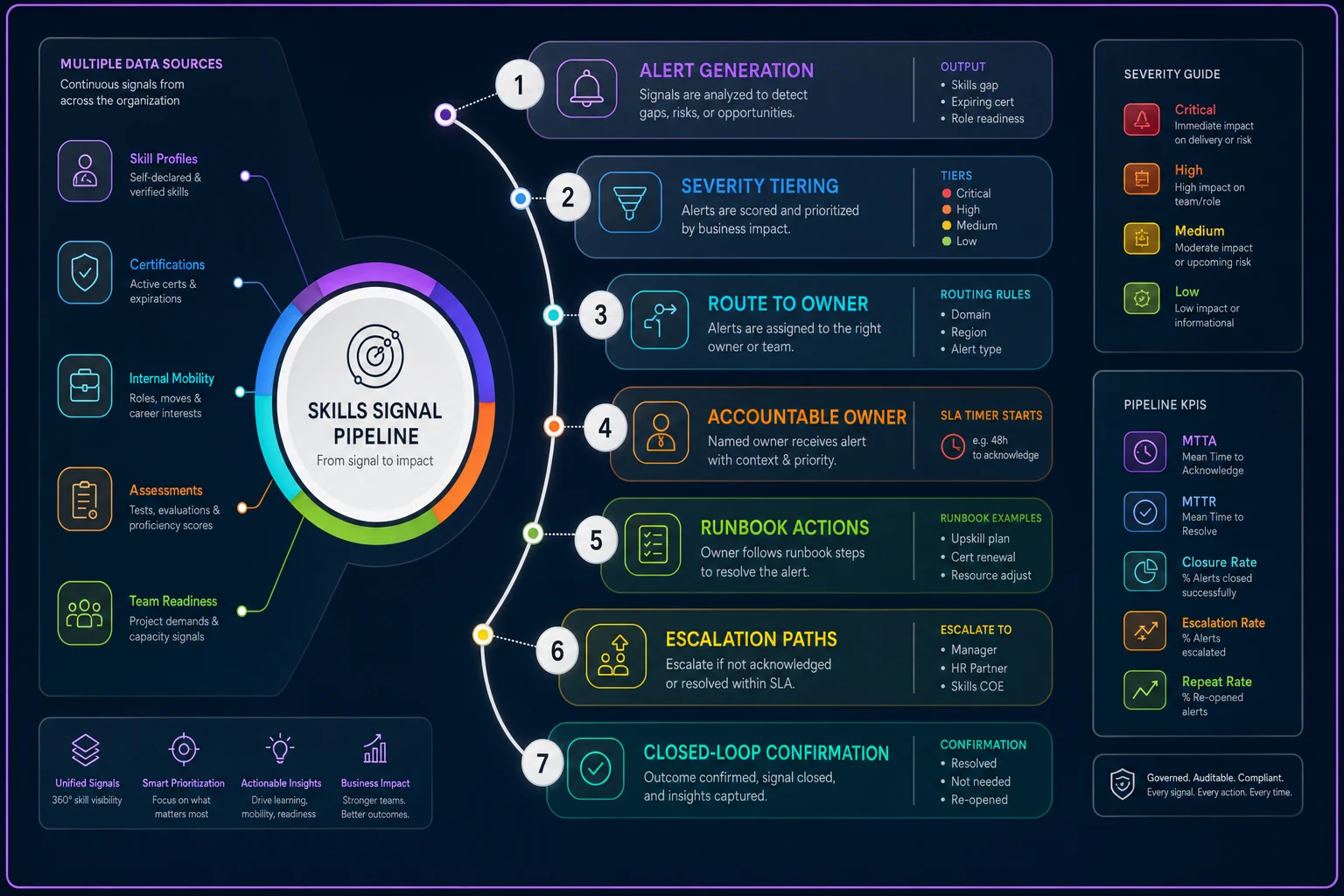
Here's a quick visual of the pipeline and handoff workflow.
Thresholds and severity tiers
One threshold per alert is fine. What breaks programs is having one severity — treating every signal as equally urgent. If a lapsed certification and a single stale profile both page the same person with the same intensity, you've built an alarm that can't be prioritized.
-
Tier 1 (critical) business risk if unaddressed quickly — e.g., a compliance-critical skill with zero qualified coverage on an active team.
-
Tier 2 (elevated) a developing gap that needs attention this month — e.g., coverage dropping from three to two qualified people.
-
Tier 3 (informational) worth tracking, no immediate action needed — e.g., a single profile crossing the staleness line.
The thing most teams miss: tiering isn't just about urgency, it's about who gets pulled in. A Tier 1 signal should route to a named accountable owner and a backup. A Tier 3 signal should accumulate quietly into a monthly review, never interrupting anyone. When you blur these, you either flood senior people with noise or let real risks sit in the same queue as trivia.
Owner RACI — the part everyone underbuilds
This is where the charter earns its keep. Every alert type needs exactly one Accountable owner. Not a team. Not a function. One name. You can have many people Responsible for doing the work, but only one neck on the line for whether it closes.
-
Responsible the team manager who runs the upskilling or redeployment action
-
Accountable the HRBP for that business unit
-
Consulted L&D for program options, Finance when budget is involved
-
Informed the department head, via monthly rollup
The pattern that kills accountability is making the manager both Responsible and Accountable with no one above them tracking closure. Managers already have day jobs; a skills alert competes with their deliverables and loses. When the HRBP owns closure, the manager has a counterpart whose actual role is to keep it moving. This connects directly to how you fund and prioritize this work — if nobody owns the budget tradeoffs, even a well-routed alert stalls at "we don't have resources for that." Getting the cross-functional funding model right is what keeps accountable owners from hitting a wall the moment an action costs money.
SLA timers that create urgency without panic
An alert without a clock ages silently. SLA timers fix this by attaching two deadlines to every signal: time-to-acknowledge and time-to-resolve.
| Severity | Acknowledge within | Resolve within |
|---|---|---|
| Tier 1 | 1–2 business days | 2–4 weeks |
| Tier 2 | 3–5 business days | 4–8 weeks |
| Tier 3 | Monthly review cycle | No hard SLA |
The operational trick here is tracking breached SLAs as its own metric. A single aged alert is a minor problem. A rising count of SLA breaches is a structural one — it usually means either the thresholds are too sensitive (too many alerts) or the owners are overloaded (not enough capacity). The breach count tells you which lever to pull before the whole system silently clogs.
Runbooks: stop re-debating the same incident
The last component is what stops every alert from becoming a committee meeting. A runbook is the pre-agreed set of actions for a given alert type, written once, so the owner isn't improvising under pressure.
-
Confirm the signal against current profile data (rule out staleness).
-
Check the internal marketplace for qualified candidates available for redeployment.
-
If coverage can be restored internally, initiate a stretch assignment or reassignment.
-
If not, trigger a targeted upskilling action with a defined completion milestone.
-
If neither closes the gap in the SLA window, escalate to hiring with the department head.
-
On resolution, re-run the readiness check and formally close the alert.
The value of writing this down isn't the steps themselves — it's that step 4 doesn't get re-argued every single time the alert fires. Without runbooks, each incident restarts the "should we train or hire?" debate from zero, and that debate alone eats most of the resolution window. A decent runbook turns a two-week deliberation into a one-day decision.
A real scenario
A mid-sized software company, roughly 1,400 employees, had a genuinely good skills platform. Clean profiles, confidence scoring, the works. What they didn't have was a charter. Alerts fired into a shared dashboard that HRBPs were "supposed to check."
When they audited it, they found something uncomfortable: of the critical-tier alerts raised over about six months, somewhere around 60% had never been formally actioned or closed. They weren't ignored out of negligence — they just had no owner and no clock, so they lost every competition for attention.
They built a charter. Named one accountable HRBP per business unit, set a two-tier SLA, and wrote four runbooks covering the alert types that made up most of their volume. Nothing elaborate. Within a quarter, time-to-acknowledge on critical alerts dropped from "whenever someone noticed" to roughly two days, and their backlog of un-actioned critical signals went from dozens down to a handful at any given time. The underlying data hadn't changed at all. The routing had.
What made the difference wasn't a smarter model. It was that an alert now had somewhere to go.
When this makes sense — and when it doesn't
This makes sense when your signal volume has outgrown one person's ability to track it informally, when you've got multiple business units with different owners, or when leadership is asking "what did we actually do about that?" and nobody can answer cleanly.
This is overkill when you're a small team where one HR lead genuinely sees and routes everything. Building formal RACIs and SLA timers for a 120-person company usually just adds process overhead that slows down what was already working. Don't build governance for scale you don't have yet.
Who should NOT do this: teams whose underlying skill data is still unreliable. If your profiles are stale or mostly self-reported, a charter will faithfully route bad signals to real people and burn their trust fast. Fix data quality first, then build the routing layer on top of it. A charter amplifies whatever's feeding it — including garbage.
Where tooling quietly helps
You can run a first version of this on a spreadsheet and calendar reminders, and honestly that's a fine place to start. The reason it eventually needs real tooling is state. Someone has to remember which alerts are open, which breached SLA, who acknowledged what, and whether the resolution actually held. That bookkeeping decays fast when it's manual — it works fine for a month and then quietly rots.
This is where operational platforms with built-in alerting, ownership routing, and SLA tracking earn their place: not because they generate smarter signals, but because they hold the state of every open loop and surface the right owner automatically when a timer runs out. The automation that matters here isn't predictive — it's the unglamorous work of making sure nothing falls through the handoff. A system that auto-routes a fired alert to its accountable owner, starts the clock, and escalates on breach is doing the one job humans reliably forget to do.
Measuring whether the charter is working
The charter itself needs metrics, or you've just moved the accountability problem up one level. Track:
-
Acknowledgement rate within SLA — are owners even seeing alerts in time?
-
Resolution rate within SLA — are loops actually closing?
-
SLA breach trend — rising means overload or over-sensitivity.
-
Re-fire rate — how often a "closed" alert re-triggers (signals a cosmetic fix, not a real one).
-
Backlog of open critical alerts — the single number leadership should see monthly.
Don't let these become their own vanity exercise. A high acknowledgement rate means nothing if resolutions are fake. The re-fire rate is the honest one — it catches the owner who closed an alert to clear their queue rather than to actually fix the gap. If you want to avoid building a dashboard that looks healthy while nothing improves, it's worth being deliberate about which metrics actually tie back to business outcomes versus which just make the chart green.
The shift this forces
The quiet thing a charter does is change what analytics is for. Before, the dashboard was a reporting artifact — something you showed in a quarterly review to prove the program existed. After, it becomes an input to a workflow. A signal is no longer information you look at; it's a work item with an owner, a deadline, and a defined close.
That reframe is the whole point. Skills analytics doesn't fail because the detection is wrong. It fails because detection was never wired to action, and un-actioned signals accumulate into a backlog nobody can see. The charter is the wiring. It's less exciting than the modeling work, which is probably why so few teams build it — but it's the difference between a program that reports gaps and one that actually closes them.
Ready to elevate your team's skills?
Join 500+ companies using Talioly to boost skill visibility, streamline training, and drive performance growth.