

Most assessment programs don't fail because they were badly built. They fail because nobody owned them after launch. Someone validates a skills test, gets a green light from a consultant, ships it, and then two years later it's still gating promotions and pay decisions with zero maintenance in between. The content has drifted, the SMEs who calibrated it have moved on, and half the questions now measure things nobody actually does anymore.
Most HR teams don't have a statistician on staff, and the ones who do rarely have that person's bandwidth for this kind of ongoing work. So the real question isn't "how do we build a psychometrically perfect assessment?" It's "how do we build a governance system a normal HR team can run — one that catches problems before they turn into a bias lawsuit or a promotion everyone quietly knows was wrong?"
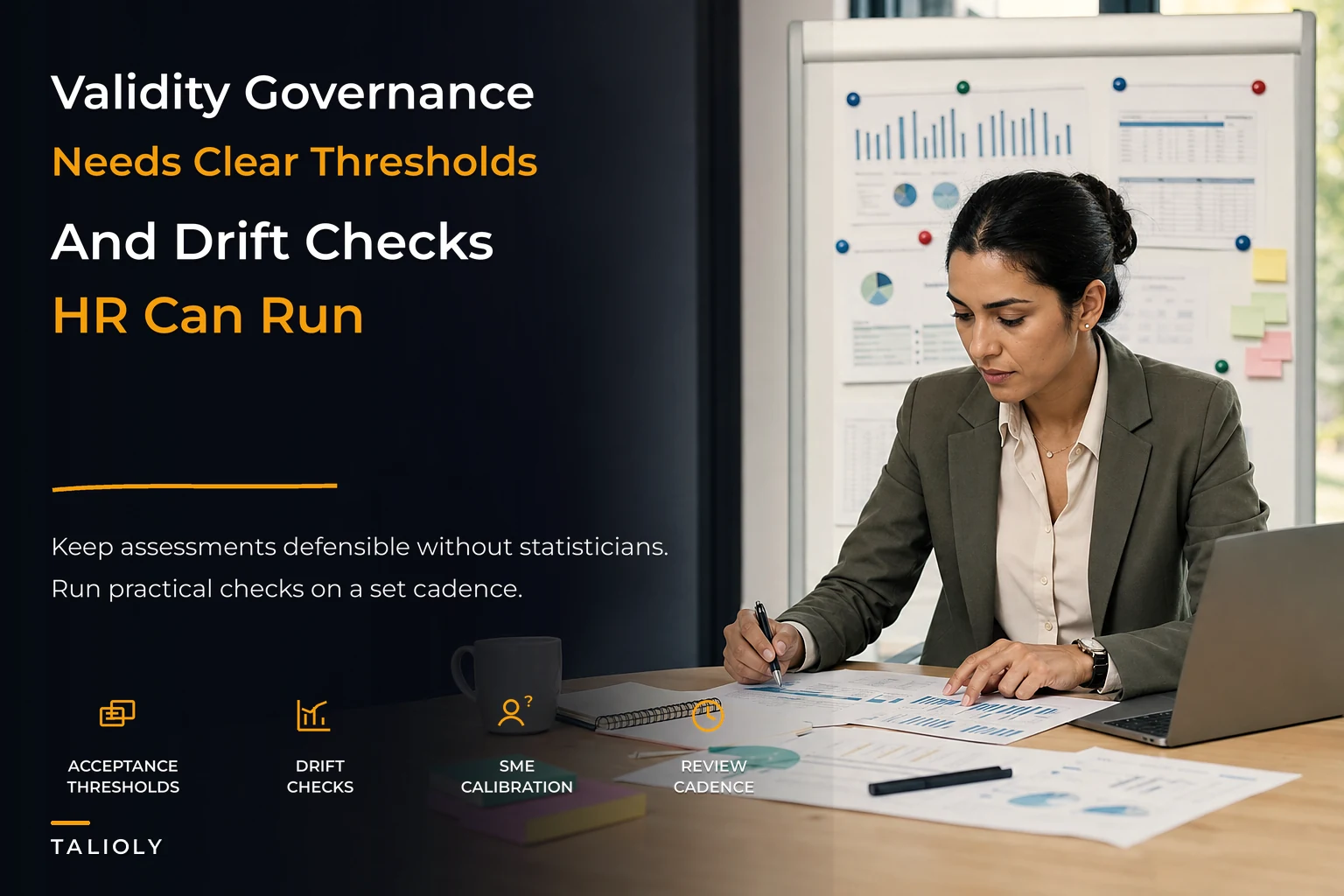
That's what this is. Not a stats course. A running system with thresholds you can defend, queries you can copy, rituals that fit into a normal quarter, and clear rules for when to pull an assessment out of service.
Why validity governance breaks in normal HR operations
Validity isn't a one-time property. It's a state that decays. An assessment that was valid at launch can quietly become invalid because the job changed, the candidate pool shifted, or the scoring got gamed once people figured out the pattern.
A company runs a proper validation study when they first build the tool — sample sizes, correlation with performance, the whole thing. Then the study becomes a PDF in a shared drive. No owner, no recurring review, no trigger that says "check this again." The assessment keeps running because it works mechanically. Scores come out, decisions get made. Nobody notices it's slowly detaching from reality until an adverse impact review or a legal challenge forces the question.
The second breakdown is over-reliance on specialists. Because validity sounds technical, HR treats it as something only a data scientist can touch — so it gets outsourced, then ignored because you can't afford to re-engage the consultant every quarter. That dependency guarantees maintenance never actually happens.
A governance system fixes this by lowering the technical bar. You don't need to build the validity model in-house. You need to monitor it in-house, with simple checks that flag when it's time to escalate. That's a completely different — and much cheaper — skill set.
The four things a non-technical governance system actually monitors
Strip away the jargon and there are four things that break, each with a check a non-technical person can run.
Stop losing track of critical skills.
Talioly helps you track, develop, and certify your workforce efficiently.
- Centralized skill profiles
- Automated training reminders
- Competency gap analysis
No credit card required
1. Acceptance thresholds — are the cut scores still defensible? A cut score is a business decision dressed up as a number. The governance job isn't to recompute it perfectly — it's to make sure it hasn't been quietly abandoned. If your passing score was set at 70% and managers are now overriding fails 40% of the time, your real threshold is fiction.
2. Score drift — is the distribution moving? If average scores are climbing every quarter, either your candidates got significantly better (rare) or the assessment leaked, got easier, or people learned to game it (much more common). Drift in the score distribution is the earliest warning signal you have, and it's dead simple to watch.
3. Predictive relationship — does the score still connect to performance? This is the heart of validity: people who score higher should, on average, do better on the job. When that link weakens, the assessment is measuring something other than competence. You don't need regression here — you need a periodic check comparing score bands to actual outcomes.
4. Group fairness — is impact evenly distributed? Pass rates that diverge sharply across groups are both a legal exposure and a signal the assessment is measuring something irrelevant. This is where a lot of programs die quietly, because nobody was watching.
The rest of this playbook turns each of these into a threshold, a query, and a cadence.
Acceptance tables: turning "is it still valid" into a yes/no
The single most useful thing you can build is an acceptance table — a set of thresholds that convert fuzzy validity questions into clear actions. This is what lets a non-statistician make the call.
| Signal | Green (keep running) | Yellow (review this quarter) | Red (pull or freeze decisions) |
|---|---|---|---|
| Manager override rate on fails | Under 10% | 10–25% | Over 25% |
| Quarter-over-quarter mean score change | Under 5 points | 5–10 points | Over 10 points |
| Score-band vs. performance alignment | Top band outperforms bottom clearly | Weak but present | Bands don't separate |
| Pass rate ratio between largest and smallest group | 0.90–1.10 | 0.80–0.90 | Below 0.80 (four-fifths flag) |
| Time since last SME calibration | Under 12 months | 12–18 months | Over 18 months |
| Item exposure (same version in use) | Under 12 months | 12–24 months | Over 24 months |
A few things worth flagging about how to actually use this:
The four-fifths ratio (bottom group pass rate divided by top group pass rate) is the one HR teams should memorize. It's not a legal safe harbor by itself, but it's the standard first screen for adverse impact and it takes about thirty seconds to compute from a pivot table. If it dips below 0.80, that's a red flag regardless of how good everything else looks.
The override rate is the sleeper metric. Managers overriding your assessment constantly is the clearest sign the tool has lost credibility on the ground — and it usually happens before the statistical signals move. Watch it closely.
Don't treat yellow as "ignore until it's red." Yellow means it goes on the review agenda. Most programs skip the yellow band entirely and only react at red, which means they're always playing catch-up in emergencies.
Simple calculators any HR analyst can build
You don't need specialized software for the core math. A spreadsheet handles all four checks.
Override rate. Count of overturned fails ÷ total fails, per quarter, per assessment. One formula.
Mean score drift. Average score this quarter minus average last quarter. Chart it over six quarters so you're looking at a trend, not a blip. A single quarter's movement is noise; three quarters climbing in one direction is a signal.
Score-band vs. performance. Split scores into three bands (top/middle/bottom third). For each band, calculate the average of a performance outcome you already track — first-year rating, ramp time, error rate, whatever fits the role. If the top band doesn't visibly beat the bottom band, the assessment isn't earning its keep. This is a crude version of predictive validity, and crude is fine for a monitoring check. When it flashes yellow, that's when you bring in the specialist.
Adverse impact ratio. Pass rate per group, then divide the lowest by the highest. That's your four-fifths number.
The mistake people make here is chasing precision they don't need. You are not publishing a peer-reviewed study. You're running a smoke detector. A smoke detector doesn't tell you the exact temperature of the fire — it just tells you to get up and look. If you want to go deeper on the reasoning behind these lightweight checks, the non-technical stats primer for validating HR assessments covers the underlying logic without turning you into a statistician.
Drift-detection queries you can hand to any analyst
If your assessment data lives in a database or export, these are the queries that surface trouble. Written in plain SQL-ish pseudocode so your BI person can adapt them to your schema in minutes.
Score drift over time: SELECT quarter, AVG(score) AS meanscore, COUNT(*) AS n FROM assessmentresults WHERE assessment_id = 'X' GROUP BY quarter ORDER BY quarter;
Watch mean_score. Rising steadily with stable n means you should investigate for leakage or gaming.
Override rate: SELECT quarter, SUM(CASE WHEN outcome='fail' AND finaldecision='pass' THEN 1 ELSE 0 END) * 1.0 / SUM(CASE WHEN outcome='fail' THEN 1 ELSE 0 END) AS overriderate FROM decisions WHERE assessment_id = 'X' GROUP BY quarter;
Pass rate by group (feeds the four-fifths check): SELECT grouplabel, AVG(CASE WHEN outcome='pass' THEN 1.0 ELSE 0 END) AS passrate, COUNT(*) AS n FROM assessmentresults WHERE assessmentid = 'X' GROUP BY group_label;
Ignore any group with a small n — small samples produce wild ratios that mean nothing. Set a minimum (around 30) before you act on a group's number.
Stale items still in circulation: SELECT itemid, firstuseddate, DATEDIFF(CURRENTDATE, firstuseddate) AS dayslive FROM items WHERE assessmentid = 'X' AND dayslive > 365 ORDER BY dayslive DESC;
One honest caveat: query results are only as trustworthy as the data feeding them. If your assessment outcomes and performance records are scattered, mislabeled, or stale, these queries will produce confident-looking garbage. Getting the underlying records clean first is worth the effort — the data-quality playbook on staleness detection and confidence scoring is a good companion here, because drift detection on rotten data just automates your mistakes faster.
SME calibration rituals that don't eat your subject-matter experts alive
Subject-matter experts are the source of truth for whether assessment content still matches the job. But they're also busy, and "help us re-validate the assessment" is the kind of open-ended ask that gets pushed indefinitely. The fix is making calibration a ritual with tight boundaries, not an open project.
-
Pre-read (async, 20 min). Send SMEs the current items plus the drift dashboard. They mark anything that looks outdated, ambiguous, or no longer job-relevant. Silence counts as approval — you don't wait for perfect attendance.
-
Live session (60 min). Only discuss items that got flagged. Don't re-review the whole bank. This one rule cuts the meeting by two-thirds.
-
Rating exercise (10 min). Have each SME independently rate whether each flagged item is still "essential / useful / obsolete." Where SMEs disagree strongly, that item goes to a decision — rewrite or retire. Disagreement between experts is itself a validity signal.
-
Sign-off. One named person records decisions and updates the "last calibrated" date. That date feeds your acceptance table.
The pattern that kills calibration is treating every session like a full rebuild. You don't re-validate everything twice a year — you triage what the data flagged. The dashboard tells you where to look; the SMEs tell you what to do about it. That division of labor is what makes it sustainable without a specialist running the room.
Worth naming one more thing: rotate your SMEs deliberately. If the same three people have calibrated an assessment for four years, their shared blind spots get baked in. Bring in one fresh SME each cycle to keep the calibration honest.
Maintenance cadence: who does what, and when
A governance system is only real if it's on a calendar with owners. Here's a cadence a two-to-three person HR team can actually sustain.
-
Monthly Pull override rates and pass rates. Ten-minute glance. Anything red gets escalated immediately, not held for the quarterly.
-
Quarterly Run the full drift dashboard — score trends, band-vs-performance, four-fifths ratio. Review against the acceptance table. Document decisions.
-
Twice a year SME calibration ritual for each active assessment family.
-
Annually Full review of cut scores and whether the assessment still maps to the current job. Refresh item bank for anything over the exposure threshold.
-
Event-triggered (anytime) Any of these force an off-cycle review — a role redesign, a reorg, a spike in complaints, an override rate crossing red, or a legal/compliance flag.
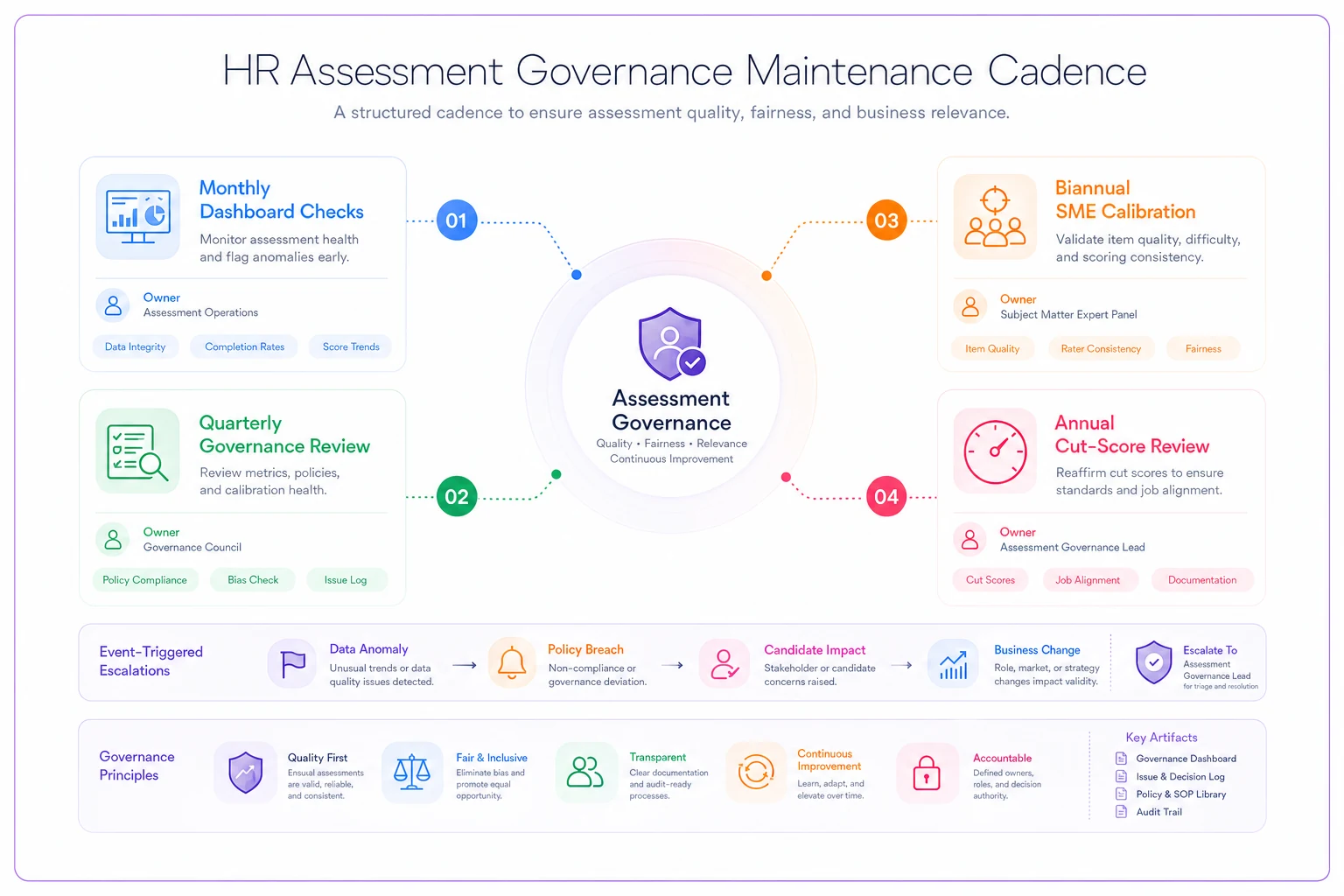
Use this visual as a one-page reminder of who does what and when.
Assign each of these to a named owner, not a team. "HR owns this" means nobody owns it. "Priya runs the quarterly dashboard review" means it happens.
Your governance checklist
Print this. It's the whole system on one page.
-
- [ ] Every live assessment has a named owner
-
- [ ] An acceptance table exists with pre-agreed green/yellow/red thresholds
-
- [ ] Override rate and pass rate pulled monthly
-
- [ ] Full drift dashboard reviewed quarterly against the acceptance table
-
- [ ] Four-fifths ratio computed every quarter, with a minimum sample size rule
-
- [ ] SME calibration ritual scheduled twice a year, triage format
-
- [ ] "Last calibrated" and "first used" dates tracked per assessment/item
-
- [ ] Item exposure monitored; refresh triggered past the threshold
-
- [ ] Cut scores reviewed annually against current job requirements
-
- [ ] Event triggers documented (reorg, complaints, red thresholds, legal flags)
-
- [ ] A clear "freeze decisions" protocol for when something hits red
-
- [ ] Escalation path to a specialist defined before you need one
That last point matters more than it looks. The goal of non-technical governance isn't to never involve an expert. It's to know exactly when to, so you're paying for a specialist on a specific flagged problem a couple of times a year instead of an open-ended retainer for work that never gets scheduled.
When this system makes sense — and when it doesn't
When it works well: You're running assessments that gate real decisions — hiring, promotion, pay, certification — and you don't have dedicated psychometric staff. This is the sweet spot. The system gives you defensibility and early warning without a full-time specialist.
When you need more than this: If you're operating high-stakes assessments at scale — thousands of candidates, heavy legal exposure, licensure-grade decisions — this monitoring layer is necessary but not sufficient. Use it as your ongoing watch, but keep real psychometric expertise formally in the loop. The governance system tells the specialist where to focus; it doesn't replace them.
Who should not lean on this alone: Anyone treating the acceptance table as legal cover. These thresholds are operational smoke detectors, not compliance guarantees. If an assessment is driving decisions with legal weight, your monitoring should inform counsel and specialists, not substitute for them.
A realistic scenario
A mid-sized logistics company used a skills assessment to gate promotions into team-lead roles — roughly 200 candidates a year across sites. The assessment had been validated once, four years earlier, then left alone.
When they finally set up basic monitoring, three things surfaced fast. Mean scores had climbed about 12 points over two years — a classic leakage pattern, and sure enough, an unofficial "study guide" of real questions was circulating between sites. The override rate on fails had crept past 30%, meaning managers had already stopped trusting the tool. And the pass rate ratio between their two largest candidate groups had drifted to around 0.76 — under the four-fifths line, and nobody had caught it.
None of that required a statistician to detect. It required someone to run four spreadsheet checks against a threshold table. They froze the assessment for promotion decisions, refreshed the item bank, ran a calibration session, and reset the cut score. Within a couple of quarters the override rate settled back under 15% and the group ratio moved above 0.85. The assessment went from a quiet liability to a defensible tool again — and the ongoing cost was a few hours a month, not a consulting engagement.
The real point
Assessment validity isn't a certificate you earn once. It's a condition you maintain, and it decays whether or not you're watching. The reason so many HR teams end up with drifted, indefensible assessments isn't incompetence — it's that they assumed validity was a technical problem requiring technical staff they didn't have, so nothing got maintained at all.
The way out is to separate the two jobs. Building and deeply validating an assessment can stay with specialists. Monitoring it — the thresholds, the queries, the calibration rituals, the cadence — is ordinary operational work a normal HR team can own. Get that split right and you'll catch problems while they're still yellow, escalate to experts only when it's worth their time, and never again discover during a legal review that a tool you've been trusting for years quietly stopped working.
Ready to elevate your team's skills?
Join 500+ companies using Talioly to boost skill visibility, streamline training, and drive performance growth.