

Skills data quality isn't about having perfect records. It's about catching talent before competitors do.
Most HR teams run skills inventories that look impressive in dashboards but fall apart under basic accuracy checks. You've got Sarah marked as "intermediate Python" from a 2019 self-assessment while she's been architecting your entire data pipeline for two years. Meanwhile, Marcus gets passed over for a team lead role because his profile still says "no management experience" — despite running cross-functional projects for eight months.
It compounds fast. Stale skills data creates a cascade of bad decisions: wrong people on projects, external hires for roles you could fill internally, and your best people leaving because they're invisible in their own company's systems.
Why skills data goes stale faster than you think
Skills profiles don't decay because someone forgot to update them. They decay because the mechanisms to capture change never existed in the first place.
Think about what actually happens after someone completes a major project. They update their LinkedIn, polish their resume, maybe mention it in a one-on-one. But their internal skills profile? Still shows whatever they filled out during onboarding.
The rot happens through multiple failure points at once. Managers assume HR maintains skills data. HR assumes employees self-report updates. Employees assume their work speaks for itself. Learning systems capture course completions but not application. Performance reviews document outcomes but not capabilities gained.
Every organizational change accelerates the problem. Team restructures create new skill requirements that never get documented. Role evolution happens gradually without anyone touching profiles. People develop real expertise through stretch assignments that exist nowhere in your data.
The confidence scoring framework that actually works
Generic confidence scores are almost useless. "High confidence" on a skill could mean anything from "took a course once" to "built this from scratch across five production systems."
Stop losing track of critical skills.
Talioly helps you track, develop, and certify your workforce efficiently.
- Centralized skill profiles
- Automated training reminders
- Competency gap analysis
No credit card required
Base Score Components (0-100 scale):
-
Evidence age
-5 points per quarter since last validation
-
Evidence type
Project work (40pts), Peer validation (30pts), Certification (20pts), Self-report (10pts)
-
Evidence frequency
Number of validated instances in past 12 months
-
Evidence scope
Team project (1x), Department (1.5x), Company-wide (2x)
A practical example — developer with "React expertise":
-
Built customer portal (Q1)
40 points base
-
Company-wide project
40 × 2 = 80 points
-
Age penalty (current Q3)
80 - 10 = 70 points
-
Three peer validations
70 + 30 = 100 points (capped)
-
Final confidence
100 (High - Recent)
Compare that to someone who took a React course six months ago:
-
Course completion
20 points base
-
No multiplier
20 points
-
Age penalty
20 - 10 = 10 points
-
Final confidence
10 (Low - Stale)
The algorithm surfaces what actually matters: recent, validated, applied skills — not theoretical or outdated knowledge.
Detection queries that expose the talent you're missing
Standard reports show skill counts and categories. They don't show decay patterns or hidden expertise.
Query 1: Stale High-Value Skills
SELECT employeename, skillname, lastevidencedate, DATEDIFF(day, lastevidencedate, GETDATE()) as daysstale FROM skillsinventory WHERE skillcriticality = 'HIGH' AND lastevidencedate < DATEADD(month, -6, GETDATE()) AND employeestatus = 'ACTIVE' ORDER BY days_stale DESC
This catches critical skills that haven't been validated recently. Run it monthly and you'll spot expertise going dark before it creates a real problem.
Query 2: Rapid Skill Growth Indicators
SELECT employeename, COUNT(DISTINCT skillname) as newskills6mo, AVG(confidencescore) as avgconfidence FROM skillsinventory WHERE evidencedate > DATEADD(month, -6, GETDATE()) AND evidencedate < DATEADD(month, -12, GETDATE()) GROUP BY employeename HAVING COUNT(DISTINCT skillname) > 3 ORDER BY newskills_6mo DESC
Identifies people rapidly expanding their capabilities — often your hidden high-potentials who don't self-promote.
Query 3: Duplicate Skills Detection
SELECT s1.employeeid, s1.skillname as skill1, s2.skillname as skill2, SIMILARITY(s1.skillname, s2.skillname) as matchscore FROM skillsinventory s1 JOIN skillsinventory s2 ON s1.employeeid = s2.employeeid AND s1.skillid < s2.skillid WHERE SIMILARITY(s1.skillname, s2.skillname) > 0.8 OR (s1.skillcategory = s2.skillcategory AND LEVENSHTEIN(s1.skillname, s2.skillname) < 3)
Catches variations like "Project Management" vs "Project Mgmt" vs "PM" that silently fragment your talent visibility.
Maintenance routines that prevent decay
Scheduled maintenance beats massive cleanup projects every time. Small, regular updates keep data accurate without overwhelming anyone.
Weekly Routines (Automated)
Every Monday morning, the system flags skills with confidence scores dropping below 50, employees with no skill updates in 90 days, new project completions without skill captures, and certification expirations within 30 days.
The maintenance runs through quick manager validations, not lengthy reviews. Managers get a handful of skills per week to verify: "Has Julie used Python in the last month? Yes/No/Unsure." That's 30 seconds per skill.
Monthly Deep Checks
-
Skills trending toward obsolescence (confidence dropping 20+ points)
-
Employees with fastest skill growth (promotion candidates)
-
Skills clusters showing high correlation (merge candidates)
-
Critical skills with single points of failure
Each check should generate specific actions, not just reports. When the system identifies Sarah as the only person with Kubernetes expertise, it should trigger a knowledge transfer plan — not just a risk flag that someone reads and forgets.
Managers get a handful of skills per week to verify: "Has Julie used Python in the last month? Yes/No/Unsure." That's 30 seconds per skill.
Here's a quick workflow of the weekly/monthly/quarterly maintenance cycle.
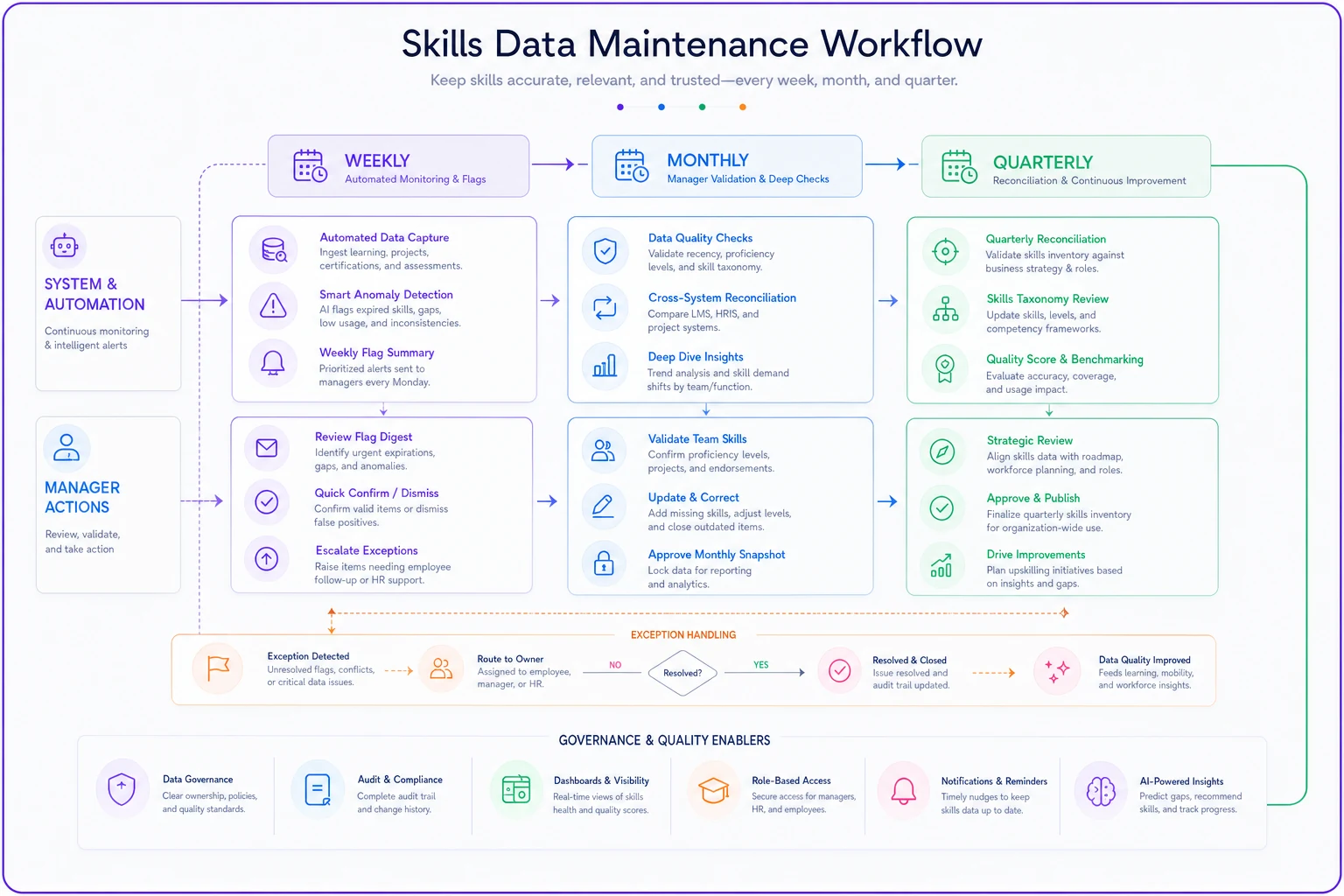
Quarterly Reconciliation
-
Project assignments vs recorded skills
-
Training completions vs skill additions
-
Role changes vs profile updates
-
External certifications vs internal records
This doesn't need to be a manual audit. Pull training logs into unified profiles automatically, then validate only the exceptions.
Exception reporting that catches problems early
Most exception reports tell you what went wrong after it already mattered. The more useful version predicts problems before they hit operations.
Template 1: Skills Mismatch Alert
TRIGGER: Employee assigned to project requiring skills not in profile
ACTION:
-
Immediate
Confirm if employee has skill (often they do)
-
If yes
Update profile, adjust confidence score
-
If no
Flag for rapid upskilling or reassignment
ESCALATION: Manager notification at T+2 hours, HR at T+24 hours
Template 2: Sudden Expertise Loss
TRIGGER: High-confidence critical skill drops below threshold
PATTERN:
-
Confidence score drops 30+ points in one month
-
No recent evidence despite active projects
-
Employee still in role requiring this skill
ACTION:
-
Automated ping to employee for quick validation
-
Manager review if no response in 48 hours
-
Skills refresh workshop if legitimate decay
Template 3: Hidden Talent Signal
TRIGGER: External profile updates without internal match
MONITOR: LinkedIn API, conference speaker lists, publication authors
FINDING: Employee adds "Machine Learning" to LinkedIn, not in internal profile
ACTION:
-
Add to internal profile with "external claim" flag
-
Request validation through next project assignment
-
Include in next skills review cycle
The key difference: these exceptions trigger operational fixes, not just notifications that get ignored.
Building the quality scorecard
A skills data quality scorecard needs to measure accuracy, completeness, and utility — not just coverage.
| Metric | Poor (<60%) | Acceptable (60-80%) | Strong (>80%) |
|---|---|---|---|
| Profile Completeness | Missing core skills | Has role skills | Has growth skills |
| Evidence Freshness | >6 months old | 3-6 months | <3 months |
| Confidence Distribution | Mostly self-reported | Mixed evidence | Project-validated |
| Search Effectiveness | <40% match rate | 40-70% match | >70% match |
| Decay Rate | >15% monthly | 8-15% monthly | <8% monthly |
Track these monthly across four problem patterns:
-
Profiles with zero updates (abandoned data)
-
Skills with no evidence (empty claims)
-
High-confidence skills with no recent projects (stale expertise)
-
New skills appearing in projects but not profiles (capture gaps)
Search Effectiveness is the metric most teams miss entirely. When managers search for "data analysis," how often do they actually find the right people? Low hit rates usually point to taxonomy problems, not missing data.
The automation layer that maintains quality without manual work
Manual data quality management breaks down at scale. You need systematic captures and validations built into the way work already happens.
Project management systems should auto-capture skills used. When someone gets assigned to a React project, their React skill gets a confidence boost. When they complete it successfully, another boost. When they're troubleshooting production issues on that same stack, you're looking at maximum confidence.
The matching engine for internal opportunities only works with fresh data. Stale profiles mean missed placements and external hires for roles you could fill from within.
AI-powered operational software handles the mundane maintenance: scanning project documents for skill evidence, comparing internal and external profiles, flagging statistical anomalies in skill distributions. This frees HR to focus on validation and strategic decisions rather than data entry and cleanup.
The practical integration points work like this:
-
Project assignments automatically update skill usage records
-
Peer reviews validate expertise through actual collaboration context
-
Training systems push completions directly to profiles
-
Code repositories analyze technical skills being actively used
When it works well, the maintenance becomes invisible. Quality improves through normal operations, not through manual inspection cycles that nobody has time for.
When good data quality becomes great talent decisions
The difference between companies that promote the right people and those that lose them often isn't strategy or compensation — it's data quality.
With clean, confident skills data, succession planning becomes more objective. You can see who's actually ready, not just who's been waiting longest. Internal mobility accelerates because you're matching real capabilities, not job titles. Training investments target genuine gaps rather than perceived ones.
Employees also get a clearer picture of their own career paths — which skills matter, where they actually stand, what development looks like in practice. That kind of transparency does more for retention than most rewards programs.
Run the queries monthly, implement the confidence algorithm, and you'll find that plenty of "impossible to fill" roles suddenly have two or three internal candidates ready to step up. The frameworks here aren't complicated — they just require someone to actually implement them before your best people find organizations that already have.
Run the queries monthly, implement the confidence algorithm, and you'll find that plenty of "impossible to fill" roles suddenly have two or three internal candidates ready to step up. The frameworks here aren't complicated — they just require someone to actually implement them before your best people find organizations that already have.
Ready to elevate your team's skills?
Join 500+ companies using Talioly to boost skill visibility, streamline training, and drive performance growth.