

Most HR teams treat consent as a legal checkbox. Stand up a modal, drop in some privacy language your counsel approved, force a click before anyone sees their skill profile, and call it compliant. Then you wonder why profile accuracy is stuck at 60% and why half your workforce has never corrected a single inferred skill.
The problem usually isn't the policy. It's the UX wrapped around it. A consent flow built purely for legal defensibility becomes a wall. People hit it, bounce, and never engage with the thing you actually need them to do: look at their own skill data and fix what's wrong.
This post is narrowly about that. Not consent law, not cross-border retention — we covered a lot of that in the HR playbook for skills consent, retention and cross-border rules. This is about the in-app experience: the exact screens, the microcopy, the correction wizard, the evidence request, and the escalation path that turns a one-time consent click into ongoing, voluntary profile maintenance.
Where the friction actually lives
When profile accuracy stalls, people blame the taxonomy or the inference model. But walk through the actual click path an employee takes and you'll find three friction points, in this order:
1. The all-or-nothing consent gate. The screen asks for blanket consent to "collect, process, infer, and share skills data" before showing anything. Employees have no idea what they're agreeing to because they can't see the data yet. So the cautious ones decline or ignore it — and your most valuable population, senior people with the richest profiles, opts out at a higher rate than average.
2. No visible path from "this is wrong" to "it's fixed." Even people who consent and spot an error have nowhere obvious to go. They see "Python: Advanced" when they've never written a line of it, shrug, and close the tab. The correction never happens because the flow doesn't exist or is buried three clicks deep in a settings menu nobody opens.
3. Corrections that go into a void. The rare employee who does submit a correction hears nothing back. No confirmation, no timeline, no resolution. Next quarter the wrong skill is still there. They learn the system doesn't listen, and they stop trying.
The pattern underneath all three: consent and correction are treated as separate systems when they're actually the same workflow. Consent should be the entry point into a self-service loop where people can see, challenge, and fix their data — with the legal coverage happening quietly in the background.
The consent screen most teams get wrong
A typical broken consent screen looks something like this:
Stop losing track of critical skills.
Talioly helps you track, develop, and certify your workforce efficiently.
- Centralized skill profiles
- Automated training reminders
- Competency gap analysis
No credit card required
> We use your skills data > By clicking "I Agree," you consent to the collection, inference, processing, storage, and internal sharing of skills and competency data derived from your work activity, assessments, and HR records, in accordance with our Privacy Policy and applicable law. > [ I Agree ]
Every word is technically fine. Legal signed off. And it converts terribly, because it gives the employee zero reason to say yes and no sense of what they're saying yes to.
Compare that to a layered consent flow that front-loads value:
> Your skill profile is ready to review > We've built a draft profile from your projects, certifications, and completed training. Some of it is inferred, which means it might be wrong. > You control it. Review what's accurate, correct what isn't, and choose what's visible to internal roles and the talent marketplace. > [ Review my profile ] [ What data did you use? ]
The difference is sequencing. The second version leads with "you can fix mistakes and control visibility," which is the actual motivation to engage. The consent itself — the legal grant — gets captured as the person moves through review and makes their first choice. You still record an explicit, timestamped, scoped consent event. You just stop demanding it before the person has any reason to care.
Granular consent beats blanket consent
| Consent model | What the employee sees | Opt-in behavior | Audit quality |
|---|---|---|---|
| Blanket | One toggle for everything | High decline/ignore on sensitive uses | Weak — can't prove scope |
| Scoped | Separate toggles per use | Partial yes; most consent to core uses | Strong — per-purpose timestamped |
| Scoped + visibility control | Toggles plus "who can see this" | Highest engagement, especially senior staff | Strongest |
The teams that move accuracy fastest let people say "yes to internal mobility matching, no to showing my profile to my own manager yet." That partial yes is worth far more than a forced blanket agreement half the org resents.
The correction wizard that actually gets used
Once someone consents and sees their profile, the correction flow decides everything. Most fail because they ask the employee to do the system's job — pick the right skill from a taxonomy of thousands of entries, assign themselves a proficiency level, write a justification. That's work, and people don't do unpaid data-entry work.
-
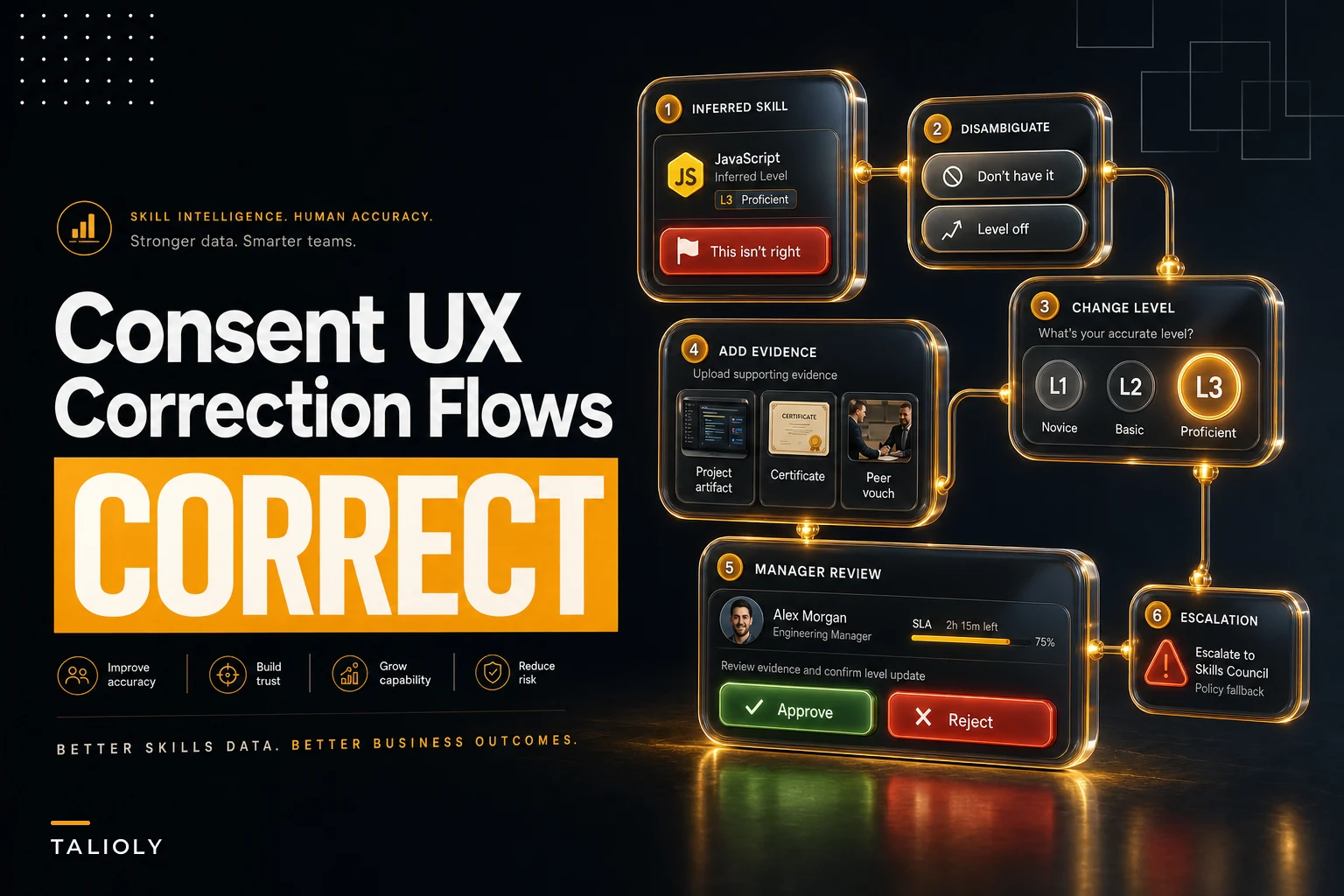
Flag, don't fix first. Next to every inferred skill, a simple "This isn't right" link. One click. No form yet.
-
Ask one disambiguating question. When they flag it, show why the system thinks they have the skill — "We inferred this from your work on Project Atlas." Then ask: "Is this wrong because you don't have this skill, or because the level is off?" Two buttons.
-
Route based on the answer. "Don't have it" removes it pending review. "Level is off" shows a three-option slider, not a ten-point scale nobody understands. This single question cuts correction abandonment dramatically because it matches the two things people actually want to say.
-
Offer optional evidence, never require it. If they're upgrading a level, show: "Want this verified? Attach a project, a cert, or name a colleague who can confirm." Optional. Requiring evidence here kills completion.
-
Confirm with a timeline. "Got it. Your manager will review the level change by Friday. We'll email you either way." The timeline is the part most systems skip, and it's what makes people trust the loop enough to use it again.
Notice what's missing: no free-text justification box, no taxonomy search as step one, no mandatory proficiency self-rating. Every one of those is a drop-off point.
Pre-fill everything you can
The biggest lever is pre-filling the correction form from existing signals. If the system already knows the project, the completed course, or the assessment score, show those as suggestions the person confirms or rejects. Confirmation is fast; creation is slow. This is the same principle behind capturing work artifacts as evidence instead of trusting self-reported skills — you want the profile building itself and the human just validating, not typing everything from scratch.
Pre-fill correction forms with existing project, course, or assessment signals so people confirm rather than type.
Visual workflow for the correction wizard:
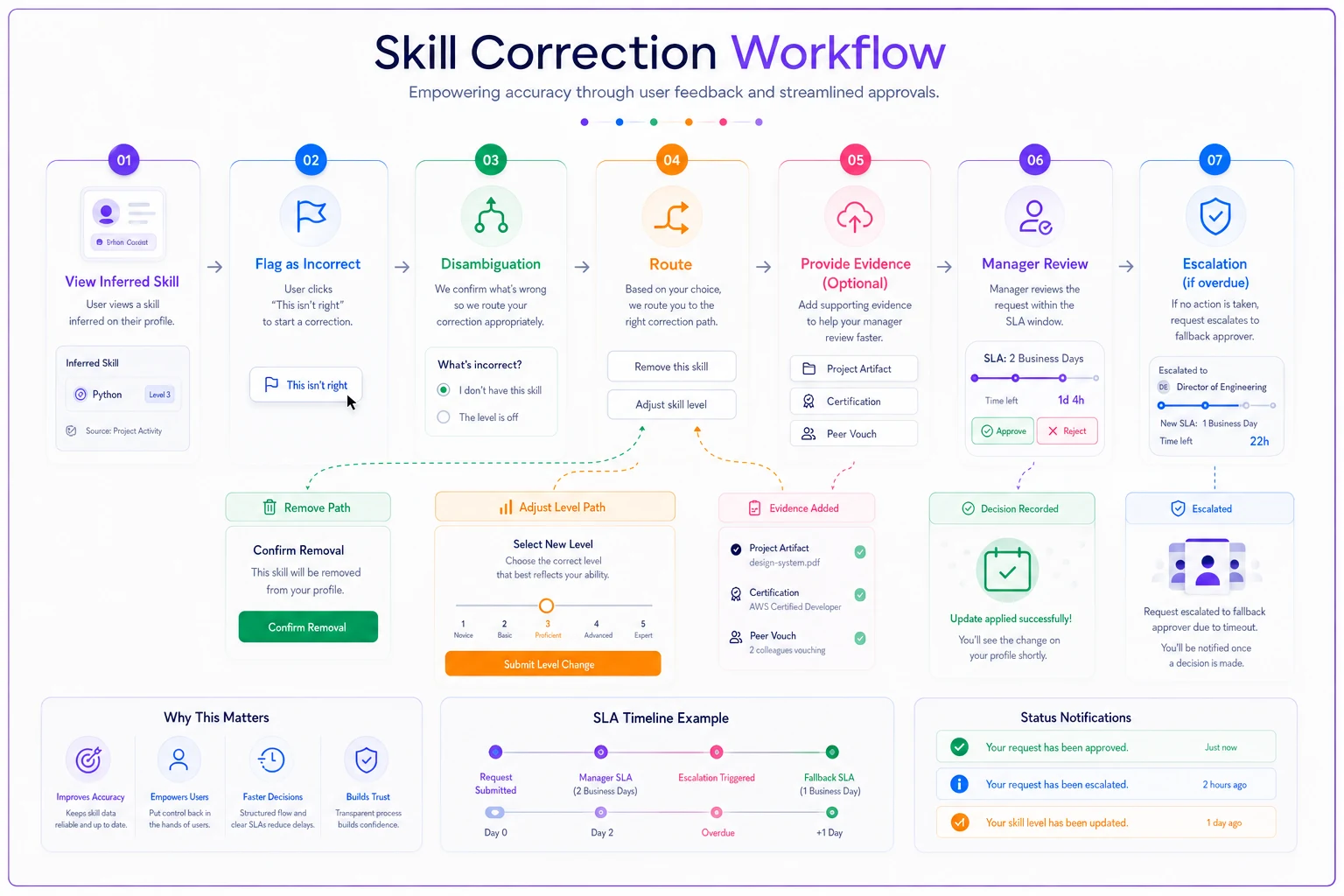
This visual maps the simple flag-first flow described above.
Evidence-request templates that don't feel like an audit
The moment a correction involves a level change or a sensitive skill, you need evidence — but how you ask determines whether you get it. "Please upload documentation proving your SQL proficiency" reads like an interrogation. People stall.
Weak: "Please provide documentation to support your claimed skill level."
Better: "To mark this as Advanced and make you eligible for related internal roles, we need one of: a project you led using it, a certification, or a colleague who can vouch. Pick whichever is easiest — this just helps match you to the right opportunities."
Keep a small library of these templates, differentiated by evidence weight:
-
Light (self-attestation ok) foundational skills, low-stakes roles. "Confirm this looks right and you're set."
-
Medium (artifact or peer) mid-level skills tied to mobility. "Attach a work sample or name a peer reviewer."
-
Heavy (verified artifact + approver) regulated, safety-critical, or pay-linked skills. "This level requires a verified project and manager sign-off."
The mistake teams make is applying heavy-evidence language to every correction. If updating "proficient in Excel" requires the same rigor as "certified in a clinical procedure," people correct nothing. Match the friction to the stakes.
SLA-backed escalation so corrections don't die in a queue
The single biggest trust-killer is the correction that goes nowhere. An employee flags an error, a manager is supposed to review it, and then — nothing. Three weeks later the data is still wrong.
-
Submission → acknowledgment
instant. Automated confirmation the moment they submit. Non-negotiable.
-
Simple removals → auto-resolve or 48 hours. "I don't have this skill" with no downstream pay or compliance impact can be applied immediately or after a short manager confirmation window.
-
Level changes → manager review within 3–5 business days. Manager gets a single-click approve/reject with context. If they don't act, it escalates.
-
Escalation path → skip-level or HRBP after SLA breach. If a manager sits on a correction past the deadline, it routes to a fallback approver. The correction never depends on one unresponsive person.
-
Resolution → notify the employee either way. Approved or rejected, they hear back with a reason. A rejection with an explanation still builds trust; silence destroys it.
The escalation fallback is what makes the whole thing credible. Managers go on leave, get busy, or quietly ignore things they disagree with. Without an SLA-triggered reroute, every one of those becomes a permanently stale data point.
A real scenario
A mid-sized logistics company — around 2,800 employees — rolled out skill profiles and hit the usual wall. Roughly 55% of employees never engaged with their profile after the initial consent modal, and inferred-skill accuracy on reviewed profiles was sitting somewhere around 60–65%. Corrections trickled in at maybe a few dozen a month across the whole org.
-
Replaced the blanket consent gate with a layered "review your profile" entry and scoped toggles.
-
Added the flag-first correction wizard with the single disambiguating question.
-
Set evidence weight by skill stakes, so most corrections needed no upload.
-
Published visible SLAs with manager escalation after five days.
Over the next quarter, profile engagement roughly doubled, correction volume jumped to a few hundred a month, and manager turnaround on level changes landed inside the SLA most of the time once escalation kicked in for the stragglers. Accuracy on actively reviewed profiles climbed into the high 70s. Nothing dramatic happened to the underlying data science — the inference was the same. People just finally had a reason, and a path, to fix it.
When this makes sense — and when it doesn't
Do this when:
-
You have inferred or imported skills that employees can't currently challenge.
-
Profile accuracy matters because you're using it for mobility, pay, or staffing decisions.
-
Your consent is a one-time gate rather than part of an ongoing loop.
Skip or delay when:
-
Your skill data is almost entirely from verified assessments with little inference — there's less to correct, so the wizard earns its keep more slowly.
-
You haven't resolved the legal scope of consent yet. Build the policy first, then the UX. Don't ship a smooth flow on top of shaky legal ground.
-
You can't staff the review side. A well-designed correction wizard that feeds an unresponsive queue is worse than no wizard, because it makes a promise you can't keep.
Who should not touch this yet: teams without any manager accountability for data review. If no one owns the approve/reject step and there's no escalation fallback, corrections will pile up and the flow will teach employees the system is a dead end.
The thing most teams miss
Consent and correction are the same loop, not two separate features.
The consent screen is where people decide whether to trust you with their professional identity. The correction flow is where they find out if that trust was warranted. If the first is a wall and the second is a void, accuracy stays broken no matter how good your inference gets. Build the entry as a reason to engage, make the correction a few taps instead of a form, match evidence friction to real stakes, and back every submission with a visible SLA and a fallback approver. The legal coverage still happens — it just stops being the first thing the employee hits. Get the flow right and the accuracy follows, because the people who know their own skills best finally have a frictionless way to tell you when you're wrong.
Consent and correction are the same loop, not two separate features. The consent screen is where people decide whether to trust you with their professional identity. The correction flow is where they find out if that trust was warranted. If the first is a wall and the second is a void, accuracy stays broken no matter how good your inference gets. Build the entry as a reason to engage, make the correction a few taps instead of a form, match evidence friction to real stakes, and back every submission with a visible SLA and a fallback approver. The legal coverage still happens — it just stops being the first thing the employee hits. Get the flow right and the accuracy follows, because the people who know their own skills best finally have a frictionless way to tell you when you're wrong.
Ready to elevate your team's skills?
Join 500+ companies using Talioly to boost skill visibility, streamline training, and drive performance growth.