
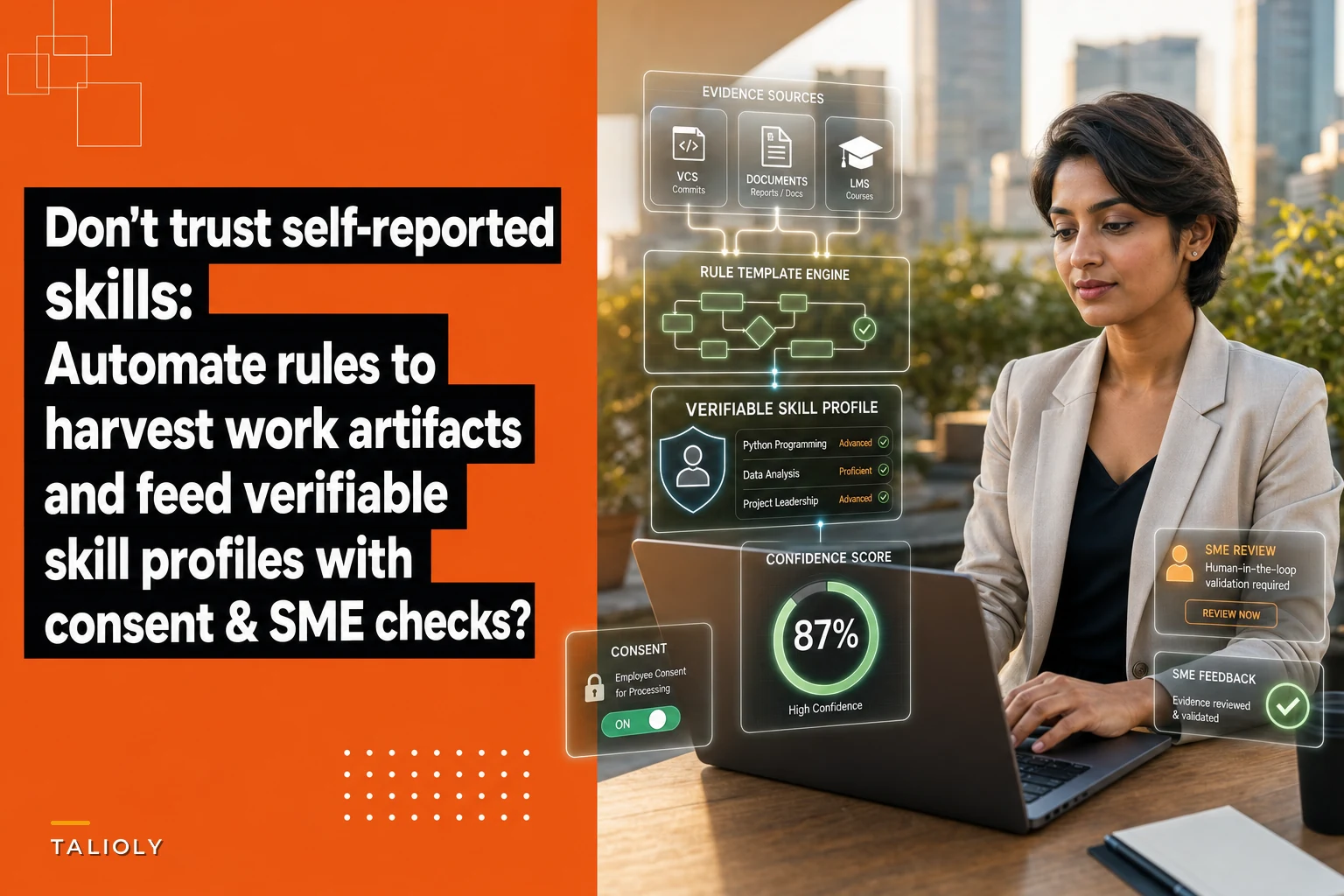

Every talent system runs on the same broken foundation: ask people what they're good at, then wonder why internal mobility fails and critical skills disappear without warning. The gap between what employees claim on their profiles and what they actually deliver creates blind spots that cost organizations real money — failed projects, bad staffing decisions, skills that walk out the door unnoticed.
The core problem isn't dishonesty. It's human nature mixed with organizational dynamics. Employees overestimate competencies they haven't touched in a year. Managers rate based on likability more than output quality. HR ends up with skill data that's three layers removed from what's actually happening on the ground.
The gap between claimed skills and proven capabilities
A developer marks themselves "expert" in Python because they wrote some scripts a couple years back. Meanwhile, their recent commits show they're building complex microservices in Go — something nobody in the organization knows about. A project manager claims advanced Agile certification, but their real strength is stakeholder management across distributed teams, which never shows up in any skill assessment.
This misalignment is systematic. Employees fill out skill surveys based on what they think matters for promotion, not what they actually do day-to-day. They emphasize credentials over current capabilities. And often they don't even recognize their most valuable skills, because those competencies developed organically through daily work rather than through any formal program.
Traditional verification attempts — manager reviews, peer assessments, certification tracking — just add more layers of subjective judgment without fixing anything. You end up with politically influenced ratings, outdated certifications, and skill profiles that reflect organizational hierarchy more than actual expertise.
The financial impact compounds fast. Projects fail when teams lack capabilities that supposedly exist on paper. High performers leave because their real skills go unrecognized. Talent acquisition keeps hiring externally for skills that already exist internally but are completely invisible in the data.
System-specific rules for different evidence sources
Real skill verification means harvesting evidence from where work actually happens. Each system type needs specific extraction rules that balance data quality with privacy requirements.
Stop losing track of critical skills.
Talioly helps you track, develop, and certify your workforce efficiently.
- Centralized skill profiles
- Automated training reminders
- Competency gap analysis
No credit card required
Version Control Systems (Git, SVN, Perforce)
Code repositories contain the richest skill evidence available, but extraction needs careful filtering. Pull request reviews show code quality assessment. Commit patterns reveal consistency and technical depth. Language usage shows what someone actually codes versus what they claim to know.
-
Active languages used in the last 90 days (weighted by lines changed)
-
Review participation rates and approval patterns
-
Documentation contributions alongside code changes
-
Framework and library usage frequency
Privacy triggers matter here. Exclude commits marked private or containing customer data references. Filter out experimental branches unless merged. Never extract commit messages containing personal information markers.
Documentation Platforms (Confluence, SharePoint, Notion)
Written artifacts reveal communication skills, domain expertise, and knowledge-sharing behavior. Page creation frequency shows initiative. Edit patterns show collaboration. View counts indicate whether the content actually adds value.
-
Technical documentation authorship (API docs, architecture decisions)
-
Process documentation creation and maintenance
-
Training material development
-
Cross-functional collaboration through shared documents
Apply consent checks before harvesting. Require opt-in for personal workspace content. Exclude draft documents unless explicitly published. Maintain audit logs showing what was collected and when.
Learning Management Systems
Course completions tell one story, but engagement patterns reveal whether learning actually stuck. Track not just completion rates but knowledge application — forum participation, peer teaching moments, resources created after training.
-
Assessment scores mapped to competency frameworks
-
Time between learning and first application in work systems
-
Peer teaching indicators (helping others with recently learned skills)
-
Resource creation showing knowledge synthesis
Set confidence thresholds based on recency and application. Certification from two years ago with no recent application gets weighted differently than last month's training immediately followed by project work.
Confidence scoring and quality thresholds
Not all evidence carries equal weight. A single GitHub commit doesn't prove expertise. One Confluence page doesn't demonstrate communication mastery. You need scoring models that factor in volume, recency, complexity, and peer validation.
Start with baseline thresholds for each skill category:
| Evidence Type | Minimum Volume | Recency Weight | Peer Validation |
|---|---|---|---|
| Code commits | 20+ instances | 0.8x per quarter old | PR approvals |
| Documentation | 5+ substantial pages | 0.9x per quarter | View/edit metrics |
| Project artifacts | 3+ deliverables | 0.7x per quarter | Stakeholder usage |
| Training application | 2+ work outputs | 0.6x per quarter | Manager verification |
Adjust scores based on complexity indicators. A developer fixing typos gets different weighting than someone refactoring core architecture. A PM updating meeting notes scores differently than one building out comprehensive project plans.
Layer in negative indicators too. High bug rates reduce coding skill confidence. Documented rework suggests gaps. Delayed deliveries affect project management scores. This creates profiles that reflect actual performance rather than just activity volume.
Scores should update dynamically as new evidence comes in. Weekly recalculation keeps profiles current. Monthly trend analysis catches skill development or decay. Quarterly reviews trigger re-verification for critical competencies.
SME fallback and exception handling
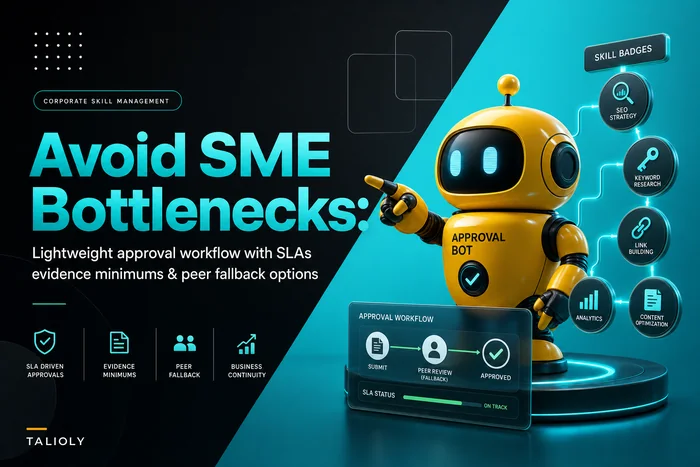
Automated evidence capture hits limits with specialized skills, emerging technologies, and nuanced competencies. You need human validation for edge cases — but you also need to avoid creating the kind of bottlenecks that killed previous SME approval workflows.
Design fallback triggers that activate selectively:
-
New skills not yet in the taxonomy
-
Disputed evidence (employee challenges automated scoring)
-
High-stakes competencies requiring human verification
-
Cross-functional skills spanning multiple systems
Keep SME involvement lightweight. Instead of full reviews, use spot checks on automated scores. Rather than approving every skill claim, SMEs validate exception cases and calibrate rules. This preserves scalability while maintaining quality where it actually matters.
Build escalation paths that prevent single points of failure. Primary SME unavailable? Route to peer experts with similar backgrounds. No internal expert? Engage external validation for specialized domains. Set SLAs at each level — 48 hours for initial review, 72 hours for escalation, one week maximum for resolution.
Exception handling needs clear boundaries. Document which skills require human validation versus pure automation. Define evidence combinations that trigger manual review. Establish override protocols for when SMEs disagree with automated scoring.
Privacy controls and consent workflows
Evidence harvesting walks a tightrope between useful insights and privacy invasion. One mishandled data extraction can destroy trust and create legal exposure fast. Build consent mechanisms that protect employees while still enabling meaningful skill verification.
Pre-harvest consent checklist
-
Data inventory mapping — Document every field extracted from each system, including metadata like timestamps, not just content.
-
Purpose limitation statements — Explicitly define how evidence will and won't be used. Skills verification only, not performance monitoring.
-
Retention policies — Set clear timelines. Raw data for 90 days, aggregated scores for two years, audit logs for seven years.
-
Access controls — Define who sees what level of detail. Managers see skill scores, not raw evidence. Employees access their own complete records.
-
Opt-out mechanisms — Provide granular controls over evidence sources. Allow exclusion of specific repositories, documents, or time periods.
Configure consent workflows that feel lightweight but maintain compliance. Use progressive consent — start with basic evidence types, expand as employees see value. Default to privacy-preserving settings with opt-in for deeper analysis. Always show employees exactly what evidence supports their skill scores.
Geographic variations matter. EU employees need GDPR-compliant deletion rights. California workers require special consent for automated decision-making. Build region-aware consent flows that adapt to local requirements without fragmenting the overall system.
The consent infrastructure should integrate with existing HR data governance systems rather than creating parallel processes. This reduces compliance overhead and keeps privacy standards consistent.
Building automation rules that scale
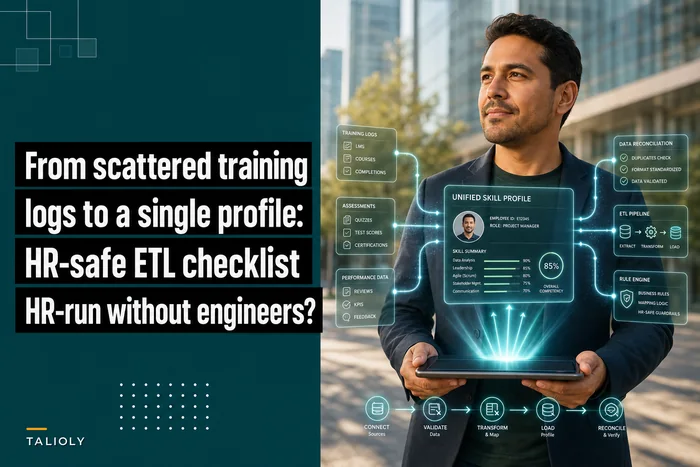
Manual evidence review worked fine for a pilot with 50 employees. At enterprise scale, you need automation that processes thousands of signals daily without human intervention. The challenge is creating rules sophisticated enough to maintain quality while remaining simple enough to troubleshoot when something breaks.
Start with deterministic rules before adding complexity. "If commits exceed 20 in JavaScript, add JavaScript skill" beats a complex ML model for initial deployment. Basic rules establish baseline evidence collection while you gather data for more sophisticated scoring.
Rule templates by system type accelerate deployment:
VCS Template Rules:
-
Language detection from file extensions
-
Commit frequency patterns for consistency scoring
-
Code review participation for collaboration skills
-
Documentation-to-code ratios for communication abilities
Document System Rules:
-
Authorship attribution from metadata
-
Content categorization via folder structures
-
Collaboration indicators from co-editing patterns
-
Knowledge depth from document complexity metrics
Learning Platform Rules:
-
Completion tracking with time-based decay
-
Assessment score mapping to competency levels
-
Peer learning indicators from forum participation
-
Knowledge application via post-training activity spikes
Layer in contextual modifiers that adjust scores based on organizational factors. A junior developer's 50 commits might indicate stronger learning velocity than a senior's 100. Context-aware rules prevent gaming while recognizing meaningful skill development.
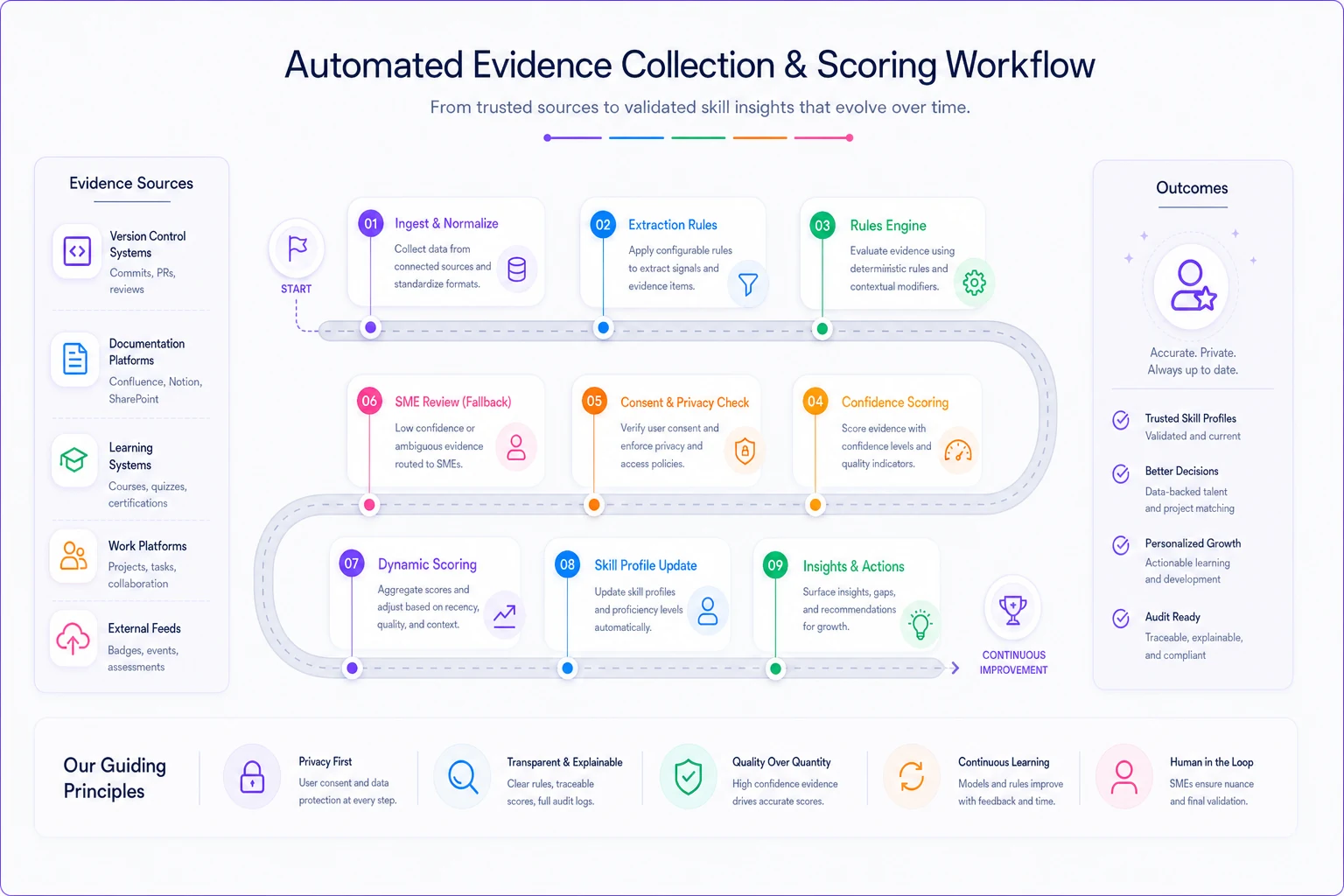
Here's a simple view of how the pipeline moves from raw artifacts to verified skill scores.
Start with a simple deterministic rule set you can explain to SMEs so initial troubleshooting and buy-in are straightforward.
The rules engine needs versioning and rollback capabilities. When you adjust language detection logic, you need to recalculate historical scores. When new evidence sources come online, backfill processing ensures consistency. When rules prove problematic, quick rollback prevents data quality issues from spreading.
What this actually looks like in practice
One technology services firm I worked with — around 2,500 people — was struggling badly with project staffing. On paper they had strong full-stack capabilities. In reality they kept missing deadlines due to skill gaps nobody could see clearly. Their traditional skill survey showed well over 400 developers claiming "advanced" JavaScript knowledge.
When they ran extraction rules against their actual Git history, the picture changed fast. Somewhere in the range of 120–130 developers had meaningful JavaScript commits in the past six months. Another group — maybe 80 or so — showed strong frontend skills specifically in React, a distinction the survey completely missed. And a smaller cohort was actively writing TypeScript, a capability nobody was tracking at all.
Initial setup took about three weeks:
-
Week 1
Configure Git extraction rules and privacy controls
-
Week 2
Set up Confluence and JIRA evidence gathering
-
Week 3
Build confidence scoring and SME fallback triggers
The results showed up quickly. Project staffing improved when managers could see verified skills instead of self-reported claims. A handful of hidden experts in emerging technologies got surfaced. Training investments shifted toward actual skill gaps rather than perceived ones.
Privacy concerns came up almost immediately — specifically around commit message extraction. The fix was straightforward: hash personal information before processing, extract only technical indicators, and give employees full visibility into what evidence is supporting their scores. That combination maintained trust while enabling verification.
Worth noting: the initial rollout wasn't smooth. The first version of the JavaScript detection logic was overcounting — flagging config file edits as meaningful JavaScript work. They had to recalibrate the rules twice in the first month before the scores felt trustworthy to engineering leads. That kind of early messiness is normal and honestly expected. The lesson is to get SME buy-in on rule logic before you start communicating scores widely.
Operational sustainability and maintenance
Evidence-based skill systems need ongoing calibration to stay accurate. Skills evolve, new technologies emerge, and organizational priorities shift. Without active maintenance, well-tuned rules drift toward irrelevance within months.
Establish monthly calibration cycles:
-
Review confidence score distributions for anomalies
-
Validate high-impact skill assessments with SMEs
-
Adjust thresholds based on project outcome data
-
Update extraction rules for new tool versions
Watch for gaming behaviors. When employees realize commit counts affect skill scores, some will inflate activity artificially. Build detection rules for unusual patterns — sudden commit spikes, meaningless documentation additions, suspicious learning platform activity. Address gaming through rule refinement, not punishment.
Quality assurance needs both automated and human elements. Automated checks flag statistical anomalies and rule conflicts. Human reviews catch subtler issues — cultural biases in evidence interpretation or skills that are valuable to the organization but invisible to extraction rules.
The maintenance burden stays manageable through modular design. Each evidence source operates independently with its own rules and scoring. System-specific issues don't cascade, and new sources integrate without disrupting existing pipelines.
Moving from pilots to production systems
Many organizations nail the technical implementation but stumble on change management. Employees resist systems that feel like surveillance. Managers distrust automated assessments. HR worries about legal exposure. These aren't technical problems — they're organizational ones.
Start with volunteer early adopters who see immediate value. Software teams often embrace evidence-based skills because they already operate in measurable systems. Their success stories build credibility for broader rollout. Use their feedback to refine rules before any mandatory deployment.
Communication strategy matters more than technical perfection. Frame the system as skill recognition, not performance monitoring. Emphasize employee benefits — better project matches, clearer development paths, recognition for expertise that was previously invisible. Always provide transparency into evidence and scoring.
Phase the rollout by evidence type rather than department:
-
Begin with least-controversial sources (training completions, certifications)
-
Add technical system evidence (code, documentation) with clear consent
-
Introduce project artifacts and deliverables
-
Finally, layer in peer validation and 360-degree inputs
Each phase should demonstrate value before proceeding. If developers see better project assignments from Git evidence, they'll advocate for the system. If managers get more accurate views of team capability, they'll support expansion. Building momentum through proven value beats forcing compliance through mandates.
The technical infrastructure should scale gradually too. Start with daily batch processing, move to hourly updates, then real-time if needed. Begin with simple rule engines, add ML scoring when data volumes justify it. Always maintain fallback to previous versions when testing new capabilities.
The compound effect of evidence-based skills
Organizations running these systems for a year or more tend to report real shifts in how talent management actually works. Internal mobility increases when employees trust that their actual work gets recognized. Training investments become more targeted. Project success rates improve with more accurate capability matching.
The deeper change is cultural. When skills become verifiable and transparent, political maneuvering decreases. Employees focus on building demonstrable expertise rather than managing perceptions. Managers shift from subjective assessments to conversations grounded in actual evidence.
The infrastructure built for evidence capture also becomes a platform for broader talent operations. Skill verification feeds into succession planning. Evidence patterns inform learning recommendations. Capability gaps automatically trigger targeted recruiting workflows.
This isn't about replacing human judgment with machines. It's about grounding human decisions in objective evidence. Managers still select team members, but with verified skill data. Employees still own their development, but with clear evidence of progress. HR still shapes talent strategy, but with far better visibility into what the organization actually knows how to do.
The organizations building these systems now will have a real advantage over those still relying on self-reported surveys. Not because they have better technology — but because they finally know what their people can actually do.
Ready to elevate your team's skills?
Join 500+ companies using Talioly to boost skill visibility, streamline training, and drive performance growth.