

Most skills programs get built backwards. Someone stands up a skills profile system, starts pulling in assessment results, work samples, manager ratings, badge data — and only much later does someone in legal ask the uncomfortable question: who agreed to all this, and where is it stored?
By then you've got a working pipeline feeding promotion decisions, internal mobility, and workforce planning. Unwinding the consent problem after the fact is painful. You either freeze the program while you clean it up, or you keep running it and hope nobody files a data subject access request that exposes the mess.
Skills privacy compliance isn't a checkbox you add at the end. It's a set of design decisions baked into how the whole pipeline works — what you collect, why, how long you keep it, who can see it, and what happens when someone in another country is involved. This is the playbook for building that in without turning your talent program into a legal liability.
Why this breaks in almost every organization
HR teams treat skills data like performance data — internal, low-risk, "we've always tracked this." But skills pipelines are different in three ways that quietly raise the stakes.
First, they aggregate. A single work artifact isn't sensitive. But combine assessment scores, peer feedback, project outcomes, certification records, and inferred skill levels into one profile, and you've created a detailed portrait of someone's professional competence. That profile can influence pay, promotion, and whether they keep their job. Regulators treat that kind of automated-influence data with more scrutiny than a training log.
Second, they infer. Modern skills systems don't just record what someone did — they score confidence, predict readiness, and sometimes flag people as "below threshold." Inferred data about a person carries the same obligations as data they gave you directly, and often more, because employees don't know it exists.
Third, they cross borders. The moment you have a shared services team in one country evaluating skills of employees in another — or a global skills taxonomy applied across regions — you're moving personal data across legal boundaries. Most HR teams don't realize this is happening until an audit surfaces it.
The reason this stays hidden is that the people building the pipeline (talent development, L&D, sometimes IT) aren't the people who own privacy risk. The two groups rarely talk until something forces them to.
What actually breaks at scale
A pilot with 200 people and one country hides all the hard problems. Everything looks fine because the blast radius is tiny and everyone involved is in the same jurisdiction.
Stop losing track of critical skills.
Talioly helps you track, develop, and certify your workforce efficiently.
- Centralized skill profiles
- Automated training reminders
- Competency gap analysis
No credit card required
-
A DSAR comes in and nobody can produce the full skills profile in the required window because the data lives in four systems that were never designed to be queried together.
-
Someone leaves, and their inferred skill scores stay in the succession planning tool for years because retention was never defined for derived data.
-
A works council in Germany or a regional privacy authority asks what legal basis you're using to run automated skill assessments — and the honest answer is "we never picked one."
-
Consent was collected once during onboarding with vague language, and now you're using the data for something that language never covered.
The underlying failure is always the same: the pipeline grew faster than the governance around it. Data collection is easy to scale. Consent, retention, and access controls are not, unless they were designed to scale from the start.
Consent UI patterns that HR can actually defend
Consent for skills data is tricky because in an employment context, regulators are skeptical that consent is ever truly "freely given" — there's an inherent power imbalance. That doesn't make consent useless. It means you often need a legal basis other than consent for the core stuff (legitimate interest or contract performance), and you use consent specifically for the optional, sensitive, or secondary uses.
The practical implication for your UI: stop bundling everything into one checkbox.
A defensible consent flow separates purposes so an employee can see and control each one. Here's what that looks like in practice.
| Data use | Recommended legal basis | Needs explicit consent UI? | What the employee sees |
|---|---|---|---|
| Core skill profile for role fit | Legitimate interest / contract | No, but requires notice | Clear notice at onboarding + always-accessible privacy page |
| Work artifacts captured as evidence | Legitimate interest | Notice + easy opt-out where feasible | "We use samples of your work to verify skills" with examples |
| Sharing profile in internal marketplace | Consent | Yes | Toggle: "Make my verified skills visible for internal opportunities" |
| Inferred readiness / succession flags | Legitimate interest + safeguards | Notice + right to review | Explanation of how scores are generated |
| Cross-border processing | Depends on transfer mechanism | Notice, sometimes consent | Where data goes and why |
| Secondary analytics / benchmarking | Consent | Yes | Separate, unbundled toggle |
The pattern that works: layered notice. A short, plain-language summary at the moment of collection, with a "learn more" link to the full detail. Nobody reads a 4,000-word policy at onboarding. But a two-sentence explanation next to a toggle — "This lets managers see your verified skills when relevant roles open up. You can turn it off anytime." — actually gets read and remembered.
A common mistake is treating consent as a one-time onboarding event. Skills systems evolve. When you add a new data source or a new use, you need a mechanism to re-notify and, where relevant, re-collect consent. Build a version stamp into every consent record so you always know which policy version someone agreed to. When capturing work artifacts as evidence, this matters even more — because the employee often has no idea their day-to-day output is feeding a skills profile unless you tell them clearly.
Build a version stamp into every consent record so you can always show which policy version someone agreed to.
When capturing work artifacts as evidence, this matters even more — because the employee often has no idea their day-to-day output is feeding a skills profile unless you tell them clearly.
Retention cadences: the part everyone skips
Retention is where most skills programs are quietly non-compliant, because "keep it forever, might be useful" is the default engineering behavior and nobody pushes back.
The principle is simple: keep skills data only as long as it serves a defined purpose, then delete or anonymize it. The hard part is that different data types in a skills pipeline have wildly different useful lifespans, and treating them uniformly is what gets you in trouble.
-
Raw evidence (work samples, assessment responses) — highest sensitivity, shortest retention. Once a skill is verified and the confidence score recorded, you rarely need the raw artifact. Consider retaining raw evidence for 12–24 months, then purging while keeping the verification result.
-
Verified skill records — medium retention, tied to employment plus a defined tail. Keep while employed, then hold for a short period after departure (often aligned with your general HR record retention, frequently 1–3 years depending on jurisdiction) before anonymizing.
-
Inferred scores and readiness flags — treat these as more sensitive than they feel. They influence decisions and can be wrong. Refresh or expire them on a cadence — stale confidence scores shouldn't linger. Anything older than 12–18 months without re-validation should be flagged as expired, not silently trusted.
-
Consent and access logs — these you keep longer, because they're your evidence that you handled everything correctly. Retain the audit trail even after the underlying data is gone.
The counterintuitive point: your retention policy should sometimes keep less of the actual skills data and more of the metadata proving how you handled it. When a regulator asks, "did you delete this person's evidence on schedule?" the answer needs to be a logged, timestamped yes.
Staleness and retention are cousins. If you've already built confidence scoring and staleness detection into your data-quality process, retention cadences plug into the same machinery — you're just adding a "delete at end of life" step to a system that already knows how old each record is.
Handling DSARs without a fire drill
A data subject access request against a skills system is uniquely awkward because the data is spread out and some of it is inferred. When an employee asks "what do you hold about my skills," they're often surprised by what comes back — the readiness flags and confidence scores they never knew existed.
A DSAR handling sequence built for skills pipelines specifically:
-
Verify identity and log the request with a timestamp. Your clock starts now (typically 30 days under GDPR-style regimes).
-
Run a defined discovery query across every source in the pipeline — profile store, assessment platform, evidence repository, marketplace, succession tool. This only works if you've mapped your data sources in advance. Discovering where data lives during a DSAR is how teams blow the deadline.
-
Include inferred data. Confidence scores, readiness ratings, and derived skill levels all count. Leaving them out because "it's not really their data" is a mistake — it's data about them.
-
Translate the technical into the human. A raw dump of scores means nothing to the employee. Explain what each field means and how inferred values were generated.
-
Apply exemptions carefully. Some material — like peer feedback that would reveal a colleague's identity — may need redaction to protect third parties. Document why you redacted.
-
Deliver in a usable format and log completion.
The teams that handle DSARs calmly all have one thing in common: they built the discovery query before the first request came in. When your skills data is unified into a single employee skill profile, the DSAR stops being a scavenger hunt across systems and becomes a single lookup. That architectural decision does more for your compliance posture than any policy document.
Cross‑border rules: the trap nobody sees coming
Cross-border processing sneaks into skills programs through the side door. You don't set out to transfer data internationally — it just happens because your talent team is centralized, your vendor hosts data in another region, or your global taxonomy is applied by analysts sitting somewhere else.
Three cross-border triggers worth watching for:
-
Centralized talent operations. A team in one country reviewing, scoring, or making mobility decisions about employees in another is a data transfer, even if it never leaves your own systems.
-
Vendor and cloud location. Where does your skills platform actually store and process data? "The cloud" is not an answer a regulator accepts.
-
Global reporting and analytics. Rolling up regional skills data into one dashboard for leadership can constitute a transfer depending on where that dashboard is accessed and processed.
The mechanism you need depends on jurisdiction — standard contractual clauses, adequacy decisions, or specific regional frameworks. The operational point for HR is less about picking the mechanism (that's legal's call) and more about surfacing that a transfer is happening so legal can put the right paperwork in place. The failure mode is silence — nobody flags it, so nobody papers it.
Contract clauses tailored to skills and evidence pipelines
Whether you're contracting with a skills platform vendor, an assessment provider, or bringing in contractors whose skills you'll evaluate, your agreements need language that generic data processing clauses tend to miss.
A checklist of clauses worth insisting on for skills and evidence pipelines:
-
Purpose limitation specific to skills data — the vendor can process skills and evidence data only for the services you defined, not for training their own models or benchmarking against other clients unless separately agreed.
-
Sub-processor transparency — you get notified of and can object to new sub-processors, because skills platforms often chain multiple tools.
-
Evidence handling and deletion — explicit terms on how raw work artifacts are stored, secured, and deleted, with deletion timelines that match your retention tiers.
-
DSAR cooperation SLA — the vendor must help you fulfill access and deletion requests within a defined window, not "reasonable efforts."
-
Cross-border processing disclosure — the vendor states where data is processed and stored, and commits to notifying you before that changes.
-
Return and deletion on termination — when the contract ends, you get your skills data back in a usable format and confirmation it's been deleted from their systems.
-
Audit rights — you can verify compliance, not just take their word for it.
For contractors specifically, the wrinkle is that their skills data lives in a grey zone — they're not employees, but you're building profiles on them. The contract needs to establish your legal basis for processing their skills data and what happens to it when the engagement ends. Most standard contractor agreements say nothing about this.
A real scenario
A mid-sized software company — around 2,400 employees across the US, Ireland, and India — had been running an internal skills marketplace for about a year. Adoption was solid. Then a departing employee filed a DSAR asking for everything the company held about their skills and "how the system decided" they weren't shortlisted for two internal roles.
The team had no consolidated way to answer. Skills data sat in the marketplace tool, an assessment vendor, a spreadsheet-based succession tracker, and the HRIS. It took roughly three weeks and pulled in four people part-time just to compile the response — and they still weren't confident it was complete. Worse, the inferred readiness scores driving the shortlisting had never been disclosed to employees at all.
The fix wasn't dramatic, but it took a quarter of focused work. They mapped every data source, defined retention tiers (raw assessment responses purged after 18 months, verified skills retained through employment plus two years), rebuilt the onboarding consent flow into layered, unbundled toggles, and wrote a standing DSAR discovery query. They also updated the vendor contract to add a DSAR cooperation SLA and evidence-deletion terms.
The next DSAR that came in took about two days to fulfill, handled by one person. And the works council conversation in Ireland — which had been tense — got noticeably calmer once there was a clear legal basis and a real retention schedule to point to.
When to invest in this — and when not to
When this makes sense: You're past the pilot stage, running skills data that influences real decisions (promotion, pay, mobility, layoffs), and you operate in more than one jurisdiction or use vendors who do. At that point the compliance debt compounds, and every month you wait makes the eventual cleanup larger.
When you can wait: A genuinely small, single-country pilot with fewer than a couple hundred participants and no automated decision-making. You still need basic notice and a retention plan, but you don't need the full apparatus yet. Just don't kid yourself about when you cross the line — most teams cross it quietly and keep operating as if they're still piloting.
Who should NOT bolt this on late: Anyone about to feed skills data into termination or layoff decisions. If inferred scores are going to influence who stays, the consent, transparency, and legal-basis work has to be done first. Doing it after is how you turn an HR program into litigation exposure.
Bringing it together
The organizations that get skills privacy compliance right don't treat it as a separate legal workstream bolted onto the talent program. They treat it as part of the pipeline's architecture — consent captured with version stamps, retention encoded as a lifecycle stage, DSAR discovery built as a standing query, cross-border transfers surfaced proactively instead of discovered in an audit.
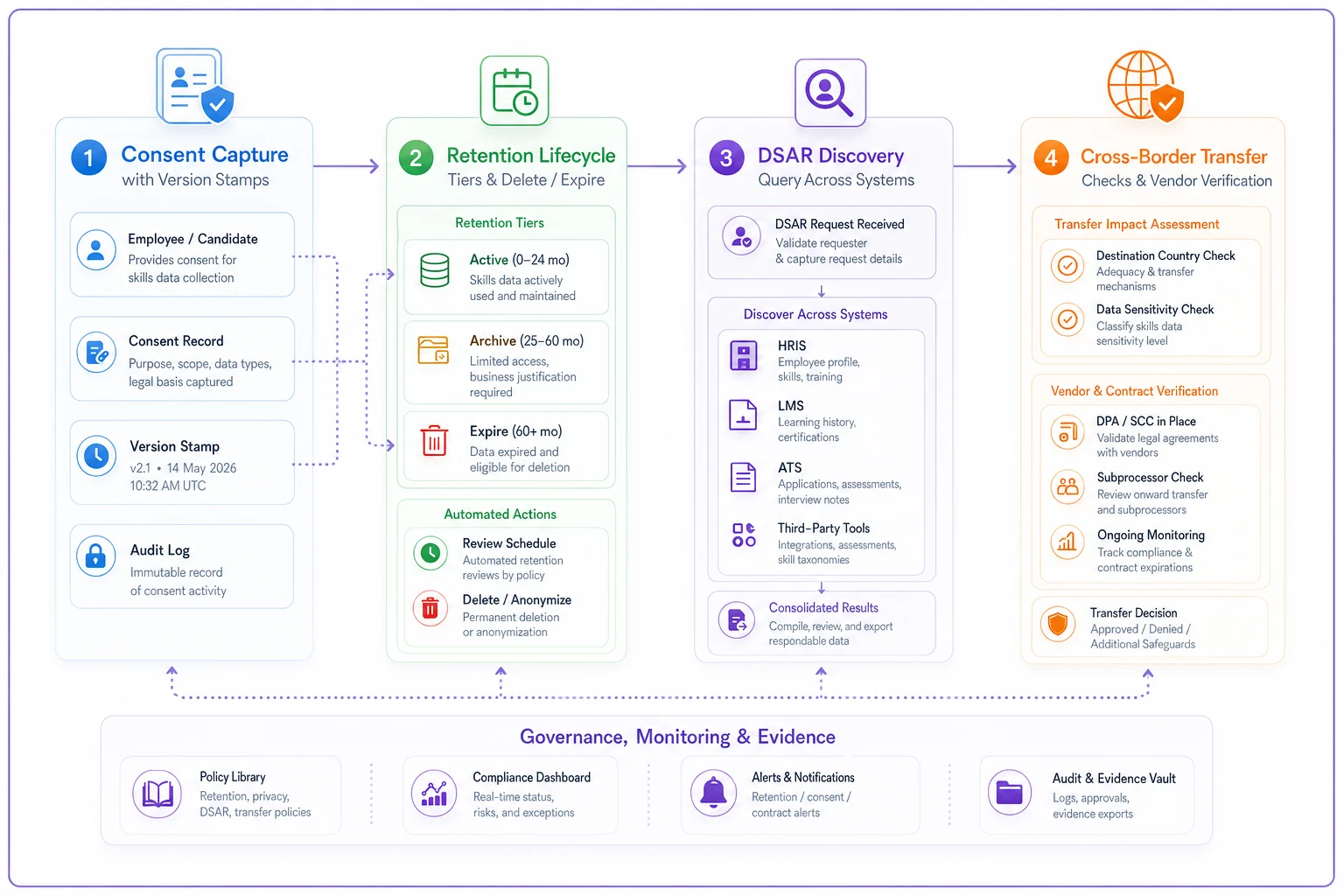
The diagram above shows how the consent UI, retention cadence, DSAR process, and contract clauses connect as parts of a single compliance workflow.
That's the real shift. Compliance stops being a series of one-off scrambles and becomes a property of a well-designed system. The consent UI, the retention cadence, the DSAR process, and the contract clauses aren't four separate projects — they're four views of the same underlying question: do you actually know what skills data you hold, why you have it, and who's allowed to touch it? Get that question answered structurally, and the rest becomes maintenance instead of firefighting.
Get that question answered structurally, and the rest becomes maintenance instead of firefighting.
Ready to elevate your team's skills?
Join 500+ companies using Talioly to boost skill visibility, streamline training, and drive performance growth.