

Most bias in promotions and pay doesn't show up as a single bad decision. It shows up as a pattern nobody was watching. One quarter a manager promotes three people who all cleared the same skill thresholds. Another quarter someone gets a bump based on "leadership presence." Individually, each call looks defensible. Stacked over 18 months, you've got a gap — and by the time HR notices, it's already baked into the pay bands.
The whole point of tying promotions and pay to skills signals was to make advancement more objective. But skills data doesn't automatically make outcomes fair. It just gives you the ability to check whether they are. Most teams never build that checking loop. They set up the skill thresholds, wire them to promotion gates, and then stop looking.
This post is about the part everyone skips: the monitoring system that watches promotion and pay outcomes against skills signals on a recurring basis, flags drift, and gives managers something to act on before it becomes a real problem.
Why "we use skills data" doesn't mean you're safe
Once an organization moves to skills-based promotion criteria, leadership tends to assume the objectivity is baked in. "We promote on verified skills, so bias can't creep in." That's wrong in a specific, measurable way.
The skills data can be perfectly clean and the decisions around it can still skew. A few common mechanisms:
-
Threshold gaming. Two employees both hit the skill bar, but only one gets promoted because a manager has more visibility into their work. The skill signal was equal; the outcome wasn't.
-
Uneven access to evidence-generating work. If certain groups get fewer stretch assignments, they generate fewer artifacts, which means fewer skill signals mature, which means they clear thresholds slower. The data looks fair. The pipeline into the data isn't.
-
Discretionary overrides. Managers exception their way past the criteria — "I know the rubric says X, but this person is ready." Overrides are fine in small doses. They become a bias vector when they cluster around a demographic or a particular manager.
-
Pay compression on the way up. Even when promotion rates look balanced, the pay increase attached to the promotion can differ. Same title change, different raise.
The promotion-rate gap and the pay-outcome gap are often two separate problems. Teams fix the first, declare victory, and never audit the second.
If you've already built badges or microcredentials into your advancement path — the kind covered in turning internal badges into promotion gates — you've actually made monitoring easier, because you now have discrete, timestamped signals to test against outcomes. But you have to actually run the test.
What skills parity monitoring actually measures
Skills parity monitoring isn't a single number. It's a small set of comparisons run on a schedule. The core question in every one: among people with equivalent skills signals, are promotion and pay outcomes equivalent across groups?
Stop losing track of critical skills.
Talioly helps you track, develop, and certify your workforce efficiently.
- Centralized skill profiles
- Automated training reminders
- Competency gap analysis
No credit card required
That "among equivalent skills signals" part is what separates real parity monitoring from a naive headcount audit. A raw promotion-rate comparison tells you almost nothing, because groups genuinely differ in tenure, role mix, and skill maturity. You have to condition on the skill signal.
| Metric | What it compares | What a red flag looks like |
|---|---|---|
| Promotion rate at threshold | Among employees who cleared the skill bar for the next level, who actually got promoted? | Group A promotes 70% of qualified people, Group B promotes 45% |
| Time-to-promotion after eligibility | Once someone hits the threshold, how long until they advance? | One group waits roughly 2 quarters longer on average |
| Pay delta per promotion | Same level change, what raise came with it? | Consistent 2–4% gap in raise size across groups |
| Override rate and direction | How often managers bypass the criteria, and for whom? | Overrides overwhelmingly benefit one group |
None of these require perfect data. You're looking for gaps between comparable people, not absolute precision. A 3-point promotion-rate difference on a small team is noise. A 25-point difference that persists two cycles running is a signal worth taking seriously.
Setting alert thresholds that don't cry wolf
The fastest way to kill a monitoring program is to alert on everything. If HR gets a flag every cycle for a two-person swing on a 15-person team, they'll start ignoring the dashboard within a quarter. Then when a real problem appears, nobody's looking.
Thresholds need two layers: a magnitude trigger and a persistence trigger. Something only becomes an alert when the gap is both big enough to matter and has shown up more than once.
-
Watch level (log it, don't alert) any gap between comparable groups over roughly 10 percentage points in a single cycle. This goes on the dashboard but generates no action. It's context.
-
Investigate level (alert HR) a gap over 15–20 points that appears in two consecutive cycles, or a single-cycle gap large enough that it can't be explained by small numbers alone.
-
Escalate level (alert HR and the relevant leader) a gap that persists three cycles, or a pay-delta gap that shows up alongside a promotion-rate gap in the same population. When both move together, that's rarely random.
Two practical notes. First, always pair the alert with the group sizes. A "40% gap" on groups of five and three is meaningless — the dashboard should show it grayed out or annotated as low-N. Second, define your comparison groups before you look at the data. Deciding what counts as a meaningful group after you've seen the results is how you end up p-hacking your own fairness audit.
The monitoring workflow, end to end
Below is how the actual cycle runs in an organization that's doing this well — a quarterly loop that mostly runs itself and only pulls humans in when something trips a threshold.
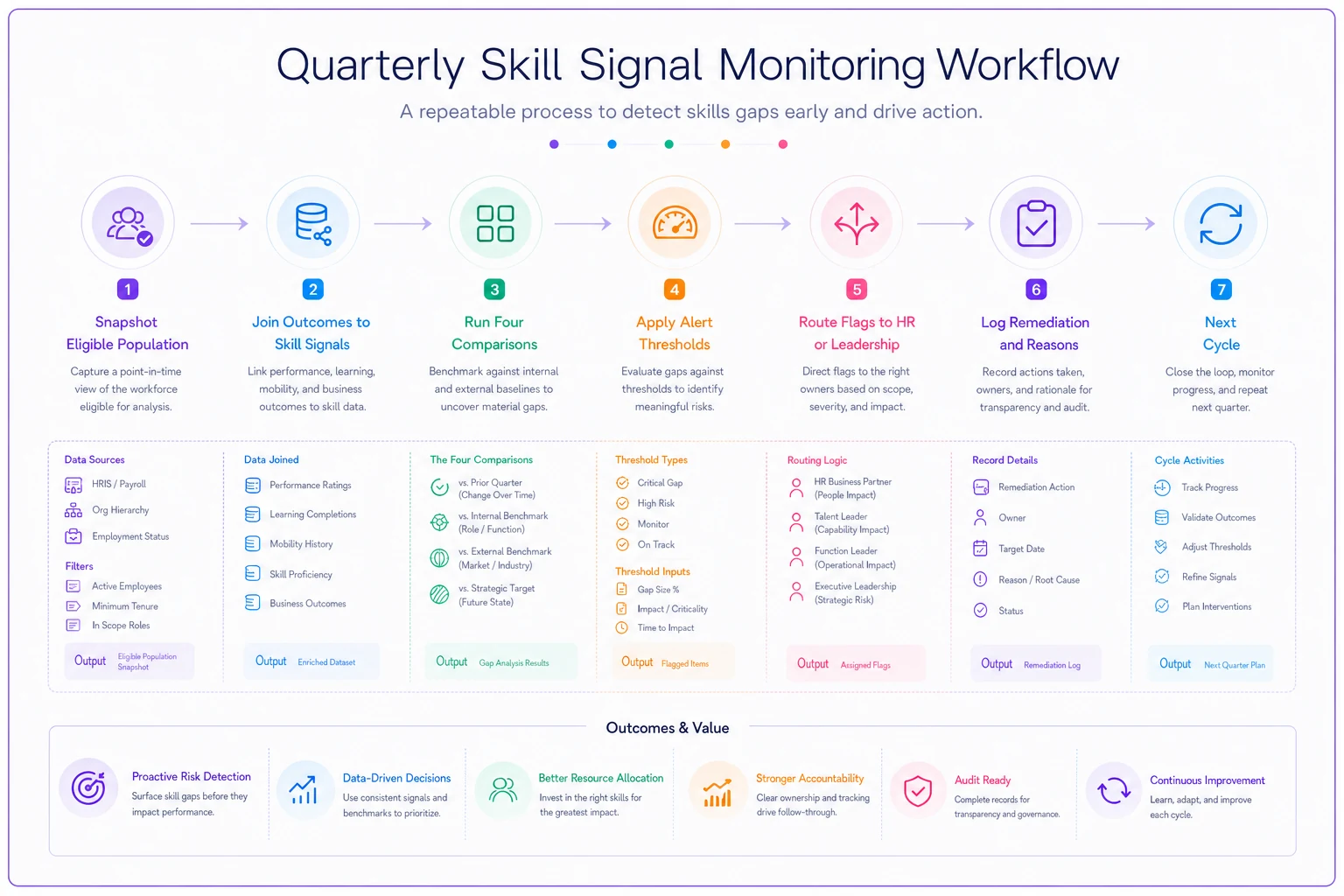
Step 1 — Pull the population. At the close of each promotion or comp cycle, snapshot everyone who was eligible — meaning they cleared the relevant skill thresholds — not just everyone who was promoted. The eligible pool is your denominator, and it's the part people forget.
Step 2 — Join outcomes to signals. For each eligible person, attach: did they get promoted, how long since eligibility, what raise came with any move, and whether an override was used. This join is the whole game. If your skills data and your comp data live in separate systems that never talk, this step is where programs die.
Step 3 — Run the four comparisons across your predefined groups, always with group sizes attached.
Step 4 — Apply thresholds. Most cycles, nothing trips. That's the point — the system should be quiet when things are fine.
Step 5 — Route the flags. Anything at Investigate level goes to an HR owner with the underlying case list, not just the aggregate. "Here are the 6 people in Group B who were eligible last cycle and weren't promoted" is actionable. "Group B has a 22% gap" is not.
Step 6 — Log the remediation and the reason. Every flag gets a resolution note. Sometimes the answer is legitimate — the eligible people genuinely weren't ready on non-skill dimensions, or headcount was frozen. Documenting why a gap existed is as important as closing it.
This is where an AI-assisted operational layer earns its keep — not by making the fairness decisions, but by handling the tedious, error-prone joins and recurring pulls. Matching skill-signal records to comp outcomes across systems, catching low-N cases, and drafting the case lists for each flag is exactly the kind of repetitive coordination work that quietly doesn't get done when it's a manual quarterly chore sitting on an already-buried HR analyst. The judgment stays human; the assembly gets automated.
Remediation: what to actually do when a flag fires
A flag is a question, not a verdict. The response depends on which metric tripped. Lumping all bias flags into one "investigate" bucket produces vague action items that go nowhere.
-
Promotion-rate gap at threshold → Look at manager distribution. Is the gap concentrated under one or two managers, or spread evenly? Concentrated gaps are a coaching-and-accountability conversation. Distributed gaps point to something structural in the criteria or the eligibility pipeline.
-
Time-to-promotion gap → Check whether the slower group is getting the assignments that generate promotion evidence in the first place. Often the delay isn't at the promotion decision — it's upstream, in who gets the visible work.
-
Pay-delta gap → This one usually traces to starting-band differences and inconsistent raise formulas. The fix is a raise-guideline audit, and it often means correcting existing pay, not just future decisions.
-
Override clustering → Pull the override reasons. If they're all "leadership presence" or other unmeasured traits, you've found a soft criterion doing the work your skills signals were supposed to do.
Treating remediation as a one-time cleanup is the main mistake. A pay correction this cycle doesn't fix the formula that produced it. Each remediation should include a "will this recur?" note and, where it will, a change to the underlying rule.
Even after the fix is in, the next cycle's monitoring pass is what confirms it actually worked. That follow-through step is where most programs fall short — the flag closes, the ticket resolves, and nobody checks whether the gap narrowed.
The executive dashboard: what leaders should actually see
Executives don't need the four raw comparisons. They need to know three things: is parity holding, where is it drifting, and is remediation actually closing gaps. Anything more and the dashboard becomes wallpaper.
A dashboard that gets used tends to have:
-
A single parity status per business unit — green/watch/investigate — so a VP can scan their org in about five seconds.
-
Trend lines, not snapshots. A 15% gap that's shrinking cycle over cycle tells a completely different story than a stable 15% gap. Leaders need the direction.
-
Open vs. closed remediation items, with age. Nothing focuses attention like "3 flags open for 2+ cycles."
-
The pay-outcome view kept separate from the promotion view. These are different problems with different owners, and merging them hides the pay issue behind the more visible promotion numbers.
Tie the dashboard to the cost story leadership already understands. When you can connect parity drift to the financial and retention impact — the same way you'd frame it in a CFO-ready skills ROI model — you get budget for remediation instead of a shrug. A promotion-rate gap that predicts regretted attrition in a high-skill group is a number a CFO will act on.
A real scenario
A mid-sized software firm, roughly 400 employees, moved to skills-based promotion gates about a year before anyone thought to audit outcomes. The gates worked as designed — clear thresholds, verified signals, defensible individual decisions.
When they finally ran the first parity pass, promotion rates across groups looked fine. Within about 4 points. Everyone almost closed the review right there.
The pay-delta comparison told a different story. Same level jumps, but one group was averaging raises roughly 3% smaller per promotion. Not dramatic per person — but compounded across two promotion cycles and a couple dozen people, it had quietly opened a pay gap in the mid-level engineering band worth something in the low six figures annually across the affected group.
The cause wasn't malice. It was a raise formula anchored to prior salary, so anyone who started lower stayed proportionally lower even as they advanced on merit. They corrected the affected salaries, switched the promotion-raise formula to anchor on target band rather than current pay, and added the pay-delta metric to their quarterly loop. Next cycle the gap came in under 1%.
The lesson they took away: their promotion process was fair, and their pay process wasn't. If they'd only watched promotions, they'd have missed it entirely.
When this makes sense — and when it doesn't
Do this if you've already tied promotions or pay to skills signals and you're running regular cycles. You have the raw material; you're just not looking at it. The monitoring loop is cheap relative to the risk it catches.
It's premature if your skills data is still stabilizing. If your signals are noisy or half your population has stale profiles, your parity comparisons will produce garbage flags and you'll burn credibility chasing noise. Get the data quality baseline solid first, then start monitoring outcomes.
Skip the heavy version if you're under about 150 people. Your group sizes will be too small for most comparisons to mean anything cycle to cycle. Run a lighter annual review instead of a quarterly statistical one — the persistence thresholds above just won't have enough data to work with.
Who should not run this as a checkbox exercise: any team that isn't prepared to act on a pay-gap finding. If you go looking and find something, you now know about it — and knowing about a documented gap and doing nothing is worse than never having checked. Only start the loop if leadership is bought into remediation, including retroactive pay fixes.
The point
Skills-based advancement gave you objectivity as a possibility, not a guarantee. The guarantee comes from the boring recurring work — the quarterly pull, the four comparisons, the thresholds tuned to stay quiet until something real happens, and the discipline to look at pay outcomes as carefully as promotion outcomes.
Most organizations already have every ingredient for skills parity monitoring sitting in their systems. What's missing is the loop that connects skill signals to actual outcomes and checks whether the two match across the people who deserve equal treatment. Build that loop, keep it quiet by default, and let it earn its keep on the one cycle where it catches something before it becomes a headline.
Ready to elevate your team's skills?
Join 500+ companies using Talioly to boost skill visibility, streamline training, and drive performance growth.