

Most badge programs die a slow, embarrassing death. Someone launches "50 microcredentials" with fanfare, employees earn a handful, and then nothing happens. No promotion. No raise. No stretch assignment. The badge sits on a profile page next to a LinkedIn-style checkmark and quietly loses all meaning.
The problem almost never lives in the badge itself. It lives in the wiring — or the total absence of wiring — between what a badge proves and what the org does about it. A badge that isn't tied to a promotion gate or a pay trigger is a participation trophy with a nicer icon.
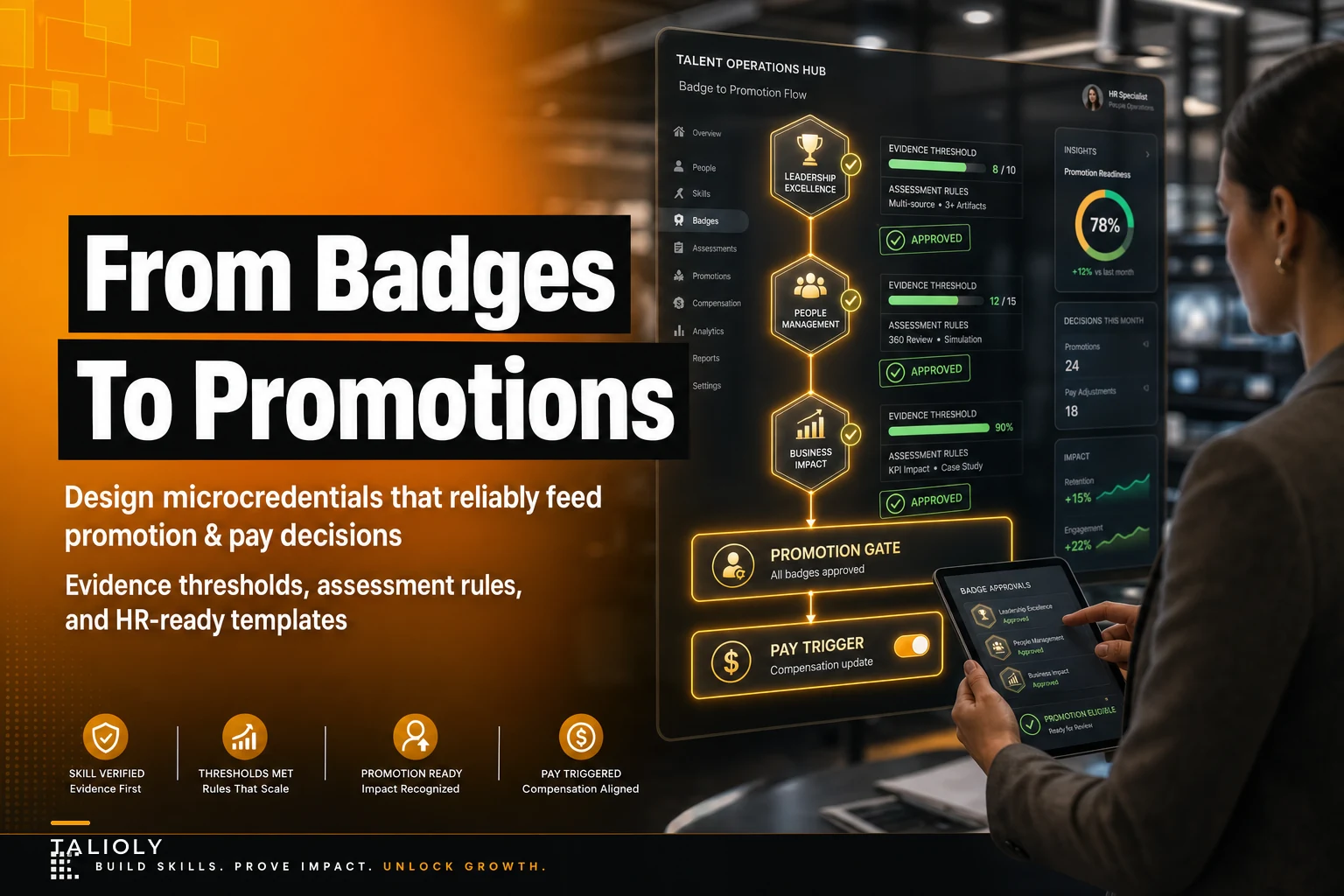
This post is about that wiring. Specifically: how to design a badge taxonomy where the evidence thresholds are strict enough that a compensation committee will sign off on them, and where earning a specific set of badges mechanically unlocks a promotion review or a pay band movement. No hand-waving. Templates you can copy.
The three-layer problem nobody separates
The reason so many internal microcredential programs stall before they influence promotions is that people collapse three very different decisions into one badge.
-
What was demonstrated (the skill/competency)
-
How strong the proof is (the evidence threshold)
-
What it entitles you to (the gate or pay trigger)
When those three get mashed together, you end up with badges that are simultaneously too easy to earn and too weak to act on. A "Data Analysis" badge issued after a two-hour course means nothing to a hiring manager. Issue that same badge only after someone shipped three production dashboards that survived peer review, and suddenly it's a signal you can promote against.
The fix is to design each layer separately, then connect them with explicit rules.
Layer 1: A badge taxonomy that maps to real progression
Your taxonomy needs a shape that mirrors how people actually advance — not a flat pile of 200 skills. Three tiers is enough for most orgs. Going beyond four creates maintenance debt that nobody funds.
Stop losing track of critical skills.
Talioly helps you track, develop, and certify your workforce efficiently.
- Centralized skill profiles
- Automated training reminders
- Competency gap analysis
No credit card required
| Tier | Name | What it proves | Typical evidence | Ties to |
|---|---|---|---|---|
| 1 | Foundational | You can do the task under supervision | Completed assessment + 1 reviewed artifact | Onboarding, ramp milestones |
| 2 | Applied | You do the task independently and reliably | 3+ real work artifacts over time, peer-verified | Role confirmation, small pay step |
| 3 | Lead/Multiplier | You raise others' output in this skill | Mentored deliverables, review sign-offs, measurable team lift | Promotion gate, band movement |
The most common mistake is orgs stuffing every skill into Tier 1 because it's the easiest to assess, then wondering why no badge influences promotions. Foundational badges should not move pay. They confirm someone reached a baseline. The badges that carry money are Tier 2 and Tier 3, and those need real evidence.
Layer 2: Evidence thresholds finance will actually respect
If a compensation committee can't defend a pay decision to a skeptical CFO, the badge won't trigger anything. The evidence threshold has to be strong enough to survive that conversation.
A workable rule: the higher the tier, the more the evidence has to come from real work rather than tests. Assessments are fine for Foundational. By the time you're issuing a Tier 3 badge that unlocks a band movement, a quiz result is close to worthless on its own.
A concrete evidence model per tier:
Foundational badge — pass one gate
-
Scored assessment above threshold (say 80%)
-
One artifact reviewed by a manager or SME
Applied badge — accumulate proof
-
Minimum 3 distinct work artifacts produced across at least 6–8 weeks (not all in one sprint)
-
At least 2 different reviewers signed off
-
No open quality flags on the artifacts
Lead badge — demonstrate multiplier effect
-
Evidence you improved someone else's output (reviewed a junior's work, ran a workshop that changed a practice, owned a standard others adopted)
-
Two senior sign-offs, one from outside the person's direct team
-
A measurable or clearly described outcome
The 6–8 week spread on Applied badges matters more than people expect. It stops the "cram a portfolio in one week before a deadline" behavior that makes badges meaningless. Real competence shows up as consistency over time, not a burst of effort right before a review cycle.
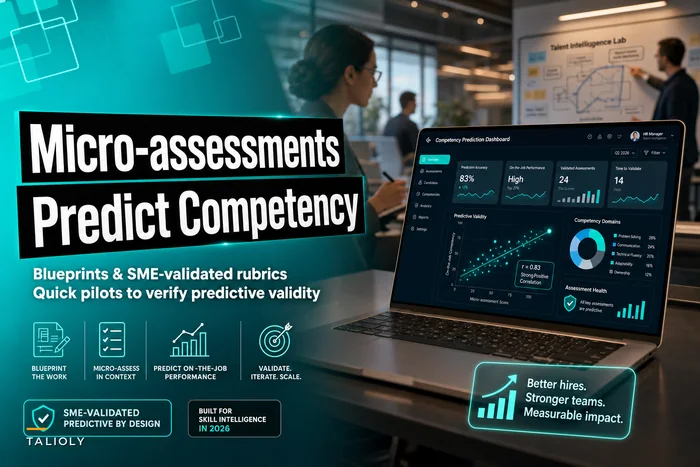
If you're serious about the artifact side of this, it's worth reading how to structure assessments so they actually predict on-the-job performance rather than just testing memory — there's a solid breakdown in this piece on micro-assessments that predict competency. The short version: an evidence threshold is only as good as the assessment feeding it.
Layer 3: The gate and pay-trigger logic
This is where badges stop being decorative. You define, in writing, which badge combinations unlock which decisions. Keep it mechanical. Ambiguity here is what lets managers quietly ignore the whole system.
> Senior Analyst gate: Candidate must hold Applied badges in Data Modeling, Stakeholder Communication, and Experiment Design, plus one Lead badge in any core skill. All badges must be current (earned or re-verified within 18 months).
> Step increase within band: Earning a second Applied badge in a role-critical skill triggers a review for a 2–4% step, subject to manager confirmation and budget window.
The key design decision: gates are eligibility, not entitlement. A completed badge set means the person qualifies for a promotion review — it doesn't hand them the title automatically. Confuse those two and you'll either terrify finance or create a system managers refuse to trust. Eligibility is defensible. Automatic promotion is not.
Sample templates HR can adopt
Copy these and adjust the thresholds to your org.
Badge specification template
-
Badge name _
-
Tier Foundational / Applied / Lead
-
Skill it proves _
-
Evidence required (list artifact types + minimum count + time spread)
-
Reviewers required (number + seniority + team-independence rule)
-
Validity period ___ months before re-verification
-
Unlocks (which gate or pay trigger, if any)
Promotion gate template
-
Target role
_
-
Required Applied badges
_
-
Required Lead badges
_
-
Currency rule
all badges verified within ___ months
-
What passing the gate unlocks
(review / eligibility / automatic step)
-
Who approves the final decision
_
Pay-trigger register template
| Trigger event | Badge condition | Pay action | Approver | Budget check |
|---|---|---|---|---|
| 2nd Applied badge | in role-critical skill | 2–4% step review | Manager + HRBP | Quarterly window |
| First Lead badge | any core skill | move to promotion slate | Comp committee | Annual cycle |
Notice the "budget check" column. Every pay trigger needs a funding reality attached, or you'll build a system that promises raises the finance team can't honor. That's the fastest way to lose employee trust in the whole program.
A real scenario
A regional insurance operations team — around 140 people in claims and underwriting support — had a training catalog nobody used for decisions. People completed courses, logged them, and nothing changed. Promotions still ran on tenure and manager gut feel, which meant a couple of strong performers left after 18 months of no movement.
They rebuilt around evidence thresholds. Foundational badges stayed course-based. Applied badges now required three real claim files or underwriting reviews, checked by two seniors over roughly two months. Lead badges required mentoring evidence. Then they wired two Applied badges in role-critical skills to a step review, and a defined badge set to the Senior Specialist gate.
The result over the following year wasn't dramatic on paper but mattered a lot in practice: roughly 11 internal promotions ran through the badge gates instead of tenure, two of them people who'd been overlooked for years. Manager overrides dropped because the evidence was sitting right there. The comp committee stopped debating "does this person deserve it" and started debating "does the budget window allow it" — a much healthier conversation.
When this actually makes sense
This design pays off when you have enough role volume that consistency matters, and enough turnover pain that "we lost a good person to no clear path" is a real cost. Orgs with structured career ladders and a comp committee that wants defensible inputs get the most out of it.
It also pairs naturally with succession work. If you're already building a promotable bench, tying badge evidence to readiness is a clean fit — the approach in this succession-readiness playbook uses the same underlying idea of validated evidence instead of manager impressions.
When this is a bad idea
Don't wire badges to pay if any of these are true:
-
You can't verify evidence reliably yet. If artifacts are scattered and manager sign-offs are inconsistent, a badge-to-pay link will just formalize bias.
-
Your skills data is stale. Badges earned three years ago tied to today's pay is a lawsuit-shaped problem. Build re-verification first.
-
Managers aren't bought in. If they'll ignore the gates, you get a paper system and a lot of cynical employees.
-
You have no budget mechanism. Triggering raises you can't fund destroys trust faster than having no program at all.
Who should not do this: very small teams where everyone's work is already visible to leadership. The overhead of a formal taxonomy isn't worth it when a five-person team already knows exactly who's ready. This is a solution for scale and opacity, not for small transparent groups.
The operational reality of keeping it honest
The quiet failure mode isn't the launch — it's month nine, when evidence starts drifting. Someone earns an Applied badge, their skill decays, but the badge stays green and keeps counting toward gates. That's why the validity period and re-verification rule aren't optional decoration; they're the thing that keeps the whole system credible.
The workflow that keeps this alive looks roughly like: artifacts get captured as work happens → reviewers confirm them against the threshold → the badge issues with a validity clock → gates read only current badges → re-verification prompts fire before expiry. Operational software helps most in the boring middle — routing artifacts to the right reviewers, tracking which badges are approaching expiry, and stopping expired badges from silently counting toward a promotion gate. Automating that decay-and-re-verify loop is usually the difference between a program that stays trustworthy and one that rots into another ignored catalog. But the real value isn't the automation itself — it's that whoever is reviewing a promotion slate can trust every green badge in front of them.
Diagram of the workflow:
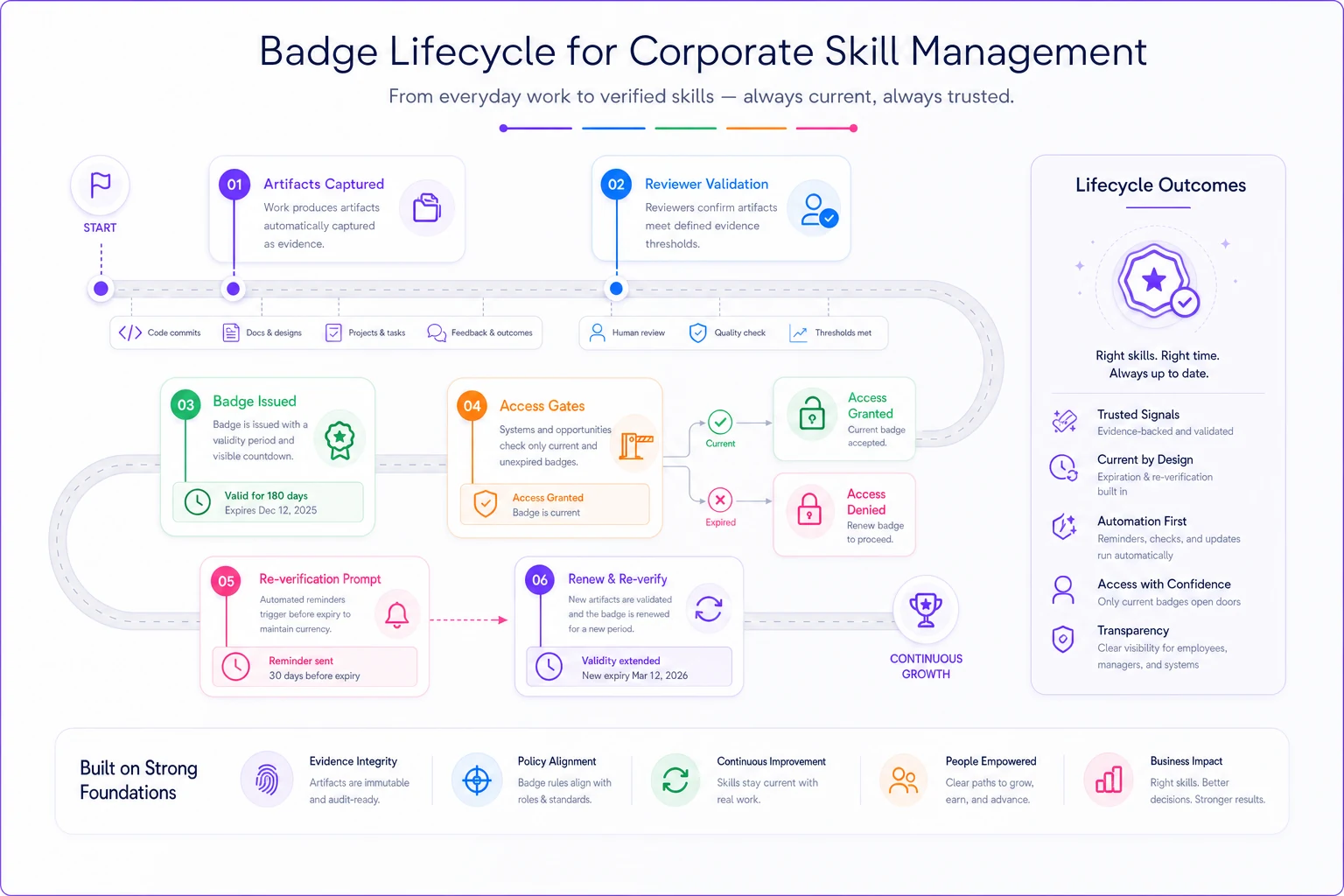
This diagram shows the routine flow that keeps badges credible.
Where to start
If you're building this from scratch, don't launch 200 badges. Pick the three or four role-critical skills where promotion decisions are hardest to defend today, write real evidence thresholds for those, and wire exactly one pay trigger and one gate. Prove the comp committee accepts the evidence. Then expand.
A badge that unlocks a real review is worth more than fifty that unlock nothing. Get the wiring right on a small set first, make sure money and promotion decisions actually flow through it, and you'll have something managers respect and employees chase — which is the entire point of internal microcredentials in the first place.
A badge that unlocks a real review is worth more than fifty that unlock nothing. Get the wiring right on a small set first, make sure money and promotion decisions actually flow through it, and you'll have something managers respect and employees chase — which is the entire point of internal microcredentials in the first place.
Ready to elevate your team's skills?
Join 500+ companies using Talioly to boost skill visibility, streamline training, and drive performance growth.