
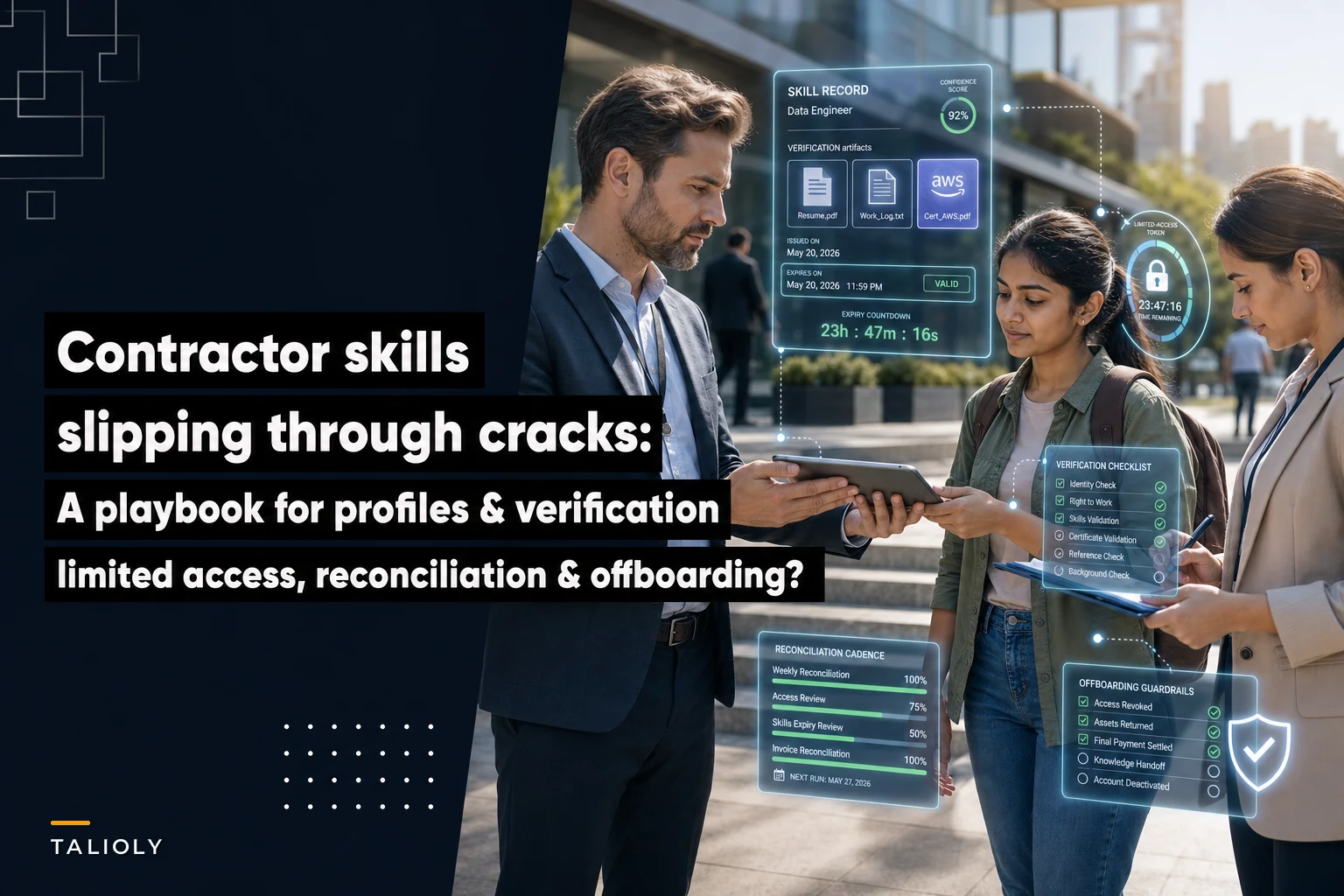

Most talent teams treat contractors like employees with a shorter shelf life. Same profile template, same verification steps, same offboarding checklist — just executed faster and sloppier. That's the root of the problem. Contingent workers move differently through your org, so the systems built for permanent staff quietly break when you point them at a 6-week SOW engagement or a rolling roster of specialized freelancers.
The failure isn't dramatic either. Nobody notices a single missed offboarding. What you get instead is slow accumulation: stale credentials, access tokens that outlive the engagement, skill records that were never verified, and a "bench" of past contractors nobody can actually search when a similar project comes up. Contingent worker skills management falls apart not because people are careless, but because it inherited the wrong operating model.
This post stays narrow on purpose. It's about the profile templates, verification rules, access controls, reconciliation rhythm, and offboarding guardrails that should be separate from your employee processes — and why keeping them separate actually saves you work later.
The core mistake: forcing contractors into the employee record model
Employee skill profiles are built to grow over years. They assume ongoing performance reviews, promotion cycles, manager coaching, and a stable identity in your HRIS. Contractors have none of that. A specialist might be with you for 4 weeks, disappear for 8 months, then return under a different agency.
When you jam that reality into the employee model, three things happen:
-
The profile gets created but never gets verified, because verification workflows assume a manager relationship that doesn't exist.
-
Access provisioning follows the "new hire" path, granting broader defaults than a contractor should ever have.
-
Offboarding gets triggered manually by whoever remembers — usually nobody — because automated employee offboarding is tied to payroll termination events that never fire for a contractor.
The pattern shows up everywhere. A company can tell you exactly which employees are certified in a tool, but ask them which of their last 40 contractors were verified on it and you get a shrug and a spreadsheet that's 7 months out of date.
The fix isn't more discipline. It's a parallel track designed around how contractors actually behave.
A contractor skill profile template that fits how they actually work
A contractor profile should carry less identity data and more engagement-specific evidence than an employee record. You don't need their career aspirations. You need to know what they proved they could do, on which engagement, verified by whom, and whether that proof is still fresh.
Stop losing track of critical skills.
Talioly helps you track, develop, and certify your workforce efficiently.
- Centralized skill profiles
- Automated training reminders
- Competency gap analysis
No credit card required
| Field | Employee profile | Contractor profile |
|---|---|---|
| Skill claims | Self + manager rated | Engagement-verified only |
| Evidence attached | Optional, grows over time | Required at engagement close |
| Verification source | Line manager | Engagement owner or SOW sponsor |
| Expiry on skills | Rare | Default 6–12 months |
| Identity linkage | Permanent employee ID | Agency + individual composite ID |
| Access defaults | Role-based | Least-privilege, time-boxed |
| Rehire notes | N/A | "Would re-engage" flag + context |
The two fields people skip and later regret: the composite ID and the "would re-engage" flag.
The composite ID matters because the same person often returns through different agencies, or as a direct freelancer after first coming through a staffing firm. If your profile is keyed only to the agency's worker ID, you get duplicate records for one human, and your verified-skills history fragments across them. Keying to person + agency lets you merge history intelligently.
The re-engage flag matters because it's the single most valuable output of any contractor engagement and almost nobody captures it. Six months later when a similar project spins up, "we worked with someone great on the last one" is useless if you can't find them or remember why they were good.
If you're building this profile from messy source data — old procurement records, agency emails, project trackers — the mechanics are close to what's covered in this HR-safe ETL checklist for building a single skill profile. Same discipline, different source systems.
Temporary verification rules: verify at the boundary, not up front
Employee skill verification can afford to be slow. Contractor verification has to happen at two hard boundaries: engagement start and engagement close. Miss those windows and you'll never get it.
At start, you're not doing deep verification. You're confirming the minimum: the credential the contract was priced on actually exists and is valid today. A contractor billing at senior rates on a certification that expired last year is both a cost problem and a risk problem.
At close, you capture the evidence that turns a claim into a verified skill. This is the window everyone wastes. The engagement owner knows exactly what the contractor did — right now, at close-out. Two weeks later they've moved on and the detail is gone.
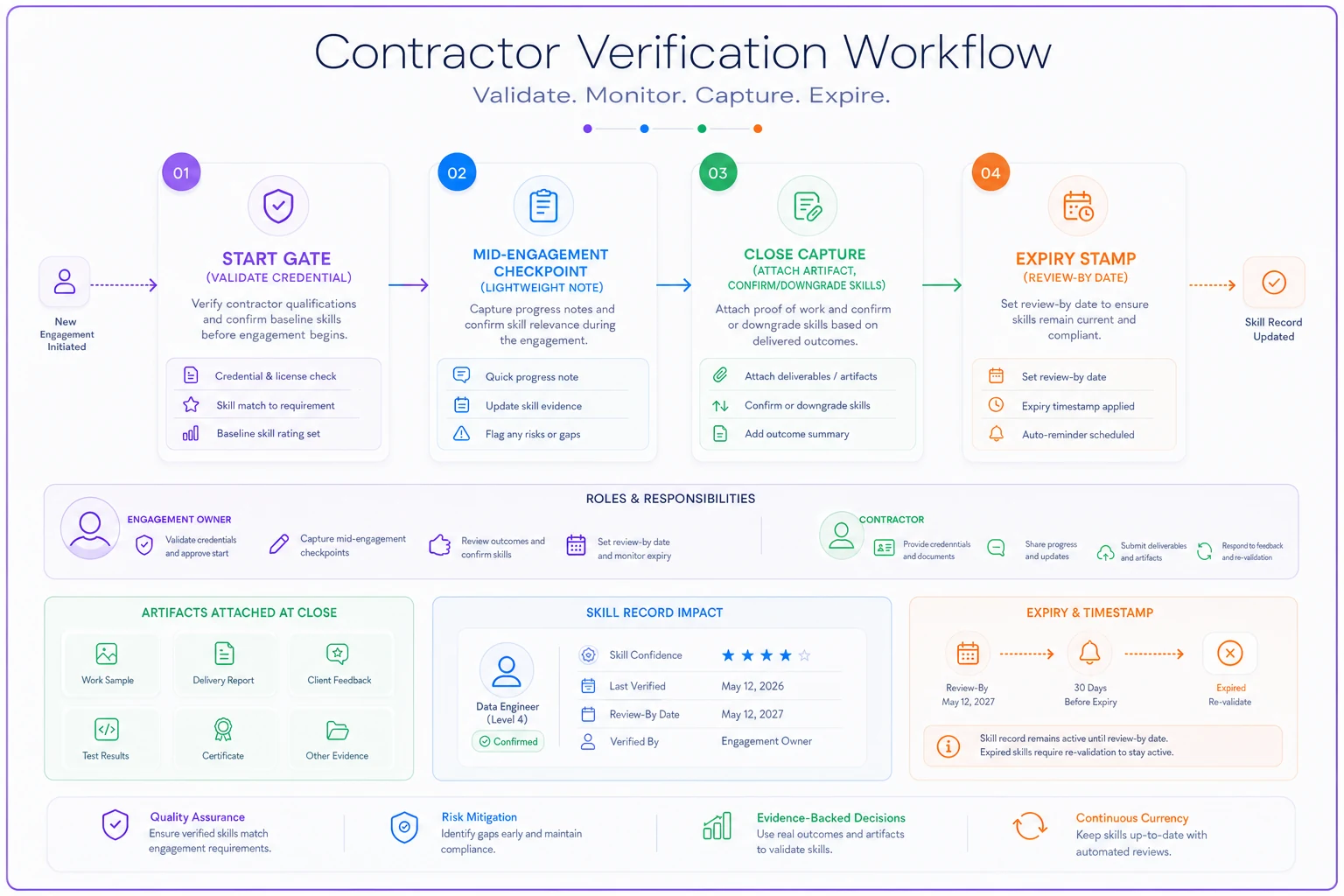
A temporary verification rule set that works:
-
Start gate validate any certification the contract rate depends on. Binary pass/fail. Don't proceed without it.
-
Mid-engagement checkpoint (only for engagements over roughly 8 weeks): a lightweight note on whether delivered work matches the claimed skill level. One paragraph, not a review.
-
Close capture engagement owner attaches one concrete artifact and confirms or downgrades each claimed skill.
-
Expiry stamp every verified skill gets a review-by date. For contractors, default to shorter windows than employees.
Here's a quick visual of that verification workflow.
The principle underneath all of this: a self-reported skill on a contractor profile is close to worthless. The person isn't around long enough for the truth to surface through daily work. The evidence-capture approach in this piece on capturing work artifacts as evidence instead of trusting self-reports applies even harder here, because with contractors you get exactly one shot at close-out to grab it.
A common failure worth naming
A team hires a data contractor "certified" in a specific pipeline tool. Nobody validates at start. The contractor is competent but not at the level billed. At close, everyone's busy, so no evidence is captured and the profile just says "verified: yes" because someone clicked through. Eight months later that profile surfaces in a search, the contractor is re-engaged at the same rate for a harder project, and it goes badly. The cost of skipping a 10-minute start gate and a 15-minute close capture compounds quietly.
Limited access tokens: least privilege and an expiry that isn't a suggestion
This is where contractor and employee processes should look least alike — and where most orgs are sloppiest.
-
Least-privilege by default. They get what the SOW requires, nothing based on a "role" copied from an employee template.
-
Time-boxed to the engagement. The token's expiry should match the contract end date, set at provisioning — not something a person has to remember to revoke.
-
Scoped to systems, not blanket. A contractor doing analytics work does not need the same footprint as one doing platform integration.
-
Logged against the composite ID, so when they return you can see exactly what access they had before.
The recurring failure: access is granted through the standard onboarding path, the contract ends, and the token lives on. In real environments this is how you end up with active credentials belonging to people who haven't worked with you in over a year. The fix is making expiry a property of the token, set at creation, tied to the contract end date — so the default behavior is that access dies on schedule and staying active requires a deliberate extension.
A simple guardrail: no contractor access should exist without an expiry date attached at the moment it's granted. If someone can't name the end date, the access shouldn't be provisioned yet.
Reconciliation cadence: the boring rhythm that catches everything
Even with good rules, drift happens. Contracts get extended informally, engagements end without anyone closing the record, tokens get manually extended and forgotten. Reconciliation is the recurring check that catches drift before it becomes a mess.
For contingent workers, monthly is the right cadence. Quarterly is too slow — a contractor engagement can start and end entirely inside a quarter, meaning it never appears in a reconciliation at all.
A monthly reconciliation should answer four questions:
-
Active tokens vs. active contracts — does every live access token map to a live engagement? Anything unmatched gets revoked or justified.
-
Closed engagements vs. captured evidence — did every engagement that ended last month get its close-out verification? Missing ones get chased while memory is fresh.
-
Expiring credentials on active contractors — anyone whose billed-rate credential expires this month?
-
Duplicate profiles — any returning contractor who got a new record instead of a merge?
Run reconciliation in the first week of each month so last-month endings are still fresh and evidence can be collected quickly.
The thing most teams miss: reconciliation isn't an audit to catch wrongdoers. It exists because informal changes are normal. Contracts get extended in a hallway conversation. That's fine — reconciliation is where that informal reality gets written back into the system.
Offboarding guardrails, kept separate on purpose
Employee offboarding is triggered by a payroll event. Contractor offboarding usually has no trigger at all, which is exactly why it fails. The engagement just... ends. Nobody files anything.
The guardrail has to be that offboarding is triggered by the contract end date itself, not by a human noticing.
-
[ ] All access tokens revoked (verified, not assumed) against the composite ID
-
[ ] Close-out verification completed and evidence attached
-
[ ] Skill claims confirmed or downgraded on the profile
-
[ ] "Would re-engage" flag set with a one-line reason
-
[ ] Shared drives / repos access removed
-
[ ] Any org-issued accounts or licenses reclaimed
-
[ ] Profile marked inactive but retained and searchable for rehire
That last point is the difference most people get wrong. You archive an employee. You retain and index a contractor. The whole point of doing verification at all is so that a past contractor becomes a searchable, pre-vetted resource the next time you need that skill. Deleting or fully deactivating the profile at offboarding throws away the exact value you spent the engagement building.
When to build this separate track — and when not to bother
This makes sense when:
-
You run more than a handful of contractor engagements a year
-
Contractors touch systems with real access risk
-
The same specialists tend to come back
-
Your billing depends on credentials you're not currently validating
This is overkill when:
-
You use one or two long-term contractors who function like staff — treat them as employees for skills purposes and move on
-
Your contingent spend is tiny and low-risk
Who should not do this: teams that haven't yet fixed their employee skill profile basics. If your core profiles are chaos, bolting a parallel contractor track onto the mess just doubles the chaos. Get the employee side stable first, then fork the model for contractors.
Real scenario: a mid-size product company cleaning up contractor sprawl
A roughly 400-person software company was running somewhere between 30 and 40 contractor engagements a year through three agencies plus direct freelancers. No separate profile track. Contractors went through employee onboarding, and offboarding happened whenever someone remembered.
When they finally ran a full reconciliation, they found around 18 active access tokens tied to engagements that had already ended — a couple more than a year old. Verified skill records existed for maybe a quarter of past contractors, and even those were mostly unverified "yes" clicks. Two people had duplicate profiles from returning through different agencies.
Nothing fancy followed. They built a separate contractor profile template, added a start-gate credential check, made access expiry mandatory and tied to contract end dates, and set a monthly reconciliation. Offboarding got triggered by the contract end date.
Within about two quarters, orphaned tokens dropped to near zero, close-out verification was happening on most engagements instead of almost none, and — the part they didn't expect to care about — the "would re-engage" flags meant they could staff two follow-on projects from past contractors instead of starting a fresh search. That last bit alone probably saved a few weeks of sourcing time each time.
The takeaway
The reason contractor skills slip through the cracks isn't negligence. It's that the systems doing the work were designed for people who stay. Contractors arrive, prove something valuable, and leave — often on a timeline too short for employee-shaped processes to keep up. Give them their own profile template, verify at the boundaries, box in access with real expiry dates, reconcile monthly, and make offboarding fire on the contract end date instead of on someone's memory. None of it is complicated. It just has to be deliberately separate, because pretending contractors are short-lived employees is the exact assumption that keeps failing.
Ready to elevate your team's skills?
Join 500+ companies using Talioly to boost skill visibility, streamline training, and drive performance growth.