

Most HR teams don't find out their skills data is trapped until the day they try to leave a vendor. That's when the real cost shows up — not in the monthly license fee, but in the migration nightmare, the mismatched taxonomies, the badges that mean nothing outside the platform that issued them, and the three months of engineering time spent reverse-engineering how one system defined "proficiency level 3."
Interoperability isn't something you negotiate after the fact. It's a set of contractual and technical requirements you write into the deal before you sign anything. If you don't demand it upfront, you'll pay for it later — usually at the worst possible moment, like mid-acquisition or mid-platform-switch.
This is the checklist procurement and engineering can actually use. Not vague "data portability" language, but the specific canonical fields, provenance metadata, versioning rules, and API contract tests that make skills data genuinely moveable between systems. There's copyable contract language and acceptance tests below so you don't have to build this from scratch.
Why skills data gets locked in — and why nobody notices until it's expensive
The lock-in rarely happens through malice. It happens through convenience and underspecification.
A vendor onboards your skills library, maps it to their internal model, and everything works beautifully inside their product. Reports look clean. Dashboards populate. Managers are happy. What's invisible is that the vendor has quietly made dozens of structural decisions — how they represent skill hierarchies, how they encode evidence, how they version a skill when its definition changes, what timestamp means "last verified" versus "last edited."
None of those decisions are wrong. They're just theirs. And because your contract never specified a neutral exchange format, the moment you need to pull the data out, you discover it only makes sense inside their schema.
Worth naming directly: the systems that feel easiest to adopt are often the hardest to leave. Fast onboarding usually means the vendor did the mapping work for you — which means the mapping lives in their heads and their code, not in a documented, portable contract.
What breaks at scale is coordination across systems. One company running a single skills platform rarely feels interoperability pain. The same company running an LMS, an HRIS, a talent marketplace, an assessment vendor, and an inferred-skills engine feels it constantly — because every integration is a bespoke translation, and every translation drifts. This is the exact failure mode covered in enterprise skills data architecture patterns, and interoperability standards are the contractual layer that keeps that architecture from rotting.
The minimal canonical fields every vendor must expose
Start here, because everything else depends on it. If two systems can't agree on what a skill record actually contains, no amount of API polish will save you.
Stop losing track of critical skills.
Talioly helps you track, develop, and certify your workforce efficiently.
- Centralized skill profiles
- Automated training reminders
- Competency gap analysis
No credit card required
You don't need a sprawling data model. You need a small, boring, agreed-upon set of fields that every vendor must be able to emit and ingest. The mistake most teams make is trying to standardize everything — which stalls forever. Standardize the minimum that makes a record portable, and let vendors keep their proprietary extensions in a clearly separated namespace.
| Field | What it means | Why it's non-negotiable |
|---|---|---|
person_id | Stable identifier for the individual | Without a stable ID, you can't merge records across systems |
skill_id | Canonical skill identifier (yours, not theirs) | Vendor-internal IDs make exports useless |
skill_label | Human-readable name at export time | Needed to validate the ID actually maps to what you think |
proficiency_value | The level, on a declared scale | Levels are meaningless without the scale definition |
proficiency_scale | The scale definition itself (e.g., 1–5, named bands) | Lets a receiving system translate correctly |
evidence_type | What backs this claim (assessment, artifact, manager, self) | A self-reported skill and a validated one are not the same asset |
evidence_ref | Pointer to the underlying evidence | Enables audit and re-verification |
confidence | How strongly the skill is supported | Critical for inferred skills and decay |
source_system | Which system asserted this | Provenance starts here |
assertedat / verifiedat / expires_at | Timestamps for assertion, verification, expiry | Separate dates prevent staleness confusion |
The single biggest field people miss: proficiency_scale as its own explicit object. Everyone exports the number. Almost nobody exports what the number means. A "4" in one system and a "4" in another can represent completely different things, and when you merge them without the scale definition, you silently corrupt your data.
Copyable contract language:
> "Vendor shall expose, via documented API and bulk export, all skill records conforming to the Canonical Skill Record schema (Appendix A), including at minimum: person identifier, client-defined skill identifier, proficiency value with its full scale definition, evidence type and reference, confidence score, source system, and distinct assertion, verification, and expiry timestamps. Vendor-proprietary fields shall be namespaced separately and shall not be required to interpret canonical fields."
Provenance metadata: where the claim came from and who touched it
Canonical fields tell you what a skill record says. Provenance tells you whether you can trust it — and whether it'll survive an audit, a bias review, or a dispute.
Provenance problems tend to surface when someone asks a question the data can't answer. "Why does this person show as expert in Kubernetes?" If the only response the system can give is "because the record says so," you have a provenance gap. You should be able to trace any skill claim back to its origin: the assessment that produced it, the manager who approved it, the work artifact that was parsed, or the model that inferred it.
-
Origin event — what action created the claim (assessment completed, artifact ingested, manager attestation, inference run)
-
Actor — the human or system responsible, with role
-
Method — how the value was derived (scored assessment, rubric, model name and version)
-
Transformation log — any steps that changed the record after creation (normalization, decay adjustment, re-mapping)
-
Immutability guarantee — original assertions are never silently overwritten; changes append rather than replace
That transformation log matters more than people expect. When a vendor re-maps your taxonomy or applies a decay rule, the record changes. Without a log, you can't tell the difference between a human-verified downgrade and an automated adjustment. Those are completely different signals, and promotion or pay decisions might ride on them.
A practical standard worth pushing for: provenance should be rich enough that a reviewer with no access to the vendor's system can reconstruct why a record looks the way it does. If they can't, the provenance is insufficient.
Versioning semantics: the part everyone underspecifies
Skills are not static. "Data analysis" in 2019 and "data analysis" in 2025 describe different things. Vendors handle this constantly — and almost always inconsistently. This is where silent corruption creeps in.
The core question your contract must answer: when a skill definition changes, what happens to existing records?
-
Immutable skill IDs with versioned definitions. The ID stays stable; the definition carries a version number. Old records point to the version they were assessed against. This is the approach most resistant to corruption.
-
New ID on material change. A meaningfully changed skill gets a new ID, and you maintain an explicit mapping from old to new. More disruptive, but unambiguous.
-
Mutable definitions with no versioning. The definition just changes under you. This is the default in too many systems, and it's the one to reject.
Demand semantic versioning on skill definitions themselves, not just on the API. A change should declare whether it's a minor clarification or a breaking redefinition, and breaking changes should never reuse the same version identifier.
Copyable contract language:
> "Vendor shall assign immutable identifiers to all canonical skills. Any change to a skill's definition shall produce a new, incrementing version of that definition, and all existing records shall retain a reference to the definition version in effect at the time of assertion. Breaking changes to skill definitions shall be communicated no fewer than 60 days in advance, accompanied by a machine-readable migration mapping."
The pattern that bites organizations: a vendor "improves" a taxonomy, silently re-points thousands of records, and three months later a succession review surfaces people who appear to have gained or lost skills nobody actually changed. By the time you notice, the audit trail is gone.
API contract tests: proving interoperability instead of hoping for it
A vendor telling you they support an open format is not the same as proving it. Contract tests are how you turn a promise into something verifiable on an ongoing basis — ideally automated, run against the live API, and tied to your renewal terms.
A contract test asserts that the API behaves exactly as specified, in a way both sides agree on. For skills interoperability, your engineering team should be able to run a suite that checks the real integration, not a demo environment.
-
Round-trip fidelity. Export a known set of records, re-import them into a clean environment, and confirm every canonical field matches byte-for-byte on the fields that should be stable. Any loss is a failure.
-
Scale preservation. Export records on a 1–5 scale and a named-band scale; confirm
proficiency_scalesurvives and still maps the value correctly. -
Provenance completeness. For a random sample of records, confirm every required provenance element is present and non-null.
-
Version reference integrity. Confirm each record references a valid, resolvable skill-definition version.
-
Pagination and completeness. Confirm a full export returns the exact record count the system reports, with no silent truncation at scale.
-
Rate and volume behavior. Confirm the export API can emit your full population within an agreed window — tested at realistic volume, not 50 sample records.
That last one catches a surprisingly common failure. An API that exports cleanly for a few hundred records can choke, time out, or silently drop records when you ask for 40,000. You want to know that before you depend on it, not during a migration deadline.
Copyable acceptance test language:
> "Prior to go-live and at each renewal, Vendor shall pass the Interoperability Acceptance Suite (Appendix B), including round-trip export/import fidelity, proficiency-scale preservation, provenance completeness on a statistically valid sample, skill-version reference integrity, and full-population export within the agreed completion window. Test failures shall be remediated within 30 days; unremediated failures at renewal constitute material breach."
Tying acceptance tests to breach terms is what gives them teeth. Without that link, they're documentation nobody runs.
Vendor-neutral exchange rules
The goal of neutrality isn't to force every vendor onto one identical format. It's to make sure the data can move through a documented, non-proprietary intermediary without a translation project every time.
-
Open, documented exchange format. Exports use a published schema you hold a copy of — not an undocumented CSV dump whose columns change between releases.
-
No proprietary-ID dependency for interpretation. Canonical fields must be interpretable without access to vendor-internal lookup tables.
-
Separation of canonical and proprietary layers. Vendor extensions are welcome but namespaced, so they never block the core data from being understood elsewhere.
-
Client ownership of the taxonomy. Your skill IDs are yours. The vendor maps to them; they don't replace them with their own as the source of truth.
-
Exit data package defined at signing. The exact contents and format of your data on exit are specified before you commit, not negotiated when the relationship is already strained.
That last point connects directly to the SLA terms worth locking down before signing — the skills data vendor SLA templates procurement can copy cover the service-level side of this, and interoperability rules are the data-structure counterpart. Together they're what make a vendor relationship actually reversible.
A short real scenario
A mid-sized financial services firm — roughly 4,000 employees — ran three skills-related systems that had accreted over about four years: an LMS, a homegrown skills matrix, and a newer talent marketplace. Each had its own idea of what a skill was. None agreed on proficiency scales.
When they tried to consolidate onto a single platform, the migration estimate came back at close to five months, mostly because nobody could reliably map proficiency levels across systems. One system's "proficient" overlapped with another's "advanced," and the evidence behind the claims was inconsistent or missing entirely. Roughly 30% of records couldn't be confidently migrated at all and had to be re-verified from scratch.
The fix wasn't technical heroics. It was going back and retrofitting canonical fields and explicit scale definitions onto the exports, then building round-trip contract tests to prove the mapping held. The re-verification work didn't disappear, but once the canonical layer existed, the next integration — adding an assessment vendor about a year later — took around two weeks instead of two months. That difference came entirely from having specified the exchange rules upfront the second time around, not from any improvement in the underlying tools.
When demanding full interoperability makes sense — and when it's overkill
This level of rigor isn't free. Writing contract tests, maintaining canonical schemas, and enforcing versioning takes real engineering attention. Be honest about when it's worth it.
When it clearly makes sense:
-
You run more than two systems that touch skills data
-
You anticipate M&A, reorganization, or platform consolidation
-
Skills data feeds consequential decisions — promotion, pay, redeployment
-
You operate across jurisdictions with audit or consent obligations
When it's probably overkill:
-
You're a smaller organization on a single platform with no near-term plan to add more
-
Skills data is informational, not tied to decisions
-
You're still in an early pilot and haven't proven the data is worth preserving
One group that should hold off entirely: teams that haven't settled their own canonical taxonomy. If your internal definitions are still shifting weekly, demanding immutable versioned skill IDs from a vendor is premature — you'll be forcing stability onto data that isn't stable yet. Get your own house defined first, even loosely, then push the standard outward to vendors.
Making it operational
None of this works as a one-time procurement checklist you file and forget. Interoperability degrades the same way everything else does — through drift, undocumented changes, and the slow accumulation of exceptions.
The organizations that keep their skills data portable treat these standards as living requirements: contract tests that run on a schedule, version change notices that get reviewed, provenance audits that happen on a sample every quarter. That's not a heavy process. For most teams it's a few hours a quarter and one person who owns it.
Here's a simple workflow to operationalize those requirements:
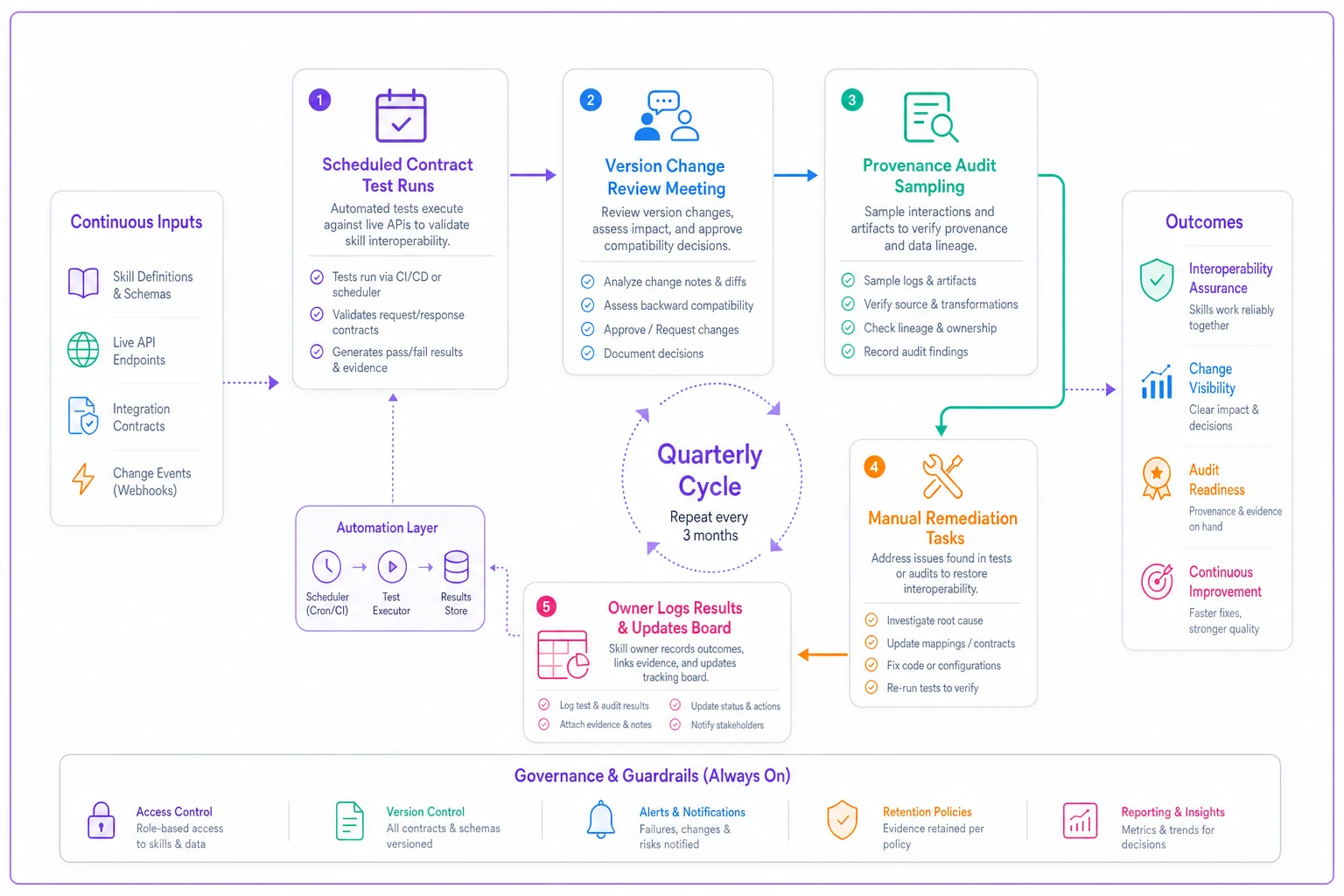
That workflow keeps the cost of drift low and makes each vendor swap predictable rather than catastrophic.
The cost of not doing it tends to show up all at once — in the form of a migration that takes six months when it should have taken six weeks. The payoff is the ability to switch vendors without a hostage negotiation, to merge two taxonomies after an acquisition without months of reconciliation work, and to actually answer "why does this record say what it says" with something real. That optionality is worth far more than any single platform feature, and it's only available to the HR leaders who demanded it in writing before the ink was dry.
The cost of not doing it tends to show up all at once — in the form of a migration that takes six months when it should have taken six weeks. The payoff is the ability to switch vendors without a hostage negotiation, to merge two taxonomies after an acquisition without months of reconciliation work, and to actually answer "why does this record say what it says" with something real. That optionality is worth far more than any single platform feature, and it's only available to the HR leaders who demanded it in writing before the ink was dry.
Ready to elevate your team's skills?
Join 500+ companies using Talioly to boost skill visibility, streamline training, and drive performance growth.