


Most skills data vendor contracts read like a marketing brochure with a signature line at the bottom. Coverage numbers, "AI-powered matching," a taxonomy that "maps to O*NET," and an uptime clause that only covers whether the API responds — not whether the data coming through it is any good.
Then six months in, someone in talent development runs a query for "Kubernetes" and gets 400 people flagged as proficient, half of whom last touched infrastructure work two years ago. Nobody breached the contract. The API was up the whole time. The data was just wrong, stale, and untestable — and there was nothing in the SOW that gave procurement any real recourse.
That gap is the whole problem. A skills data vendor SLA written for uptime protects the pipe. It does nothing for what flows through it. And when you're feeding that data into promotions, redeployment, pay decisions, and workforce planning, "the API was up" is not the standard you needed.
This is the contract language most teams wish they'd had before they signed. Acceptance tests you run before go-live, freshness and accuracy SLAs with real thresholds, monitoring you can actually see, and remediation language that gives you leverage when the feed degrades — because it will.
Why skills feed contracts fail in a way you don't notice for months
The failure isn't usually malice. It's that the failure modes of a data feed are invisible until you go looking, and standard SLA templates were built for systems where "working" and "not working" are obvious.
A payment gateway either processes the transaction or it doesn't. A skills feed can be fully "operational" while quietly rotting. Skills decay, people change roles, certifications expire, and the vendor's inference model drifts. None of that trips an alert unless the contract required one.
The pattern that shows up repeatedly: the vendor sells on coverage — "we have 12,000 skills mapped, 94% of your workforce profiled." Coverage is easy to measure and easy to inflate. What nobody negotiated was freshness (how old is the data behind each profile) and accuracy (does the skill claim match reality). Those two things actually determine whether your downstream decisions are sound, and they're almost never in the SOW.
At small scale, you get away with it. A team of 200 people, a few managers who know everyone — errors get caught by humans who happen to know that Priya moved off the data team in March. The feed can be mediocre and nobody really suffers, because human context fills the gaps.
That breaks the moment you scale the usage, not just the headcount. When you start routing internal mobility, layoff redeployment, or skills-based pay off the feed, you're making thousands of decisions where no human is checking. A 15% error rate that was invisible at 200 people becomes a fairness and compliance liability at 5,000. The contract you signed when the feed was a "nice reference" is now governing consequential decisions, and it has no teeth.
The four things your SLA has to cover (and what most cover instead)
Before the clause language, it helps to see the gap plainly. Here's what typical contracts cover versus what actually protects you.
Stop losing track of critical skills.
Talioly helps you track, develop, and certify your workforce efficiently.
- Centralized skill profiles
- Automated training reminders
- Competency gap analysis
No credit card required
| Concern | What most contracts say | What the contract should say |
|---|---|---|
| Availability | "99.9% API uptime" | Keep it — but it's the least important line |
| Coverage | "X% of employees profiled" | Coverage with a minimum confidence threshold per profile |
| Freshness | Nothing | Max age of source signals per skill category, measured and reported |
| Accuracy | "Industry-leading matching" | Sampled accuracy against a labeled ground-truth set, with a floor |
| Monitoring | Vendor status page | Data-quality dashboard you can access, with metric-level visibility |
| Remediation | Service credits for downtime | Credits + cure periods tied to data SLAs, plus exit rights |
The right-hand column is the whole game. Availability protects the connection. Everything below it protects the decisions.
One thing worth saying upfront: accuracy is meaningless without a ground-truth set you both agree on. You cannot enforce an accuracy SLA against "the vendor's opinion of their own accuracy." You need a labeled sample — a few hundred profiles your team has verified — that becomes the yardstick. If the vendor won't agree to be measured against a sample you help build, that tells you something before you sign.
Acceptance tests: what has to pass before go-live
Acceptance testing is your one moment of maximum leverage. Before you've paid, before you've integrated, before you're dependent. Don't waste it on a demo.
A real acceptance test runs the vendor's feed against a portion of your own workforce that you already understand, and checks whether the output matches reality. Build this into the SOW as a gate — payment or full rollout is contingent on passing.
A workable acceptance sequence:
-
Ground-truth sample. You and the vendor agree on a labeled set of 200–400 employee profiles that HR has manually verified. This is the answer key.
-
Blind run. The vendor's feed profiles the same population without seeing your labels.
-
Accuracy check. Compare feed output to your labels. Set a pass threshold — for example, skill-level precision and recall of at least 80% for core/critical skills, with lower tolerance acceptable for peripheral ones.
-
Freshness check. For a sample of profiles, verify the age of the underlying evidence. If a "current" skill is backed by a signal 18 months old with no decay applied, that's a fail.
-
Confidence calibration. Check that the vendor's confidence scores actually mean something — high-confidence claims should be right more often than low-confidence ones. A flat, uninformative confidence score is worse than none.
-
Edge population test. Run it specifically against contractors, recent internal movers, and people with non-linear career paths. This is where feeds fall apart, and it's exactly the population you'll most want to redeploy.
> "Prior to production rollout, Vendor's feed shall be evaluated against a Client-provided ground-truth sample of no fewer than 300 verified employee profiles. Acceptance requires ≥80% precision and ≥75% recall on skills designated Critical by Client, and evidence-freshness compliance (per Section X) on ≥90% of sampled profiles. Failure to meet acceptance criteria within two remediation cycles of 15 business days each entitles Client to terminate without penalty and recover any prepaid fees."
That last sentence is the part that matters. An acceptance test with no consequence for failure is just a formality.
Here's a simple workflow for acceptance testing.
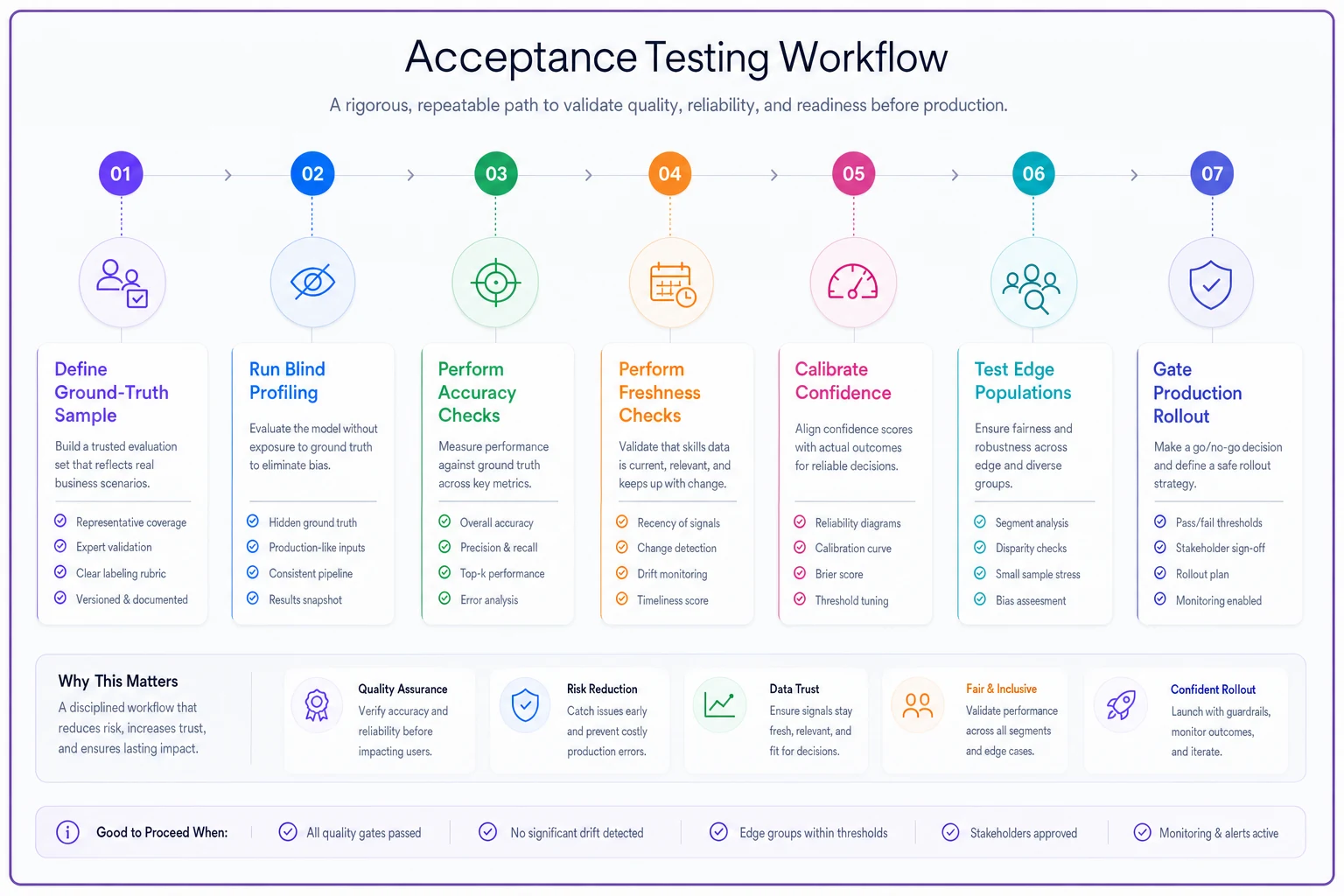
Use this sequence as the gate before production rollout so payment and full integration are contingent on passing the tests.
Freshness and accuracy SLAs with numbers that mean something
Ongoing SLAs are where you keep the vendor honest after the honeymoon. The trick is writing thresholds specific enough to enforce but realistic enough that the vendor will actually sign.
Freshness. Not every skill decays at the same rate. A cloud certification and a decade of accounting judgment don't age the same way. So don't write one blanket freshness number. Tier it.
-
Fast-decay skills (specific tools, platforms, certifications)
source evidence no older than 6–9 months, or a decay factor applied and disclosed.
-
Medium-decay (domain and process skills)
12–18 months.
-
Slow-decay (foundational competencies)
24+ months acceptable, but staleness still flagged.
The contract should require the vendor to report the freshness distribution monthly, not just promise it. "We maintain freshness" is unenforceable. "≥85% of active-skill signals are within their tier's freshness window, reported monthly" is enforceable.
Accuracy. Same principle — measurable and sampled, not asserted. Require a recurring accuracy audit against a refreshed ground-truth sample; quarterly is reasonable. Set a floor (say, sustained precision above 78% on critical skills) and define what happens when it slips below.
> "Vendor shall submit to a quarterly accuracy audit against a Client-refreshed ground-truth sample of no fewer than 200 profiles. If measured precision on Critical skills falls below 78% in any audit, a Remediation Period is triggered per Section X. Two consecutive failing audits constitute a material breach."
One realistic caution on numbers: don't over-tighten. If you demand 95% precision, either the vendor won't sign or they'll game the definition of "match" until 95% means nothing. Thresholds you'll actually hold to are better than aspirational ones you'll quietly ignore.
Getting your side of the ground-truth data clean is its own project — if your internal records are scattered across LMS exports, spreadsheets, and old assessment tools, the acceptance test ends up measuring your mess, not the vendor's quality. The groundwork in turning scattered training logs into a single employee skill profile is worth doing before you run a vendor acceptance test, not after.
Monitoring dashboards: stop trusting, start seeing
An SLA you can only verify by asking the vendor for a report is an SLA you don't really have. The vendor grades their own homework, quarterly, on their schedule.
Your contract should require access to a live data-quality dashboard — not the uptime status page, the data one. What you want visible:
-
Freshness distribution by skill tier, updated at least weekly
-
Coverage broken down by department, level, and employment type (so contractor gaps don't hide inside a healthy company-wide number)
-
Confidence-score distribution and drift over time
-
Volume of skills added, expired, or revalidated per cycle
-
Accuracy audit results, retained historically so you can see trends
The reason this matters operationally: degradation is gradual. A feed doesn't fail all at once — it drifts. Freshness slips two points a month. Confidence scores flatten. Coverage in the contractor population quietly erodes as the vendor's connectors break. If you only see a quarterly summary, you catch it a quarter late, after decisions have already been made on bad data.
> "Vendor shall provide Client with continuous, role-appropriate access to a data-quality dashboard exposing, at minimum: freshness distribution by skill tier, coverage by department and employment type, confidence-score distribution, and rolling accuracy-audit history. Metrics shall refresh no less than weekly. Dashboard access is a condition of the service, not a paid add-on."
That last clause is there on purpose. Vendors love to put observability behind a premium tier. The visibility that lets you enforce the contract should not be something you pay extra for.
Remediation language: what happens when it breaks
Every SLA above is decoration without remediation that has real consequences. This is where you build the escalation ladder so a degraded feed triggers action instead of a shrug.
A reasonable remediation structure has three rungs:
-
Notify and cure. When a data SLA is missed, the vendor has a defined cure period — commonly 15–30 business days — to bring the metric back into compliance, with a written remediation plan due within a few days of notification.
-
Service credits tied to data, not uptime. Credits that only apply to API downtime are useless for skills feeds. Tie credits to sustained freshness or accuracy misses. It doesn't have to be a large amount — the point is to make degradation cost the vendor something so it actually gets attention.
-
Exit rights. Two or three consecutive failed cure cycles, or two consecutive failing accuracy audits, constitute material breach with the right to terminate and recover prepaid fees. Without an exit, you're a hostage — the vendor knows switching is painful and has no real incentive to fix anything.
Two things procurement regularly forgets in remediation:
-
Data portability on exit. Require that on termination, the vendor returns your data and derived skill profiles in a usable, documented format within a set window. Otherwise "termination rights" mean walking away and rebuilding from zero, which is enough friction that you'll never actually exercise them.
-
Root-cause obligation. For any material SLA miss, require a written root-cause explanation. "We fixed it" is not the same as understanding whether a connector broke, the model drifted, or the taxonomy mapping degraded — and you need that to judge whether it'll happen again.
> "Upon any Data SLA miss, Vendor shall deliver a written remediation plan within 5 business days and cure within 20 business days. Sustained non-compliance beyond the cure period accrues service credits per Schedule Y. Two consecutive failed cure cycles, or two consecutive failing quarterly accuracy audits, constitute material breach entitling Client to terminate and to receive, within 30 days, a full export of Client data and derived profiles in a documented, machine-readable format."
A real scenario: what tightening the SLA actually changed
A mid-sized financial services firm — roughly 3,000 employees — had a skills feed in place for about a year, sold on coverage. On paper, 91% of the workforce was profiled and the vendor reported strong "match quality." Talent development wanted to use it to drive an internal mobility push after a restructuring.
When they finally ran a manual check against a sample before committing, the picture was uglier than the reports suggested. Around a third of the profiles for people who'd changed roles in the past year still reflected their old skills — the feed wasn't picking up recent movement. Contractor coverage, buried inside the healthy company-wide number, was closer to 50%. And confidence scores were basically flat, so there was no way to tell a solid inference from a guess.
None of this had breached the existing contract, because the existing contract only measured coverage and uptime.
On renewal, they rebuilt the SLA around acceptance testing, tiered freshness reporting, a quarterly accuracy audit against a 250-profile ground-truth set, dashboard access, and remediation with real exit rights. The immediate effect wasn't a magic jump in a headline metric — the vendor's behavior changed. Freshness on recently-moved employees improved within two cycles because it was now measured and visible to the client. The contractor coverage gap got a remediation plan attached to it instead of staying buried. Within a couple of quarters, the team trusted the feed enough to actually route mobility decisions through it — which was the whole point of buying it.
The lesson wasn't that the vendor was bad. They delivered exactly what the old contract measured. The feed got better because the contract started measuring things that mattered.
When a heavy SLA makes sense — and when it doesn't
Not every skills feed needs this level of contractual armor. Over-engineering the SOW for a low-stakes use case just slows procurement down.
This level of rigor makes sense when:
-
The feed drives consequential decisions — promotions, pay, layoffs, redeployment
-
You're operating at a scale where humans can't catch errors profile-by-profile
-
You have compliance or fairness exposure if the data is systematically wrong
-
The vendor is becoming a system of record that other tools depend on
Probably overkill when:
-
The feed is a reference source, not a decision engine
-
You're piloting and haven't committed to production use yet (though acceptance testing still applies)
-
The population is small enough that human review is genuinely catching errors
Who should not sign until they've done more homework: any team whose internal skills data is still a mess. If your ground-truth set is unreliable, every SLA above measures the wrong thing, and you'll blame the vendor for errors that originate in your own records. Similarly, if your credential and taxonomy mapping is inconsistent, the accuracy audit will be noisy — the operational patterns for mapping external credentials to internal taxonomies are worth sorting out first, so you're measuring the feed and not your own definitional drift.
Pull it together before the next renewal
The uncomfortable truth about skills feeds is that the contract is the quality control. There's no other enforcement layer. If the SOW measures coverage and uptime, that's what you get — a feed that's technically available and superficially complete while the data underneath quietly ages out of usefulness.
The fix isn't complicated, but it has to be in writing before you sign or renew. Acceptance tests against your own verified sample. Freshness thresholds tiered by how fast each skill actually decays. Accuracy audits against a ground-truth set you help build. A dashboard you can see without asking. And remediation with cure periods, data-tied credits, and a real exit — including your data on the way out.
Copy the snippets above, adjust the numbers to what you'll genuinely hold the vendor to, and get them into the next redline. A skills feed you can trust for high-stakes decisions is worth the extra pages in the SOW. A feed you can't trust is worse than no feed at all, because it makes wrong decisions look data-driven.
The fix isn't complicated, but it has to be in writing before you sign or renew. Acceptance tests against your own verified sample. Freshness thresholds tiered by how fast each skill actually decays. Accuracy audits against a ground-truth set you help build. A dashboard you can see without asking. And remediation with cure periods, data-tied credits, and a real exit — including your data on the way out.
Ready to elevate your team's skills?
Join 500+ companies using Talioly to boost skill visibility, streamline training, and drive performance growth.