

Every talent team that builds a serious internal taxonomy eventually hits the same wall: the outside world doesn't speak your language. A candidate shows up with a PMP, a Google Cloud cert, an OSHA 30, a bootcamp completion badge, a vendor-specific "certified administrator" credential, and three LinkedIn Learning courses. None of those map cleanly to the skill nodes you spent 18 months defining. And yet HR is expected to treat them as evidence of competency inside your promotion logic, your internal mobility engine, and your workforce planning models.
The naive approach is to treat this as a data-entry problem. Someone in HR ops looks at a certificate, guesses which internal skill it "kind of" matches, types it in, and moves on. That works for maybe 200 employees. Past that it falls apart — and it falls apart quietly. People get overlooked for roles, duplicate skills pile up, and your taxonomy slowly loses the trust of the managers who were supposed to rely on it.
This is a systems piece. External credential mapping to internal taxonomy isn't one workflow — it's an ingestion pipeline, a trust-scoring layer, a versioned mapping catalog, a human review loop, and a maintenance rhythm that keeps all of it from rotting. Skip any one of those and the whole thing degrades.
Where the whole thing usually breaks first
Before getting into the fix, it helps to understand the failure pattern, because it's remarkably consistent across organizations.
The first break is silent duplication. Two recruiters map "AWS Certified Solutions Architect – Associate" to two different internal nodes — one calls it "Cloud Architecture," the other "AWS Administration." Now the same credential means two different things depending on who touched the record. Reporting gets muddy. A manager searching for cloud talent misses half the people who actually have it.
The second break is trust flattening. A rigorous proctored certification and a two-hour self-paced webinar both end up as a checkmark next to a skill. There's no signal about how much weight the evidence deserves. When everything counts the same, the taxonomy becomes noise, and experienced managers stop believing it. Once that happens, they go back to resumes and hallway conversations — and you've lost the whole point of building the system.
The third break is staleness with no expiry logic. A CPR certification from 2019 sits in the profile looking identical to one earned last month. Vendor certs get retired. Cloud platforms rename entire certification tracks. Without version awareness, your mapping table describes a world that no longer exists.
Teams typically invest heavily in defining the internal taxonomy itself and almost nothing in the ingestion machinery that feeds it. That's backwards. The taxonomy is the easy part. The pipeline that keeps it fed with clean, trustworthy, current external data is where the real operational work lives.
The ingestion pipeline: five stages, not one
Think of credential ingestion as a pipeline with distinct stages, each with its own owner and its own failure mode. Cramming them into a single "enter the cert" step is exactly why things go wrong.
Stop losing track of critical skills.
Talioly helps you track, develop, and certify your workforce efficiently.
- Centralized skill profiles
- Automated training reminders
- Competency gap analysis
No credit card required
-
Capture — the raw credential arrives (uploaded PDF, API feed from a learning provider, manual entry, a digital badge with embedded metadata). At this stage you're not interpreting anything. You're just recording what showed up, verbatim, with its source.
-
Normalization — the raw string "AWS Cert. Sol. Arch – Assoc." becomes a canonical identifier. This is where you strip abbreviations, fix casing, and match against known credential names. Somewhere around 30–40% of manually entered credentials have some spelling or formatting variance from the official name, which is why normalization can't be skipped.
-
Verification — is this credential real and does it belong to this person? Some sources are self-attesting (someone typed it in), some are verifiable (a signed digital badge, a provider API confirmation, a registry lookup). This stage produces a verification status, not a skill mapping.
-
Mapping — the normalized, verified credential gets connected to one or more internal skill nodes using your mapping templates. This is where the taxonomy actually gets touched.
-
Scoring & write — the mapping is assigned a trust score and written into the employee's skill profile with all its metadata intact: source, verification status, issue date, expiry, and mapping template version.
The critical thing here: each stage should be reversible and auditable. If you discover six months later that a mapping template was wrong, you need to find every profile affected and re-run just the mapping stage — without re-collecting the underlying credentials. Pipelines that collapse capture and mapping into one action make this kind of correction nearly impossible, and at scale you will need to make corrections.
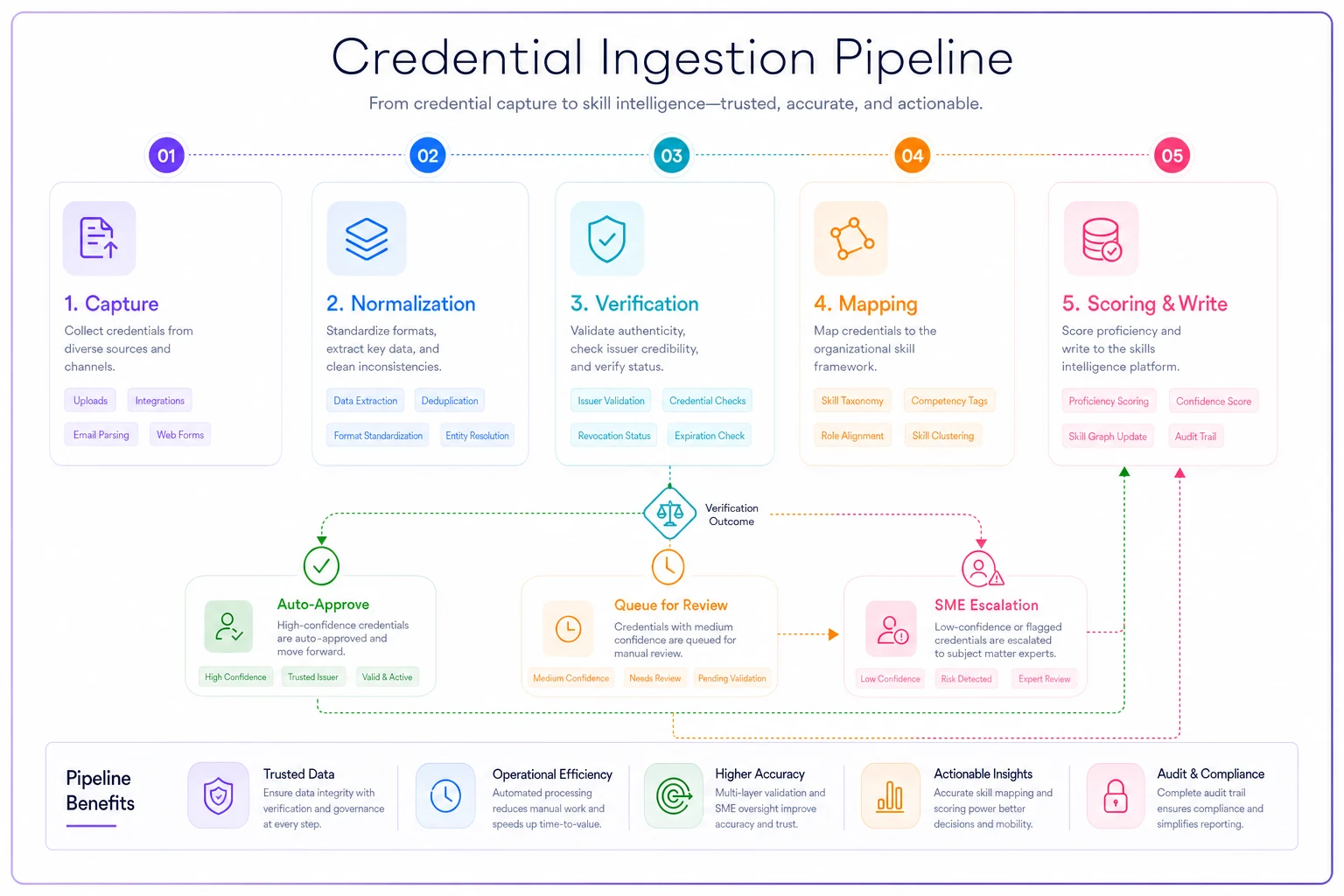
This diagram shows the stages and decision branches in the ingestion pipeline.
Pipelines that collapse capture and mapping into one action make this kind of correction nearly impossible, and at scale you will need to make corrections.
Trust-scoring heuristics that managers will actually believe
A credential's value depends on how it was earned, not just what it's called. A trust score encodes that difference into something your matching and promotion logic can use.
You don't need a fancy model to start. A simple weighted heuristic across a few dimensions gets you most of the way:
| Dimension | Low trust | Medium trust | High trust |
|---|---|---|---|
| Verification | Self-reported, no proof | Certificate uploaded | Verified via issuer API / signed badge |
| Assessment rigor | Attendance / completion only | Quiz or open-book test | Proctored, passing threshold |
| Issuer reputation | Unknown provider | Recognized vendor | Accredited body / industry standard |
| Recency | Older than validity window | Within window, aging | Recent, well inside validity |
| Specificity to role | Generic / tangential | Adjacent skill | Direct match to skill node |
Roll these into a 0–100 score with weights that fit your context. A field-safety org might weight recency and verification heavily. A software org might weight assessment rigor and issuer reputation. The exact number matters less than the logic behind it — a proctored, issuer-verified, recent certification should land around 85–95 while a self-reported webinar completion lands closer to 25–35, and everyone downstream can see why.
One mistake that shows up constantly: teams build a trust score, then hide it. Don't. Surface it. When a manager sees a skill flagged as "self-reported, low verification," they treat it appropriately instead of either over-trusting it or dismissing the whole taxonomy. Transparency is what keeps the system credible.
This also connects directly to how you design internal evidence thresholds. If you've already built promotion logic around microcredentials, external credential trust scores need to slot into the same gating framework. The approach in turning internal badges into promotion gates works well as the model that external credentials get reconciled against, so a PMP and an internal project-leadership badge can be compared on the same scale.
Versioned mapping templates: the part everyone forgets
What separates a system that lasts from one that quietly decays is this: your mappings change over time, and you need to know which version of the logic was applied to each profile.
A mapping template is a rule that says "this external credential maps to these internal skill nodes at these trust levels." But those rules aren't permanent. Vendors retire certs. Your taxonomy gets restructured. What counted as "Cloud Architecture" evidence in 2022 might be split into three nodes in 2024.
| External credential | Internal skill node(s) | Trust ceiling | Template version | Status |
|---|---|---|---|---|
| AWS SAA-C03 | Cloud Architecture (L2), AWS Platform (L2) | 90 | v3.1 | Active |
| PMP | Project Leadership (L3), Stakeholder Mgmt (L2) | 85 | v2.4 | Active |
| OSHA 30 | Workplace Safety (L2) | 80 | v1.2 | Active |
| Vendor "Certified Admin" (retired) | Legacy Platform Admin (L1) | 40 | v1.0 | Deprecated |
| Generic PM webinar | Project Leadership (L1) | 30 | v2.4 | Active |
Notice the deprecated row. When a credential is retired, you don't delete its mapping — you mark it deprecated and stop applying it to new records, while existing profiles retain the version they were mapped under. That's how you keep history honest.
The deeper architectural point is that credential mappings are part of your broader skills data model, not a side table. The enterprise skills data architecture patterns worth studying treat external credentials as one more source feeding the canonical profile — with its own lineage and confidence metadata attached, never overwriting internally validated skills without a clear precedence rule.
Human-in-the-loop reconciliation: where to spend human attention
Automation handles the routine 80%. The remaining 20% is where humans earn their keep, and the design goal is to make sure review only kicks in where it's genuinely needed.
The routing logic is straightforward:
-
Auto-approve when the credential matches a known mapping template with high confidence and verification is strong. No human touches it.
-
Queue for review when confidence is medium, when a credential matches multiple possible nodes, or when the trust score sits near a threshold that affects promotion or mobility eligibility.
-
Escalate to an SME when the credential is unknown to your templates entirely, or when it's a certification you haven't mapped before.
The mistake is either extreme. Some teams auto-approve everything and let garbage flow into profiles. Others route everything to a human and create a review backlog that makes the whole system unusable — credentials sitting unreviewed for six to eight weeks, meaning new hires were invisible in internal searches for their first two months. Neither works.
A reconciliation checklist for the human reviewer keeps decisions consistent:
-
Does the normalized credential name match the official issuer name?
-
Is the verification status appropriate for the trust score being assigned?
-
Does the mapped skill node actually reflect what the credential demonstrates, or is it aspirational?
-
Is the credential current, or should an expiry flag be attached?
-
If this credential is new, should it become a reusable mapping template so the next person doesn't get queued?
That last point is the compounding one. Every SME escalation should produce a new template. Handled well, your review queue shrinks over time because the system learns the mappings that used to require a human. Handled poorly, you re-litigate the same "what does this cert mean" question every single time it appears.
Maintenance cadence: the calendar that keeps it alive
Credential mapping is not a project you finish. It's a system you maintain, and the maintenance rhythm matters more than the initial build quality.
-
Monthly — clear the reconciliation queue, review escalations, promote recurring escalations into new mapping templates.
-
Quarterly — audit trust-score distribution (if 90% of everything scores high, your scoring is too generous), and review which credentials are approaching expiry so profiles don't silently go stale.
-
Twice a year — check issuer changes. Vendors rename, retire, and restructure certification tracks constantly. Any affected mapping template gets versioned and deprecated as needed.
-
Annually — reconcile the mapping catalog against taxonomy changes. If your internal skill nodes shifted, your external mappings almost certainly need to shift with them.
One thing worth internalizing: mapping tables rot from the issuer side, not just your side. Your taxonomy might be stable for a year, but the certifications flowing in are changing underneath you the whole time. Teams that only maintain their internal taxonomy and never audit the external mappings end up with credentials pointing at concepts the issuer stopped teaching two years ago.
A real scenario
A mid-sized logistics company — around 2,300 employees, heavy on operations and warehouse roles — had a taxonomy in place but was mapping external certs by hand through HR ops. Forklift certifications, hazmat handling, DOT compliance courses, and a mix of vendor equipment certs were all being entered manually.
The problems were the usual ones. The same forklift cert was mapped three different ways depending on the entering coordinator. About a quarter of safety-critical certifications had no expiry tracking, which is a genuine compliance risk in that industry, not just a data hygiene issue. Internal mobility searches were missing qualified people because their certs were mapped to nodes nobody searched for.
They didn't rebuild the taxonomy. They built the pipeline around it: normalization rules for the top 40 or so credentials that made up the bulk of volume, a five-dimension trust score, versioned mapping templates, and a review queue with auto-approve for high-confidence matches. Roughly 70% of incoming credentials started auto-approving cleanly. The manual review workload dropped from somewhere around 15–18 hours a week across the ops team to a few hours. Expiry tracking became automatic, and a quarterly issuer audit caught two retired vendor certs before they caused a mismatch.
The outcome that mattered most wasn't the time saved. It was that operations managers started actually using internal search to fill shifts and reassign people, because the data finally matched reality.
When this level of rigor makes sense — and when it doesn't
When it makes sense: you're past a few hundred employees, external credentials genuinely feed real decisions (promotions, internal mobility, compliance, staffing), and you have more than a handful of credential types flowing in from multiple sources. The moment credentials influence who gets a role or whether you're compliant, the ingestion machinery pays for itself.
When it's overkill: small teams where a single person knows every credential and every person, or environments where external certs are informational only and never gate a decision. Building versioned templates and trust-scoring heuristics for 60 employees is effort you'll never recover.
Who should not do this: teams that haven't yet stabilized their internal taxonomy. If your skill nodes are still shifting weekly, building an external mapping layer on top just doubles the churn. Get the internal model reasonably stable first, then build the ingestion pipeline that feeds it. Trying to do both at once is how you end up with mappings that were obsolete the day they were written.
Pulling it together
External credential mapping is one of those areas where the difference between a working system and a slowly-failing one comes down to plumbing nobody wants to build — the normalization rules, the version tracking, the review routing, the maintenance calendar. The taxonomy gets all the attention. The ingestion pipeline does all the work.
Treat every external credential as a piece of evidence with a source, a trust level, and a version history — not as a checkbox. Once your system carries that context all the way through to the skill profile, managers trust it, searches surface the right people, and your compliance-critical credentials stop expiring in the dark. That's the whole game.
Treat every external credential as a piece of evidence with a source, a trust level, and a version history — not as a checkbox. Once your system carries that context all the way through to the skill profile, managers trust it, searches surface the right people, and your compliance-critical credentials stop expiring in the dark. That's the whole game.
Ready to elevate your team's skills?
Join 500+ companies using Talioly to boost skill visibility, streamline training, and drive performance growth.