
Inferred skills are the part of your skills data nobody really owns. Someone turned on a feature — maybe the HRIS started tagging skills from project history, maybe a vendor model started reading resumes or Jira tickets — and now you have thousands of skill entries that no human ever typed. They show up in promotion shortlists, redeployment matches, and succession benches. And most HR teams have no idea how those inferences are made, how often they go stale, or what to do when they quietly start being wrong.
That's the real governance gap. Not whether to use inferred skills — most organizations already are — but whether anyone is actually watching them. Models drift. The labor market shifts, job titles change meaning, a new tool replaces an old one, and suddenly the model that was 80% accurate last year is confidently mislabeling people. Without a charter, nobody notices until a manager complains that the system keeps recommending the wrong people.
This is a systems problem, and it touches almost everything in your skills operation.
The chain of dependencies most teams never map
An inferred skill isn't a single data point. It's the output of a pipeline, and every stage in that pipeline can fail independently.
A rough map of the chain looks like this:
-
Raw signals — work artifacts, project assignments, certifications, performance notes, tool usage
-
The inference model — whatever maps those signals to skill labels and confidence scores
-
The skill profile — where inferences merge with self-reported and SME-verified data
-
Downstream consumers — promotion gates, internal marketplace matching, workforce planning, pay decisions
When the model at stage two drifts, the damage doesn't stay at stage two. It flows into decisions that affect real careers and real budgets. A drifting model feeding a promotion shortlist isn't an ML problem — it's a fairness and compliance problem.
And the reason this breaks so quietly is that inferred skills look authoritative. A confidence score of 0.73 feels precise. Nobody questions it the way they'd question a self-rating. That false sense of rigor is exactly what makes drift dangerous.
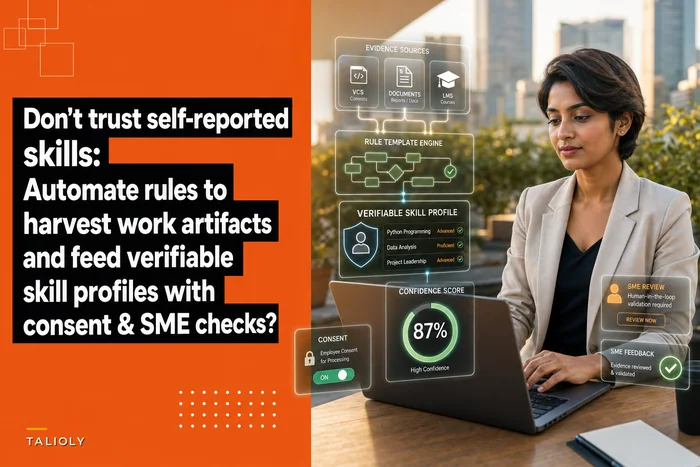
If you're still leaning heavily on self-reported inputs feeding into these models, it's worth revisiting how you're capturing evidence in the first place — the logic behind using work artifacts as evidence instead of self-reported skills is a prerequisite to any of this working.
What breaks at scale
At 200 employees, you can eyeball the output. Someone in HR knows most people and notices when a skill tag looks off. At 2,000 or 20,000 employees across regions and job families, that informal check is gone.
Stop losing track of critical skills.
Talioly helps you track, develop, and certify your workforce efficiently.
- Centralized skill profiles
- Automated training reminders
- Competency gap analysis
No credit card required
Silent label decay. A skill like "cloud infrastructure" meant something different three years ago. The model keeps using the old mapping. People get tagged with a skill that no longer reflects what the business needs.
Population shift. You acquire a company, expand into a new market, and suddenly the model is seeing data it was never calibrated on. Inference quality quietly collapses for that population while staying fine everywhere else — so your averages hide it completely.
Feedback loops. The model recommends people for projects. Those projects generate new artifacts. Those artifacts feed the model. If the model had a bias, it just trained itself to be more biased. This one is nasty because it looks like the model is "learning."
Confidence inflation. Models retrained on their own outputs tend to get more confident without getting more accurate. You start seeing 0.9 confidence scores on inferences that are plain wrong.
A typical example: a company with roughly 6,000 employees turns on skill inference, gets decent results in year one, and never re-checks it. Eighteen months later an internal audit finds that about one in six inferred skills in a newly acquired business unit are mismatched — but because overall accuracy still reads around 82%, nobody flagged it. The failure was concentrated, not spread out, and the aggregate number hid it completely.
The required artifacts — what every inferred skill model must ship with
You can't govern a model you can't inspect. Before any inferred skill influences a decision, the model behind it needs a basic set of documentation. None of this requires an ML PhD to read — it requires discipline.
| Artifact | What it answers | Who owns it |
|---|---|---|
| Model card | What does this model infer, from what inputs, with what known limits? | Vendor / data team |
| Training data summary | What population was it built on? What's missing? | Vendor / data team |
| Confidence score definition | What does 0.7 actually mean here? | Vendor |
| Baseline accuracy by segment | How well does it work per job family / region? | HR analytics |
| Known failure modes | Where does it reliably get things wrong? | Vendor + HR |
| Revalidation history | When was it last checked against SME truth? | HR ops |
| Decision-boundary doc | At what confidence does an inference get used vs. flagged? | HR governance |
The one most teams skip is baseline accuracy by segment. Aggregate accuracy is close to useless for governance because it averages away exactly the concentrated failures that hurt you. Insist on per-segment numbers or you're flying blind.
Drift-detection queries HR can actually run
You don't need a monitoring platform to catch most drift. You need a handful of queries run on a schedule, with thresholds that trigger a human to look.
A practical starter set, in plain terms:
-
Confidence distribution over time. Pull the distribution of confidence scores monthly. If average confidence creeps up while nothing else changed, suspect inflation — the model is getting cocky, not better.
-
Inference volume by skill. Count how many people get each inferred skill. A skill that suddenly doubles in population without a corresponding business change is a red flag.
-
Segment accuracy delta. For each job family and region, compare current spot-check accuracy against the baseline. Flag anything that drops more than 8–10 points.
-
New-population coverage. After any acquisition or org change, run a check specifically on the affected population. Don't wait for the monthly cadence.
-
Override rate. Track how often managers or SMEs override an inferred skill. A rising override rate is the earliest and most honest drift signal you have — the people closest to the work are telling you the model is wrong.
Pro-tip: prioritize the override-rate signal when you can only run a few checks — it's often the earliest and most actionable drift indicator.
That last one deserves emphasis. The override rate is your canary. Models degrade quietly in the data, but managers complain loudly in real life. Instrument those complaints before you instrument anything fancy.
Human-in-the-loop checkpoints that don't create bottlenecks
The instinct after reading all this is to make humans approve everything. That kills the value of inference and buries your SMEs. The point is putting humans only where the stakes and uncertainty are both high.
A simple decision frame:
-
High confidence + low-stakes use (suggesting a learning resource) → let it flow, no human review
-
High confidence + high-stakes use (promotion gate, pay trigger) → lightweight confirmation required
-
Low confidence + any use → flag for review before use
-
Low confidence + high-stakes → never auto-use; route to SME
The mistake teams make is reviewing by volume instead of by risk. They end up having SMEs rubber-stamp hundreds of obvious, high-confidence inferences while the genuinely ambiguous ones slip through because everyone's exhausted. Reverse it. Protect SME attention for the cases that actually need judgment.
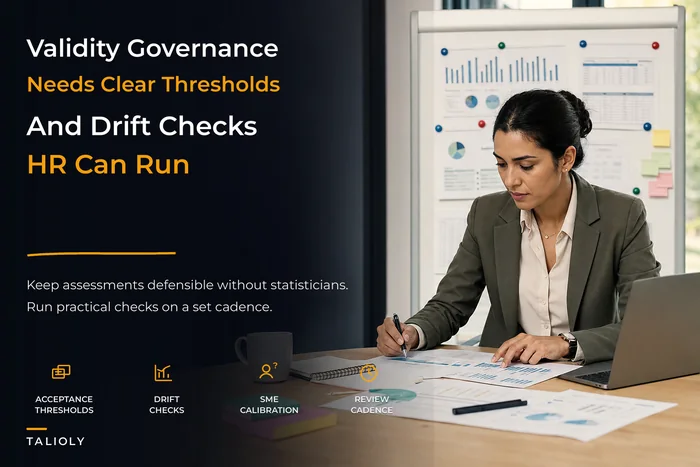
If SME capacity is your constraint — and it usually is — the validity side of this needs its own structure. The thinking behind running assessment validity governance without data scientists applies directly to deciding which inferences are trustworthy enough to act on.
SME revalidation rituals
Checkpoints catch problems in the moment. Revalidation rituals catch slow drift that no single query flags. This is the scheduled part of the charter — the discipline of checking the model against ground truth on a cadence.
Quarterly, per critical skill family: pull a small random sample — 25 to 40 inferred skills — and have an SME judge each one against real evidence. Not the whole population. A sample. Record the hit rate.
Track the trend, not the snapshot. One quarter at 85% means little. Three quarters drifting 85 → 81 → 76 means your model is dying, and you now have the paper trail to prove it.
Rotate reviewers. If the same SME always validates the same skill, you build in their blind spots. Rotating catches systematic SME bias too.
Keep the evidence. Every revalidation round produces a small dataset of "model said X, truth was Y." Over a year that becomes your most valuable asset — it's how you measure whether a retrain actually helped, and it's your defense if a decision ever gets challenged.
The pattern that keeps repeating: teams run one enthusiastic revalidation at launch, prove the model works, and then never do it again. The ritual only matters if it's boring and repeated. A one-time validation tells you the model was good. It says nothing about today.
Monitoring queries and escalation flows
Detection without escalation is just a dashboard nobody reads. Every flagged signal needs a clear path to a human with authority to act.
A clean escalation flow has three tiers:
-
Tier 1 — Watch. Minor drift (small confidence shift, modest override uptick). Logged, reviewed at the monthly governance meeting. No action required yet.
-
Tier 2 — Investigate. Segment accuracy drop past threshold, or override rate climbing fast. Triggers a targeted SME spot-check within a defined window. The affected inferences get a "verify before use" flag.
-
Tier 3 — Halt. Confirmed material drift in a high-stakes use. The model's output is suspended for that use case — promotions and pay decisions stop relying on it — until revalidated. This needs a pre-named decision owner so it doesn't stall waiting for consensus.
The single most important design choice here is naming the Tier 3 owner in advance. When a model is actively making bad promotion recommendations, you do not want a three-week debate about who has the authority to pull the plug. Decide now, in calm conditions, who can say stop.
A short workflow in plain language
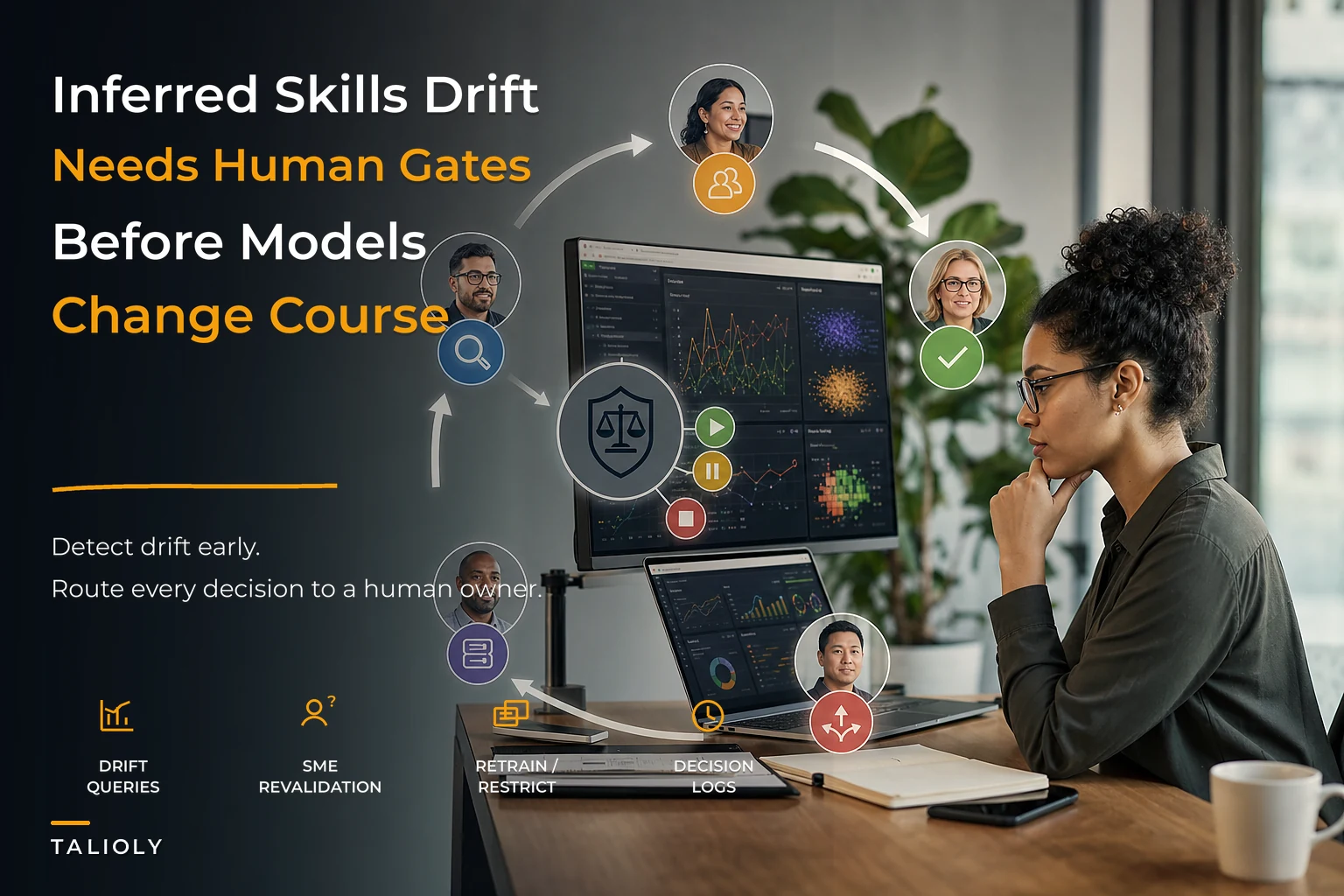
Picture the monthly cadence end to end. The analytics person runs the five drift queries and drops results into a simple scorecard. Anything green stays green. Anything amber routes to the relevant SME for a spot-check with a one-week SLA. The SME either clears it or confirms the problem. Confirmed problems go to the governance owner, who decides between retrain, restrict, or halt. Decisions get logged with a date and a reason. Next month, you check whether last month's actions actually moved the numbers. That loop — run, route, decide, log, verify — is the charter working as a system.
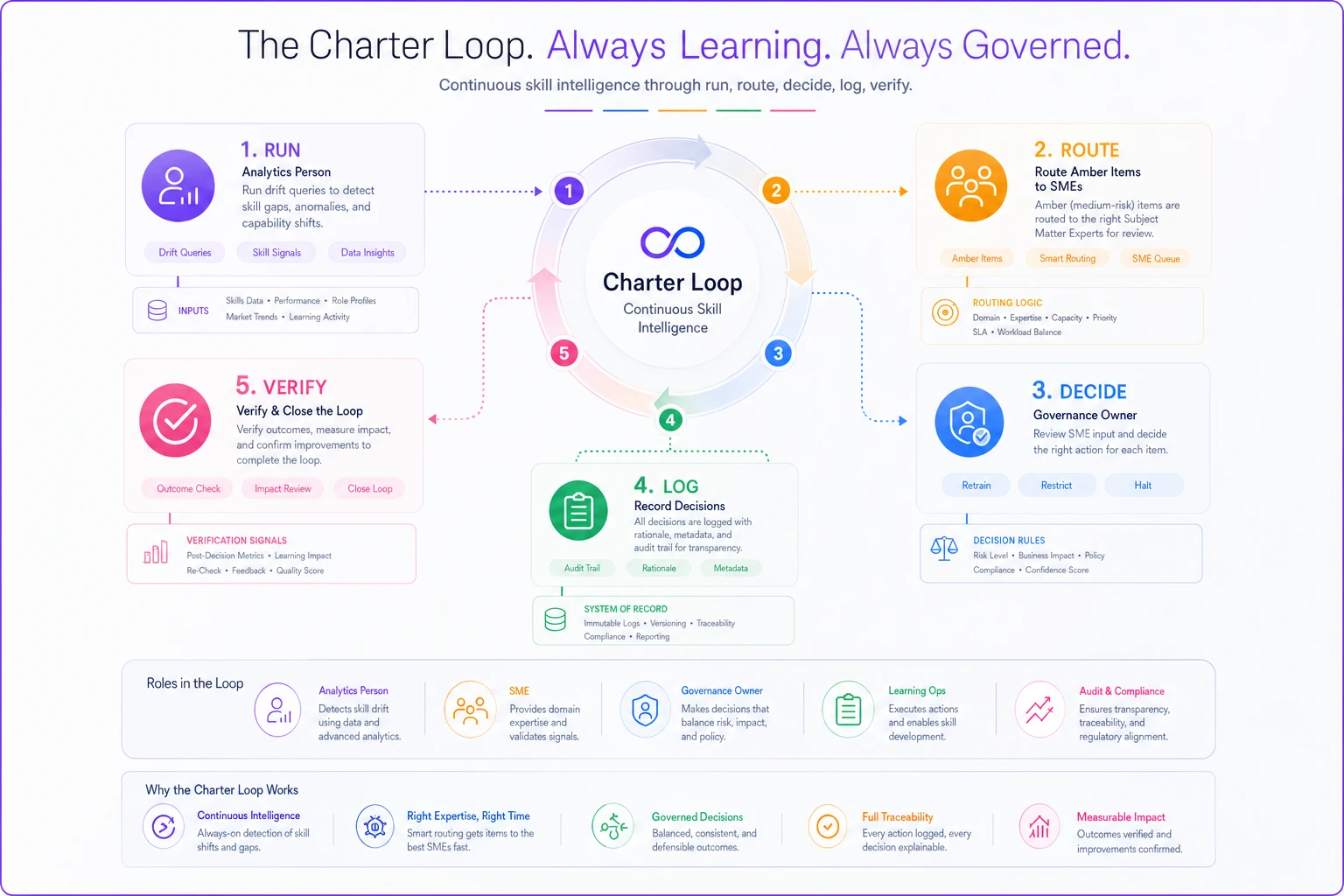
A simple visual of the run→route→decide→log→verify loop helps people remember who does what and when to act.
A real scenario
A mid-sized financial services firm, around 4,500 employees, had been using inferred skills to power internal mobility for about two years. Matching looked fine on the surface. Then managers in one division started quietly ignoring the system's recommendations and filling roles through their own networks.
When HR dug in, they found the override rate for that division had climbed from roughly 15% to over 40% across a year — but nobody had been tracking overrides, so it had gone unnoticed. A targeted spot-check of about 30 inferred skills in that population showed the model was mislabeling a cluster of technical roles that had shifted toolsets after a platform migration the model never learned about.
They didn't rebuild anything fancy. They stood up the five drift queries, set a quarterly SME revalidation on their twelve most decision-critical skill families, and named a governance owner with halt authority. Within two quarters the override rate for that division settled back under 20%, and more importantly, trust came back — managers started using the recommendations again because they could see the system was being watched. The fix wasn't a better model. It was governance the model never had.
When this makes sense — and when it doesn't
When a full charter is worth it: inferred skills feed high-stakes decisions (promotion, pay, succession), you operate across multiple job families or regions, or you've grown past the point where any one person can eyeball the data. At that scale, ungoverned inference is a liability.
When it's overkill: if inferred skills only power low-stakes suggestions and you're under a few hundred people, a quarterly manual review might genuinely be enough. Don't build a three-tier escalation flow to govern course recommendations.
Who should not do this yet: teams that haven't sorted out their underlying evidence quality. Governing a model built on garbage inputs just gives you well-documented garbage. Get the evidence pipeline honest first, then govern the inference layer on top of it.
Where tooling fits — lightly
Most of this charter runs on queries, a scorecard, and a calendar. You do not need an ML platform to start. That said, as the number of models and skill families grows, hand-running checks across dozens of segments gets unsustainable, and the logging alone becomes a job. A skills platform that tracks confidence scores, override rates, and revalidation history in one place earns its keep — not because it replaces judgment, but because it keeps the signals visible so people can act on time instead of after the complaints start.
The goal isn't automation for its own sake. It's making sure drift never again hides behind a reassuring aggregate number.
Closing thought
Skills model governance isn't about predicting every way a model might fail. It's about building a loop that notices when one does — before a bad inference quietly becomes a bad promotion decision. The organizations that handle inferred skills well aren't the ones with the best models. They're the ones who assumed from day one that their models would drift, and built the rituals, checkpoints, and escalation paths to catch it. Start small: five queries, one quarterly ritual, one named owner with halt authority. That's a functioning charter, and it's miles ahead of trusting a confidence score nobody's checked in a year.
Ready to elevate your team's skills?
Join 500+ companies using Talioly to boost skill visibility, streamline training, and drive performance growth.