

Most integration plans treat skills data as an afterthought. The deal team obsesses over payroll consolidation, benefits harmonization, and HRIS cutover dates. Then somewhere around day 60 a hiring manager on the acquired side tries to fill a role using their old competency framework, the acquiring company's ATS rejects it, and suddenly nobody can agree on what "Senior Data Engineer" actually means across the combined org.
That's the moment the real work starts. And by then you're already behind.
Skills taxonomy migration during M&A isn't a data-cleanup task you slot in after the legal close. It's a conflict-resolution exercise between two organizations that spent years building different definitions of competence, different proficiency scales, different rules for what counts as "proven." Both sides think their version is the correct one. Neither is entirely right. This piece walks through a staged approach — discovery, canonical mapping, parallel reconciliation, ownership, and cutover — built around the timelines M&A actually runs on, not the ones the integration slide deck promises.
Why skills integration breaks differently than other HR system merges
Payroll has a right answer. Everyone agrees what an hourly wage is. Benefits enrollment has rules that regulators enforce. But skills frameworks are opinionated by design — they encode how each company thinks about capability, leveling, and career progression. When you merge two of them, you're not reconciling data. You're reconciling two philosophies of what talent looks like.
A typical example looks like this. Company A uses a 5-point proficiency scale where a "3" means "can work independently." Company B uses a 4-point scale where a "3" means "can teach others." Map those naively and you either inflate half the acquired workforce or quietly demote them. Nobody notices for weeks — until a promotion cycle runs against the merged data and a bunch of people who were clearly senior on their old scale get flagged as mid-level.
The second thing that breaks is evidence provenance. One side may have years of verified skill records tied to project artifacts and manager sign-off. The other might have mostly self-assessments from an annual review checkbox. Merge those into one profile store without tracking where each rating came from, and you've laundered weak data into your promotion and staffing decisions. Six months later you can't tell which skill records you can trust.
And the third — the one that causes the most political damage — is naming collisions. Two frameworks will have skills with identical names that mean different things, and different names that mean the same thing. "Client Management" in a consulting acquisition is not "Account Management" in the SaaS parent, even though a lazy mapping treats them as one. Get this wrong at scale and you break internal mobility, because the matching engine now thinks people have skills they don't.
If your existing taxonomy is already straining, the merge will expose every weak seam. A lot of the failure modes here are the same ones that surface when enterprise skills taxonomies break as organizations scale — M&A just compresses years of organic drift into a single quarter.
Stage one: discovery before you touch a single mapping
The mistake most teams make is jumping straight to the mapping spreadsheet. You can't map what you haven't inventoried. Discovery is boring, and it's where the whole project succeeds or fails.
Stop losing track of critical skills.
Talioly helps you track, develop, and certify your workforce efficiently.
- Centralized skill profiles
- Automated training reminders
- Competency gap analysis
No credit card required
What discovery actually needs to surface:
-
Framework shape — how many skills, how many categories, what proficiency scale, and whether skills are flat or hierarchical on each side
-
Evidence model — how each side captures proof (manager attestation, assessment scores, work artifacts, certifications, pure self-report) and what percentage of records fall into each bucket
-
Freshness — how much of each dataset is stale, and what the revalidation cadence has been
-
Downstream dependencies — every system that reads skills data
the ATS, the internal marketplace, learning assignments, succession planning, comp bands
-
Ownership reality — who actually maintains the taxonomy on each side, not who's listed as the owner on the org chart
That last one catches people. On the acquired side, the "skills taxonomy owner" is frequently someone who left, or a committee that stopped meeting two years ago. If nobody currently owns the source framework, you're not migrating a living system — you're doing archaeology. Plan accordingly.
A useful discovery output is a simple side-by-side profile:
| Dimension | Acquiring Co (parent) | Acquired Co | Conflict severity |
|---|---|---|---|
| Proficiency scale | 5-point, independence-based | 4-point, teaching-based | High |
| Evidence mix | ~70% verified, 30% self-report | ~25% verified, 75% self-report | High |
| Taxonomy depth | 3-level hierarchy, ~600 skills | Flat list, ~280 skills | Medium |
| Refresh cadence | 12-month revalidation | None enforced | Medium |
| Downstream readers | ATS, marketplace, succession | ATS only | Low |
The severity column drives sequencing. High-conflict dimensions need reconciliation decisions from leadership, not from whoever's holding the spreadsheet. Don't let a data analyst quietly decide that a "3" equals a "3" — that's a policy call with promotion and pay consequences.
Stage two: canonical mapping — pick a spine, not a winner
The framing that keeps this from turning into a political knife fight: you're not choosing whose taxonomy wins. You're building a canonical target that both sides map into. Sometimes the parent's framework is the canonical spine. Sometimes it's a cleaned-up hybrid. But the language matters — "we're mapping both into a shared model" lands very differently than "you're adopting our system."
The canonical model is the neutral ground. Every skill from both frameworks maps to a canonical entry, with the mapping relationship recorded explicitly: exact match, subset, superset, partial overlap, or no equivalent. That last category — "no equivalent" — is the one people skip, and it's where the value hides. The acquired company often has specialized skills the parent never named because they never did that kind of work. Those aren't noise to discard. They're capability you just bought.
A few mapping heuristics that hold up under M&A pressure:
-
Map at the skill level, translate at the proficiency level. Keep these two operations separate. First establish that Skill X maps to Canonical Skill Y. Only then apply the scale-conversion rule. Merging both steps at once is how you get silent demotions.
-
Default proficiency translation to conservative. When a 4-point "3" could map to either a 3 or a 4 on the 5-point scale, round down and flag for revalidation rather than up. Inflating skill levels during a merge creates staffing decisions you can't defend later.
-
Preserve source lineage on every record. Never overwrite the origin. You want to be able to answer "where did this rating come from and on which original scale" for at least a full performance cycle after cutover.
-
Treat name collisions as guilty until proven innocent. Same name across frameworks gets a manual review, not an auto-merge. Tedious and non-negotiable.
-
Batch the long tail. The top 100–150 skills usually cover the vast majority of the workforce. Map those with care and human review. The rare, low-population skills can go through a faster pass with a lower confidence threshold — the blast radius is small.
Default to conservative proficiency translations and flag ambiguous mappings for revalidation.
The canonical model itself should follow patterns that survive future growth. The same design thinking behind solid canonical profile models and integration tradeoffs applies here, because the merged taxonomy has to keep working long after the integration team disbands.
Stage three: parallel reconciliation — run both systems on purpose
The instinct is to flip everyone to the new canonical model on a single date. Resist it. For anything above a couple hundred people, a hard cutover on skills data means you're betting the entire combined workforce's mobility, staffing, and promotion decisions on a mapping nobody has stress-tested against real decisions.
Parallel reconciliation means the acquired org's original framework stays readable — in shadow mode — while the canonical model becomes the system of record. For a defined window, key decisions get checked against both. If someone shows up as mid-level on the canonical model but senior on their original framework, that discrepancy surfaces as an exception, not a silent error someone discovers during their promotion denial.
In practice, this usually runs four to eight weeks. You're watching for one signal: the exception rate. Early on, a chunk of records throw discrepancies between the old and new view. As you fix mapping rules, that rate should fall. When it plateaus at a low, stable number, the remaining exceptions are genuine edge cases rather than systemic mapping errors — and that's your evidence the canonical model is ready to stand alone.
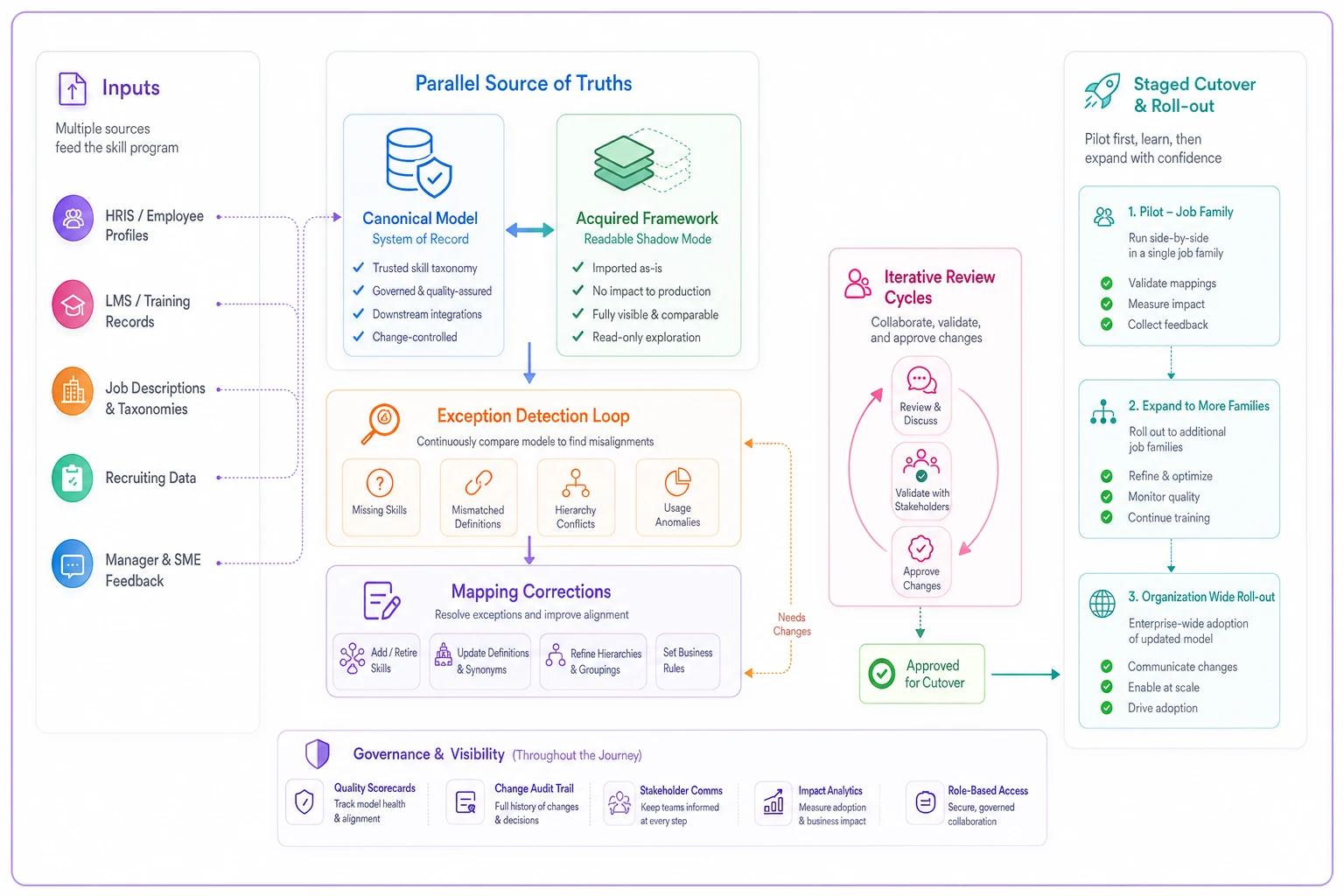
This sketch shows the iterative loop you'll run while watching the exception rate trend down as mappings are corrected.
The exception rate rarely goes to zero, and chasing zero is a trap. There will always be a handful of genuinely ambiguous roles — a hybrid position, a specialist skill with no parent equivalent. The goal isn't a perfect map. It's a map where the remaining ambiguity is small, known, and manually owned.
Stage four: RACI for ownership — because "everyone" owns nothing
Every M&A skills project I've watched stall dies at the same point: nobody owns the merged taxonomy after the integration PMO stands down. The deal team disbands, the consultants roll off, and the canonical model starts rotting within a quarter because there's no standing owner to approve new skills, resolve disputes, or enforce revalidation.
A workable RACI for the migration and the ongoing state:
| Activity | Responsible | Accountable | Consulted | Informed |
|---|---|---|---|---|
| Discovery inventory | Integration analyst | Skills program lead | Both taxonomy owners | HRBPs |
| Canonical model design | Skills architect | Skills program lead | Business unit leads | Hiring managers |
| Proficiency translation rules | Skills architect | HR leadership | Comp, Talent | Managers |
| Exception resolution | HRBP + manager | Skills program lead | Employee | — |
| Post-merge governance | Standing taxonomy owner | HR leadership | BU leads | Whole org |
The single most important row is the last one. Before cutover, name the standing owner — the person or small council who owns the merged taxonomy in steady state. If that role isn't filled and funded before the integration team leaves, the whole migration decays back into two informal frameworks living in people's heads.
The person who's Accountable and the person who's Responsible should almost never be the same. When they collapse into one name, decisions stop getting escalated and the "owner" quietly starts making policy calls — like proficiency mappings that affect comp — without the authority to make them.
Stage five: cutover and rollback — plan the retreat first
Nobody wants to talk about rollback during an integration. It feels like planning to fail. But a skills cutover that can't be reversed is a cutover you should be worried about, because the failure mode isn't a crashed server — it's hundreds of people getting mismatched to roles, denied promotions, or made invisible to the internal marketplace, quietly, over weeks.
A cutover template that holds up:
-
Freeze window. A short period where skills-dependent decisions (promotions, marketplace matches, staffing) pause. Keep this genuinely short — a long freeze is where hiring managers revolt and start working around the system.
-
Snapshot both states. Full export of the acquired framework and the pre-cutover canonical state. This is your rollback anchor.
-
Staged flip, not big bang. Cut over one business unit or job family first. Watch it for a defined period. Expand only when the exception rate stays flat.
-
Defined rollback triggers. Decide before cutover what conditions force a rollback — for example, exception rate above a threshold, or a specific number of escalated promotion disputes. Vague triggers mean you'll rationalize staying the course while damage accumulates.
-
Communication runbook. Managers need to know what changed, what to do when a report's skills look wrong, and who to escalate to. A cutover with no comms plan generates a flood of confused tickets that looks like a system failure even when the mapping is fine.
The staged flip is where most of the risk drains out. Piloting the taxonomy cutover on a single job family — say, one engineering discipline of 40–60 people — lets you catch mapping errors when they affect dozens, not thousands. A partial rollback of one unit is an inconvenience. A full rollback across a merged org of several thousand is a resume-generating event.
Where AI-assisted tooling actually earns its place
Most of this work is judgment, and no tool replaces the human calls on proficiency translation or name collisions. But two parts of the process are genuinely painful at scale and benefit from automation.
The first is the initial mapping pass. When you're staring at 600 skills on one side and 280 on the other, generating first-draft mappings — clustering likely matches, flagging probable collisions, scoring confidence on each proposed mapping — turns weeks of manual spreadsheet work into a review task. The tool proposes, humans decide. You still review every high-population and every low-confidence mapping by hand; automation just gets you to the review faster and stops you from missing obvious overlaps in a list that long.
The second is exception monitoring during parallel reconciliation. Tracking discrepancies between the old and canonical views across thousands of profiles, surfacing the ones that cross decision thresholds, watching the exception rate trend over time — that's exactly the kind of continuous, boring-but-critical monitoring that operational skills platforms handle well and humans handle poorly. Managed on spreadsheets, it simply doesn't get done, and the silent errors accumulate.
The point isn't to automate the decisions. It's to automate the volume so your people spend their time on the calls that actually need judgment.
A real scenario: mid-size SaaS acquiring a services firm
A mid-market SaaS company (roughly 1,400 employees) acquired a professional services firm of about 350. Two completely different worlds — the SaaS side ran a mature 5-point, evidence-heavy framework; the services firm had a flat list of around 280 skills, mostly self-reported, no revalidation in years.
The first pass at integration was a straight name-match merge done in three days by a lone analyst under deadline pressure. It looked done. Then the next promotion cycle ran, and roughly a fifth of the services-side candidates got flagged as under-qualified against roles they'd been doing competently for years — because the proficiency scales had been combined without a translation rule, and self-reported ratings had been treated as equal to verified ones.
They stopped, rolled back the promotion decisions, and rebuilt on the staged approach. Discovery took about two weeks. Canonical mapping of the top ~130 skills with human review took another three. Parallel reconciliation ran for about six weeks, with the exception rate starting high and settling to a small, manually-owned set of edge cases. The staged cutover went job family by job family over roughly a month.
The outcome wasn't dramatic in headline terms, but it mattered: promotion decisions in the following cycle held up without mass re-adjudication, internal marketplace matches for the acquired staff started firing correctly, and — maybe most importantly — the services-side employees stopped feeling like the merge had quietly demoted them. That last part doesn't show up on a dashboard, but it's the difference between retaining the talent you paid for and watching it walk.
When this staged approach is overkill
Not every deal needs five stages. If you're acquiring a company of 30 people with a handful of roles and no formal framework, you're not migrating a taxonomy — you're onboarding individuals. Build their profiles from scratch in your canonical model and skip the reconciliation machinery. The overhead of parallel running would cost more than the risk it prevents.
The staged approach earns its complexity when you have real scale on both sides — meaningful headcount, mature frameworks, and live downstream systems reading skills data for consequential decisions. The rough threshold is whether a mapping error would silently affect enough people that you couldn't manually catch it. Below that line, careful manual work beats process. Above it, skipping the stages is how you end up rolling back a promotion cycle.
The thing to get right
The whole game is refusing to treat skills data as a mechanical merge. Two frameworks encode two theories of what capability means, and jamming them together fast — under deal pressure, with one analyst and a spreadsheet — produces confident, wrong data that corrupts staffing and promotions for months before anyone traces the cause back to the mapping.
Discovery first. A canonical spine both sides map into, not a winner. Parallel running until the exception rate proves the map. A named owner who survives the integration team. And a rollback plan you built before you needed it. Do those five things in order, at the pace the actual timeline allows, and the skills side of the merge stops being the thing that quietly breaks in month three.
Discovery first. A canonical spine both sides map into, not a winner. Parallel running until the exception rate proves the map. A named owner who survives the integration team. And a rollback plan you built before you needed it. Do those five things in order, at the pace the actual timeline allows, and the skills side of the merge stops being the thing that quietly breaks in month three.
Ready to elevate your team's skills?
Join 500+ companies using Talioly to boost skill visibility, streamline training, and drive performance growth.