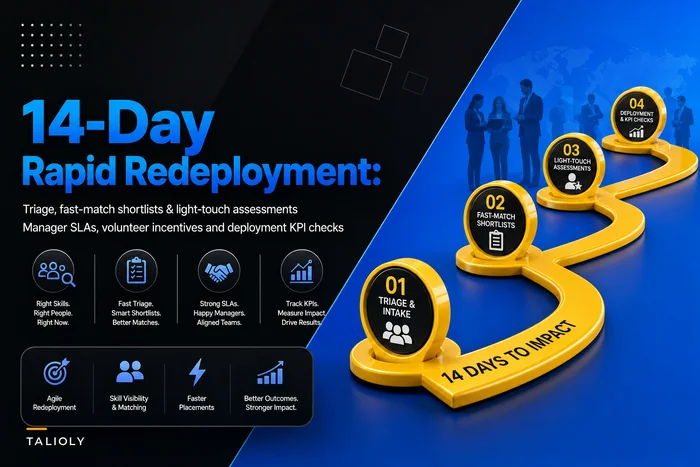



Most redeployment stalls don't happen because there's no talent. They stall because nobody can tell, fast enough, whether the person in Operations can actually do 70% of the job in Fulfillment Analytics. HR knows redeployment should be faster than external hiring. The problem is the decision itself — who moves where — takes two weeks of back-and-forth, and by then the hiring manager has already posted the external req.
A transferable skills matrix fixes the slow part. It turns "I think she could probably do that role" into a scored, evidence-backed shortlist you can defend in a 20-minute meeting. Below is how to build one that actually survives a 7–14 day redeployment window — including the gates that keep it honest and the templates that get managers to release people instead of hoarding them.
The real reason redeployment stalls (and it's not a people shortage)
The pattern shows up constantly: a team suddenly needs three people for a stood-up project. HR pulls a list of "possibly qualified" internal candidates built on job titles, maybe a LinkedIn-style skill tag or two. Hiring managers glance at it, don't trust it, and ask for interviews with all nine people "just to be safe." Nine interviews across three managers takes 8–10 business days to schedule. The window closes.
The matrix problem underneath is subtle. Everyone has skills data somewhere — performance notes, past project roles, completed training. But none of it is arranged by how close a person's current skill set is to the target role. Without a similarity view, every candidate looks equally plausible and equally risky, so managers default to interviewing everyone or trusting no one.
The other quiet killer: no minimum evidence bar. Someone lists "SQL" on a profile from a course they took in 2021. Nobody knows if that counts. The whole list gets treated as unreliable, and the fastest path — moving someone who's a genuine 80% match — gets buried under the noise of maybes.
What a transferable skills matrix actually is (structurally)
Strip away the jargon and it's a grid. Rows are your people (or role groups). Columns are the target role's required skills, weighted by how important each one is to day-one productivity. Each cell holds two things: a proficiency level and the evidence backing it. The output is a single similarity score per person against that specific target role.
Stop losing track of critical skills.
Talioly helps you track, develop, and certify your workforce efficiently.
- Centralized skill profiles
- Automated training reminders
- Competency gap analysis
No credit card required
The mistake people make is building one giant static matrix for the whole org and expecting it to answer every redeployment question. It won't. A useful matrix is generated per target role, on demand, because transferability is always relative. A customer success rep is a strong match for an onboarding specialist role and a weak match for a data analyst role — same person, different column set, different score.
A stripped-down example for a single open role, "Revenue Operations Analyst":
| Candidate | SQL/querying (w: 3) | Dashboarding (w: 2) | Process mapping (w: 2) | Stakeholder comms (w: 3) | Finance literacy (w: 2) | Similarity |
|---|---|---|---|---|---|---|
| Priya (Sales Ops) | 2 (verified) | 3 (verified) | 3 (verified) | 3 (verified) | 2 (self) | 84% |
| Marcus (Support Lead) | 1 (self) | 2 (verified) | 2 (verified) | 3 (verified) | 1 (none) | 58% |
| Dana (Jr. Analyst) | 3 (verified) | 2 (verified) | 1 (self) | 1 (self) | 3 (verified) | 71% |
Notice what the score surfaces: Priya is the obvious fast move, but her only gap is a self-reported finance score — a clean, specific thing to validate in one short check rather than a full interview loop. Dana looks strong on hard skills but weak on the softer columns that actually determine whether she survives the role. That nuance is exactly what title-based lists destroy.
Why similarity scoring beats keyword matching
A lot of internal mobility tools do keyword overlap — count how many skill tags match and call the highest number your top candidate. That produces confidently wrong shortlists. It ignores weighting (not all skills matter equally for ramp-up), ignores proficiency depth (a "2" and a "4" both count as a match), and ignores evidence quality (a self-rating and a verified rating weigh the same).
Weighted similarity fixes all three. The formula doesn't need to be complicated. For each required skill, take the candidate's proficiency, cap it at the target level needed, multiply by the skill's weight, and divide the sum by the maximum possible score. This matters operationally because it naturally rewards people who are strong where the role is demanding and quietly penalizes gaps in high-weight skills — which is how an experienced hiring manager thinks anyway. You're just making their instinct repeatable and reviewable.
One pattern worth stealing: weight day-one critical skills separately from learnable-in-30-days skills. A candidate missing a learnable skill shouldn't score the same as one missing a non-negotiable. Some teams run two scores — a "ready now" score and a "ready in 30 days with support" score. For a 7–14 day redeployment you mostly care about the first one.
Minimum evidence gates: the thing that keeps the matrix honest
A similarity score is only as trustworthy as the evidence underneath it. Without gates, people game the matrix — intentionally or not — by rating themselves high on everything, and your 84% match turns out to be a 50% match with good self-esteem.
-
Day-one-critical skills must have verified evidence (a work artifact, a completed assessment, a manager sign-off from the last 12 months). Self-reports don't count toward the score for these.
-
Secondary skills can use self-reports but get a confidence discount (e.g., self-rated proficiency counts at 60% of its value until verified).
-
Any skill older than ~18 months gets flagged as stale and either re-verified or discounted.
-
No candidate enters a shortlist without at least two verified skills in the target role's top-weighted column set.
The gate does something politically useful too: when a manager pushes back on a shortlist, you're not defending a vibe. You're pointing at the evidence record. That shifts the conversation from "I don't trust this list" to "do you dispute this specific artifact," which is a much shorter conversation.
If you're building the artifact side of this — capturing real work products instead of self-ratings — pair the matrix with the thinking in the shortlisting rules for matching verified skills to internal vacancies without relying on titles. The matrix is the scoring layer; the verification approach is what fills the cells with something defensible.
Micro-assessment shortcuts for the gaps
Even a strong candidate will have one or two unverified cells. The slow instinct is to run a full assessment or a panel interview to close them. For a two-week window, that's too heavy. The better move is a targeted micro-assessment aimed only at the specific gap the matrix exposed.
Priya's example above had exactly one soft spot: self-reported finance literacy. You don't need a finance exam. A 20-minute task that proves the floor is enough — "here's a P&L snippet and three revenue scenarios, tell us which drives the forecast and why." Pass/fail against a short rubric. Done in an afternoon.
The principle: assess the delta, not the person. The matrix already told you what's verified. You only spend assessment time on the one or two cells that are both unverified and high-weight. In practice this cuts the validation step from a multi-day interview loop to a handful of short, role-specific checks.
-
One micro-assessment per unverified high-weight skill — no bundling.
-
Cap each at 30 minutes of candidate time and 15 minutes of reviewer time.
-
Score against a 3–4 line rubric written before the assessment, not after.
-
Results feed straight back into the matrix cell as new verified evidence (so you never re-test the same gap for the next role).
That last point compounds. Every micro-assessment you run permanently upgrades someone's profile, so the matrix gets faster and more accurate the more you use it.
Manager-release incentives: the part everyone skips
You can build a perfect matrix and still stall, because the receiving manager is thrilled and the releasing manager is not. Letting a strong performer move out of your team to fill someone else's gap feels like pure loss. If there's no incentive to release, managers will slow-walk, claim the person is "mid-project," or counter-offer.
-
Backfill guarantee with a clock. The releasing manager gets a committed backfill (temp, contractor, or redeployment inbound) within a defined window. Vague promises don't work; a dated commitment does.
-
Release credit that counts. Track releases as a positive manager metric, visible to leadership, the same way receiving talent is tracked. If only receiving is rewarded, hoarding is rational.
-
Partial-release options. For a 2-week redeployment, a 60% time-split for the first week beats an all-or-nothing demand that triggers a hard no.
-
A short, written release agreement that spells out duration, return date (or conversion terms), and what the releasing team gets in exchange.
Managers almost never object to candidate quality once the matrix is credible. They object to the loss. Fix the loss, and the shortlist starts moving.
Shortlist templates that compress the decision
The final friction point is the handoff. A shortlist that's a messy spreadsheet creates another round of questions. A shortlist that's a tight, standardized one-pager per candidate gets a decision in one meeting. Each entry should carry:
-
Similarity score and the top 3 matched skills (with evidence type)
-
The 1–2 gaps and the micro-assessment result closing them
-
Availability and current manager's release status
-
Estimated ramp-up (ready now / ready in ~30 days with support)
-
A one-line risk note
Keep it to five candidates max. A 20-person list signals you haven't done the filtering; a 5-person scored list signals you have. The whole point of the matrix is to do the hard narrowing before the meeting, so the meeting is a yes/no, not a discovery session.
A real scenario: filling three roles in nine days
A mid-sized logistics company (around 600 employees) needed to stand up a small analytics pod — three roles — after winning a contract that required reporting their old processes couldn't support. Normal path: post externally, 6–8 week fill time, miss the contract SLA.
Instead, HR generated a transferable skills matrix against each of the three target roles, pulling from existing training records and past project artifacts. The first pass produced about 14 plausible people. Evidence gates knocked that to 6 with real verified matches. Two micro-assessments (one SQL task, one stakeholder-comms scenario) closed the open gaps over two afternoons.
The sticking point was a releasing manager in Operations who didn't want to lose his strongest process analyst. A backfill commitment within 10 business days plus a documented 3-month return option got him to yes. All three roles were filled internally in about nine days, versus the 6–8 weeks external would've taken. Rough cost avoided on agency fees and ramp time: somewhere in the $18k–$25k range — and they hit the contract start date, which was the part that actually mattered.
The quieter win: the six verified profiles and two new micro-assessment results stayed in the system, so the next redeployment started from a richer base.
When this makes sense — and when it doesn't
This makes sense when you have recurring short-fuse gaps, a reasonable amount of existing skills evidence to pull from, and leadership willing to back release incentives. It works especially well for cross-functional roles where adjacent skills transfer — ops to analytics, support to CS, QA to product.
This is a bad idea when your underlying skills data is garbage. A matrix built on empty or stale profiles just produces confident nonsense faster. Fix the evidence base first. It's also the wrong tool for roles requiring deep, non-transferable expertise — you're not matrix-matching your way into a senior actuary seat in two weeks.
Who should not run this yet: teams with no verification pipeline at all. If every cell would be self-reported, the gates can't function, and you've built a prettier version of the title-based list you were trying to escape. Start by capturing a few verified artifacts per person, then layer the matrix on top.
Where to start this week
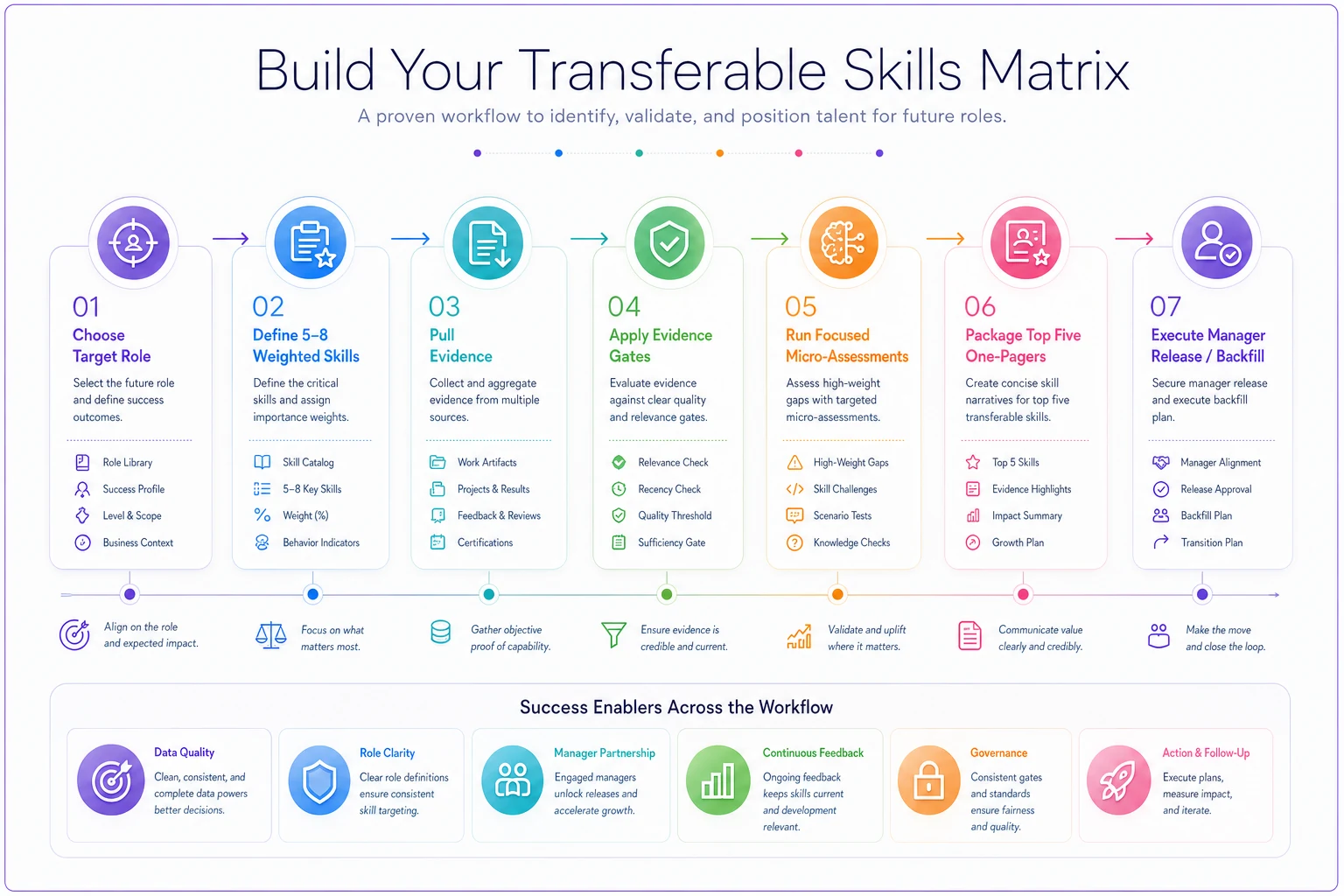
You don't need a platform to prove the concept. Pick one open role you're actually struggling to fill. Build the column set for that role only — 5–8 skills, weighted. Pull existing evidence for 10–15 candidates. Apply the evidence gates and let the weak matches fall away. Run micro-assessments only on the surviving candidates' high-weight gaps. Package the top five as one-pagers.
Here's a simple workflow to run the matrix fast.
If this becomes a regular motion rather than a one-off, that's the point where generating role-specific matrices, enforcing evidence gates automatically, and keeping micro-assessment results attached to profiles starts to pay for itself — doing by workflow what you'd otherwise rebuild by hand every time. For the operational sequencing around the tight window itself, the 14-day rapid redeployment playbook pairs well here — the matrix tells you who, the playbook tells you how to run the clock.
Stop asking "who might be able to do this?" and start asking "who scores 80%+ against the verified requirements, and what's the one thing I need to check before Friday?" That question has a fast answer. The old one never did.
Ready to elevate your team's skills?
Join 500+ companies using Talioly to boost skill visibility, streamline training, and drive performance growth.