



Most compensation problems don't show up in the pay model. They show up in the arguments around it — the manager who insists their engineer is "basically a senior," the finance partner who blocks a raise because the justification is vague, the employee who quietly finds out they're paid 12% below someone doing identical work. The pay bands aren't broken. The connection between what someone can actually do and what they get paid is broken.
A skills-based pay framework only works when it closes that gap with math finance can audit and HR can defend. Not competency language. Not vibes. Actual rules: this verified skill level maps to this band position, promotion clocks start on this trigger, and every adjustment leaves a trail someone in a compliance review can follow six months later.
This is the operational version — the one you can hand to a CFO without them poking three holes in it before lunch.
Where the wiring actually breaks
Comp usually looks fine on paper because the band structure is clean. Level 3 pays $85k–$110k. Level 4 pays $105k–$140k. Neat. The problem is that placement inside those bands is where the entire thing quietly rots.
In real operations, this usually happens in three places at once:
-
Manager discretion fills the gap the framework left open. If nobody defined what moves someone from band midpoint to upper-third, the manager's confidence level becomes the deciding variable. Confident managers over-pay their people. Quiet managers under-pay theirs. Neither is tied to skill.
-
Promotions get decided before the skills are verified. Someone gets the title, then HR reverse-engineers the justification. Finance sees the pattern eventually and stops trusting the whole process.
-
Nobody owns the drift. Over 18–24 months, a team of 40 accumulates dozens of small placement decisions that were reasonable individually and indefensible collectively. That's the pay equity time bomb — not malice, just accumulated slack.
The framework doesn't fail at design time. It fails at decision time, because there's no rule connecting a verified skill level to a specific number. The band exists. The verification exists (sometimes). The math between them is missing.
The core mechanic: skill level to band position
The whole framework hinges on one relationship. A verified skill level should map to a defined zone inside the band, not a single point, and not the whole band.
Stop losing track of critical skills.
Talioly helps you track, develop, and certify your workforce efficiently.
- Centralized skill profiles
- Automated training reminders
- Competency gap analysis
No credit card required
Here's the structure that holds up under scrutiny:
| Verified skill level | Band position | What it means operationally |
|---|---|---|
| Emerging (can do with support) | Band min → 25th percentile | Still ramping, closing verified gaps |
| Proficient (independent) | 25th → 60th percentile | Fully carries the role's core scope |
| Advanced (raises the bar for others) | 60th → 85th percentile | Verified impact beyond own tasks |
| Expert (org-level reference) | 85th → max | Rare; requires evidence, not tenure |
The critical insight most frameworks miss: the band position is a zone, not a destination. A "Proficient" engineer isn't automatically at the 60th percentile — they earn movement within the Proficient zone based on verified skill breadth, not time served. This kills the most common comp complaint, which is "I've been here three years, where's my raise?" Tenure doesn't move you. Verified capability does.
And the skills have to be verified, not self-reported, or the entire pay-band math inherits garbage inputs. If your evidence pipeline is soft — self-assessments, manager gut checks, stale training records — you're building precise math on top of noise. The verification layer is load-bearing here, not a nice-to-have.
Worked example: placing a real role
Put actual numbers on it, because that's where these frameworks earn or lose their credibility.
Say you've got a Level 4 Operations Analyst band running $96k–$134k, a $38k spread. Four skill dimensions matter for this role: data modeling, process design, stakeholder management, and systems fluency. Each gets verified on a 1–4 scale against evidence.
Analyst A verifies at: data modeling 3, process design 3, stakeholder 2, systems 3. Average lands at Proficient-high. Their band zone is the 25th–60th percentile, so $105.5k–$118.8k. Because three of four dimensions are Advanced-adjacent, they place at the top of Proficient — call it ~$117k.
Analyst B, same title, hired the same quarter, verifies at: data modeling 2, process design 2, stakeholder 3, systems 2. That's solidly Proficient-low. Their zone caps lower, landing them around $108k.
That ~$9k gap between two people with identical titles is now defensible. It's tied to verified skill differences on named dimensions. When Analyst B asks why A earns more, the answer isn't "A has been here longer" — it's "here are the two skill dimensions where verified evidence differs, and here's the closing plan." That conversation is survivable. The vague version isn't.
Promotion clocks: the timing rules nobody writes down
Promotions blow up budgets when there's no rhythm to them. Someone gets promoted in March, another in June, and by Q4 finance has no idea what the run-rate impact will be. Promotion clocks fix this by making advancement predictable in timing even while it stays earned in substance.
A promotion clock has three parts:
-
The trigger. Advancement eligibility opens only when verified skills cross the next band's entry threshold — not on a review date. The skill evidence starts the clock, not the calendar.
-
The dwell period. Once triggered, a minimum window (usually 60–90 days) confirms the skill level is sustained, not a one-time spike from a single project. This is what stops the "hero project → instant promotion → regression" pattern that quietly damages team trust.
-
The decision window. Promotions get decided on a fixed cadence (say, quarterly) even though eligibility can trigger any time. Finance gets predictable batches. Employees get a known date. Nobody's raise depends on when they happened to catch their manager in a good mood.
The pattern worth stealing: separate when someone becomes eligible from when the promotion executes. Eligibility is continuous and evidence-driven. Execution is batched and budget-aware. Most orgs collapse these two into one messy event, which is exactly why promotions feel arbitrary and unbudgetable at the same time.
If you're tying advancement to specific evidence thresholds, the mechanics of using internal badges as promotion gates pair directly with this — the badge becomes the trigger, the pay-band zone becomes the number.
Anomaly detection: finding the drift before it becomes a lawsuit
This is the part finance actually cares about and HR usually skips. A skills-based pay framework generates checkable data. If verified skill levels map to band zones, then anyone sitting outside their expected zone is an anomaly worth a look.
You don't need a data science team for this. You need a handful of queries you run monthly against your comp table joined to verified skill profiles:
-
Over-band placement People paid above their verified skill zone. Not always wrong — could be a market premium or a red-circled legacy rate — but each one needs a documented reason. No reason on file? Flag it.
-
Under-band placement People paid below their verified zone. These are your quiet flight risks and your equity exposure. In practice this list is where the promotable-but-overlooked people hide.
-
Same-skill pay divergence Two people with matching verified profiles and matching band, paid more than ~8% apart. This is the query that catches pay equity problems while they're still fixable.
-
Stalled clocks Anyone eligible for promotion (trigger fired) but sitting past two decision windows with no action. That's a manager sitting on a promotion, and it's a retention leak.
Anomaly detection isn't a witch hunt — it's a maintenance routine. Comp drift is like tire wear. It happens gradually, it's invisible day to day, and it fails you at the worst possible moment. Running these queries monthly turns a catastrophic annual "pay equity audit" into a boring routine cleanup. Twelve small corrections a year beat one panicked reconciliation.
Run the anomaly queries monthly — small corrections beat a panicked annual reconciliation.
Manually joining comp data to verified skill profiles every month across a few hundred employees is exactly the kind of repetitive reconciliation that gets skipped when people are busy — which is always. AI-powered operational software that continuously matches verified skill levels against band placement and surfaces outliers means the anomalies find you instead of hiding until the annual review. The check actually happens on schedule instead of getting quietly deferred to "next quarter" forever.
Audit-ready adjustment templates
Every pay change needs to leave a record that survives a skeptical reviewer. The template is boring on purpose — boring is what "audit-ready" means.
A defensible pay-adjustment record captures:
-
Employee, current band, current band position
-
Trigger for the adjustment (verified skill change / promotion clock / anomaly correction / market)
-
The specific verified evidence — which skill dimensions moved, and the artifacts behind them
-
Old rate → new rate, and the band-position math justifying it
-
Approver, date, and the decision window it fell into
The mistake people make is documenting the decision but not the evidence chain. "Promoted to Level 5, +$14k" tells an auditor nothing. "Level 5 trigger fired on verified advancement in process design and systems fluency (artifacts attached), 90-day dwell confirmed, executed in Q2 window, placed at Level 5 25th percentile" tells them everything. The second version is what lets finance sign off without a meeting.
A real scenario
A mid-sized professional services firm — roughly 220 employees — had classic band drift. Same-title pay gaps up to 19% inside a single analyst level, and finance had frozen mid-cycle raises because they couldn't predict the run-rate.
They didn't rebuild their bands. They kept the existing structure and bolted on the skill-to-zone mapping, then ran the four anomaly queries against verified profiles for one job family as a pilot — about 30 people. The first pass surfaced 7 under-band placements (four of whom were flagged as flight risks by their managers within weeks), 3 over-band placements with no documented reason, and 2 stalled promotion clocks.
Correcting the pilot group cost roughly $40k–$50k in adjustments — real money, but a fraction of what it would cost to lose even two of those under-paid analysts and backfill them. More importantly, finance got a repeatable, budgetable process. When they extended it firm-wide over the next two quarters, promotion timing shifted to quarterly batches and the run-rate became something they could forecast instead of fear. Pay gaps within job families compressed to under 8% without a single across-the-board raise.
When this makes sense — and when it doesn't
This works well when you have a real verification layer feeding trustworthy skill levels, bands that already exist and roughly hold, and a finance partner willing to trade "flexible discretion" for "predictable, defensible math." It shines in organizations past roughly 100 people where drift has started but hasn't calcified.
This is a bad idea when your skill data is mostly self-reported or stale. Precise pay-band math on unreliable inputs just launders bad data into confident-looking numbers, which is worse than admitting you're guessing. Fix the evidence pipeline first.
Who should probably not start here: very small teams where everyone's comp is negotiated individually and there's no band structure to anchor to. Also organizations mid-reorg, where the roles themselves are unstable — map skills to zones once the org design settles, not during the churn.
Making the CFO relationship work
The reason these frameworks stall isn't HR resistance — it's that finance never trusts the inputs. Every anomaly query, every adjustment template, every promotion clock exists partly to give finance a reason to say yes. When comp decisions come with an evidence chain and predictable timing, finance stops being the department that blocks raises and starts being a partner in a system they can actually model.
If you're building the business case to get finance bought in before you touch a single band, the companion piece on a CFO-ready skills ROI model covers how to frame the investment side of this so the numbers survive an executive review.
The system, not the spreadsheet
A skills-based pay framework isn't a comp table with better labels. It's a connected loop: verified skills feed band placement, band placement feeds promotion clocks, promotion clocks feed budget forecasts, and anomaly queries feed back into corrections that keep the whole thing honest over time. Break any one link and the others degrade quietly — usually invisibly, until an equity audit or a resignation letter makes it visible all at once.
[GRAPH: Skills-Based Pay Loop — Verified Skills → Band Placement → Promotion Clock → Budget Forecast → Anomaly Detection → Corrections → back to Verified Skills]
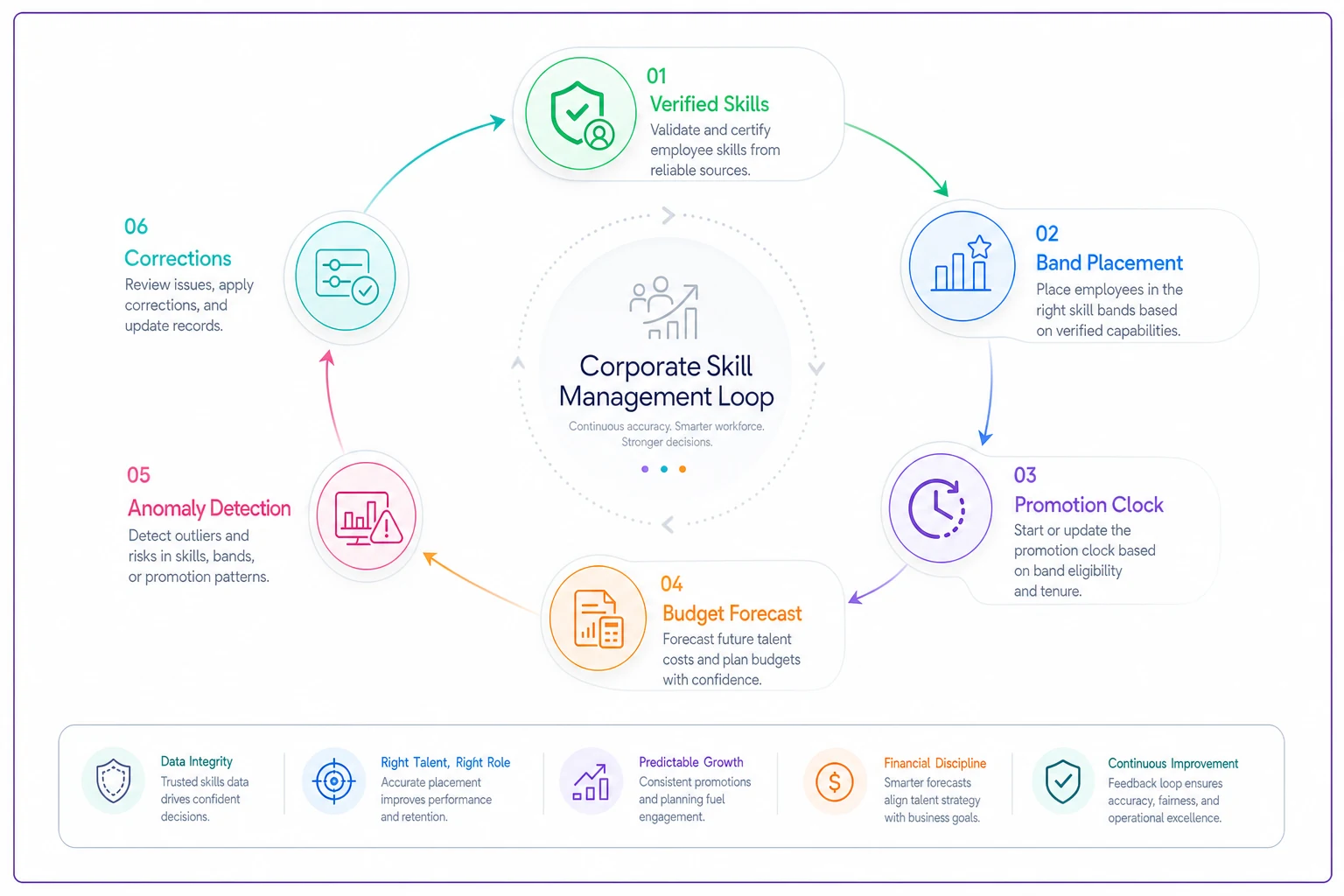
The organizations that get this right don't have smarter compensation philosophies. They have tighter wiring between what people can verifiably do and what they're paid, plus a maintenance routine that catches drift while it's still cheap to fix.
Start with one job family, get the four queries running, and let the anomalies show you where your real gaps are. The math is the easy part. Making it check itself every month is what actually protects you.
Ready to elevate your team's skills?
Join 500+ companies using Talioly to boost skill visibility, streamline training, and drive performance growth.