

Most manager nudges fail quietly. Someone in HR writes a reminder email—"Please complete your quarterly development check-ins"—schedules it to fire every Monday, and then nothing changes. Completion rates barely move. Nobody runs the numbers because there's no experiment to run numbers against. The nudge just becomes wallpaper.
The problem isn't that nudges don't work. It's that most HR teams ship one version to everyone, all at once, with no control group and no way to tell whether the copy, the timing, or the incentive did anything at all. You can't improve what you never measured against a baseline.
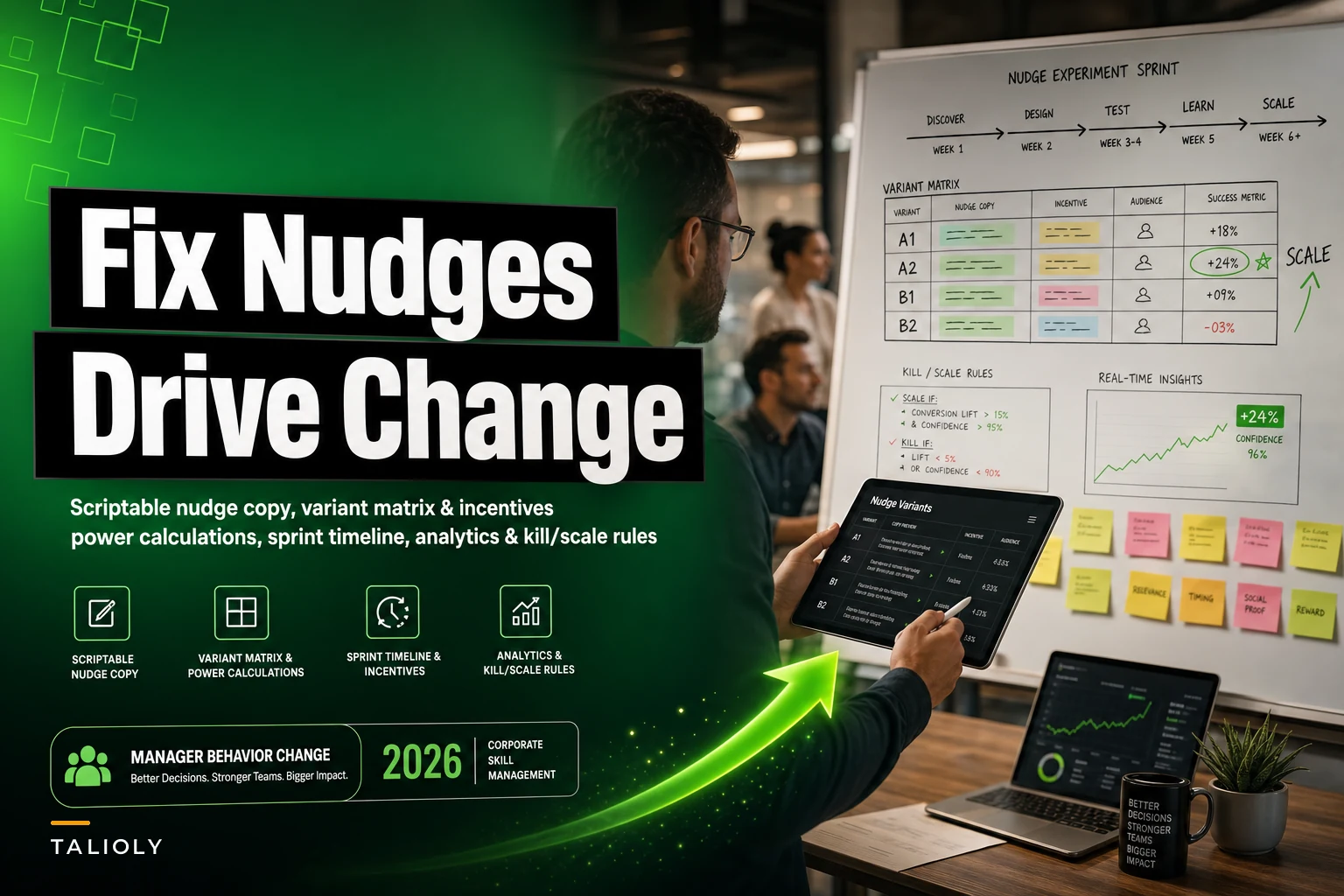
This is a working manager nudge A/B testing playbook: how to write scriptable nudge variants, build a variant matrix that doesn't explode into 40 combinations, size your sample so results actually mean something, run tight sprints, and decide—on evidence—whether to kill a variant or scale it. No theory. Just the recipes.
The core mistake: shipping one nudge to everyone
A pattern that shows up constantly: an HR team wants managers to hold more coaching conversations. They draft a message, get it approved, and blast it to all 200 managers. Two weeks later coaching logs are up slightly. Leadership calls it a win. Next quarter the effect is gone.
What actually happened? Nobody knows. Maybe the bump was seasonal. Maybe a VP mentioned coaching in a town hall that same week. Maybe half the managers never opened the email and the other half were already doing it. Without a holdout group, you attributed a change to your nudge that might have had nothing to do with it.
The fix is boring but powerful: always keep a control group that gets nothing (or gets the current default), and change only one meaningful thing at a time. If you test new copy AND new timing AND a new incentive all at once and completion jumps, you learn that something worked. You just have no idea what to keep.
A related mistake is testing trivial variations. Changing "Hi Sarah" to "Hey Sarah" is not an experiment worth a two-week sprint. Test things that plausibly change behavior: loss framing vs. gain framing, peer comparison vs. no comparison, a manager's own team data vs. generic language, a small public commitment vs. a private reminder.
Scriptable nudge copy: write variants, not messages
The word "scriptable" matters here. You want nudge copy built from swappable components so you can generate variants systematically instead of hand-writing each one. Think of a nudge as a template with slots.
Stop losing track of critical skills.
Talioly helps you track, develop, and certify your workforce efficiently.
- Centralized skill profiles
- Automated training reminders
- Competency gap analysis
No credit card required
A basic scriptable structure:
-
Trigger line — why they're getting this now ("3 of your 6 reports have no development goal set")
-
Framing — gain, loss, or social ("Managers who set goals early see 30% faster ramp" vs. "Reports without goals are 2x more likely to stall")
-
Specificity — generic vs. personalized with their actual team data
-
Ask — the single concrete action ("Set one goal for one report by Friday")
-
Friction reducer — the link, the pre-filled form, the two-click path
When these are components, your variants write themselves. Here's what a real variant set looks like for a "set development goals" nudge:
| Variant | Framing | Personalization | Ask size |
|---|---|---|---|
| A (control) | Neutral reminder | None | "Complete goal-setting" |
| B | Loss ("reports stalling") | Named reports missing goals | One goal, one report |
| C | Social ("peers at 78%") | Team completion % | One goal, one report |
| D | Gain ("faster ramp") | Named reports | Full team, this week |
Notice B, C, and D each change roughly one lever versus A. That's deliberate. When you keep the ask size constant across B and C, any difference between them is attributable to framing. When D changes both framing and ask size, you've muddied it—so either fix that or accept D is a combined bet, not a clean test.
One thing worth flagging: personalized nudges that reference a manager's actual team data consistently outperform generic copy, but they're also the most fragile. If your underlying data is stale and you tell a manager "2 of your reports have no goals" when they set them last week, you've torched your credibility for the whole program. Personalization only works when the data behind it is clean.
Building a variant matrix that doesn't explode
The trap with A/B testing is combinatorial blowup. Three framings × two personalization levels × two ask sizes × three send times = 36 cells. You don't have the sample size, and you don't have the patience.
-
Pick one primary lever per sprint. Sprint 1 tests framing only. Sprint 2 takes the winning framing and tests personalization. Sprint 3 tests timing. Sequential, not simultaneous.
-
Cap active variants at 3–4 including control. More cells means smaller groups per cell, which means you need a huge population to detect anything.
-
Hold everything else fixed. Same send time, same channel, same ask size within a framing test.
Sequential testing feels slower, but it's the only way smaller orgs get clean answers. If you have 180 managers, you cannot meaningfully split them 36 ways. You can split them into 4 groups of roughly 45 and actually learn something.
A sequential sprint structure might look like this:
Sprint 1 → Test framing (A/B/C/control, all else fixed) ↓ Winner identified Sprint 2 → Lock winning framing → Test personalization level ↓ Winner identified Sprint 3 → Lock framing + personalization → Test send timing ↓ Final winning combination → Scale
This keeps each sprint clean and makes it obvious which lever moved the needle.
Sample size: the math nobody wants to do (but has to)
This is where most HR nudge programs fall apart. They run a test on 25 managers, see 11 complete vs. 8 in control, and declare victory. That difference is almost certainly noise.
The main drivers of required sample size:
-
Baseline rate — if 40% of managers already do the thing, you're measuring lift from 40%.
-
Minimum detectable effect (MDE) — the smallest improvement you'd care about. Detecting a 3-point lift needs way more people than detecting a 15-point lift.
-
Confidence and power — the standard is 95% confidence, 80% power.
A practical rule of thumb: to reliably detect a 10 percentage point lift (say from 40% to 50%) at normal confidence, you need roughly 350–400 people per group. To detect a 5-point lift, you're into the thousands per group. To detect a big, obvious 20-point lift, you can get away with around 90–100 per group.
The uncomfortable truth for smaller orgs: if you only have 150 managers total, you can only reliably detect large effects. That's fine—just be honest about it. Design your nudges to swing for big behavioral changes, and treat small measured differences as "keep watching," not "proven." For the underlying stats logic in plain language, this walkthrough on validating HR assessments, pilots and lift covers the reasoning without the jargon.
A realistic example of sizing a test:
-
180 managers, baseline goal-setting completion around 35%
-
Split into 4 groups of ~45
-
With 45 per group, you can only see effects of roughly 25+ points
-
Decision either accept you're only testing for big wins this sprint, OR run the test over two cycles and pool managers across time to build a larger sample
That second option—pooling across cycles—is underused. If your nudge fires quarterly, you can run the same clean 2-variant test for three quarters and combine the data, effectively tripling your sample without changing anything else.
Pool similar test cycles when possible to increase power without expanding headcount.
If your nudge fires quarterly, you can run the same clean 2-variant test for three quarters and combine the data, effectively tripling your sample without changing anything else.
Incentive structures worth testing
Copy and timing move behavior at the margins. Incentives move it harder—but they're also where programs create bad habits. A few incentive structures worth putting into a variant:
-
Recognition-only — a manager's completion shows up on a leaderboard or in their skip-level's dashboard. Cheap, and social visibility often outperforms money for salaried managers.
-
Micro-relief — completing the behavior removes a friction elsewhere ("finish check-ins and skip this month's manual status form"). Trading one task for removing another tends to work well.
-
Team-tied — the incentive attaches to the manager's team outcome, not the manager's activity. Harder to game.
-
Nothing (control) — genuinely test whether the incentive adds anything over good copy alone. Sometimes it doesn't.
The mistake to avoid: activity-based cash or points that reward the behavior itself. Pay managers per logged coaching conversation and you'll get lots of logged conversations and no actual coaching. Any incentive tied directly to a countable action will get gamed. Tie incentives to downstream outcomes, to recognition, or to friction removal—not to the raw count.
If you're building incentive tests into a broader adoption effort, the mechanics here connect directly to running manager experiments, SLAs and incentive tests inside a stalled skills program.
Sprint timeline: a two-week cadence that works
Nudge tests don't need long timelines. They need clean ones.
-
Days 1–2 Define the single lever, write variants from the component template, get the copy pre-approved.
-
Day 3 Randomize managers into groups. Randomize at the manager level, not the team level, unless the nudge spills over between teammates.
-
Days 4–14 Nudge fires on schedule. No changes mid-flight. Resist the urge to "fix" a variant that looks like it's underperforming on day 6—that ruins the test.
-
Day 15 Pull the numbers, run the analytics checks, make a kill/scale call.
The hardest discipline is doing nothing during the run. When a variant looks bad early, people want to tweak it. Don't. You'll never know what would have happened, and you can't compare a variant you changed halfway through.
A simple visual of the sprint keeps everyone aligned on who does what and when.
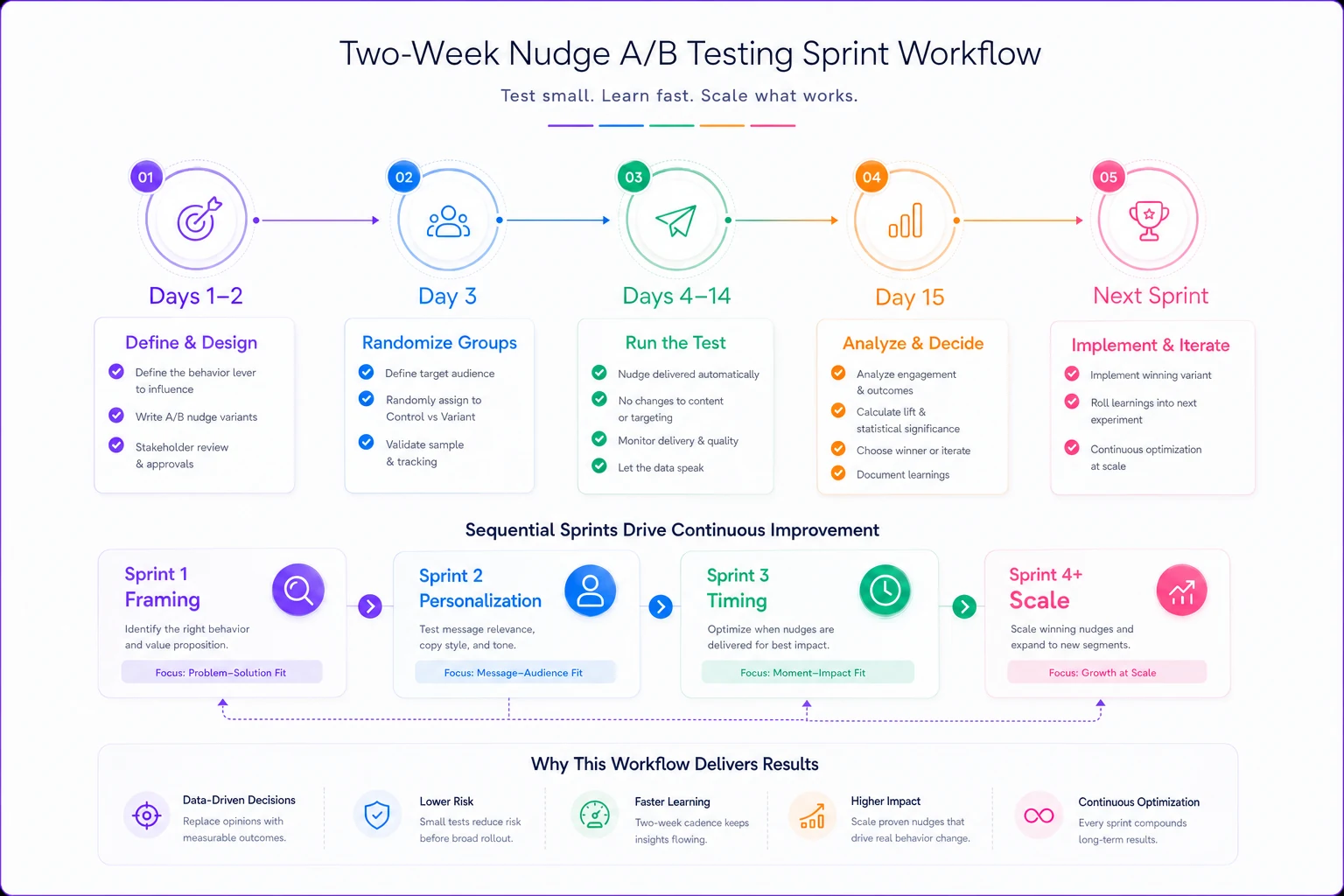
This visual maps the core steps into a single, shareable workflow you can pin in your sprint plan.
Analytics checks before you trust any result
Before you act on a result, run these validation checks. Skipping them is how teams "prove" things that aren't real:
-
Randomization sanity check — are the groups actually comparable? Compare group sizes and a couple of baseline traits (team size, tenure, prior completion). If group C is accidentally full of high-performers, your "win" is selection, not the nudge.
-
Sample sufficiency — did each group actually hit the size you needed for your MDE? If not, label the result "underpowered" and don't scale on it.
-
Statistical significance AND practical significance — a result can be statistically real but too small to matter operationally. A 2-point lift that's "significant" across 4,000 managers may not be worth the effort.
-
Guardrail metrics — did the nudge cause harm elsewhere? A goal-setting nudge that boosts completion but tanks the quality of goals (all vague one-liners) is a loss. Always watch a quality guardrail, not just the count.
-
Novelty decay — check whether the effect holds in week 2 or was just week-1 curiosity. Many nudges spike then fade.
That novelty point is the one people miss most. A new nudge format gets attention simply because it's new. Run it long enough, or re-run it a cycle later, to confirm the lift survives once the novelty wears off.
Kill or scale: decision rules that remove the debate
Decide the rules before the sprint so nobody argues the results afterward.
| Outcome | Condition | Decision |
|---|---|---|
| Scale | Beats control by ≥ your MDE, passes significance, guardrails clean | Roll out to full population |
| Iterate | Positive direction but underpowered or below MDE | Re-run with larger sample or refined variant |
| Kill | No difference or negative, guardrails clean | Drop it, keep control |
| Investigate | Wins on primary metric but hurts a guardrail | Do not scale; diagnose the harm first |
The "investigate" row is the one that saves programs from themselves. A nudge that lifts completion but degrades quality is worse than no nudge. Killing it feels like failure, but scaling it would be the real failure.
Pre-committing to these rules also makes the post-sprint conversation faster. Instead of debating whether a borderline result "counts," you check it against the decision table and move on. That alone cuts a lot of political friction out of the process.
A real scenario: the mid-size retailer that stopped guessing
A regional retail company with about 210 store and department managers had a chronic problem: quarterly development conversations sat around 30–35% completion no matter how many reminder emails went out. HR had been sending the same "please complete your check-ins" email for over a year.
They ran a two-variant sprint—control (the old email) vs. a variant with loss framing plus each manager's actual list of reports missing conversations. Split roughly 105 and 105. Two-week window, no mid-flight changes.
Control landed near its usual ~32%. The personalized loss-framed variant came in around 51%. With ~105 per group, that ~19-point gap cleared their pre-set MDE, and the randomization check showed the groups were balanced on tenure and team size. The guardrail check on conversation quality—a quick rubric applied to logged notes—held steady. The extra conversations weren't garbage.
They scaled it. Next quarter, completion across the full manager population settled somewhere in the high 40s to low 50s. Not the 51% exactly, which is expected—scaled rollouts usually regress a little from the test peak. Still, moving from a stuck 32% to roughly 48–50% was a genuine shift, and it happened because they tested one clean lever with a real control instead of blasting everyone and hoping.
The follow-up sprint tested send timing (Monday vs. Thursday) on top of the winning copy. Came back flat—no meaningful difference. Which is also a useful result: they stopped debating send times and moved on.
When this makes sense—and when it doesn't
Do this when you have enough managers to form real groups (roughly 90+ for big-effect tests, more for subtle ones), a behavior you can actually measure, and leadership willing to keep a holdout group. Also do it when the behavior genuinely matters—coaching, goal-setting, review completion, feedback frequency.
Skip it when your population is tiny (under ~50 managers), because you'll only ever detect enormous effects and you're better off just talking to people directly. Skip it when you can't measure the behavior cleanly—if your completion data is unreliable, fix the data before layering nudge experiments on top of it. And skip formal A/B testing for one-off, low-stakes reminders; not everything needs an experiment.
Who should not do this: teams that won't hold a control group. If leadership insists everyone gets the "best" nudge immediately, you can't test anything—you're back to guessing. Teams that secretly tweak variants mid-sprint will get nothing but noise. The discipline is the whole point.
Rolling out the winner without losing the lift
Scaling a winning variant isn't just "send it to everyone now." A few things protect the effect:
-
Expect some regression. Test peaks rarely survive intact at full scale. Plan for a slightly lower number and you won't panic.
-
Keep a small holdout even after rollout. A 10% control group tells you whether the lift is holding over time or quietly decaying.
-
Re-check the personalization data on the full population. A nudge that referenced clean data for 105 managers might hit stale records for the other 105. Bad data at scale kills trust fast.
-
Log which variant won and why. Six months later, someone will want to change the copy "to freshen it up." Your records tell them what they'd be gambling with.
Start with a single sprint on your most stuck manager behavior. One clean test beats a year of hopeful reminders.
The teams that get durable behavior change from nudges aren't the ones with the cleverest copy. They're the ones who treat each nudge as a small, disciplined experiment—one lever, a real control, honest sample math, pre-committed decision rules—and then actually scale only what the numbers earned. Start with a single sprint on your most stuck manager behavior. One clean test beats a year of hopeful reminders.
Ready to elevate your team's skills?
Join 500+ companies using Talioly to boost skill visibility, streamline training, and drive performance growth.