
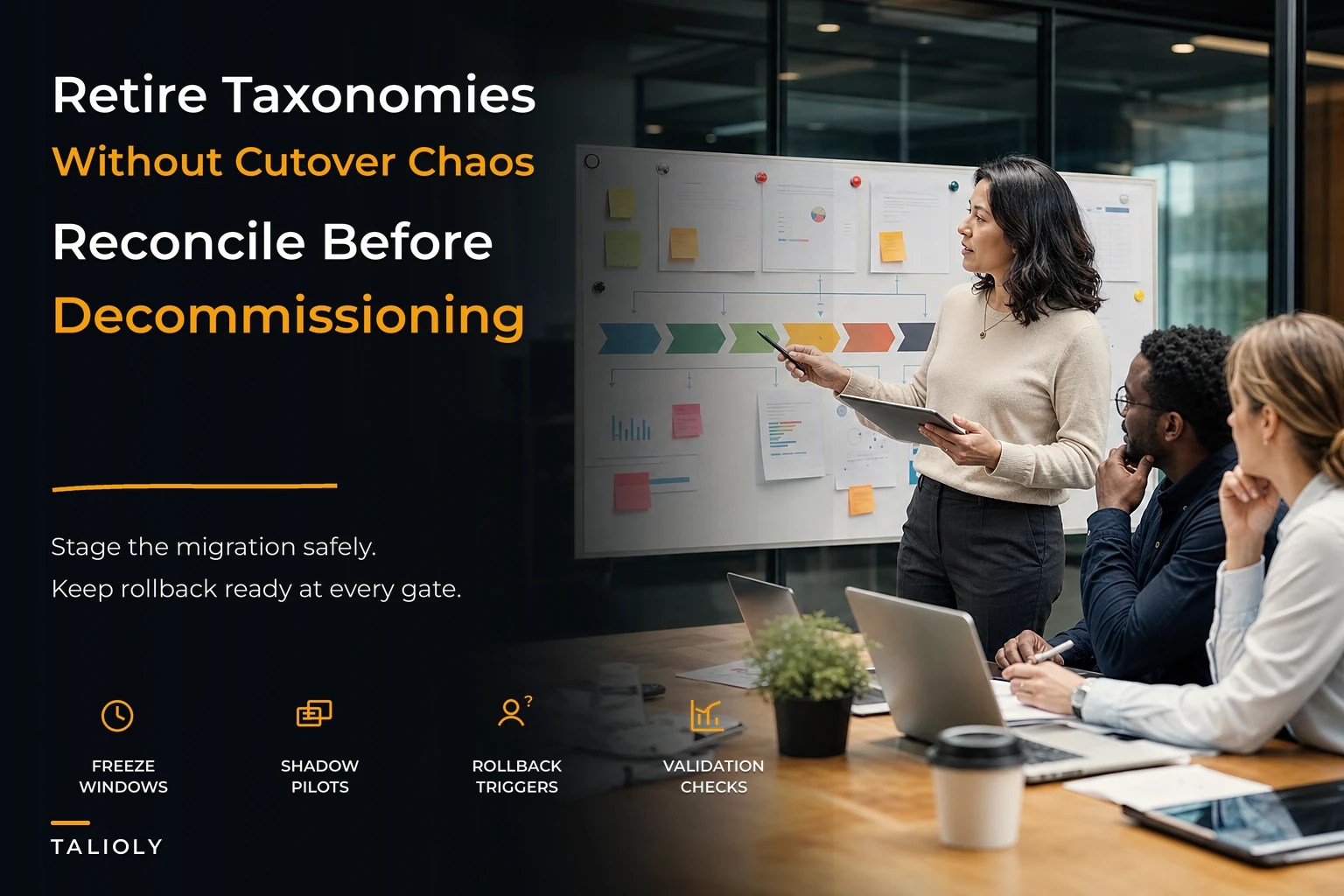

Most taxonomy failures don't happen during the build. They happen during the retirement. A new framework gets approved, everyone's excited, and then the old taxonomy just... lingers. Six months later you've got two sources of truth, half your integrations pointing at the dead one, and a manager running a promotion case off skill codes that technically don't exist anymore.
Retiring a taxonomy is harder than launching one because the launch is additive and the retirement is subtractive. When you add something, nothing breaks if people ignore it. When you remove something, everything downstream that depended on it breaks the moment you flip the switch — and you usually don't find out until payroll, mobility matching, or a compliance report quietly produces garbage.
This is a playbook for pulling a legacy taxonomy out of a live organization without taking down the things that lean on it. The emphasis is on sequencing, reversibility, and knowing what breaks before it breaks.
Why taxonomy retirement is a systems problem, not a data problem
People treat a taxonomy like a spreadsheet of skill labels. In reality it's the shared vocabulary that a surprising number of operational systems silently agree on. Your learning platform tags courses against it. Your mobility engine matches candidates on it. Promotion rubrics reference specific proficiency levels. Pay bands sometimes map to skill clusters. Compliance reports roll up competencies by category. Dashboards aggregate on taxonomy nodes.
When the taxonomy itself is the thing being removed, every one of those dependencies becomes a potential failure point. And they're rarely documented in one place. HR knows about the obvious integrations, but there's always a shadow consumer somewhere — a finance report, a workforce planning model, a BI dashboard somebody built two years ago that reads skill codes directly out of a table.
If you've already lived through the way enterprise taxonomies break as organizations scale, you know the core issue — the taxonomy drifts, splinters, and collects shadow versions. Retirement is what happens when you finally decide to clean that up. But the cleanup can cause more damage than the drift if the cutover is handled badly.
The first mental shift: you're not deleting data. You're decommissioning a dependency that other systems trust. Treat it like retiring a database that production code still queries.
The dependency map comes before anything else
Before you set a single date, you need to know who consumes the old taxonomy and how. Not "roughly," not "the main systems." Every consumer, including the ones that will embarrass you later.
Stop losing track of critical skills.
Talioly helps you track, develop, and certify your workforce efficiently.
- Centralized skill profiles
- Automated training reminders
- Competency gap analysis
No credit card required
A practical dependency map covers five categories:
-
Direct integrations — LMS, HRIS, mobility/marketplace engine, assessment tools that write or read skill codes via API
-
Reporting consumers — BI dashboards, compliance reports, headcount and workforce planning models that aggregate on taxonomy nodes
-
Human workflows — promotion rubrics, pay-band mappings, succession criteria, job architecture docs that reference specific skill names or levels
-
Stored references — employee profiles, historical assessment records, archived evidence tagged against old codes
-
External touchpoints — anything that maps external credentials or vendor certifications into your internal structure
That last one tends to get missed. Mapping between external frameworks and your internal taxonomy is its own operational layer, and when you retire the internal side, the mapping breaks on both ends.
The output you want is a table that tells you, for each consumer, what breaks if the old taxonomy disappears tomorrow.
| Consumer | Reads or writes | What breaks on cutover | Reversible? |
|---|---|---|---|
| Mobility matching engine | Reads skill codes | Candidates stop matching open roles | Yes, if mapping retained |
| Promotion rubrics | Human reference | Managers cite dead skill names | Partly — needs doc updates |
| Compliance competency report | Aggregates nodes | Rollups mis-count or zero out | No — report runs monthly |
| Pay-band mapping | Reads clusters | Band assignments break silently | No — highest risk |
| BI skills dashboard | Direct table read | Charts go blank or wrong | Yes — rebuild query |
The "reversible?" column is the one that changes your whole sequencing. Anything in the "No" column forces you into a dual-run approach rather than a clean cutover.
Freeze windows: stop the ground from moving
You cannot migrate a taxonomy that's still being edited. The most common early mistake is running a migration while people are still adding skills, reclassifying employees, or tweaking proficiency levels in the old system. You end up reconciling a moving target, and the mapping you built on Monday is wrong by Friday.
A freeze window is a defined period where changes to the old taxonomy are locked. No new skill codes, no reclassifications, no structural edits. Read access stays live — people can still see their profiles and run reports — but write access to the taxonomy structure is frozen.
In practice you need two kinds of freeze:
-
Structural freeze — nobody changes the shape of the old taxonomy (adding/removing/renaming nodes). This usually starts a few weeks before cutover and holds until retirement is complete.
-
Data freeze — a shorter, tighter window right before cutover where even employee-to-skill assignments are locked, so the snapshot you migrate is the snapshot that goes live.
The structural freeze is the one people resist, because there's always a team mid-project who "just needs to add three skills." Hold the line. Every exception you grant during the freeze is a reconciliation break you'll chase later. If something genuinely can't wait, log it as a post-cutover change to apply in the new taxonomy — not a last-minute edit to the dying one.
A realistic freeze timeline for a mid-sized org is roughly three to four weeks of structural freeze, with a 48–72 hour data freeze immediately before the cutover event.
Pro-tip: Log every freeze exception as a post-cutover change and enforce the structural freeze rigorously to avoid reconciliation debt.
If something genuinely can't wait, log it as a post-cutover change to apply in the new taxonomy — not a last-minute edit to the dying one.
Shadow pilots: run the new taxonomy in the dark first
Before anyone depends on the new taxonomy, run it in shadow mode. A shadow pilot means the new taxonomy is live and populated with migrated data, but it's not driving any decisions yet. It sits beside the old one and you compare outputs.
The point isn't to test whether the new taxonomy exists — it's to test whether it produces the same operational results as the old one where it should, and intentionally different results where you changed something.
A good shadow pilot picks a bounded slice of the org — one business unit, maybe 200–400 employees — and runs real workflows against both taxonomies in parallel:
-
Run mobility matching for the same open roles against old and new. Do the same candidates surface?
-
Pull the competency compliance report from both. Do the rollups reconcile?
-
Take ten real promotion cases and re-evaluate them under the new rubrics. Same outcomes?
Where results diverge, you investigate before cutover, not after. Sometimes the divergence is correct — you merged two overlapping skill clusters on purpose, so matching behaves differently. Sometimes it's a mapping error. The shadow pilot is where you separate the intentional changes from the broken ones.
One pattern worth flagging: shadow pilots expose mapping assumptions that looked fine on paper. A one-to-one mapping that seemed obvious turns out to be one-to-many in practice, because the old taxonomy had a catch-all node that three new nodes now split. You only see that when you run real data through both.
Dual-run reconciliation: the heart of a safe cutover
For anything in the "not reversible" column — pay mappings, compliance reports, workforce planning — you don't cut over cleanly. You dual-run. Both taxonomies stay live, both get populated, and you reconcile the outputs on a schedule until you trust the new one completely.
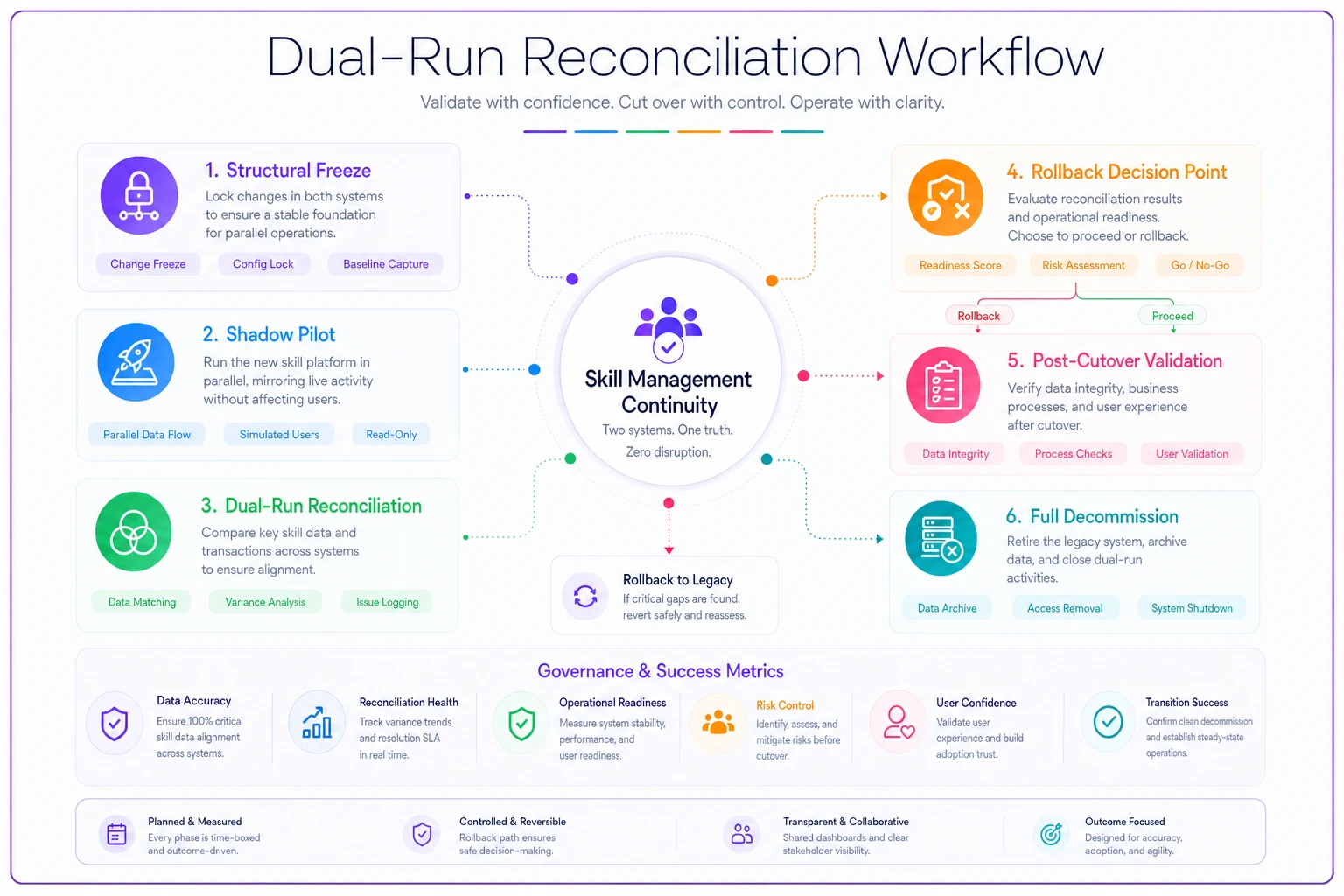
Dual-run reconciliation is the work most teams underestimate. Every reporting cycle during the dual-run period, you generate the critical outputs from both taxonomies and diff them. For a compliance report, that means running the old competency rollup and the new one side by side and explaining every difference. For pay-band mapping, it means checking that every employee lands in the same band under both systems — or, where they don't, that the difference is a known and approved change.
A reconciliation log for each cycle should capture:
-
The output being compared (report, match set, band assignment)
-
Count of matching records vs. diverging records
-
For each divergence
cause, whether it's intentional, and resolution
-
Sign-off from the owner of that downstream system
You keep dual-running until you hit a stability threshold — something like two or three consecutive reconciliation cycles with zero unexplained divergences. Not zero divergences total; zero unexplained ones. Intentional changes will always show up. What you're waiting for is confidence that nothing is breaking silently.
How long this takes depends on cycle length. If your compliance report runs monthly, you're dual-running for two to three months minimum. People hate hearing that, but the alternative is discovering a broken pay mapping in a quarter-end audit.
This is also where a phased approach pays off. If you've done a phased taxonomy migration during an M&A integration, the dual-run discipline is the same muscle — you never trust a single cutover moment; you trust accumulated reconciliation evidence.
Rollback triggers: decide in advance what makes you abort
The mistake here is emotional, not technical. Teams get so invested in the cutover date that when something goes wrong, they try to patch through it instead of rolling back. That's how a bad cutover turns into a three-week firefight.
Define your rollback triggers before cutover, written down, with named decision-makers. A rollback trigger is a specific, observable condition that automatically forces a return to the old taxonomy as the system of record.
-
Pay-band mapping produces more than a tiny number of unexplained band changes
-
Compliance report fails to reconcile and the gap can't be explained within 24 hours
-
Mobility matching drops match volume below a defined floor for active roles
-
More than a set threshold of employee profiles come back with null or orphaned skills
-
Any data-integrity error that corrupts historical assessment records
These need to be pre-agreed and binary. When a trigger fires, you don't convene a debate about whether it's "really that bad." You roll back, because you already decided this condition was unacceptable when you were calm and not under pressure.
For rollback to actually be possible, the old taxonomy has to stay fully intact and operable throughout the dual-run. This is why "we deleted the old one on cutover day" is such a dangerous move. You keep the old system as a hot standby — frozen but functional — until you're past every rollback trigger and the dual-run has gone quiet.
Post-cutover validation: prove it's actually working
Cutover day is not the finish line. The hours and days immediately after are when you validate that the new taxonomy is driving real decisions correctly. Validation is active checking, not waiting for complaints.
A post-cutover validation sequence runs in order:
-
Integrity checks first. Every employee has a valid profile. No orphaned skills, no null mappings, no duplicated records. This runs within hours of cutover.
-
Spot-check critical workflows. Pull a sample of real mobility matches, a sample of promotion-eligible profiles, and a compliance rollup. Confirm they produce sane results against known cases.
-
Reconcile against the shadow pilot predictions. You already know what the new taxonomy should produce for your pilot slice. Confirm live behavior matches that prediction.
-
Watch the high-risk downstream systems. Pay mapping and compliance reporting get daily eyes for the first full cycle, not just a one-time check.
-
Confirm external mappings still resolve. Vendor certifications and external credentials should still land on the right internal nodes.
Each step has an owner and a pass/fail result logged. If any step fails, you check it against your rollback triggers. Not every failure forces a rollback — a broken BI dashboard is fixable in place — but every failure gets evaluated against the pre-agreed thresholds rather than judged in the moment.
A real scenario: retiring a legacy taxonomy at a services firm
A professional services firm of around 4,000 employees had two taxonomies running in parallel after years of drift — the official one and a "practical" one that a few business units had quietly forked. Leadership approved a consolidated framework and wanted the old structures gone.
Their first instinct was a hard cutover over a weekend. The dependency map killed that idea fast. They found eleven consumers, including a quarterly compliance report and a pay-band mapping nobody in HR owned — it had been built by a finance analyst two years earlier and read skill clusters directly from a database view.
They ran a structural freeze for about four weeks, then a shadow pilot on a single 300-person practice. The shadow pilot immediately surfaced a problem: the old taxonomy had a generic "consulting skills" bucket that the new framework split into four. Mobility matching under the new taxonomy returned noticeably different candidate sets for several roles — not wrong, but different enough that an uninvestigated cutover would have looked like the matching engine was broken.
Dual-run ran for roughly ten weeks, tracking the monthly compliance report and the pay mapping across three cycles. The first cycle had around fifteen unexplained band discrepancies — all traced to employees who'd been mapped to the old catch-all node and hadn't been reclassified. They fixed the mappings, the second and third cycles came back clean, and only then did they retire the old taxonomy as system of record. The old structure stayed available in read-only standby for another quarter before full decommission.
No rollback was triggered. But the rollback triggers were written down, and the finance pay-mapping discrepancy in cycle one came close enough to the threshold that having the standby ready actually mattered.
When a clean cutover actually makes sense
Dual-run reconciliation is expensive in time and attention. It's not always warranted.
A clean, fast cutover can make sense when:
-
The old taxonomy has very few downstream consumers and all of them are reversible
-
There are no pay, promotion, or compliance dependencies on the taxonomy structure
-
The org is small enough that validation can cover nearly every record by hand
-
The new taxonomy is a near-superset of the old one, so mappings are overwhelmingly one-to-one
When a clean cutover is a bad idea
Skip the clean cutover and commit to dual-run when any of these are true: the taxonomy feeds pay or compliance, you have shadow consumers you can't fully enumerate, historical assessment records are tagged against the old codes, or the new framework restructures clusters rather than just renaming them. Structural changes to how skills group together are the single biggest source of silent downstream breakage.
Who should not attempt this yet
If you can't produce a complete dependency map, you're not ready to retire anything. The retirement will expose dependencies you didn't know about, at the worst possible time. Spend the effort on the map first. A retirement without a dependency map isn't a migration — it's a controlled demolition where you've forgotten which walls are load-bearing.
Keeping the whole thing coordinated
The hardest part of taxonomy retirement isn't any single step — it's that freeze windows, shadow pilots, dual-run reconciliation, and rollback readiness all have to run as one coordinated process, with different owners holding different pieces. The freeze is owned by whoever governs the taxonomy. Reconciliation is owned by the downstream system owners. Rollback authority sits with someone senior enough to make the call under pressure.
Where this falls apart is coordination. The freeze holds but reconciliation slips. The shadow pilot passes but nobody wrote down the rollback triggers. Someone decommissions the old system before the dual-run cleared, and now there's no standby to fall back to.
The teams that get this right treat retirement as a staged, evidence-driven process rather than a single dramatic switch. They prove the new taxonomy produces correct results before anyone depends on it, run both in parallel until the numbers reconcile, and keep the exit door open the entire time. That's the whole playbook: never flip the switch until the data tells you it's safe, and never close the door behind you until you're sure you won't need to walk back through it.
Ready to elevate your team's skills?
Join 500+ companies using Talioly to boost skill visibility, streamline training, and drive performance growth.