


Most internal talent marketplaces fail within 18 months. Not because the technology breaks or employees don't care. They fail because organizations treat them like job boards instead of operational services that need active management, clear handoffs, and measurable SLAs.
The difference between a functioning marketplace and a dead one comes down to governance. Real governance — not policy documents gathering dust, but operational runbooks with specific timelines, consent checkpoints, and throughput metrics that get reviewed weekly.
The matching engine that nobody actually runs
The pattern is pretty predictable once you've watched a few of these stall out. HR launches with enthusiasm, posts a few roles, sends company-wide emails about "career mobility opportunities," then watches engagement fall off by month three. Meanwhile, talent acquisition keeps posting the same roles externally while high-performers leave for competitors that actually offer career paths.
The organizations that make internal marketplaces work treat them like production systems. Matching SLAs, candidate consent workflows, manager handoff protocols, weekly health metrics. They run them like services, not suggestion boxes.
Why marketplaces die without operational governance
Internal marketplaces fail for operational reasons, not strategic ones. The technology works fine. The concept makes sense. But without clear ownership and service-level agreements, they become digital graveyards.
Stop losing track of critical skills.
Talioly helps you track, develop, and certify your workforce efficiently.
- Centralized skill profiles
- Automated training reminders
- Competency gap analysis
No credit card required
Take a typical scenario: an engineering manager posts an opening for a senior developer. Three internal candidates express interest. Then nothing happens for two weeks. The candidates don't know if they're being considered. The manager doesn't know they need to respond. HR assumes everything's working because people are using the platform. Eventually the manager fills the role externally because "we couldn't find anyone internally."
This happens because nobody owns the matching process. There's no SLA requiring managers to respond within 72 hours. No consent flow ensuring candidates know their application was received. No escalation path when things stall. No metrics tracking how many matches actually convert.
The marketplace becomes a black hole. Employees stop trusting it after one bad experience. Managers stop posting because they get better results going direct to recruiters. Within six months, usage drops to near zero except for mandatory postings everyone ignores.
Compare that to organizations where internal mobility actually works. They treat marketplace operations like customer service operations. Every interaction has an owner, a timeline, and a fallback. Matches get tracked like support tickets. Response times get measured. Throughput metrics get reviewed in ops meetings.
Building your matching SLA framework
A functioning marketplace needs service-level agreements at every handoff point. Not aspirational goals — operational commitments with clear owners and escalation paths.
Start with the core matching workflow. When a role gets posted, your marketplace should automatically identify potential matches based on verified skills, not just keywords. We covered the matching logic in detail previously, but the operational piece matters just as much as the technical one.
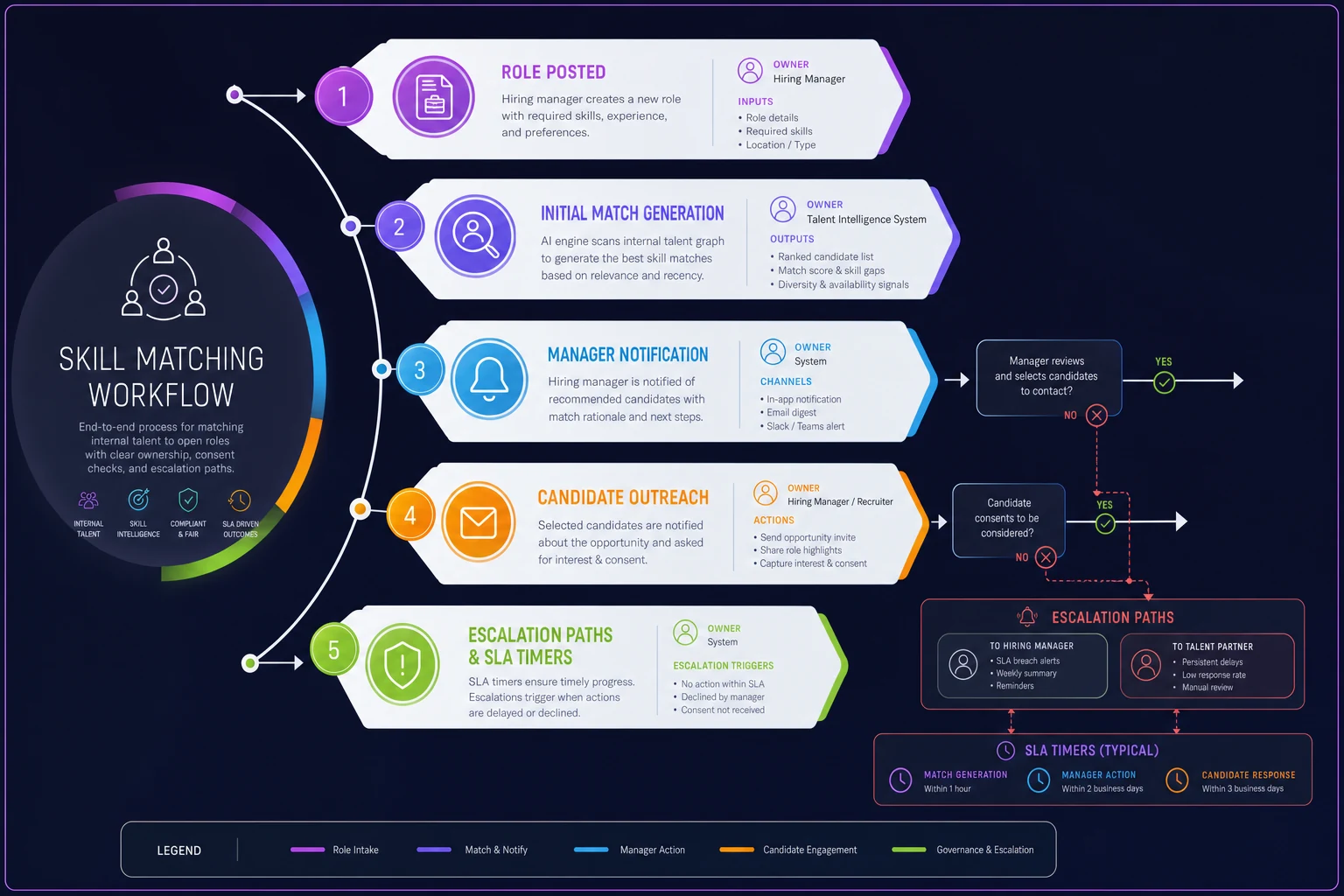
This diagram shows the sequence and ownership across each SLA handoff in the matching process.
Initial Match Generation
-
Timeline
Within 4 hours of posting
-
Owner
Marketplace operations team
-
Deliverable
Shortlist of 5–10 qualified internal candidates
-
Escalation
If no matches found, notify talent acquisition lead within 24 hours
Manager Notification
-
Timeline
Immediately after match generation
-
Owner
Automated system with ops backup
-
Deliverable
Manager receives match list with skill alignments
-
Escalation
If manager doesn't acknowledge within 48 hours, escalate to their director
Candidate Outreach
-
Timeline
Within 24 hours of matching
-
Owner
Hiring manager or designated talent partner
-
Deliverable
Personalized outreach to matched candidates
-
Escalation
If no response within 72 hours, talent partner takes over
Tie SLA violations to visible operational consequences so managers prioritize internal matches.
The SLAs need teeth. If a manager consistently misses their response windows, their roles get deprioritized for internal filling. If talent partners don't follow up, it shows up in their performance reviews. Without consequences, SLAs are just suggestions.
One financial services firm saw marketplace usage jump from around 12% to 67% after implementing strict SLAs. The difference? Managers knew that missing the 72-hour response window would delay their requisitions by a week. Suddenly everyone found time to review internal talent.
Candidate consent workflows that actually protect people
The fastest way to kill marketplace trust is exposing someone's career interests without their consent. Yet most marketplaces either overshare everything or lock down so tight that managers can't find anyone. You need granular consent flows that give candidates real control while keeping the marketplace functional.
Consent isn't binary. Different scenarios require different disclosure levels.
Passive Interest
Employees can flag interest in role types without applying to specific positions. Their current manager doesn't get notified, but they appear in searches for relevant roles. Career window shopping, essentially.
Active Application
-
Anonymous until shortlisted
-
Name visible but current manager not notified
-
Full transparency including manager notification
Manager Notification Triggers
-
After candidate accepts initial screening call
-
After candidate passes first round
-
After formal offer extended
-
Never (for certain protected scenarios)
A technology company built their consent flow after several senior engineers left because managers found out about internal applications and subtly retaliated. They now use a three-tier consent system. Tier 1 keeps everything anonymous until final rounds. Tier 2 notifies managers only after offers. Tier 3 provides full transparency for employees with managers they actually trust.
Consent also needs to be granular and revocable. Employees should be able to adjust settings per application, not globally. They should see exactly who can see what at each stage. And they should be able to withdraw without penalty.
Your consent workflow also needs documented protocols for edge cases. What happens when someone applies to multiple roles at once? What if they apply to their boss's peer's team? What if they're on a performance improvement plan? These scenarios need defined handling procedures, not case-by-case improvisation.
Manager and role-owner handoff protocols
The handoff between hiring managers and current managers determines whether internal moves go smoothly or turn into political disasters. Most organizations leave this to individual relationships and hope for the best. That's why internal mobility becomes a minefield.
Structured handoff protocols with clear steps, timelines, and documentation requirements fix this. Not every situation needs the same process, but every situation needs a process.
Standard Handoff Process
-
When an internal candidate progresses past initial screening, the hiring manager initiates a formal handoff conversation with the current manager. This isn't a permission request — the employee has already consented to the process. It's operational coordination.
-
The handoff covers
-
- Proposed transition timeline
-
- Knowledge transfer requirements
-
- Backfill planning and support
-
- Development areas the employee needs help with
-
- Success metrics for the first 90 days
-
Both managers document agreements in the marketplace platform. This creates accountability and kills the "I never agreed to that timeline" conversations that derail transfers.
Accelerated Handoff Process
For critical roles or time-sensitive moves, use an accelerated protocol. The hiring manager can proceed with interviews while handoff negotiations happen in parallel. The current manager gets 48 hours to raise blocking concerns, but can't delay indefinitely.
Dispute Resolution Escalation
-
When managers can't agree on transition timing
-
Day 1–3
Managers attempt direct resolution
-
Day 4–5
HR business partner mediates
-
Day 6+
Department heads make the final call
A retail company with around 8,000 employees cut internal transfer time from 62 days to 19 days by implementing these protocols. Before, managers would negotiate endlessly or quietly block transfers through delays. Once everyone knew the timeline and escalation path, that largely stopped.
The operational detail matters here. Document who owns each step, what completion looks like, and how to handle exceptions. If a current manager is on PTO, who has authority to approve the handoff? If the employee is mid-project, what counts as "completion" for handoff purposes?
Dispute resolution framework for contested moves
Not every internal move goes smoothly. Managers block transfers. Candidates claim discrimination. Teams fight over top performers. Without a clear dispute resolution framework, these conflicts poison the entire marketplace.
Your framework needs to handle three types of disputes:
Blocking Disputes
-
Manager must provide specific, documented business impact
-
Cannot block for more than 60 days
-
Must provide a development plan addressing any "readiness" concerns
-
Second block attempt within 12 months requires VP approval
Selection Disputes
-
Candidate can request specific feedback within 5 business days
-
Hiring manager must provide skill-based justification
-
HR reviews for bias indicators
-
If patterns emerge across the same manager or similar demographics, it triggers an audit
Timing Disputes
-
Default to 30-day transition unless a critical project is documented
-
Maximum extension of 60 days
-
Current manager must provide a backfill plan by day 15
-
Hiring manager can withdraw offer if timeline exceeds 90 days
Track dispute patterns closely. If the same manager blocks multiple transfers, that's a performance issue. If certain departments never release talent, that's a cultural issue requiring intervention, not just documentation.
Throughput KPIs that measure marketplace health
Most organizations track vanity metrics like number of postings or profile views. These tell you nothing useful. You need throughput metrics that measure actual mobility outcomes.
Core Marketplace KPIs
| Metric | Calculation | Target | Below-Target Signal |
|---|---|---|---|
| Matching Efficiency Rate | Valid matches / Total roles posted | >80% | Poor skill profiling or broken matching logic |
| Candidate Response Rate | Responses to outreach / Total contacted | >60% | Trust issues or poor communication |
| Manager Response Time | Avg hours from match delivery to action | <48 hours | Poor adoption or unclear process |
| Internal Fill Rate | Roles filled internally / Total posted | >35% | Matching quality problems or political blocking |
| Time to Internal Fill | Days from posting to accepted offer | <21 days | Process bottlenecks or handoff delays |
| Consent Conversion Rate | Employees moving passive to active interest | >15% quarterly | Marketplace trust issues |
Leading Indicators
-
New profiles created
-
Skills verified per employee
-
Manager posting frequency
-
Dispute frequency
-
SLA violation rate
When leading indicators drop, you usually have 4–6 weeks before lagging metrics follow. A sudden drop in new profiles means employees are losing faith. Rising disputes mean political barriers are forming. SLA violations tend to predict upcoming fill-rate drops.
Cohort Analysis
-
By department
which teams embrace vs. resist internal mobility?
-
By level
are senior roles filling internally at lower rates?
-
By tenure
do newer employees use the marketplace more?
-
By performance
are high performers getting blocked more often?
One pharmaceutical company found their R&D department had a 6% internal fill rate while Sales hit 47%. R&D managers viewed internal talent as their personal investment and systematically blocked transfers. Only cohort analysis surfaced that pattern.
Regular governance rituals that prevent decay
Marketplaces decay without active governance. You need operational rituals that maintain momentum, surface issues early, and prevent the slow slide into irrelevance.
Weekly Marketplace Operations Review
-
SLA violations from the previous week
-
Stuck matches (no movement for more than 5 days)
-
New disputes requiring resolution
-
Leading indicator trends
This isn't a strategy meeting. It's an operational standup focused on unblocking specific issues. Takes 30 minutes. Fixes problems before they become patterns.
Monthly Marketplace Health Review
-
Throughput KPIs vs. targets
-
Cohort analysis findings
-
Dispute pattern analysis
-
Manager adoption scores
-
Candidate satisfaction feedback
Include hiring managers and HR business partners. Focus on systemic issues, not individual cases. Output should be specific process improvements, not general recommendations.
Quarterly Governance Board Review
-
Internal mobility outcomes vs. goals
-
Investment ROI (cost savings from internal fills)
-
Competitive benchmarking
-
Policy modification recommendations
-
Resource allocation decisions
This connects operational metrics to business outcomes and forces the question of whether the marketplace is actually delivering value.
Annual Marketplace Audit
-
End-to-end process efficiency
-
Technology platform performance
-
Consent and compliance adherence
-
Manager and employee satisfaction
-
Competitive marketplace analysis
Brings outside perspective to prevent institutional blindness and identifies gaps between how the process is supposed to work and how it actually runs.
Building your operational runbook
Your marketplace needs an operational runbook that anyone can execute. Not a strategy document — step-by-step procedures for running the service day-to-day.
The runbook should include:
Daily Operations Checklist
-
Check for SLA violations
-
Review new postings for compliance
-
Process consent modifications
-
Trigger matching runs
-
Send overdue notifications
-
Update operational dashboard
Standard Operating Procedures
-
How to handle each dispute type
-
How to process manager handoffs
-
How to manage consent changes
-
How to investigate matching failures
-
How to onboard new managers
-
How to audit data quality
Emergency Procedures
-
System outage protocols
-
Data breach response
-
Executive escalation paths
-
Legal hold procedures
-
PR crisis management
Templates and Tools
-
SLA violation notifications
-
Dispute intake forms
-
Handoff agreement templates
-
Consent modification forms
-
Health report formats
-
Escalation scripts
Update the runbook monthly based on what you're actually learning. Every team member should be able to run marketplace operations using only the runbook. If they can't, it's not complete.
Moving from job board to operational service
The shift from job board to operational service requires changing how you think about internal mobility entirely. It's not about posting jobs and hoping people apply. It's about running a service with clear standards, measurable outcomes, and continuous improvement.
Start small but be rigorous. Pick one department or job family. Implement full operational governance for just that segment. Get the SLAs working. Test the consent flows. Refine the handoff protocols. Measure obsessively. Once one segment runs smoothly, expand gradually.
The companies getting internal mobility right treat their marketplaces like production systems. Ops teams, runbooks, SLAs, health metrics. They review performance weekly, not annually. Problems get fixed in days, not quarters.
Most importantly, they recognize that internal talent marketplaces require operational discipline, not just good intentions. The matching technology, skill profiles, and posting systems are necessary but not sufficient. Without the unsexy work of SLAs, handoffs, consent flows, and dispute resolution, your marketplace becomes another failed HR initiative with a graveyard of unused profiles.
This operational foundation doesn't require massive investment or organizational transformation. It requires consistency and treating internal mobility like the critical business service it actually is. With the right operational runbook, even a small team can run a marketplace that moves talent where it's needed, when it's needed, without the political chaos that usually kills these things.
Your internal talent isn't waiting for another job board. They're waiting for something that respects their time, protects their interests, and actually delivers on the promise of career mobility. That only happens when you stop thinking about features and start thinking about operations.
Ready to elevate your team's skills?
Join 500+ companies using Talioly to boost skill visibility, streamline training, and drive performance growth.